You walk up to the gate with your cane, the line is already forming, and the agent never looks up. Most people assume the airline simply doesn’t care. The real story is that most of the help is only triggered when you speak up, not when you hit a certain birthday.
Age alone doesn’t qualify you for anything. Needing extra time or assistance does. Below are 12 things the official rules say agents can do, and a few of them are far more surprising than a seat near the front. One of them says staff aren’t supposed to carry you up stairs. Another says “no thanks” is a complete answer.
#12 – They Can Offer You Preboarding
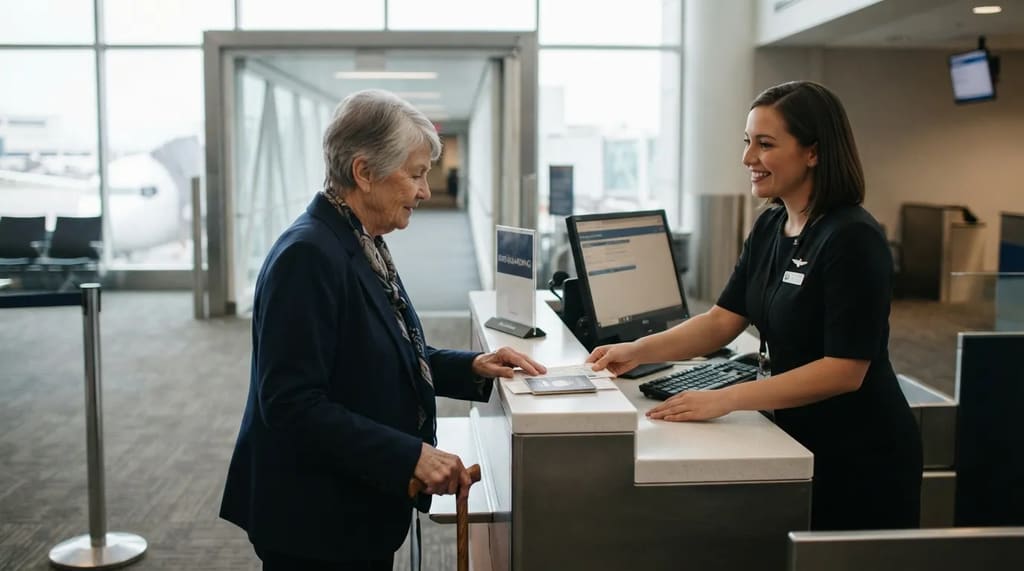
Asking to board early is the one request that makes everything else easier.
Carriers must offer preboarding to passengers with a disability who self-identify at the gate as needing additional time or assistance to board, stow accessibility equipment, or be seated.1 Notice what’s missing. There’s no age requirement and no medical note at the gate.
Here’s the catch. The agent may never announce it. Not all airlines announce preboarding for passengers with special needs, even when it’s available, so you have to tell the agent at the gate.
What preboarding buys you:
- A quieter jet bridge with no crowd behind you
- Open overhead bins and space to settle in
But the next thing agents can do happens before you even sit down…
#11 – They Can Make Sure You Know the Safety Basics
Early boarding isn’t only about convenience.
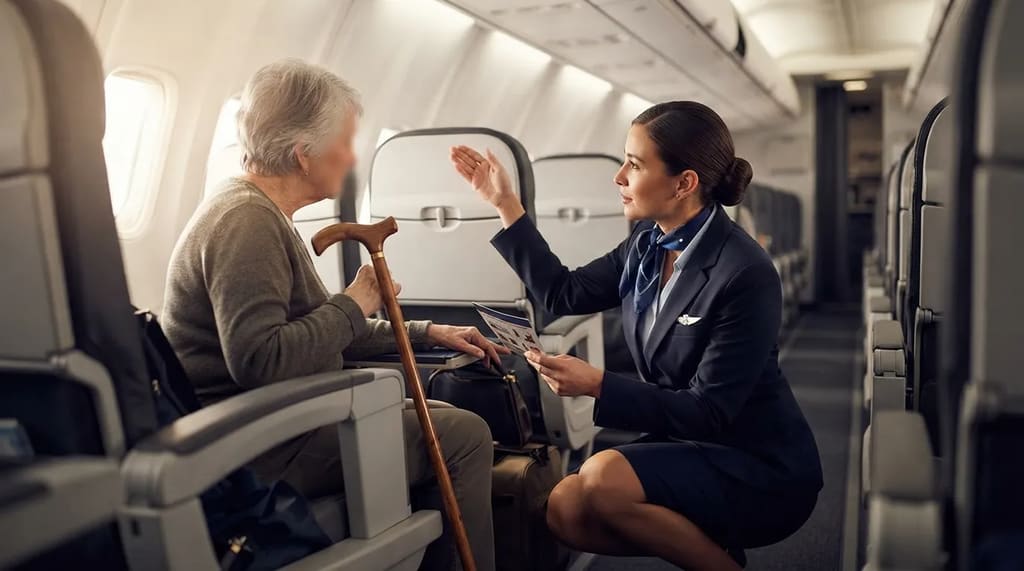
It’s easy to assume the safety briefing is the same for everyone and can’t be adjusted. The Department of Transportation’s guidance for air travelers with disabilities says otherwise. It describes a briefing before other passengers board, if the passenger with a disability chooses to preboard.2
For a cane user, that matters. You may need to know where your cane will be kept and how you’d reach an exit if you’re seated far from one.
Worth Knowing
- The briefing happens before other passengers board, and only if you choose to preboard
- Ask where your cane will be kept during the flight
- Ask how you’d get to the nearest exit from your seat
- Ask who to signal if you need help mid-flight
Asking costs nothing. Tell the agent you’d like a briefing, and they can pass the message along to the crew.
It’s tempting to skip it because you feel you’ve heard it all before. But every aircraft layout is a little different, and a cane changes how you’d move through the cabin.
This is a safety question, not a favor.
And once you’re on the plane, your cane raises a question that surprises a lot of travelers…
#10 – They Can Let You Keep Your Cane With You
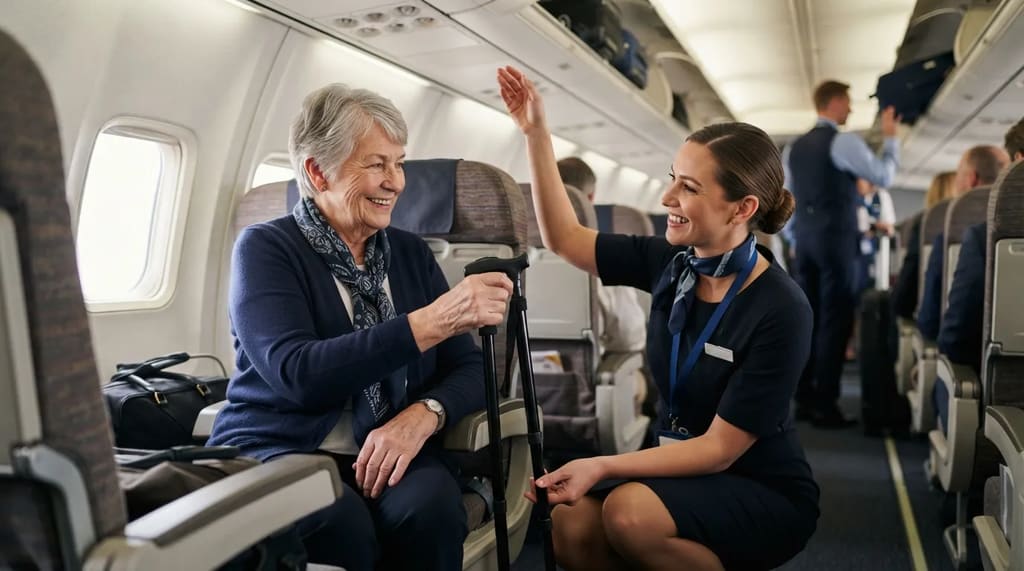
You don’t have to hand your cane over at the gate.
Persons using canes and other assistive devices may stow these items in the aircraft cabin, consistent with safety regulations.2 3 That wording matters. The cane is treated as an assistive device, not as ordinary baggage.
Plenty of travelers worry it will be taken away like an oversized bag. The rules are built around keeping you mobile.
The practical limit is safety. A cane can’t block an aisle or an exit path, so it has to be stowed during taxi, takeoff, and landing.
Your agent’s job is to help you work out where it goes. The answer shouldn’t be the checked-bag pile.
Next comes a detail that makes the cane much less of a hassle once you’re aboard…
#9 – They Can Help You Stow and Retrieve It
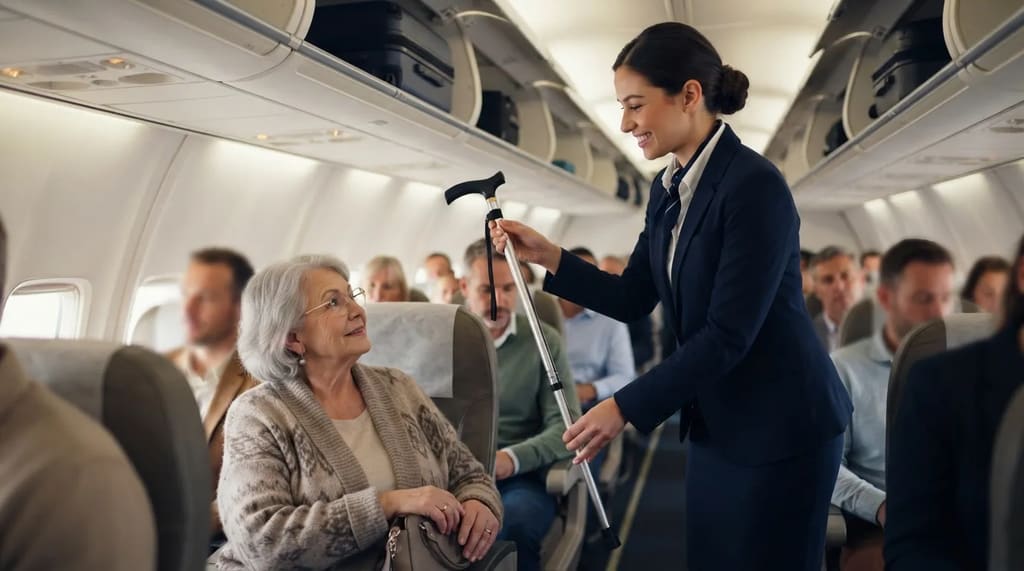
Getting the cane into place is a job the airline is expected to help with.
Once you’ve boarded, airlines must provide assistance, if requested, such as stowing and retrieving carry-on items, including assistive devices. That covers your cane.
The key words are “if requested.” Nobody is going to take it from your hand uninvited, so you have to ask.
Here’s what to ask for:
- Help stowing the cane before takeoff
- Help getting it back at landing, before you stand
The retrieval part is the piece almost nobody thinks about. Picture the moment the plane lands and you realize you can’t stand without the cane, and it’s stowed out of reach.
Travelers handle this differently. Some keep it along the seat, and others use a closet or crew-designated spot.
Quick Compare
- Along your seat: Easy to reach, but it must stay clear of the aisle and exit paths during taxi, takeoff, and landing
- Closet or crew-designated spot: Out of everyone’s way, but you’ll need to ask for it back before you stand
The best place is wherever you can get it back easily, so agree on a spot before the door closes.
That brings us to the luggage, which is where many seniors end up doing far too much alone…
#8 – They Can Handle Your Carry-On Bags
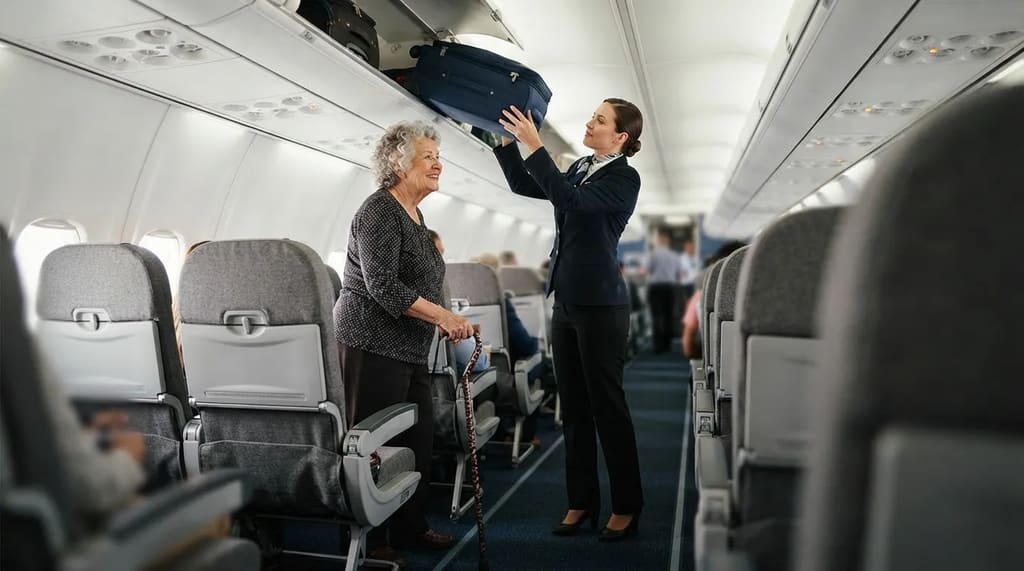
Lifting a bag overhead while leaning on a cane is a recipe for a stumble.
Airlines must provide personnel to help passengers with disabilities in carrying and stowing their baggage.4 That’s part of the enplaning duty, not a courtesy.
It extends beyond the gate. The same assistance applies on the plane, where getting a bag into the overhead bin means balancing on one leg.
Think about what a carry-on involves. You lift, you twist, and you shift your weight away from your support. One slip and you’re in trouble.
Plenty of travelers say they’re fine, and often they are, right up until the moment they aren’t. Reaching overhead with one hand on a cane is where a lot of avoidable stumbles start.
A better plan:
- Pack light enough to need less help
- Ask the agent or a flight attendant to lift the bag
But where you sit matters even more than where your bag goes…
#7 – They Can Work on Your Seat Assignment
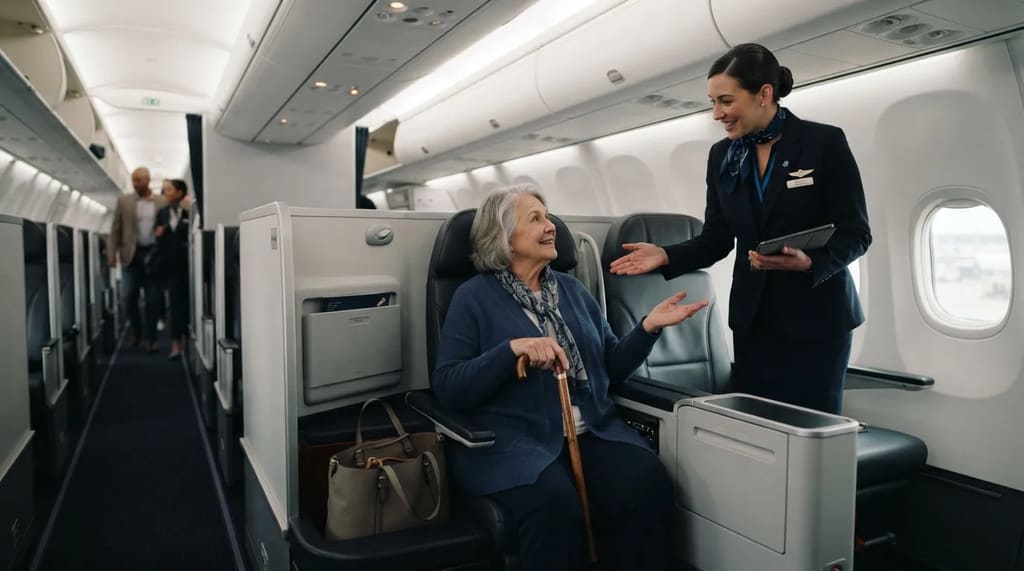
The wrong seat can turn a short flight into an ordeal.
On airlines that assign seats in advance, you can ask for one that suits you. Where a carrier doesn’t, passengers who identify themselves as needing a seating accommodation may pre-board and select the seat that best meets their needs.
That’s a real advantage. On open-seating flights, early boarding can mean first pick.
Now for the debate. Plenty of frequent flyers swear by the bulkhead row for legroom. Some accessibility-minded travelers argue it’s a trap for cane users, since there’s no under-seat storage in front of you and the cane has to go somewhere else. That’s opinion, not regulation, so weigh it yourself.
An aisle seat is the most common request. It means fewer people to climb past on the way to the lavatory.
Seats are only half the story. For many passengers, the struggle starts long before the jet bridge…
#6 – They Can Arrange Help Getting to the Gate
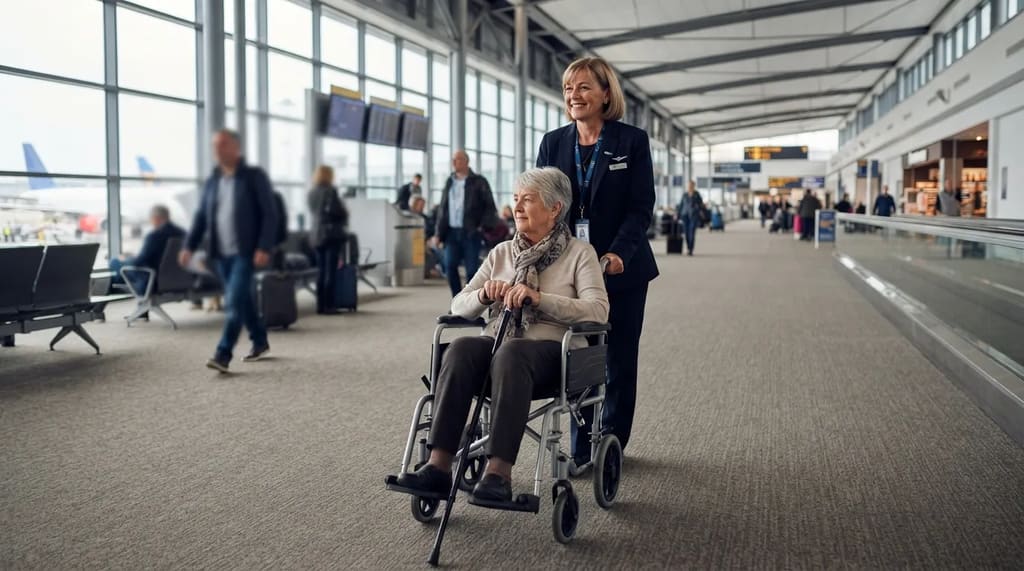
A long concourse is a bigger challenge than most people let on.
Airlines must help passengers with disabilities in boarding, deplaning, making flight connections, and transporting between gates. That includes equipment such as wheelchairs and electric carts, and personnel to propel them.
Here’s the misconception. Wheelchair service isn’t reserved for people who can’t walk at all. A cane user facing a long terminal is exactly who it’s for.
Saving your energy has a purpose. A tired walker is more likely to stumble on the jet bridge, and you’ll reach your seat already worn out.
You don’t have to use a chair for the whole trip. Some travelers accept it only for the longest stretch.
And what happens when the plane doesn’t connect to a jet bridge at all?
#5 – They Can Arrange Alternatives to Stairs
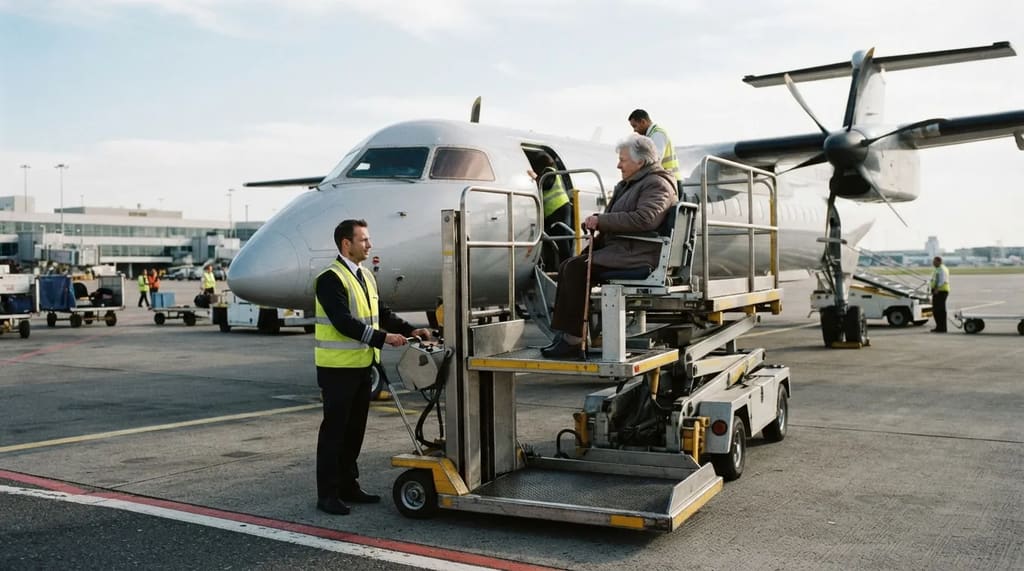
You should never be expected to climb stairs you can’t manage.
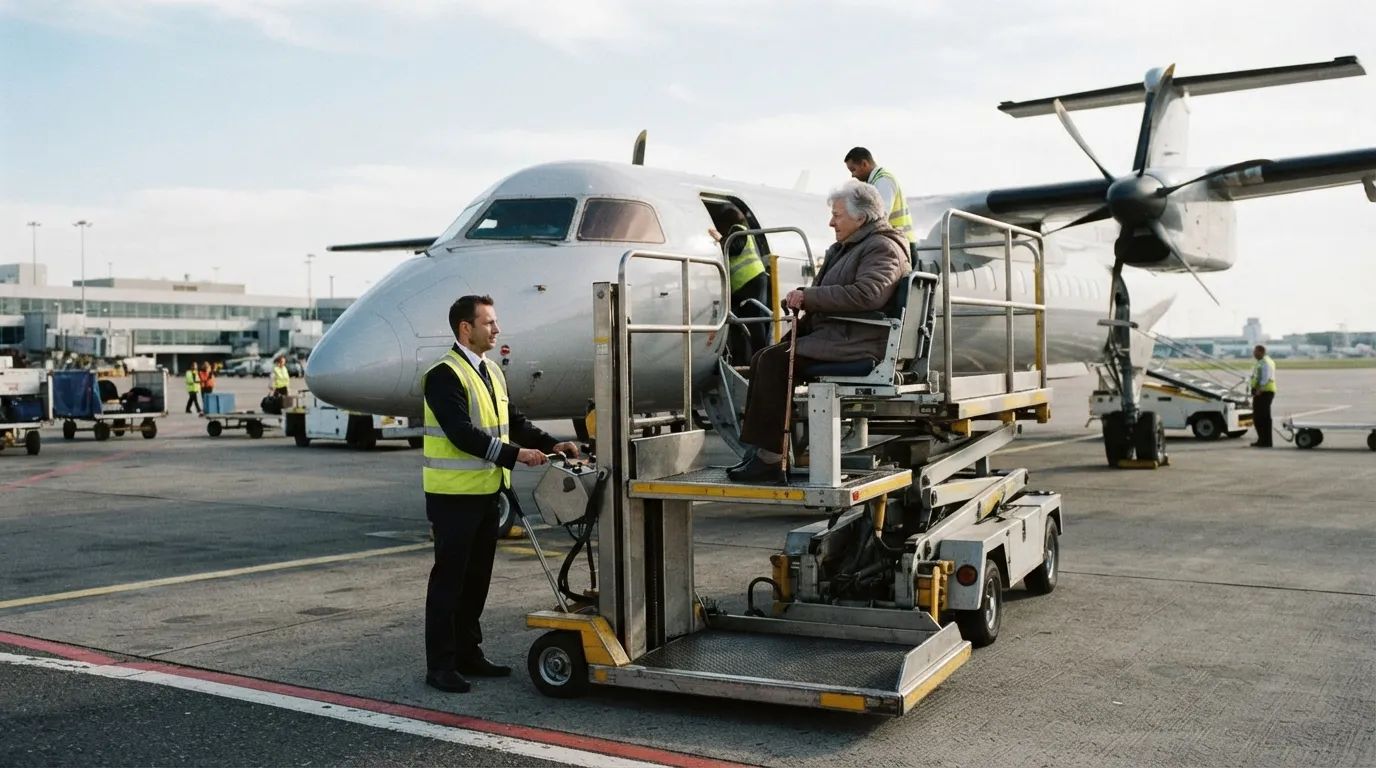
Some flights board from the tarmac. For those, carriers must provide boarding assistance using mechanical lifts, ramps, or other suitable devices that do not require employees to lift or carry passengers up stairs.5
That last part is the surprise. Staff aren’t supposed to carry you up the steps. The airline must supply proper equipment.
Smaller aircraft often use this kind of boarding, so it comes up more than you’d think. A boarding chair is one option for those who can’t climb, and it’s described as a way to board using the aircraft’s boarding stairs.
At a Glance
- Before you book: Ask what boarding method the flight will use
- At check-in: Say plainly that stairs are hard for you
- On the tarmac: Expect a lift, ramp, or other suitable device
- Never expected: Being lifted or carried up the steps by staff
If stairs are hard on you, say so well before the flight. Don’t wait until you’re standing at the bottom of them. Agents can often tell you the boarding method in advance.
For anyone with a bad knee or hip, that one question can decide whether a trip is feasible. Next, what happens after you’re through the door…
#4 – They Can Help You Get to Your Seat
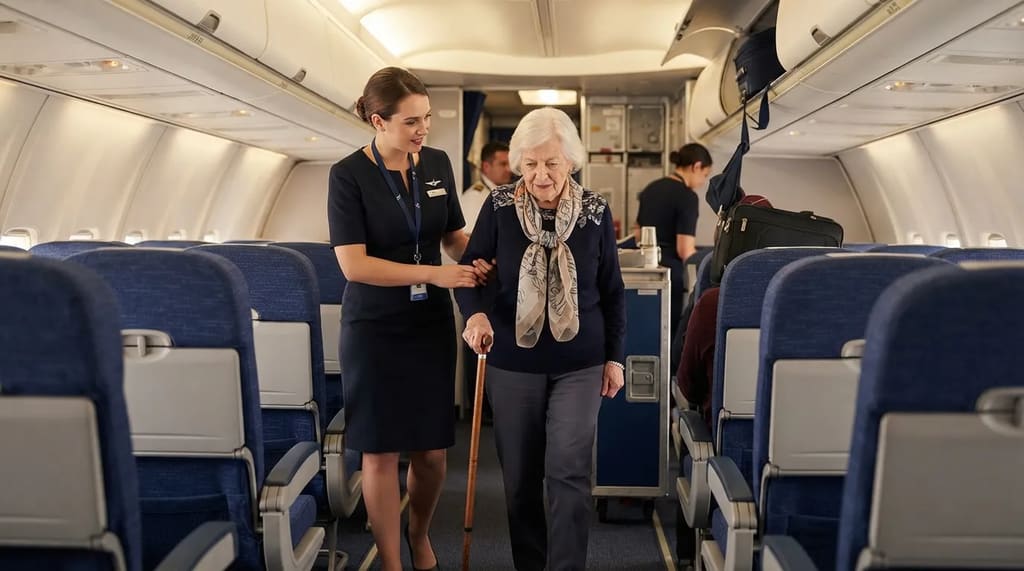
Making it down the aisle is a task you don’t have to do alone.
Passengers with disabilities must get prompt and timely boarding and deplaning assistance, upon request, from properly trained airline personnel, including assistance with moving to and from seats.
Aisles are narrow, and a cane takes up room. Add a crowd and a moving cart, and it gets tight fast. Early boarding solves most of that.
What a trained agent or crew member can do:
- Walk ahead of you to clear the way
- Steady the seatback as you turn in
The “trained” part is easy to overlook, but it’s in the rule. You’re entitled to someone who knows how to help without making things worse.
Be direct about how you want to be helped. A grab at your arm can throw off your balance.
The same assistance matters even more when you’re changing planes, and that’s where plans fall apart…
#3 – They Can Hand You Off for Connections
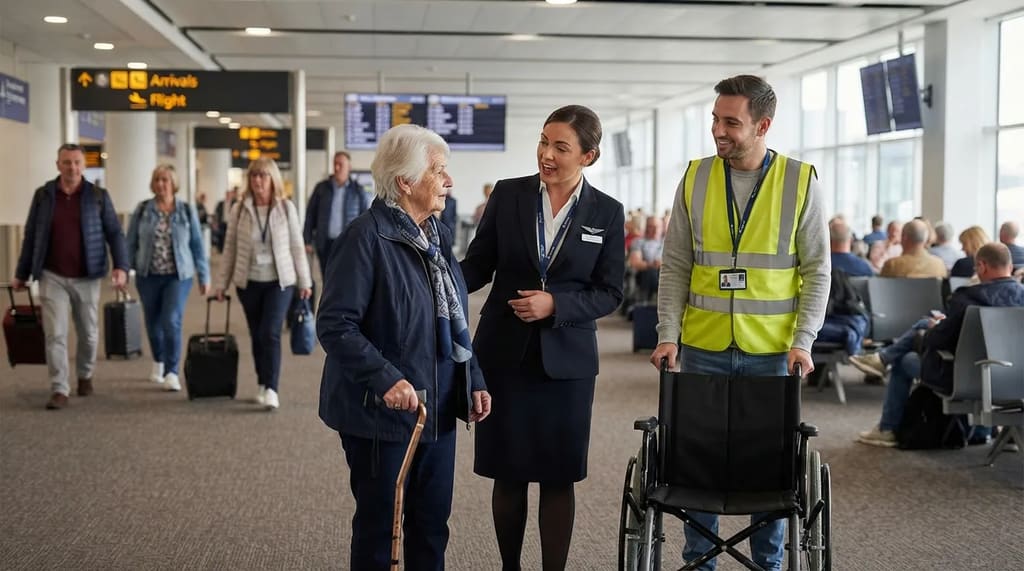
A missed connection is often an assistance problem, not a distance problem.
The rules say airlines must help with making flight connections and transporting between gates. The DOT notes that, on connecting flights, the delivering carrier is responsible for providing assistance.
In plain terms, the airline that brings you in is responsible for getting you started toward the next gate. It isn’t someone else’s job.
This is where trips often go sideways. A short layover plus a long walk with a cane is a bad combination.
The trap is stepping off the plane without knowing who is meeting you. Ask the agent at your departure gate to confirm that assistance is arranged at the other end.
If you can choose, pick the longer layover. A cushion of time is cheaper than a rebooking.
Related Stories From Travelbinger

Landing is the next hurdle, and it’s one many people forget to plan for…
#2 – They Can Help You Deplane Without the Rush
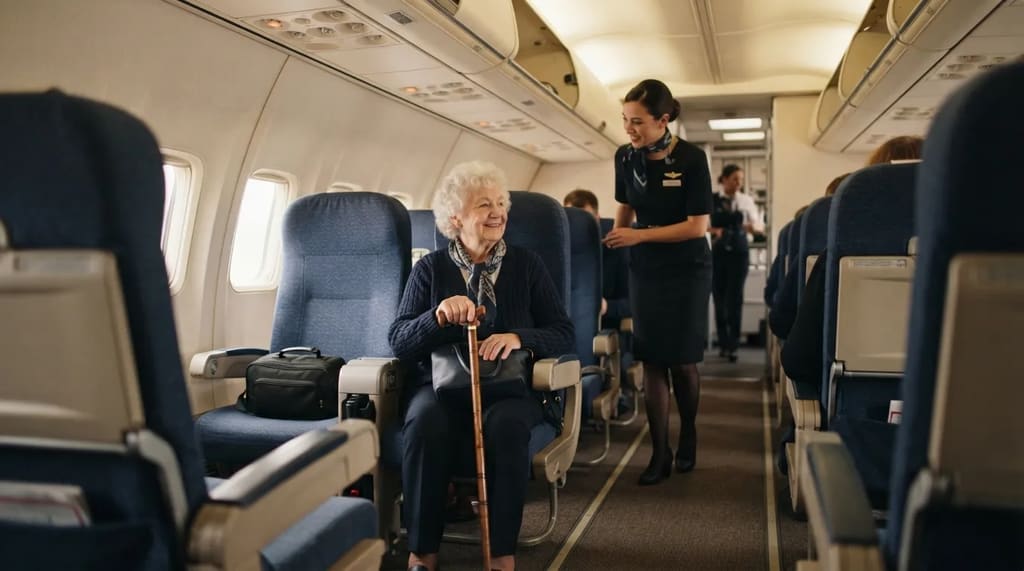
Getting off the plane can be harder than getting on.
The rule is the same: carriers must provide timely enplaning, deplaning, and connecting assistance to passengers with disabilities requesting such assistance. Notice the word “requesting.” You have to ask.
The moment the seatbelt sign goes off, everyone leaps up at once. For someone with a cane, that scramble is the riskiest moment of the trip.
The smart move is to stay seated. Let the crowd file out, then ask for your cane and your bag.
There’s pressure to stand with everyone else so you don’t seem slow, but a crowded aisle is when falls happen. Nobody is timing you.
Fast Facts
- Deplaning help is available to passengers who request it
- Tell the flight attendant before landing, so they can alert the ground team
- Stay seated until the aisle clears, then ask for your cane and bag
- If you’ve arranged a wheelchair or escort, confirm it’s waiting before you go
One more thing agents can do for you has nothing to do with equipment at all…
#1 – They Can Respect Your Cane and Your Choices
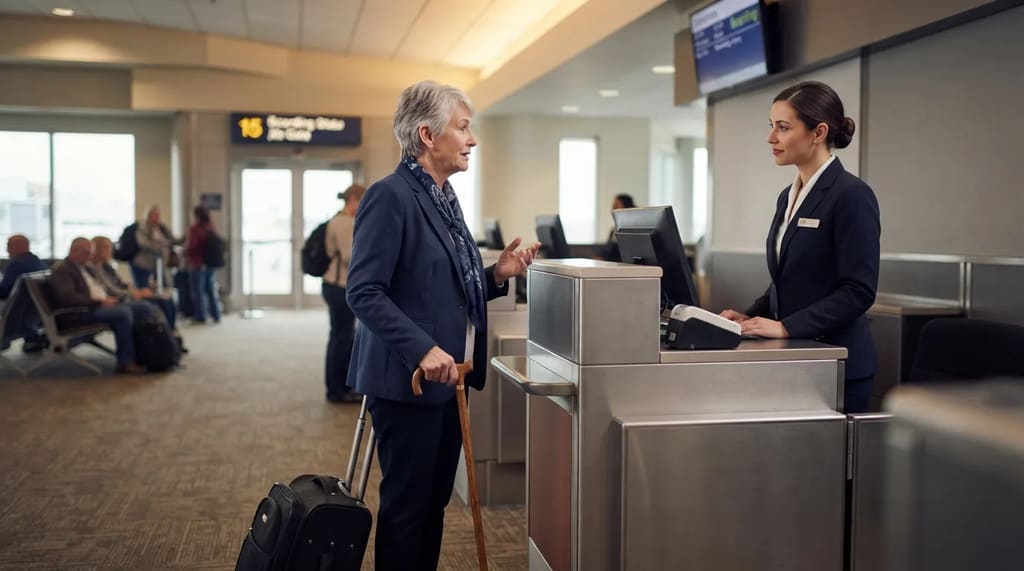
The most important thing a boarding agent can do is listen to you.
Federal guidance for airline staff is blunt. Avoid patting an individual with a disability or touching the individual’s wheelchair or cane.6 7 People with disabilities consider their assistive devices to be part of their personal space.
It goes further. Staff shouldn’t move a person’s cane if the person has placed it on the ground near a seat.7
You also stay in control of the help itself. Airlines must not require a passenger with a disability to accept special services, including preboarding, that the passenger hasn’t requested.1
That means “no thanks” is a full answer. You can decline preboarding, and the DOT says so directly.
Every piece of help on this list is an option, and you pick the ones that suit you.
That’s the full list, and the pattern is hard to miss.
The Bottom Line
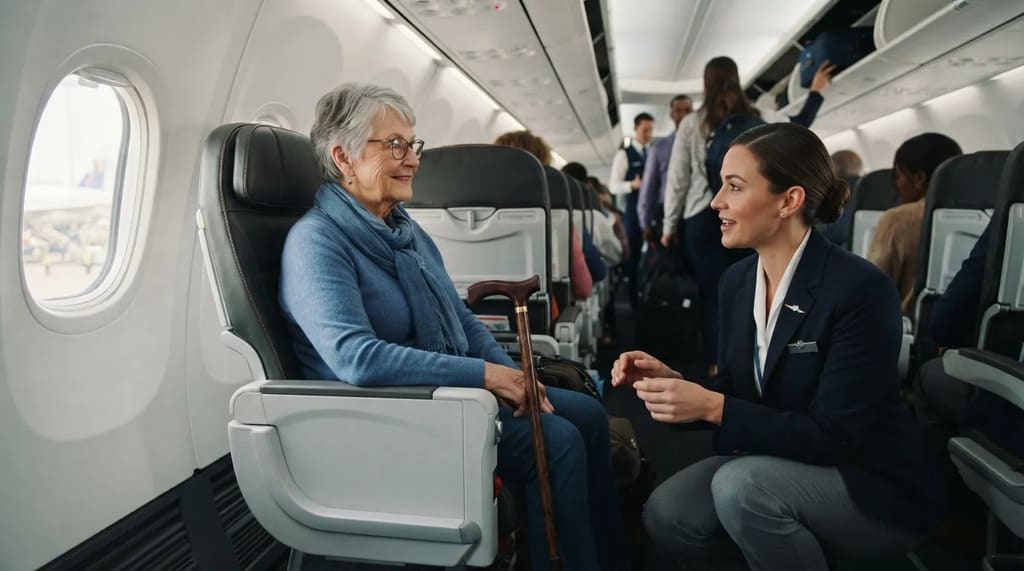
The biggest surprise is that your age doesn’t unlock any of this. Speaking up does. Preboarding, help with bags, seat accommodations, gate-to-gate escorts, and deplaning assistance all depend on you telling someone what you need. Airlines must offer them, but they’re often not announced.
Your cane can ride in the cabin. Staff are told not to touch it without asking, and you can turn down any service you don’t want.
So which of these would you have asked for first, and is there a request at the gate that finally worked for you?
Bonus: The Insider Trick Nobody Tells You

If an agent says no, or just shrugs, ask for the airline’s Complaint Resolution Official, often called the CRO.
U.S. disability rules require airlines to have a CRO available at each airport during operating hours, either in person or by phone. The CRO has the authority to settle a disability-related problem on the spot, so you don’t have to argue with a busy gate agent.
- Step 1: Stay calm and say, “Can I speak with a Complaint Resolution Official, please?”
- Step 2: State the fix you need in one sentence, such as preboarding, a wheelchair escort, or a boarding method without stairs.
- Step 3: Ask for the CRO’s name and write it down, along with the time.
Do the groundwork before the trip, too. Call the airline’s accessibility desk at least 48 hours ahead and ask them to note your cane and the help you want on your reservation. That way the agent sees it on screen before you say a word.
Also worth saving: the U.S. Department of Transportation runs a hotline for air travelers with disabilities at 1-800-778-4838. It can help if a problem comes up mid-trip. For airport security, TSA Cares at 1-855-787-2227 can arrange screening help, and it recommends calling about 72 hours before you fly.
- eCFR Preboarding Rule: https://www.ecfr.gov/api/versioner/v1/full/2022-02-22/title-14.xml?chapter=II&part=382&subchapter=D
- DOT New Horizons Guide: https://www.transportation.gov/sites/dot.gov/files/docs/Horizons_2009_Final_0.pdf
- DOT Stowing Devices: https://www.transportation.gov/resources/individuals/aviation-consumer-protection/assistive-device-guides/stowing-devices
- DOT Wheelchair Assistance Tips: https://www.transportation.gov/sites/dot.gov/files/docs/Wheelchair_and_Guided_Assistance_Tips-Tip_Sheet.pdf
- ACAA Boarding Assistance Manual: https://www.corada.com/documents/guide-to-acaa/c-boarding-and-deplaning-assistance
- DOT Airline Employee Guidance: https://www.transportation.gov/sites/dot.gov/files/docs/TAM-07-15-05_0.pdf
- Technical Assistance Manual Draft: https://www.federalregister.gov/documents/2012/07/05/2012-15233/nondiscrimination-on-the-basis-of-disability-in-air-travel-draft-technical-assistance-manual