The brochure says “moderate walking.” It doesn’t say how many steps climb into the coach, how long the cobblestones run, or whether there is a single bench in sight. That gap is where a ticket you can’t use comes from, and Princess, for one, makes no refund on an excursion unless you cancel before the closing time printed on it. Each of these fourteen requests is one the cruise lines’ own accessibility pages, forms and tour listings already make room for.
But one request on this list is different. The desk can’t promise it, no matter how politely you ask, and it decides whether the other thirteen matter. First, the request that costs the desk nothing: how a tour describes its own difficulty.
#14 – The Activity Level Translated Into Steps and Minutes

Cruise Critic notes that most lines publish each tour’s duration, physical ability level and accessibility information. Descriptions often flag long walking stretches or uneven terrain. Ask the desk to put the rating in plain terms: how many minutes you will be on your feet, whether the ground is cobbled or paved, and whether there is somewhere to sit.
Go by the listed level, not the brochure photo. A terrace looks the same whether you reach it by elevator or by a steep climb. If a tour can’t tell you how much walking it involves, pick a different tour.
The rating describes the walking, which leaves the coach steps that get you to the walking in the first place.
#13 – How Many Steps Lead Up Into the Coach

Tour vehicles range from small vans to full-size coaches, and the height of the first step is a detail brochures seldom mention. Before booking, ask the desk for the number of steps on the vehicle, the longest stretch between rest stops, and whether a restroom is available along the route.
Those answers cost the desk nothing, and they tell you more about your day than the tour’s title does. Even the lines’ own systems treat coach steps as a dividing line. Royal Caribbean’s first accessibility level is for guests who can walk short distances and manage the steps of a motor coach.1 If you can’t manage them, ask early for a tour that uses an adapted vehicle.
#12 – The Senior Discount That Lives on the Fare, Not the Tour
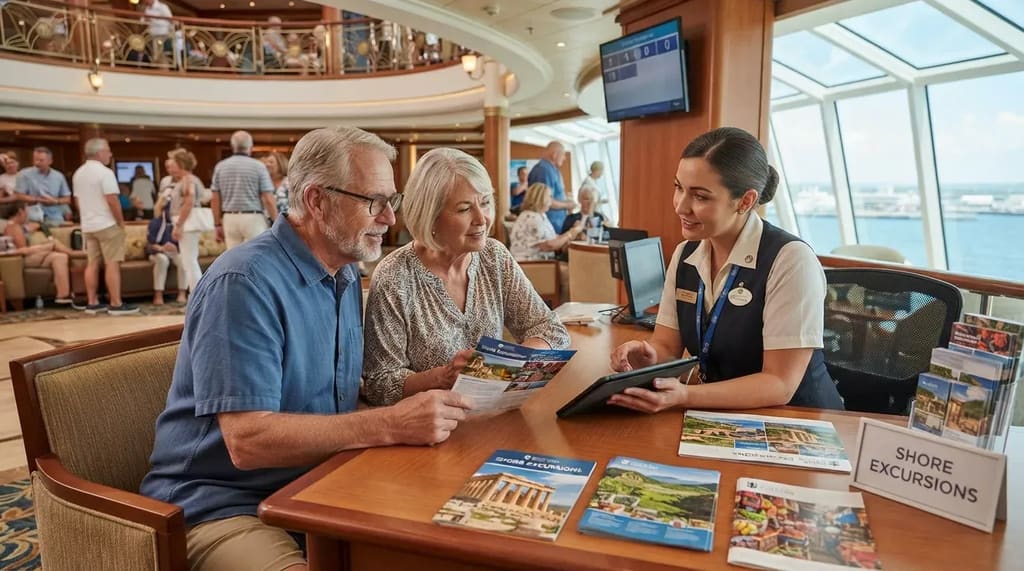
The age discounts that exist sit mainly on the cruise fare. Cruise Critic reports that some lines offer reduced fares to travelers 55 and older on select sailings. Royal Caribbean and Carnival let you search for senior fares online, and MSC has offered discounts to passengers 65 and older who book directly.2
Whether any of that carries over to excursion prices varies by line, so ask. I wouldn’t build a budget around a yes. Some independent excursion vendors do offer senior discounts, but the ship’s desk has no power over a price that belongs to an independent company.
Comparing the senior fare against current sales will likely save you more than any haggling over a tour. Cruise Critic says it is worth doing because many offers apply only to select sailings.2
At a Glance
- Some lines reduce fares for travelers 55 and older on select sailings
- Royal Caribbean and Carnival let you search senior fares online
- MSC has offered 65-and-over discounts to direct bookers
- Excursion discounts vary, and independent vendors set their own
Savings aside, the tour still has to suit the pace you want for the day.
#11 – Gentler Tours That Still Fill a Whole Day Ashore

Holland America offers shore excursions across different activity levels, including cultural and enrichment-focused options. Cruise Critic quotes an accessibility-equipment rental executive saying the line caters well to travelers who like the slower pace of an Alaska itinerary. Ask the desk which tours in your port sit at the easy end, and what they include in place of the hiking.
A slower tour can still be a full day. A museum, a scenic drive or a tasting gives you the place without the long walk. Cruise Critic’s advice is to be realistic about your physical abilities when planning, and the reason is practical: a tour you can finish beats an ambitious one you leave early.
#10 – The Cancellation Deadline Printed on the Ticket
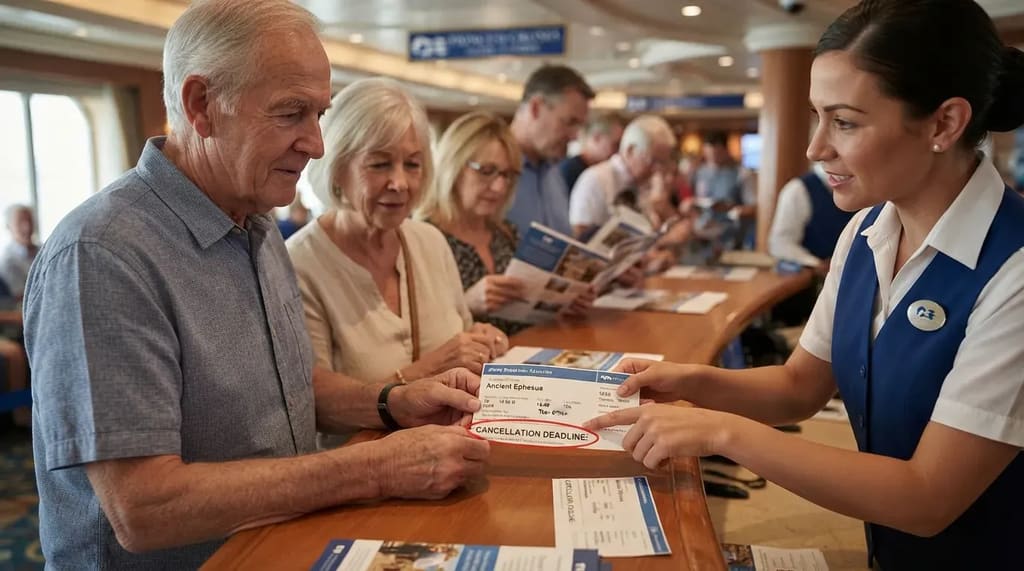
Princess requires you to cancel before the closing time printed on the shore excursion ticket. If an excursion is canceled for reasons beyond its control, a full refund is made. A pre-paid tour cancelled five days or more before sailing is refunded. Once you are aboard, the ticket’s closing time is the date that matters, so ask the desk to point it out.
Carnival’s terms work differently. They say your sole recourse for a cancelled activity is a refund of the amount paid. In the cases it describes, that comes as shipboard credit, and any unused credit is refunded by check on the morning of debarkation. Know the cutoff before you pay, because a sick day in the middle of the cruise is easier to absorb when you already know what it costs.
A refund covers the money and says nothing about a bus that runs late.
#9 – Who Answers for a Late Return to the Ship
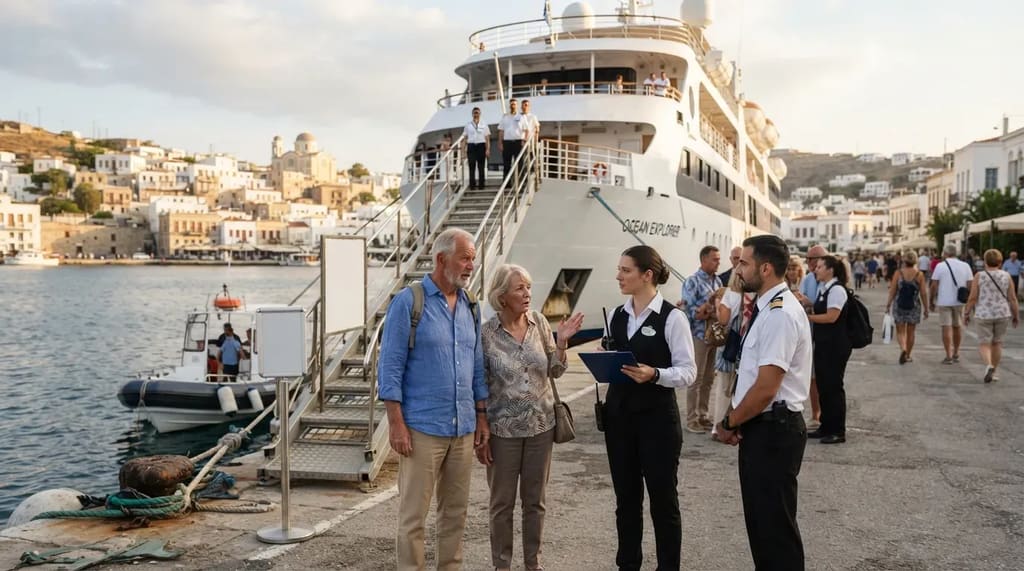
A tour booked through the ship is timed around the ship’s departure. That is the main reason to choose it in an unfamiliar port when your pace is slow. Independent operators vary. Some publish return-to-ship guarantees, but those are the company’s own promises, not the cruise line’s.
One operator’s terms say it arranges and pays for transport to the next port, a hotel and meals if a late tour makes you miss the ship. My view: if you need extra time getting on and off a coach, the ship’s own tour is the easier choice at a port you haven’t visited. Independent tours can be smaller, as one operator’s average group is 12 guests against 50 or more on many cruise-line coaches, but they leave the reading of the guarantee to you.
#8 – Advance Notice for Hearing, Vision and Service Animals

Cruise Critic notes that several lines require advance notice for large-print menus, ASL interpreters, accessible shore excursions and service-dog arrangements. Carnival has separate forms for guests with sensory needs, cognitive disabilities or invisible disabilities, with an adult version for guests over 18. Disney lists assistive listening and captioning, and ASL interpreters on designated sailings with 60 days’ notice or more.
If hearing the guide is half the point of the tour for you, say so when you book, not at the dock. The lines that need notice need it before the ship sails.
Those forms cover what you need to see or hear. Equipment for getting around goes through a separate route.
#7 – A Rented Scooter Waiting in the Stateroom
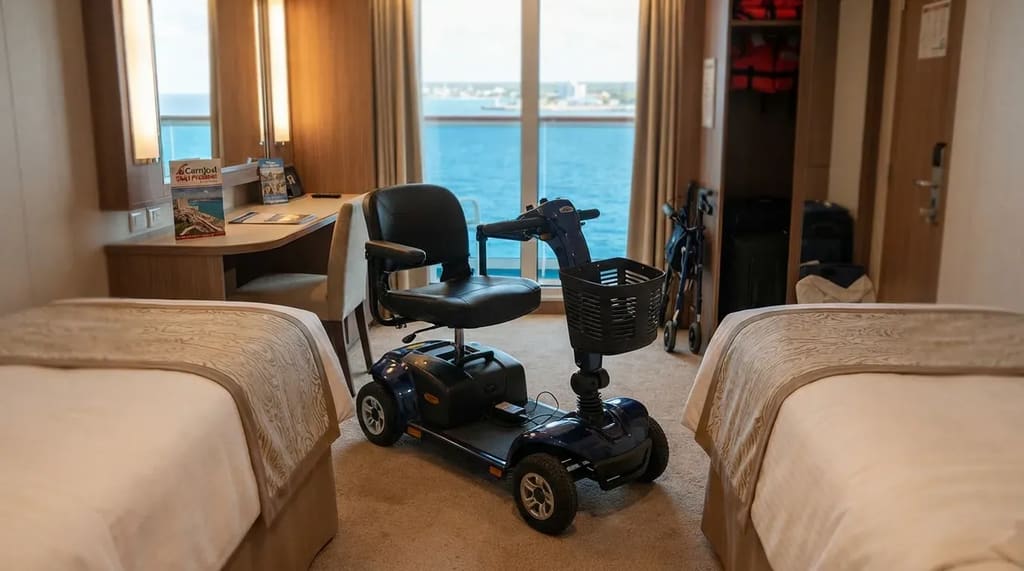
Carnival encourages guests who regularly use a wheelchair or scooter to bring their own or rent from its preferred vendor, Scootaround. A scooter you bring should fold so it can be stored in the cabin. Batteries must be charged in the stateroom, so Carnival recommends one with removable batteries. Rental companies deliver to the stateroom, a hotel or the port, and they also rent rollators with seats and hand brakes.
Which one to choose depends on your ports. A scooter is ideal at docked ports and useless at tender ports under some lines’ rules. On Carnival, motorized wheelchairs and mobility scooters cannot be taken on its tenders.3 4 If half your itinerary anchors offshore, ask whether a folding rollator, which rental companies also offer, fits the trip better.
Quick Compare
- Scooter: Should fold for cabin storage, needs charging in the stateroom, and can’t ride Carnival’s tenders
- Folding rollator: Rentable with a seat and hand brakes, and a better match if the itinerary anchors offshore
Whatever the scooter does for your legs, it does nothing for breathing equipment, which has its own forms.
#6 – Oxygen and CPAP Machines, Declared Early
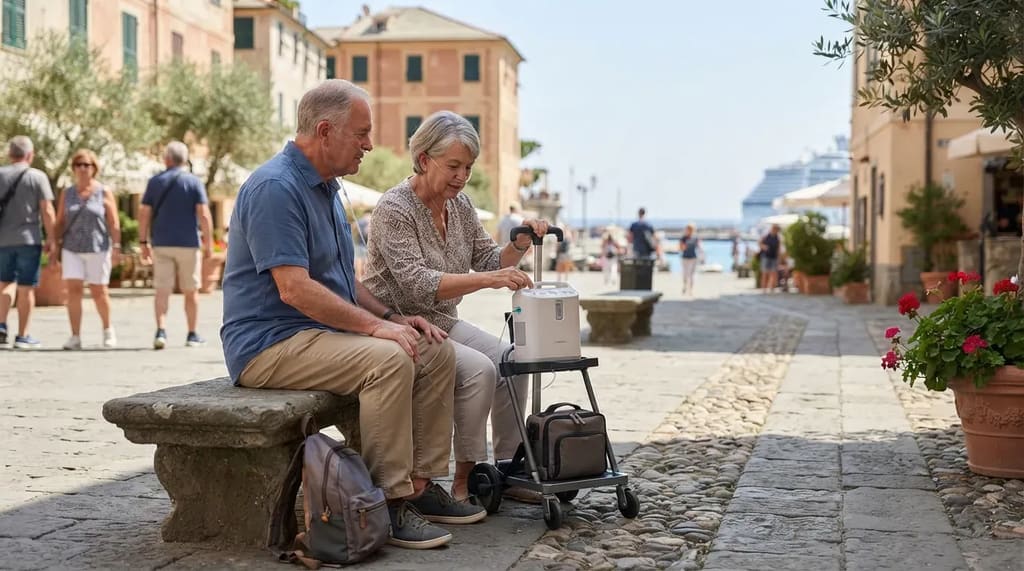
Carnival’s special-needs page lists guests sailing with oxygen tanks, a concentrator or a CPAP machine, and it keeps a separate form for them. Royal Caribbean asks guests taking oxygen on a tour to give the device’s length, width and height in advance on its accessible shore excursion form.
Don’t count on the ship supplying oxygen. Generally you supply it and tell the cruise line in advance. Rental companies offer portable concentrators for cruises, and a valid prescription is required. Check the excursion operator’s own requirements too, since the ship’s form doesn’t settle what the tour company allows on board. Your doctor can tell you how many hours of battery a full day ashore calls for.
#5 – An Adapted Vehicle, Requested Before Sailing
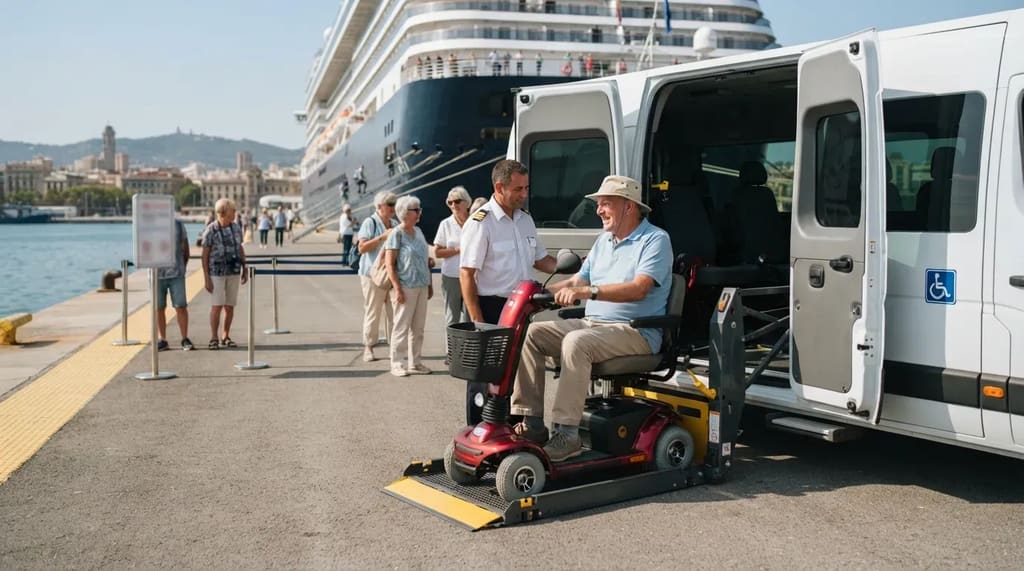
Carnival lets wheelchair users request accessible transportation for scooters or wheelchairs in advance at the shore excursion desk, subject to availability. Celebrity offers ramp- or lift-equipped vehicles on selected accessible excursions, while Holland America may arrange options depending on the port and local provider.
Notice the wording: selected, depending and subject to availability all mean the desk is checking a port-by-port list, not promising something fleet-wide. Excursions included on river and expedition cruises might not be available to guests who use motorized scooters, so the question belongs on smaller ships too.3
Royal Caribbean sorts the same need into two levels, each with its own rules about devices and companions.
#4 – Royal Caribbean’s Two Levels of Accessible Tours
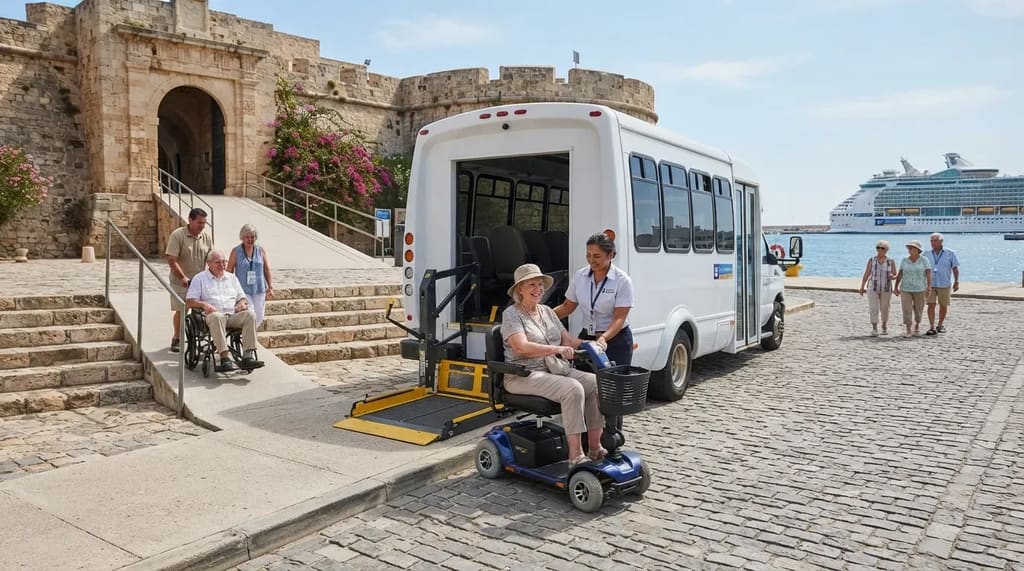
Its accessible shore excursions are small-group tours with lift- or ramp-equipped vehicles, attractions with flat or ramped entrances, and local independent operators familiar with accessibility needs. Level 1 suits guests who can walk short distances, manage coach steps and bring a standard folding wheelchair or scooter that fits in the luggage compartment. Level 2 is for guests who cannot manage coach steps or who use a wheelchair or scooter full time.1
The request needs specifics, which is why it pairs with the forms above:
- The mobility device type
- Its dimensions, length by width by height
- Its weight
The line expects an able-bodied person to accompany a full-time wheelchair user at all times,1 and guests must stay seated on the chair or scooter to use ramps and lifts. Those are this line’s terms, so check each line’s own version.
Even a tour built this carefully does little for you if the ship anchors offshore and you can’t reach the pier.
#3 – The Ports and Private Islands Built With Wheelchairs in Mind
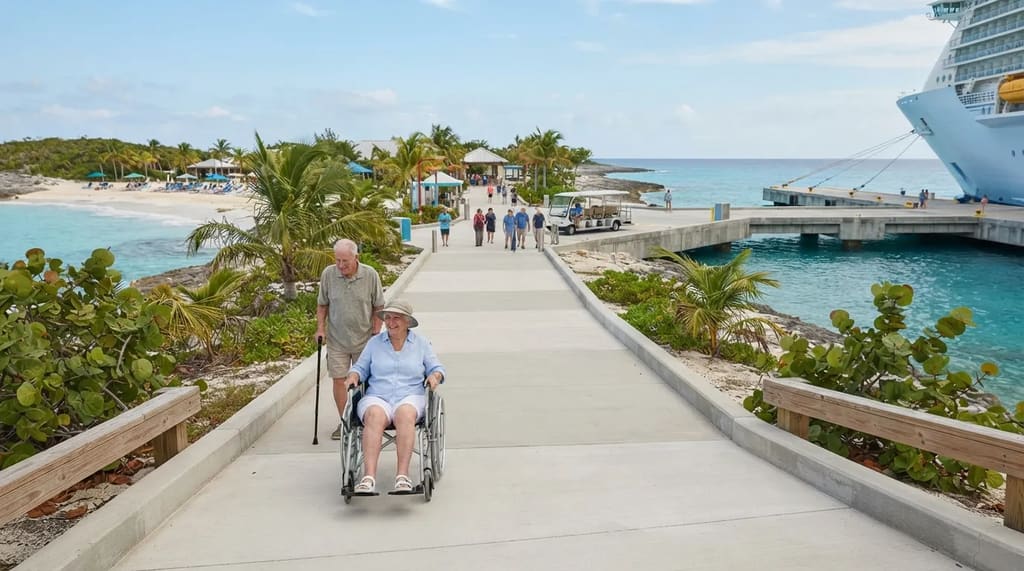
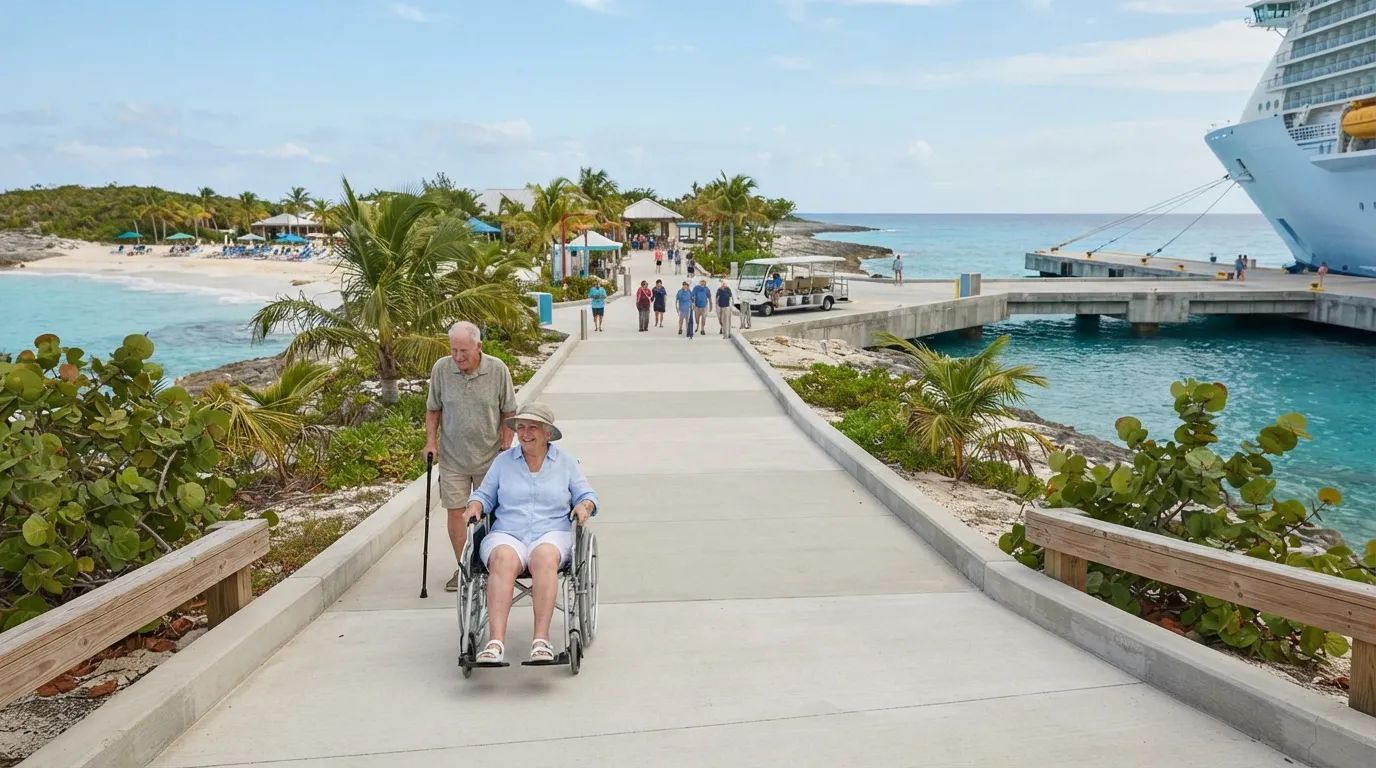
Docked ports are usually manageable, while tender ports often are not, which makes the itinerary the first accessibility decision you make. The lines’ private destinations are being built with that in mind. MSC’s Ocean Cay is fully ADA compliant, needs no tendering and offers reservable beach wheelchairs, and Royal Caribbean’s CocoCay has paved routes and an accessible tram. Norwegian’s new pier at Great Stirrup Cay is described as a major accessibility step for Bahamas sailings.
Related Stories From Travelbinger
Travel Weekly reports that accessible-excursion providers are expanding and sometimes partnering directly with cruise lines. Even so, I’d pick a pier over a famous view. If you can’t manage steps, an itinerary full of clifftop, anchored stops like Santorini is likelier to keep you aboard than any tour can make up for.
Fast Facts
- Ocean Cay (MSC): Fully ADA compliant, no tendering, reservable beach wheelchairs
- CocoCay (Royal Caribbean): Paved routes and an accessible tram
- Great Stirrup Cay (Norwegian): A new pier described as a major accessibility step
At anchored ports, the boat that carries you ashore varies from ship to ship.
#2 – The Tender Platform on Your Particular Ship
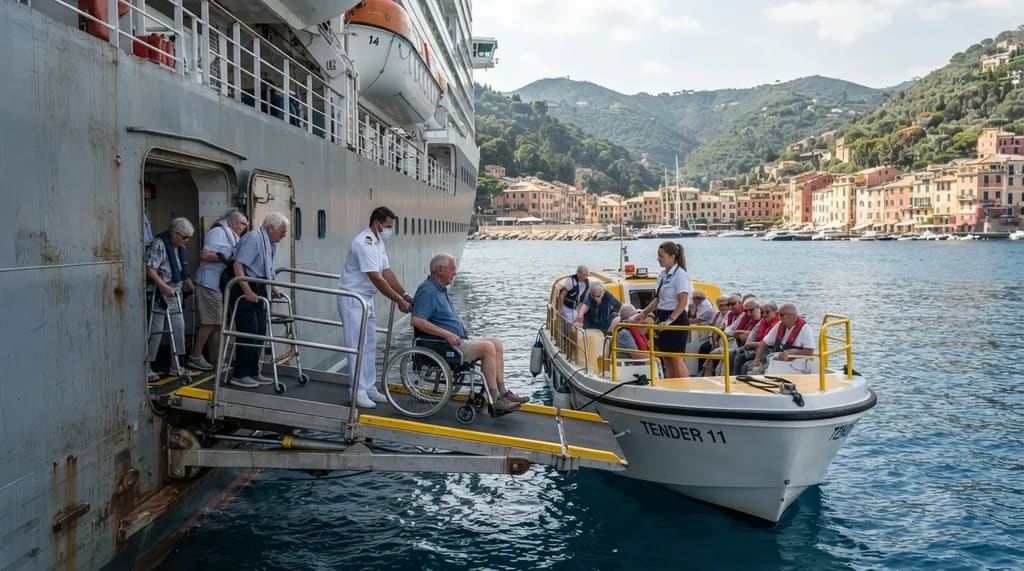
At certain ports, small boats known as tenders carry passengers from the ship to shore. The equipment differs by ship. Celebrity’s Millennium-class and Edge-class ships have a tender loading platform that wheelchairs and smaller scooters can use, and Edge-class ships add a stair platform lift and ramp access.5 Carnival, by contrast, requires passengers to manage steps and a fold-up wheelchair.
Virgin Voyages expects most tender users to take steps and limits manual chairs to collapsible models. Princess says wheelchair and scooter access is limited at tender ports. So ask the accessibility department about your ship and your exact device, not about the line in general.
Equipment on the platform counts for little on a day the ship won’t let you board.
#1 – The Captain’s Call at the Tender Door
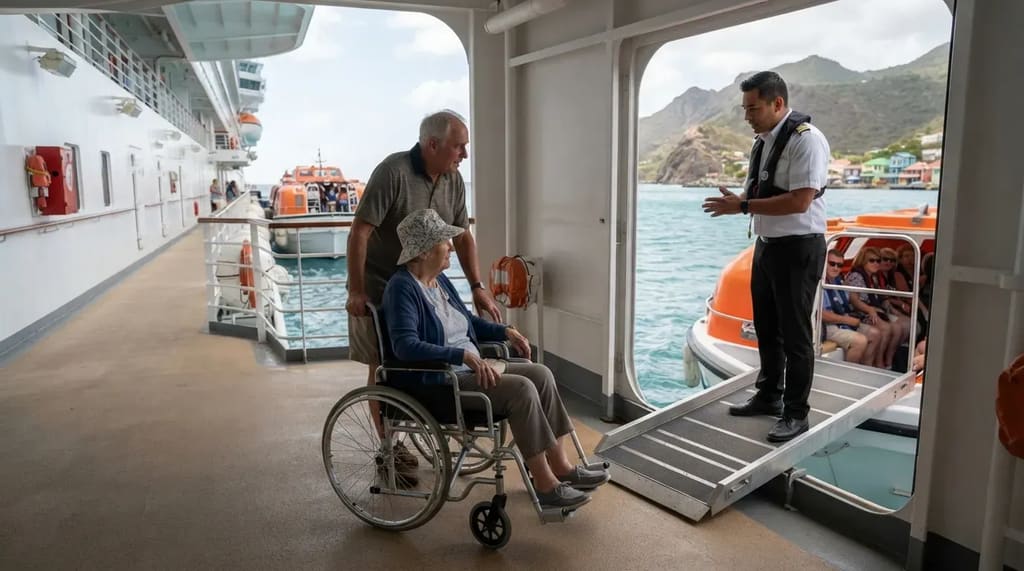
Cruise Critic says it is always the decision of ship officials whether a wheelchair user may board a tender at any given moment.3 On Carnival the captain makes that decision, and crew aren’t allowed to carry guests on or off. Princess’s passage terms warn that some tender ports may keep a wheelchair user aboard for safety.6 That is why no excursion booked months ahead can settle the question.
So the request is for a plan. Ask the accessibility department for the written policy on every tender port on your itinerary, and ask the desk what happens to a booked tour if you can’t board. That is where the cancellation deadline from earlier matters again.
Carnival’s list of tender ports flagged as having no accessible shuttle includes Kona, Moorea and Port Douglas, which shows how specific the answers can be.6 Treat a tender day as a maybe, and buy a ticket for it only once you know the refund terms.
The desk works from specifics. A device’s dimensions, a count of coach steps, an oxygen unit’s battery life and a port list sorted into piers and tenders all give the staff something to check, where a bare mention of your age gives them nothing to look up. Most of the answers above live in forms and published policies, so the sooner your details are on record, the more room the ship has to say yes.
Which port on your last cruise would you have handled differently if you had asked one more question at the desk?
- Royal Caribbean Accessible Excursions: https://www.royalcaribbean.com/experience/accessible-cruising/accessible-shore-excursions
- Cruise Critic Senior Cruise Tips: https://www.cruisecritic.com/articles/cruise-tips-for-senior-travelers
- Cruise Critic Accessible Cruising: https://www.cruisecritic.com/articles/accessible-cruising-what-to-expect?stay=1&posfrom=3
- Carnival Accessible Features Overview: https://wheelchairtraveling.com/carnival-cruises-accessible-features/
- Cruise Critic Accessibility Ranking: https://www.cruisecritic.com/articles/best-mainstream-cruise-lines-for-accessibility
- Tender Port Wheelchair Policies: https://cruiseports.co/tender-ports-wheelchair-scooter/