Picture the pier at the end of a port day. The gangway is still there, the all-aboard time is posted next to it, and somewhere in town a few passengers are still sure they have plenty of time. That one printed time sets the budget for your whole day, and a mistake around it can cost you a tour fee, a missed ship, or the price of chasing the vessel to the next port.
The thirteen mistakes below run from booking habits to clock errors to tender boats. The choice that looks cheapest on the booking page is tied to the biggest bill of all, and that link is saved for the end. First, though, comes the mistake that happens before you ever leave home.
#13 – Waiting Until You Are Aboard to Book
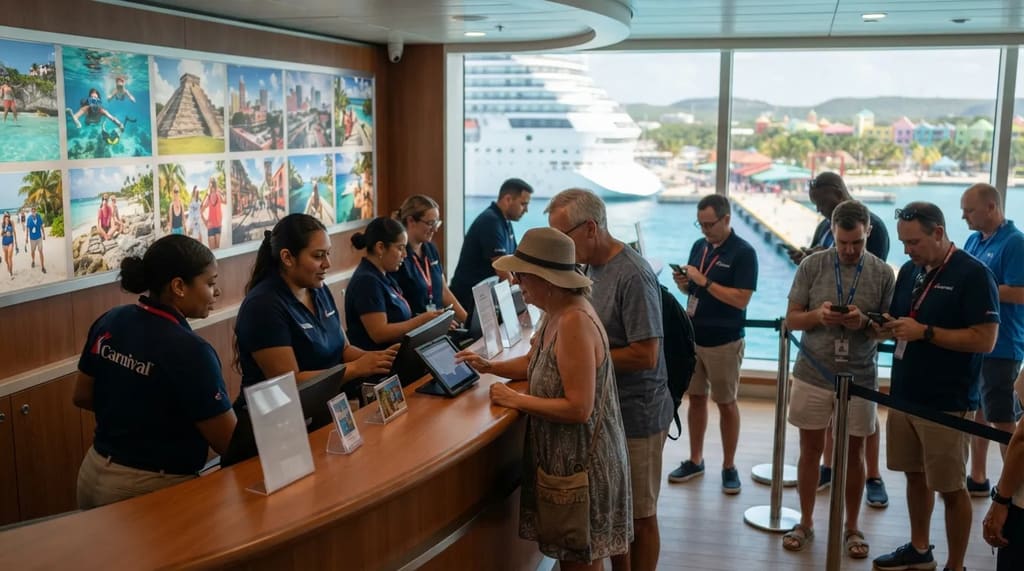
Carnival recommends booking shore excursions as early as possible after you book the cruise and meet its deposit requirements. The reason is the fallback: if the tour you want is gone, your only option is to check with the Shore Excursion Manager aboard and hope for a last-minute cancellation.1
Booking early does not lock you in. Until the cut-off time, you can make new bookings or cancel all or part of an existing order.2 You lose little by reserving the tour you care about most and dropping it if something better turns up.
I would book only the one or two tours you would hate to miss and leave the rest of the week open. A fully scheduled itinerary leaves no room for a slow morning or a port that turns out smaller than you expected.
Reserving a seat settles whether you go. It says nothing about how much walking the tour asks of you.
#12 – Skipping the Activity Level on the Tour Page

A tour’s title names the destination, while its activity level tells you what the day will ask of your legs. The Points Guy advises reading terms like “moderate” or “strenuous” and also checking the number of miles walked, kayaked or biked.3
The label alone cannot carry the decision. Cruise lines put an activity level or accessibility symbol on their tours, but those symbols are advisory rather than contractual. Steps usually tell you more than the word “moderate.”
Princess, for example, says guests who can manage three to five steps onto and off a tour bus and have a collapsible mobility device should generally be able to book standard tours. That is a figure you can check against your own day. Before booking, find out:
- How many miles or hours the tour spends on foot
- How many steps there are onto the bus or boat
- Whether seating is available along the way
Numbers on a tour page describe an average guest, so the operator also needs to hear your own limits in plain words.
#11 – Telling the Operator Nothing About Your Pace

Operators plan around what you tell them, and “moderate mobility” tells them very little. A phrase such as “short walks with regular seating” is far more useful. So is saying whether you can climb two or three steps with help, need an arm for balance, or must stay close to a restroom.
The vehicle matters as much as the walking. Standard vans may have a high step, a narrow doorway, or too little room for a mobility device. Tell your tour provider before the day of the excursion, in the booking message rather than at the meeting point.
This is where a small group earns its price, since a guide with a dozen guests can slow down for one of them. It only works if the guide knows ahead of time.
#10 – Booking a Tour With a Strict Cancellation Window
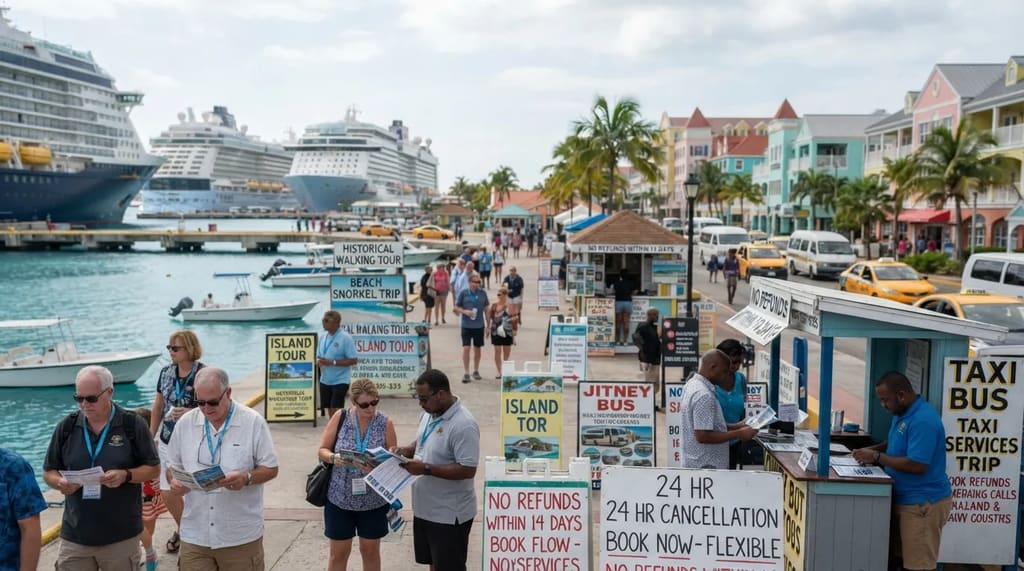
Cancellation windows on independent tours vary a great deal. One Cruise Critic writer’s Viator-booked tour in Nassau had a 24-hour window, while another booking service makes tours non-refundable from 14 days before the tour date.
That matters because plans change. If your itinerary shifts, a long cancellation window can mean losing the full booking. Say you book a strenuous tour and decide nine days out that it is too much. Under a 14-day rule, you are paying either way.
My view is that independent bookings suit simple activities near the pier, such as a beach or a walk through the old town, particularly when your port stay is long. For those, a strict window is a small risk. Before you pay, check:
- The cancellation deadline, in hours or days
- What happens if the ship skips the port or arrives late
- How you can reach the operator by phone while at sea
With the refund terms understood, what remains is the quality of the tour itself, which a star rating shows only in part.
#9 – Trusting a Star Rating Without Checking Group Size

A high average built on thousands of reviews can hide a recent drop in quality. Reading the newest reviews, from the last couple of months, tells you more than the overall score. That score may still be praising a guide who has since left.
Group size is the other number worth finding. Cruise-line tours can carry 40 to 60 people, while independent small-group operators often run 8 to 20. Tours outside the cruise line can also mix passengers from several ships and even resort guests, so “small group” does not always mean fellow cruisers.
Quick Compare
- Cruise-line tour: often 40 to 60 people, and the ship waits if the tour runs late
- Independent small group: often 8 to 20 people, but the crowd may include other ships and resort guests
- Independent small group: the ship sails on schedule if you are late
If the tour is a wander through an old town, a small group is worth some research. If it is a long coach ride, group size matters less than how reliably the tour gets you back, which comes up again at the end.
#8 – Trusting Your Phone’s Clock at the Pier
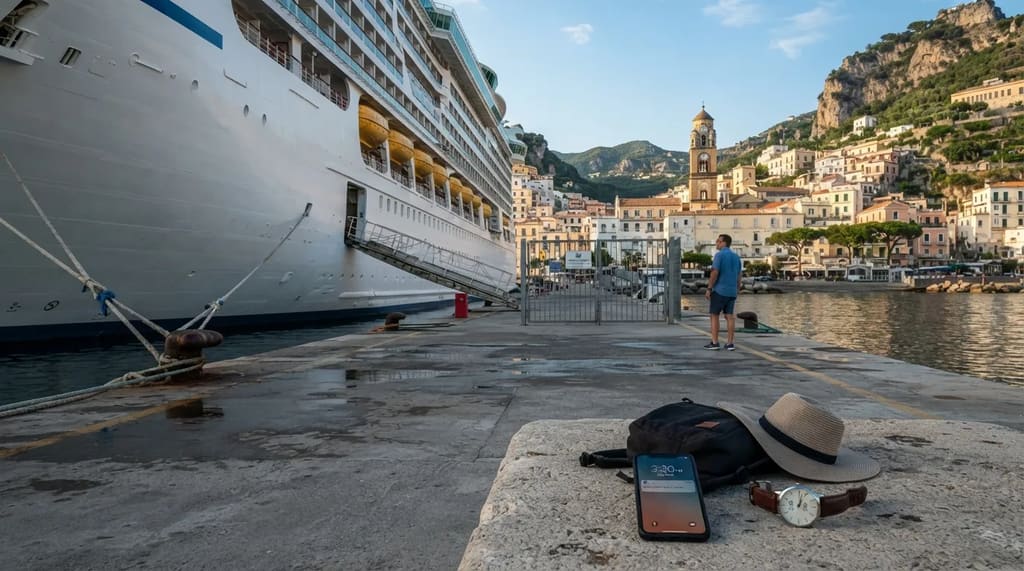
Ship’s time is the official time aboard, and it does not always match local port time. Your phone may switch to local time on its own, so check which time zone the ship is using and adjust your watch if necessary.
The daily program or the cruise line’s app states ship time and any change from the day before. Reading that newsletter carefully is the first lesson in avoiding a missed ship. The mix-up is easy to make because everything on shore will be running on a different hour.
I would wear a plain watch set to ship time and treat the phone as a second opinion. A wrong clock does not announce itself. You find out only when the pier is quiet.
Even with the right clock, the biggest time printed in the program is not the moment the ship leaves.
#7 – Reading All-Aboard as the Sailing Time
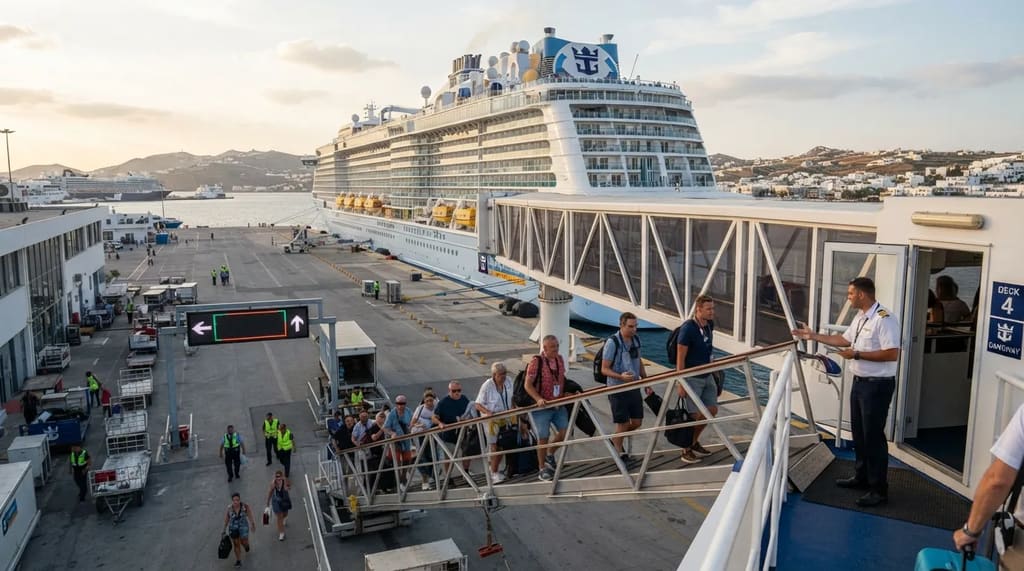
All aboard falls 30 to 60 minutes before the ship sails, and Royal Caribbean says its own is generally about 30 minutes before departure.4 A ship scheduled to sail at five may therefore need you aboard by half past four or earlier.
Confirm the deadline in the daily program, the app or the onboard announcements. The cut-off varies between cruise lines and ports, so a time you remember from one stop may not hold at the next.
At a Glance
- All-aboard usually falls 30 to 60 minutes before sailing
- Royal Caribbean’s is generally about 30 minutes before departure
- Check the daily program, the app or announcements at every port
- The ship typically sails on its published schedule
As the hour nears, the ship is already counting. Security staff monitor who has not returned, and guest services will try to reach you in your cabin. If travelers are not back by all-aboard, the ship will typically sail on its published schedule.
#6 – Not Asking When the Last Tender Leaves
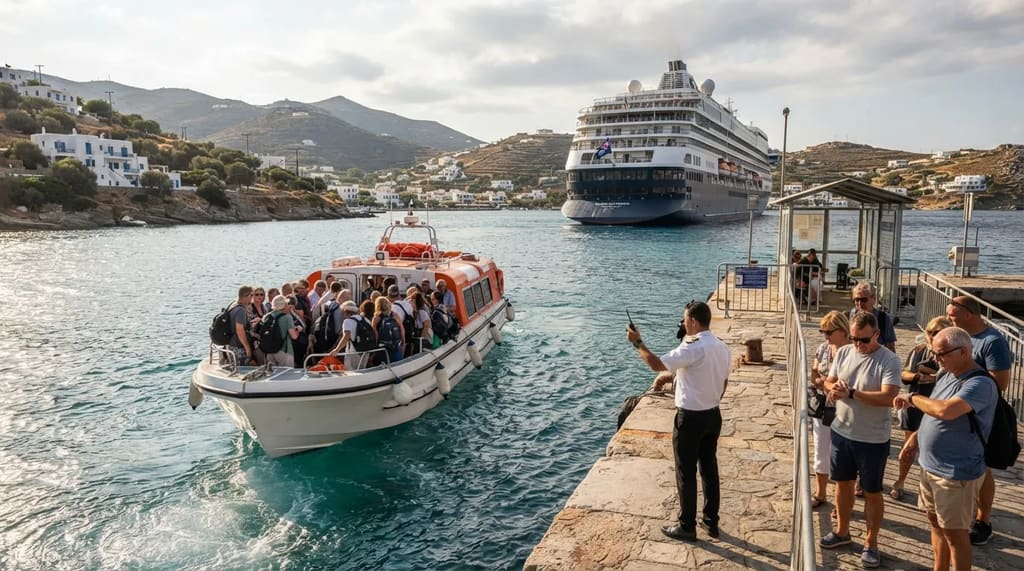
A tender port is one where the ship anchors offshore and passengers are ferried to land in small boats. In many ports, the final tender leaves well before the ship sails, so all-aboard is not always the number that governs your day.
Ask crew members what time the last tender leaves, then plan backward from that. Waits for the tender can reach 45 to 60 minutes at peak times, and that comes on top of the walk back to the landing.
Ship-sold excursions get priority tendering, which is a real advantage when the sight is far from the landing. A cruise-line tour is worth considering at a tender port when the main attraction is far away or you worry about getting back on time. If you are only strolling near the landing, I would not pay extra for it.
Tenders raise a harder question for anyone who walks slowly or uses a mobility device, and the port itself can look deceptively easy.
#5 – Judging a Port by How Flat It Looks
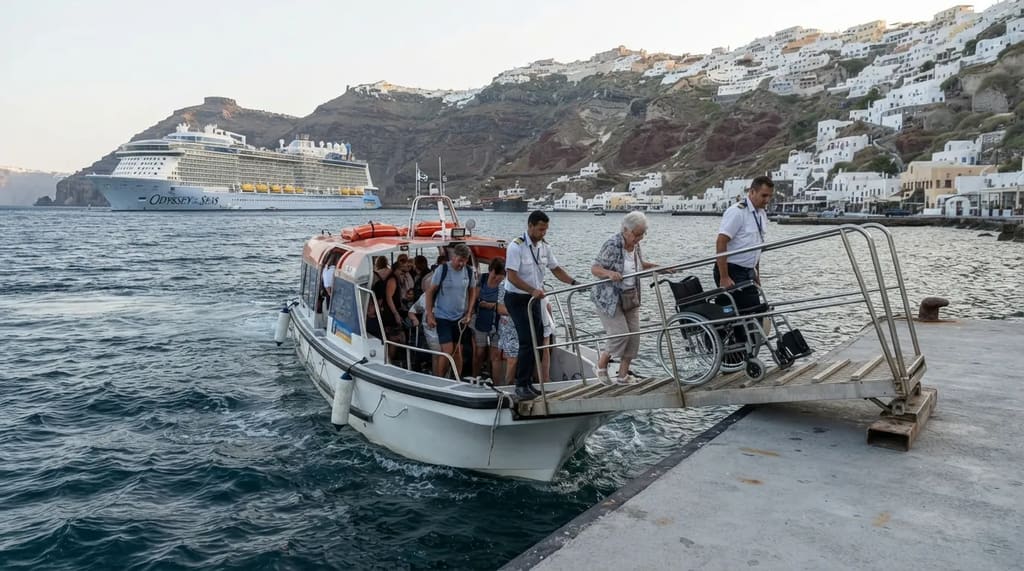
An accessible-looking destination does not guarantee an accessible tender day. For travelers with mobility concerns, tender ports can be more difficult than docked ports, which is worth knowing before you choose an itinerary.
Royal Caribbean says most of its tenders require steps and a collapsible manual wheelchair. Power chairs and scooters are generally possible only on roll-on tenders, and the captain makes the final decision. A port may also switch between a berth and tendering, so treat every tender call as conditional until the day.
That is why the order of your choices matters. One planner argues for choosing the port list first, the cabin second and the ship third, and says five docked ports with a plain ship beat four tender calls on a fancier one. If you use a wheelchair or scooter, I agree with that ranking. Ask the cruise line, port by port, before you book:
- Whether tender assistance is available for your specific device
- Whether the port might switch between dock and tender
- Whether the answer can be given in writing
Getting ashore smoothly still leaves you with a ship card, identification and medication to look after.
#4 – Leaving the Ship Without Contacts and Essentials

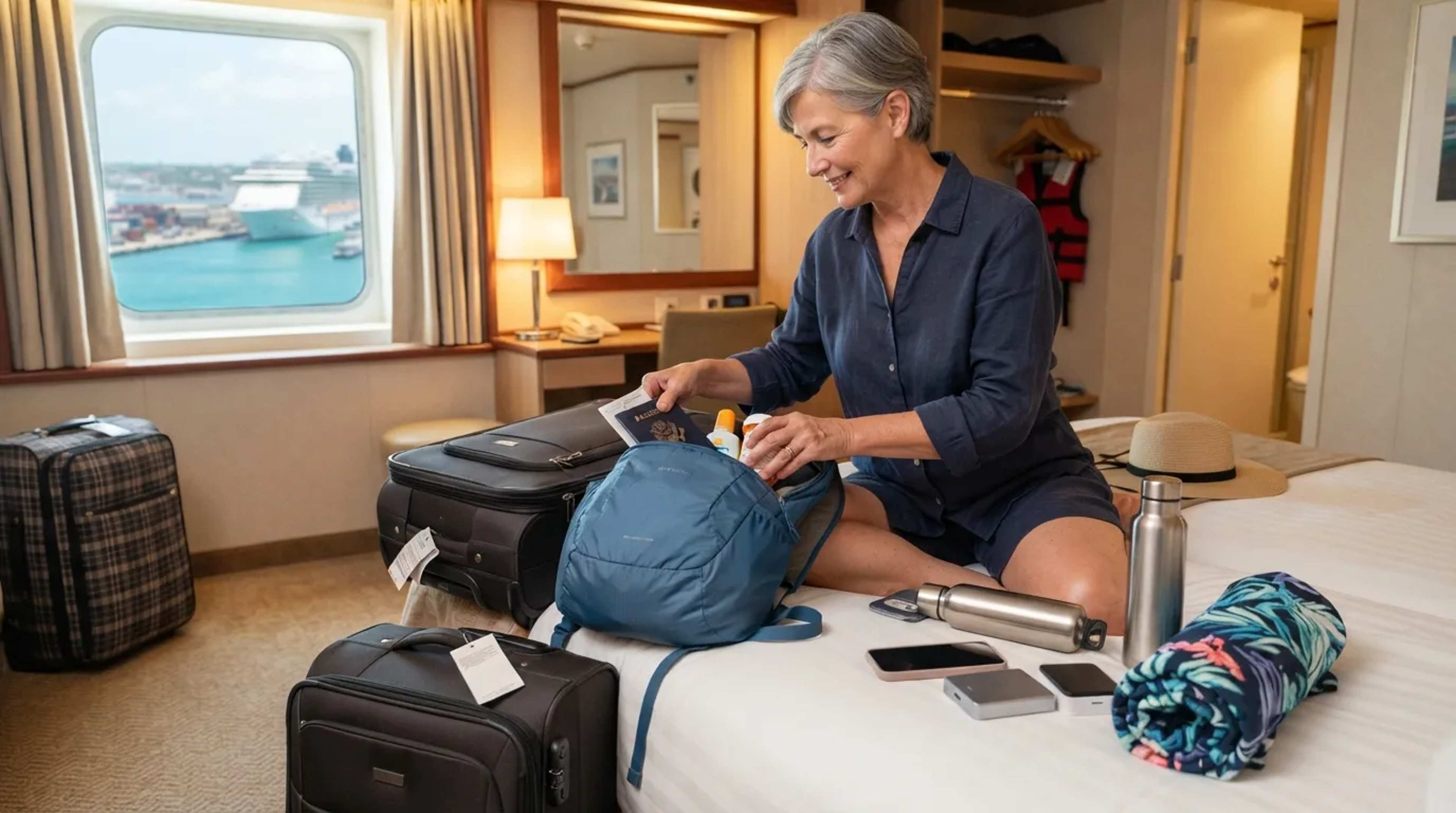
Keep your ship card, identification, essential medication, a mobility-device charger if you need one, and local contact details with you rather than in a vehicle or checked bag. A bag left in a tour van stays with the van, and the van may not be where you are when you need it.
Save the key details offline, since phone service abroad is not something to count on at the moment you need it.
Worth Knowing
- Port name and terminal
- Your ship’s name
- The port-agent number
- Your driver’s contact
- The local emergency number
Then there is one rule about timing. If you think you will miss all-aboard, call the ship or its port contact before the deadline, not after. Early notice gives the ship’s staff something to work with, while a call after sailing mostly gives them a report.
Calling early is a fallback. The better plan is a return time that never needs the call.
#3 – Scheduling Your Return Right Up to All-Aboard

Advice on the buffer ranges from 30 to 90 minutes before all-aboard. One guide suggests an alarm 90 minutes ahead, and more for a distant port or an independent excursion.5 The longer figures belong with independent tours, boat transfers and tender ports.
The reasons are ordinary. Traffic, weather, road closures and elevator outages can all eat time, as can a slower walking pace. These delays tend to arrive together, so a buffer that looks generous on paper is often used up.
I would take the long figure. Ninety minutes costs you a little sightseeing at the end of the day, while a close call can cost the rest of the cruise. Plan your day backward from all-aboard, not from departure.
- Find the all-aboard time in the daily program
- Subtract 90 minutes for the return to the pier
- Subtract the travel time, which tells you when the tour must end
Plenty of independent operators promise to get you back, though a promise and a held ship are different things.
#2 – Taking a Late-Return Guarantee to Mean the Ship Waits
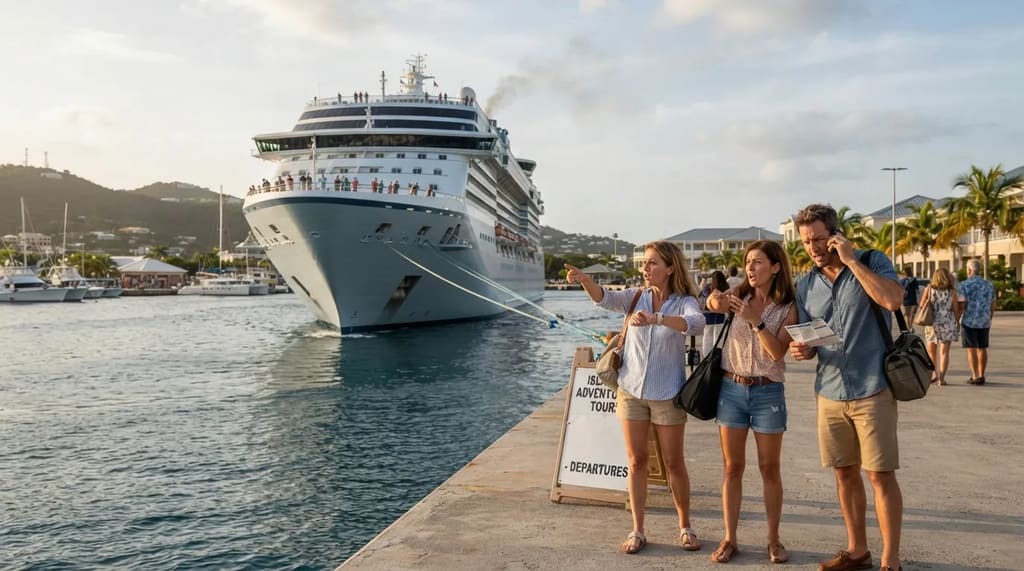
Some independent operators guarantee you will reach the ship on time or pay for you to get to the next port of call. That is a repayment promise. They cover your expenses to catch up if you miss the ship, but the ship does not wait.6
The wording to look for is a guarantee of return before the ship’s all-aboard time, naming your ship and date. A vague “we never miss a ship” does not say what happens when it fails, so ask exactly that.
Related Stories From Travelbinger



Confirm the guarantee in writing, with your ship name and date in the email. Treat it as protection for the bad day, not as a reason to book a tour that ends near all-aboard. The buffer from the previous item still applies.
The ship’s own tours carry a different kind of promise, one that holds the vessel at the pier.
#1 – Assuming the Ship Waits for a Tour You Booked Yourself
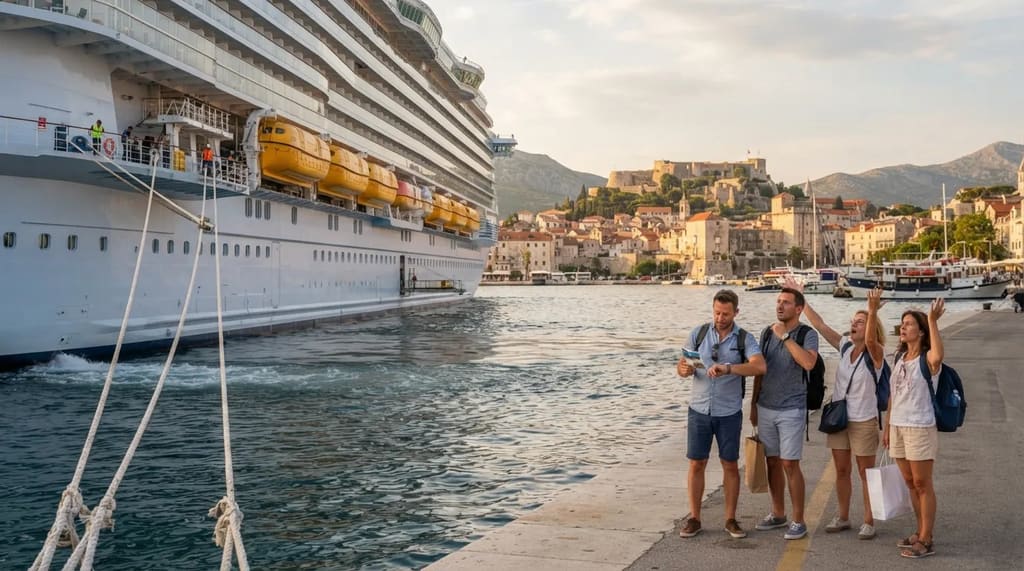
If an official ship excursion runs late, the ship waits. Independent excursions come with no such guarantee.5 6 The cruise line holds the ship for its own tours because it controls them, and once you arrange the day yourself, the job of being back before all-aboard is yours alone.
This is the hidden cost behind the lower price of an independent tour. If the tour runs late, the ship typically sails on schedule, and getting yourself to the next port at your own expense6 can dwarf whatever you saved. Unless travel insurance covers it, the bill is yours.
So the choice depends on the distance. At ports with long drives, boat transfers to smaller islands, or complicated logistics, booking through the cruise line is worth the premium for the ship-waits guarantee. For a beach or a walk near the pier, my view is that the independent price is fair.
- Pay the ship’s premium for long drives from the pier
- Pay it for boat transfers to smaller islands
- Pay it at tender ports where the sight is far from the landing
Plan the Day Backward From the Gangway

Most of the mistakes above come from treating the all-aboard time as the end of the day. It works better as the starting point, with the tour, the tender and the buffer all fitted in front of it.
That shift also settles the booking question. A tour is cheap only if it leaves enough room to be late, and a more expensive one can be the better value when the ship’s schedule will not move.
At the last port you visited, what time did you plan to be back at the ship, and how close did you cut it?
Bonus: The Two-Alarm Rescue Card Nobody Tells You About
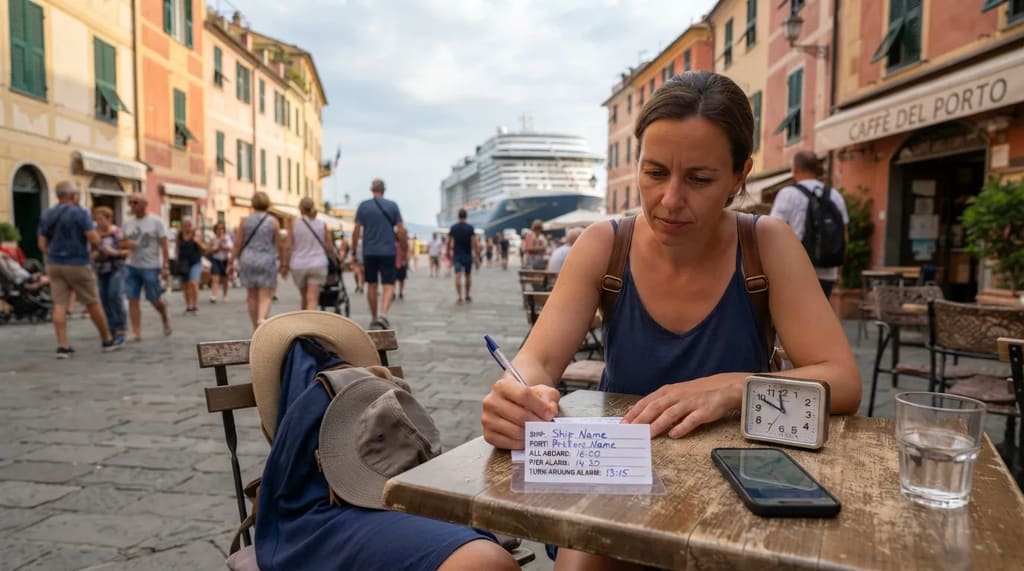
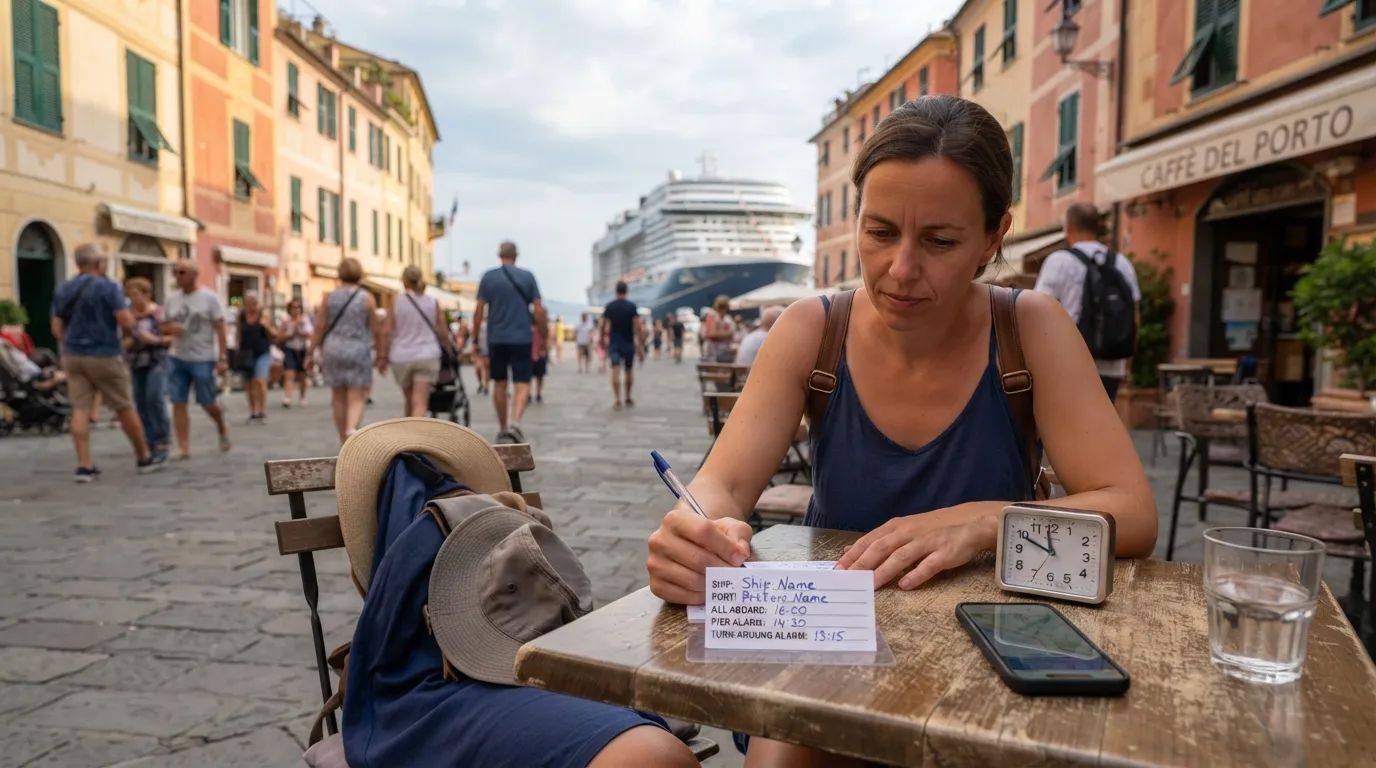
Most travelers set one deadline: the time they must be at the pier. The smarter habit is to set two, and to prepare a “rescue card” before you ever leave the ship.
Step 1: Set a turn-around alarm. This is the moment you must start heading back, no matter what you are doing. To find it, take your all-aboard time in ship time, subtract 90 minutes, then subtract your travel time to the pier (add tender wait time at a tender port).
Step 2: Set a pier alarm. Make it your all-aboard time minus 90 minutes, so you know exactly when you should be standing at the gangway or tender landing with time to spare.
Step 3: Write a rescue card. Put it on paper or in a screenshot that works offline. Include:
- Your ship’s name, the pier or terminal, and the all-aboard time in ship time
- The port-agent phone number, which is usually listed in the daily program or available from guest services
- Your cabin number and the ship’s emergency contact number
If it still goes wrong, call the ship or port contact before the all-aboard deadline, not after. If the ship has already sailed, go straight to the port agent rather than waiting at the pier. Carry your ID and ship card, and keep every receipt, because travel insurance claims depend on a paper trail.
Why it works: the turn-around alarm fires while you can still fix the problem, and the card means you do not have to find a phone number in a panic.
- Carnival Shore Excursion FAQs: https://help.carnival.com/app/answers/detail/a_id/2866/~/
- Carnival Shore Excursions: https://www.carnival.com/shore-excursions
- Points Guy Ship vs Independent: https://thepointsguy.com/cruise/ship-sponsored-vs-independent-cruise-excursions/
- All-Aboard Times Guide: https://travelbinger.com/16-things-nobody-warns-travellers-about-shore-excursions-until-they-book
- Missing Your Cruise Ship: https://cruiseportadvisor.com/what-happens-if-you-miss-your-cruise-ship/
- Excursion Guaranteed Return: https://www.goldencircledaytours.is/blog/shore-excursion-guaranteed-return