Picture 48 to 52 travelers on one motorcoach, and a rule that says nobody gets to keep their seat. On many escorted tours, that is how the week works. The daily shuffle, plus the lobby scene at the end of each drive, shapes how tiring a tour feels, and the fixes cost a few minutes or nothing at all.
Thirteen tips follow, the coach first and then the hotel desk. The cheapest one is a single phone question, and it decides whether several of the others even apply to you. Start with the seat you grab on boarding day, because it is worth far less than it feels.
#13 – Your Boarding-Day Seat Lasts One Day

On many motorcoach tours you choose a seat on the first morning, and the rotation starts from that choice. TLC Tours, for example, lets you pick when you board and then moves you up one seat each day.1
Coach USA’s Van Galder tours go further. They require all passengers on tours of three or more days to take part in daily rotation. If your trip runs that long, plan on moving.
So skip the sprint for the front window. Arriving on time matters, but hurrying to claim the prize seat buys you one morning and nothing after it.
The rotation follows a pattern, though, and the pattern is not the same from one company to the next.
#12 – How Far the Rotation Moves You Each Morning

Each company sets its own step, so a rule you learned on one trip may not hold on the next. Three operators describe three different systems:
Sunshine also reserves the front seat opposite the driver for the Tour Director, so that seat never comes around to you at all.
On the second morning, ask the director which way and how far the rotation goes. Then work out your next few seats at breakfast, so you board quickly and hold up fewer people.
Tomorrow’s seat still leaves the departure time to deal with, and coach tours treat that as fixed.
#11 – Fifteen Minutes Early at the Coach Door

Pieter on Tour, a coach-tour company, tells first-timers that when the guide announces a departure time, the wheels turn at that time. Their advice is to be at the coach 15 minutes early.2
On a rotation morning you also have a new seat to find and a day bag to stow. The cushion pays for itself even if you are never late.
If mornings are slow for you, set the alarm earlier instead of counting on the group to wait. A coach will wait once, but each wait comes out of the day’s sightseeing.
#10 – The Light Jacket Worth Keeping Within Reach

The driver sets the temperature for the whole coach, and nobody gets a personal thermostat. Van Galder’s tour policy admits that a temperature comfortable for everyone is difficult to maintain, and suggests a light jacket.
Rotation adds a second variable. Coaches have large panoramic windows, so a window seat in afternoon sun feels nothing like a seat under a cold vent. A seat that looks perfect in the morning can feel like a different climate zone by midday.
Worth Knowing
- One temperature setting serves the entire coach.
- Sun-warmed window seats and vent-chilled seats can sit only a few rows apart.
- A layer that goes on and off easily beats a request to change the setting.
That is one small benefit of rotating, since you will not be stuck in the same spot all week. Adjusting your own layers is simpler than asking the driver to change the setting, because the setting has to suit everyone.
A chilly seat is a nuisance, but a swaying one is a real problem for travelers who get queasy, and seat position matters most there.
#9 – Seats That Calm an Unsettled Stomach
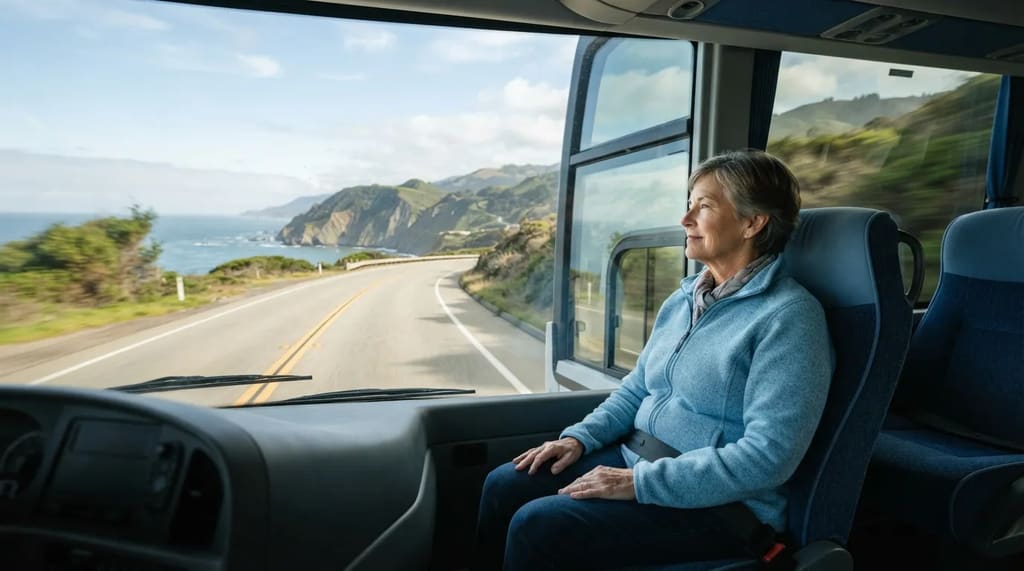
Motion sickness starts as a mismatch: your inner ear feels the bus move while your eyes, fixed on a seatback or a phone, report a still world. Seats with a clear view of the road ahead help your eyes and inner ear agree.3
- Best: the front third, roughly over or just behind the front axle, by a window, facing forward.3
- Acceptable: the middle of the bus, over the rear seats.
- Worst: the back, since uneven roads shake the rear seats much more than those up front.
Reading and screens can make motion sickness worse, so save them for rest stops. Under a one-seat-a-day system like TLC’s, you pass through every row, so the back rows will come around.
Don’t sit through that to be polite. Tell the director on day one, because Go Ahead Tours asks travelers with considerations such as motion sickness to let the Tour Director know. Whether the answer is yes depends on the company’s policy.
A good seat does little for the traveler who needs something from a bag that is stored beneath the coach.
#8 – The Day Bag That Rides With You
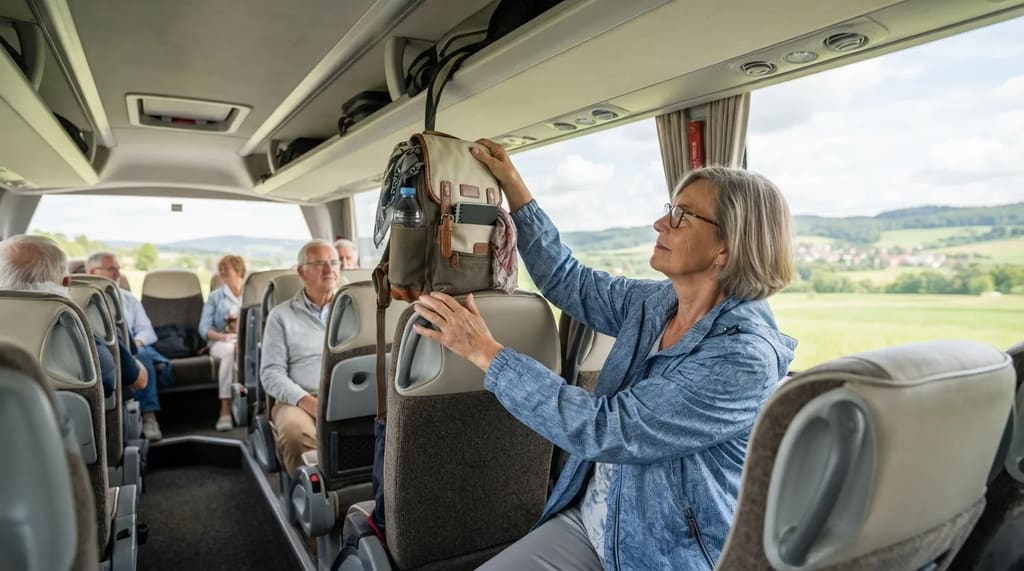
Go Ahead Tours tells travelers to pack a small day bag with essentials for longer bus rides, because large luggage is stored under the bus.
At a Glance
- Medications
- Glasses
- Water and a snack
- Your light jacket
Mayflower asks passengers to remain seated while the coach is moving and, if they must move, to hold on to the seatbacks. It also asks for care when removing carry-on bags from the overhead rack.
Rotation means you carry the bag to a new seat each morning, so weight matters twice. A bag you cannot lift down comfortably with one hand is better kept at your feet.
#7 – What to Tell the Tour Director on Day One

On a coach where seats are not assigned, the director cannot adjust for a need that nobody mentions. Pieter on Tour says travelers with mobility concerns should tell the tour director, who can often accommodate special seating needs.
Sunshine Tours goes further. It asks to hear about health concerns needing special attention, and about equipment such as a walker, wheelchair, scooter or oxygen. A short list is enough:
- Motion sickness or a need for the front rows
- Stiff knees, or trouble with steps and a preference for the aisle
- Any equipment that needs storing or extra time to board
Say it once, plainly, on the first morning. A need raised on day one becomes something the director can plan for, while the same need raised on day four sounds like a complaint.
Arrival at the hotel brings its own instructions, usually given once and to the whole group at the same moment.
#6 – Listening When the Keys Are Handed Out

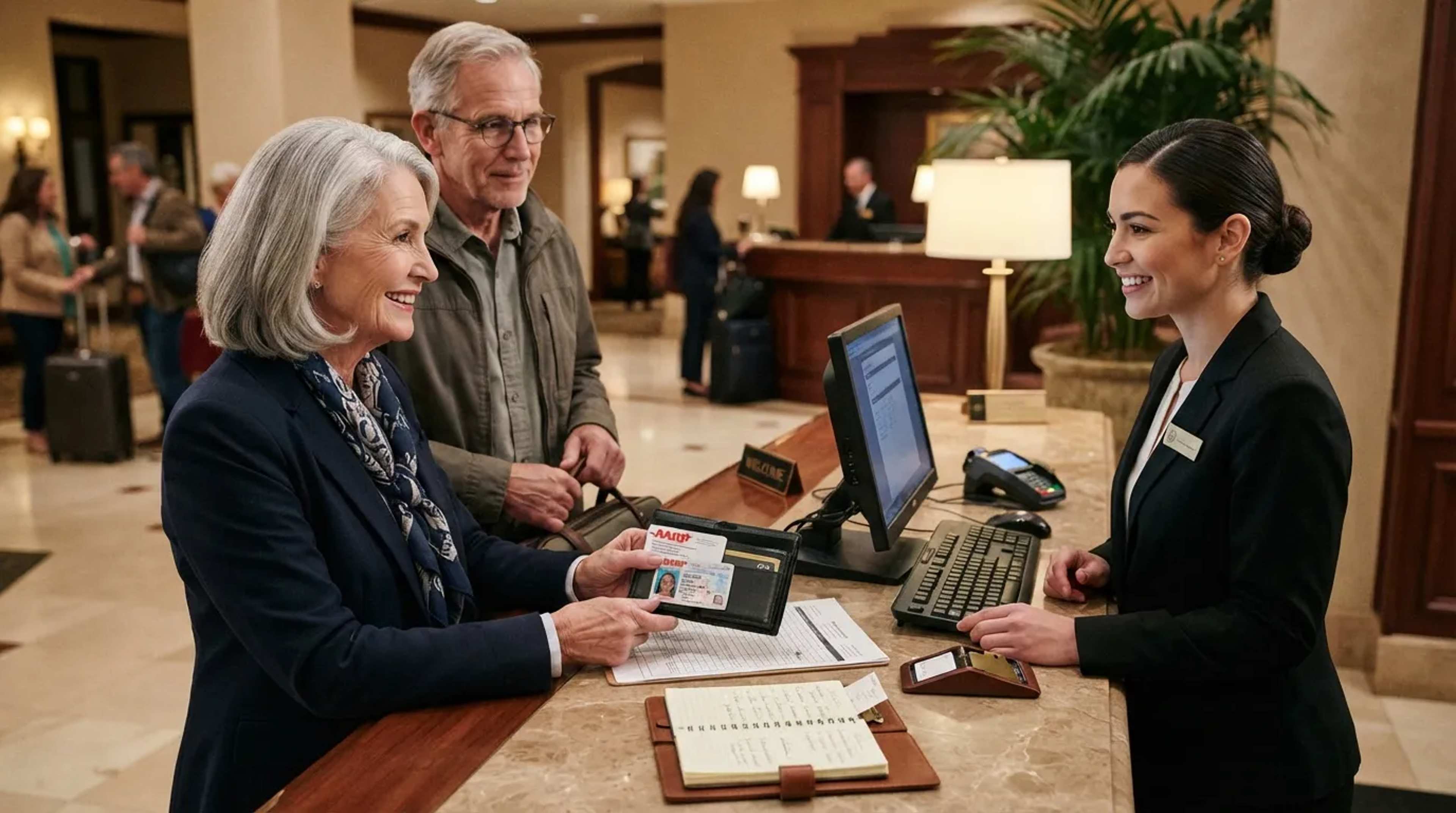
Many hotels that take coach groups prepare ahead. One group-arrival standard calls for key envelopes ready two hours before the coach and the group checked in away from the main desk, in its own area.
The goal is speed. A booking guide for tour leaders sets a five-minute key handout on the coach against a 45-minute lobby line, which is why the instructions come once and fast.
Fast Facts
- Key envelopes ready: two hours before the coach arrives.
- Check-in spot: a separate group area, not the main desk.
- Key handout on the coach: about 5 minutes, versus a 45-minute lobby line.
Group-tour operators ask travelers to listen carefully to the instructions for key pick-up and retrieving luggage. If you sit far back, tell the director you could not hear and ask for it again.
Write down your room number and floor, along with the director’s. On some tours the leader shares his own room number so he is easy to contact in an emergency.
Once you hold a key, the next job is getting your bags to match it.
#5 – A Tag on Every Bag Before It Leaves the Coach

A hotel group-arrival standard has every group bag tagged with a room or surname at the coach. A traveler guide from a European operator tells you to identify and tag your baggage with the room number.
What happens next depends on the tour. At some hotels you carry your own luggage to the room, and at a few the bell staff bring the larger bags.
That is why porterage deserves a question before you book. A booking guide notes that unlisted porterage shows up on the master bill at whatever the bell desk charges, so ask whether handling is included in the price.
If it is not, pack for the stairs. A bag you can lift up one flight is worth more than the extra pair of shoes you left home.
A tagged bag settles where the luggage goes and leaves the key card in your pocket, which is easier to ruin than it looks.
#4 – Keeping the Key Card Working and Accounted For
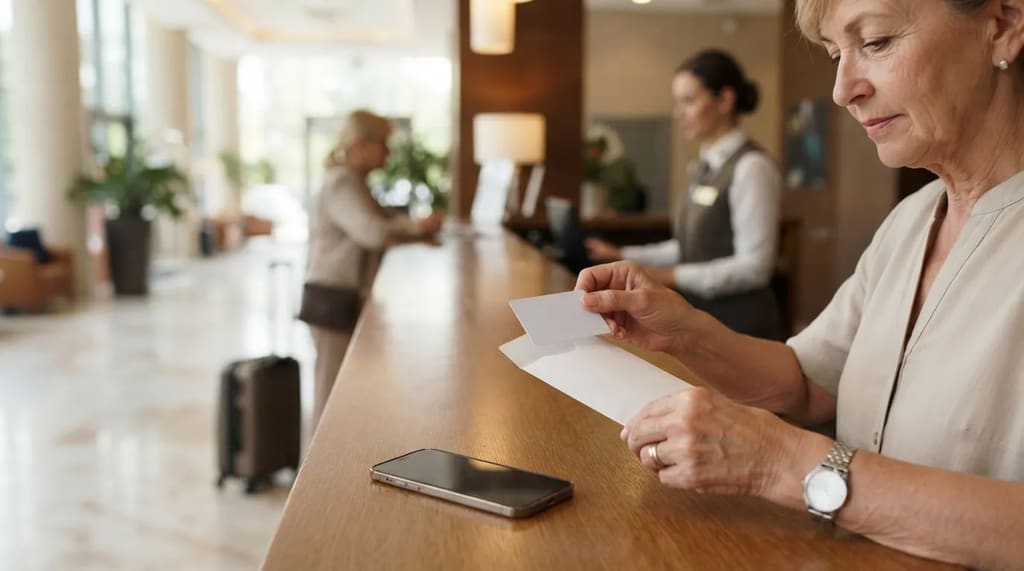
One group-travel guide warns that a key card that gets wet or sits next to a cell phone may lose its program and have to be reprogrammed or replaced at the desk.
Quick Compare
- Safe habit: keep the card in its paper sleeve, in a pocket apart from your phone.
- Risky habit: let it get wet or ride beside your phone, and it may need replacing.
- If it goes missing: tell your group leader right away.
The leader will go with you to the front desk for a new key. A hotel-safety checklist written for student groups adds that an unreported missing card leaves a room exposed to anyone who finds it.
The same logic applies to adults. Do not wait until bedtime to report a lost card, and ask the desk to deactivate the old one when they cut the new one.
#3 – Room Requests That Have to Go In Weeks Early

By the time the coach pulls up, the rooming list is already set. One hotel standard has staff check it line by line 48 hours before arrival, covering names, room types, bed set-ups, shares, access needs and dietary notes.
So a request for two beds, a room near the elevator or a ground-floor room is a booking-time request. Ask for it at the desk after the list has been checked, and you are asking a hotel to undo planning it considers finished.
Related Stories From Travelbinger



- Bed type, one large bed or two
- Access needs, such as steps or distance to the elevator
- Dietary notes, since the same list carries them
Put these in writing when you book, just as you would tell the director about motion sickness on the coach. A spoken request in a crowded lobby is the easiest one to lose.
Even a well-planned room leaves the question of where your passport and cash spend the night.
#2 – Valuables, Passports and the Room Safe Code
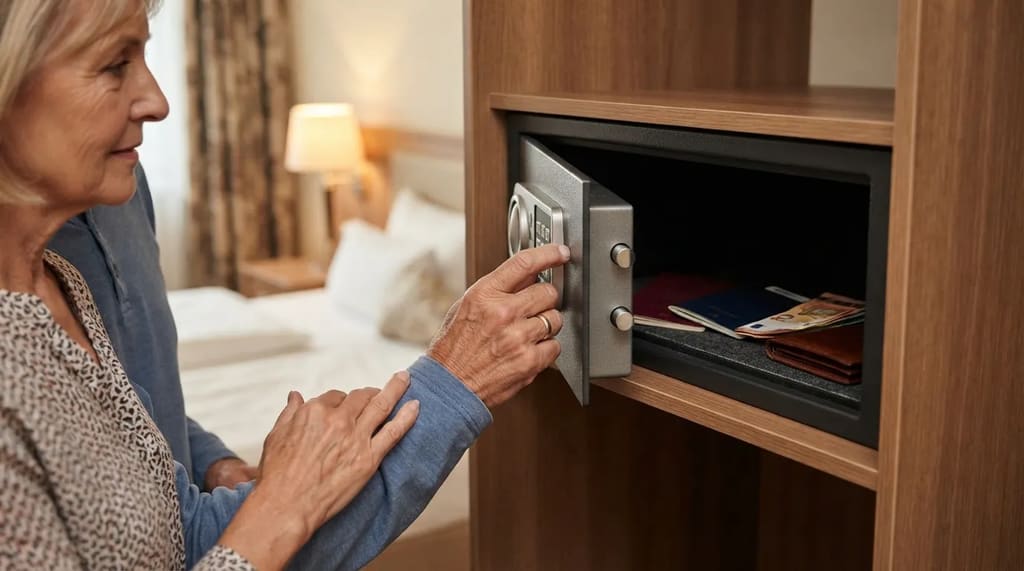
A European operator’s traveler notes say to keep no money or valuables in your checked luggage. That matters because a tagged suitcase may be carried by a bellhop and sit unattended in a hallway or lobby.
The room safe is the usual answer, and it brings its own risk. The same notes tell you to reset and remember your safe code, since arranging a duplicate key costs $50 to $300.
Pick a number you can recall without your phone, and do not write it on the same paper as your room number. If you share a room, make sure both of you know it.
All of this works under whatever rules your tour company has set, and those rules differ from one company to the next.
#1 – Asking About Seat Rules Before You Pay

Companies handle exemptions very differently, and the difference can decide what a hard seat problem costs you. Mayflower considers exemptions only for passengers who provide a doctor’s note. Others are far stricter:
- Sunshine Tours: everyone must rotate seats, with no exceptions.
- TLC Tours: it cannot accept doctor’s notes for front-seat requests, and suggests boarding at the first pickup location if seat location is a concern.
- Van Galder: no special requests for seats will be honored.
That changes the plan for the queasy traveler in the motion-sickness tip. Someone counting on a front seat after one word with the director may meet a firm no on a tour that rotates without exceptions.
Booking is the moment your money is committed, so it is the moment to ask. If you have a real need, give the rotation policy more weight than the itinerary or a modest price difference.
A phone call costs nothing, and it is the one item here that can change the rule itself instead of how you handle it.
A group tour runs on rules that were set before you arrived: the rotation pattern, the rooming list, the key envelopes. Your leverage is greatest early, when you can still choose a company, send a note or speak to the director on the first morning.
Late in the trip, the same request tends to sound like a complaint. Most of these tips are small, and each one gets harder to fix the later you try.
On your last group trip, what was the first thing you wished you had told the tour director?
- TLC Tours Seating Policy: https://www.funwithtlc.com/tour/dup/
- Pieter on Tour Etiquette Guide: https://www.pieterontour.com/european-coach-tours/first-time-on-a-coach-tour-a-guide-to-daily-life-etiquette-and-seat-rotation/
- Bus Seat Motion Sickness Guide: https://dizzout.com/blog/where-to-sit-on-a-bus-to-avoid-motion-sickness