Federal rules require airlines to give some passengers a specific seat, but the guarantee comes with a clock that no boarding pass mentions. Miss it, and you may take whatever row is left, with a fixed armrest, a long walk to the lavatory or a tray table you can’t move.
These 14 requests run from soft favors to firm rights, and the gap between the two can decide your row. Stay for the last one, which is the sentence to say, and the person to ask for, when an agent tells you no. First comes the softest favor on the list.
#14 – The Aisle Seat for Easy Getting Up
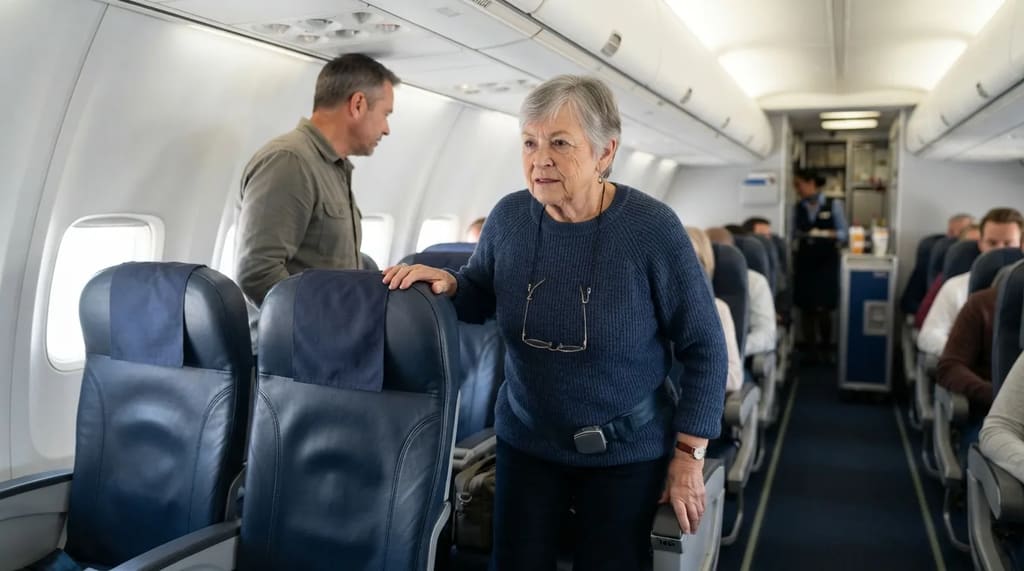
The aisle is the easiest seat to ask for, and it comes with a bill paid in small interruptions. If you stand up often for a stiff knee, a medication schedule or frequent lavatory trips, request it at check-in while the seat map still has choices.
An aisle seat means standing every time a seatmate needs out. You can also get bumped by beverage carts and passing passengers. That’s the trade for leaving your row whenever you like.
If you rarely get up, the aisle is overrated, because you collect the bumps and never use the freedom. A window seat you can settle into is the better ask on a short flight with no lavatory trip planned.
Getting out of your seat is one thing. Where you sit in relation to the lavatory is another, and being too close can be worse than being too far.
#13 – A Seat a Few Rows From the Lavatory
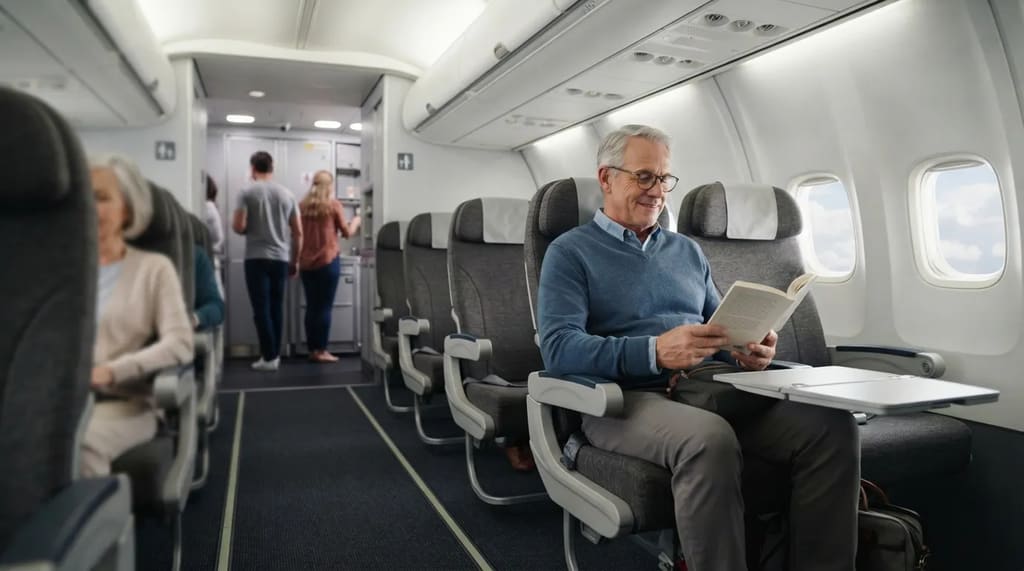
The seat beside the lavatory saves steps and costs you rest. Lines form in the aisle, the door opens and closes for the whole flight, and the light and noise don’t stop when you’d like to doze.
Ask for a seat a few rows from the lavatory rather than beside it. You’ll be near enough to reach it without a long walk and far enough to stay out of the queue.
Most seat maps mark the lavatories with a symbol, so you can look before you ask. Tell the agent you’d like a few rows back and let them pick the seat, since they can see which rows are open. If you need to go often, this request pairs well with the aisle seat.
Seat maps show only the seats still for sale. They don’t show the empty row the gate agent can see on the screen and you can’t.
#12 – The Empty Row When the Flight Isn’t Full
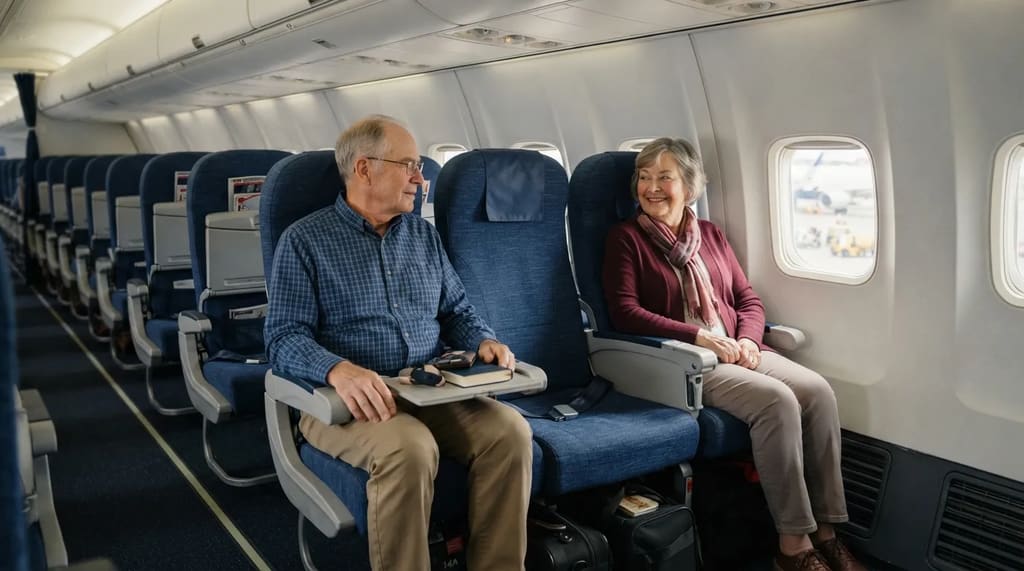
This request depends on a screen you never get to see. Near departure, the agent can tell how full the flight is, and on a light flight a seat with an open neighbor is a fair thing to ask for at the desk.
It’s a favor, though, not a right. The softer requests, like the empty middle seat, depend on the flight and the staff. Ask before boarding, because after boarding the agent can’t help you.
Treat it as a bonus and nothing more. The empty middle seat is the most overrated request on this list, because an agent can decline it without citing any rule, and a flight that fills up leaves you with nothing to fall back on.
Seats are only half of boarding. A good seat is hard to reach if you’re pushing through a crowd on the jet bridge, and that problem has its own request, separate from the wheelchair booking some travelers assume covers it.
#11 – Preboarding Requested at the Desk and the Gate
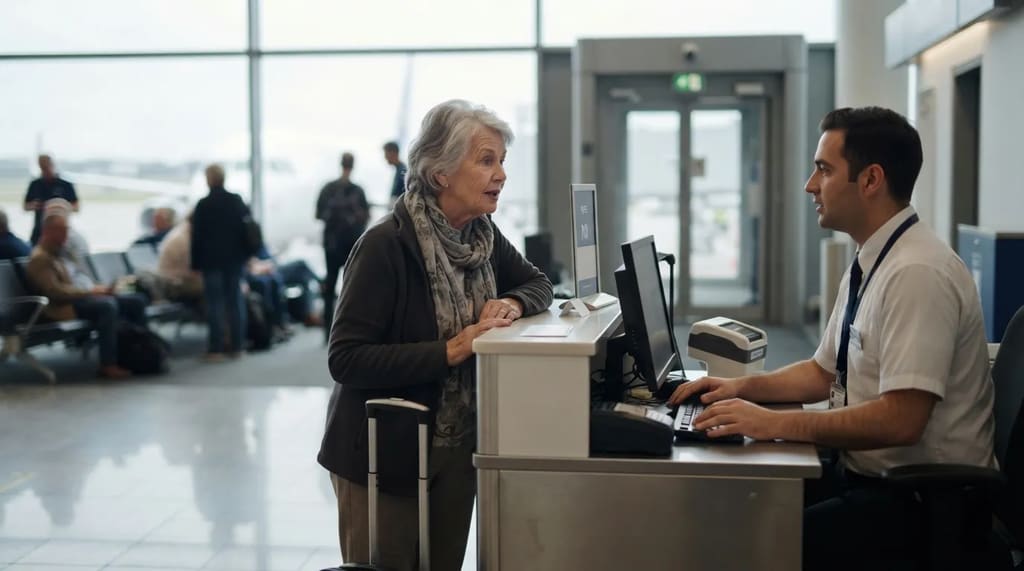
Booking wheelchair help doesn’t mean you’ve asked to preboard. The two are separate requests, and an agent who sees only one on the screen has no reason to call you forward early.
Federal law requires airlines to offer preboarding to any passenger who needs extra time or assistance getting to a seat.1 Say the word preboard at check-in and again at the gate. Airlines are required to make a boarding announcement for passengers who need extra time or assistance.
You don’t need a wheelchair to qualify, because the test is needing additional time or assistance to board. No documentation is required.
At a Glance
- Wheelchair booking: arranges help getting around, but doesn’t by itself ask for early boarding.
- Preboarding: a separate request, so say it at check-in and again at the gate.
- Who qualifies: anyone who needs extra time or assistance to reach a seat.
- Paperwork: none required.
If you fly Southwest, advice about slipping in between boarding letters belongs to the open-seating era. Assigned seating began there in January 2026, and the airline has no special boarding for seniors, so the need-based request is the one that applies.
Boarding first gets you to your seat without a crowd. Then comes the row everyone calls the best in coach, the one with nothing in front of you and a storage problem you’ll notice at takeoff.
#10 – The Bulkhead Row, Only With a Reason
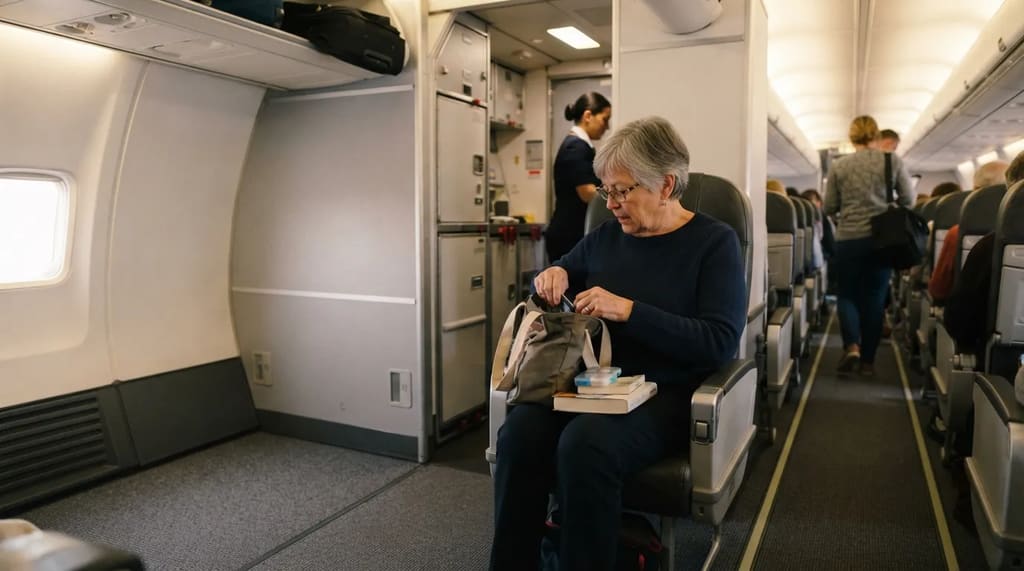
The bulkhead row has no seat in front of it, which also means no under-seat storage. Your larger bag goes overhead for takeoff and landing, so pull out your glasses, pills or reading material before you sit down.
The tray table is stored in the armrest, so the armrest is immovable. That makes climbing out of the seat tighter, and lavatories or a galley often sit right in front of the bulkhead, so lines and crew can gather beside you. You’re back to the lavatory queue from earlier.
- Bulkhead: open floor space ahead, but bags go overhead during takeoff and landing.
- Standard aisle row: less stretch room, but a bag, cane or medication can sit within reach.
Choose the bulkhead only when you have a medical reason or a service animal. If extra legroom eases circulation problems on a long flight, it can be worth the trade. Without a condition like that, the bulkhead is overrated for an ordinary trip.
Legroom has rules attached everywhere, and the row with the most of it has the strictest. It’s a seat you can be asked to give up even after you’ve boarded.
#9 – Moving Out of an Exit Row You Can’t Staff
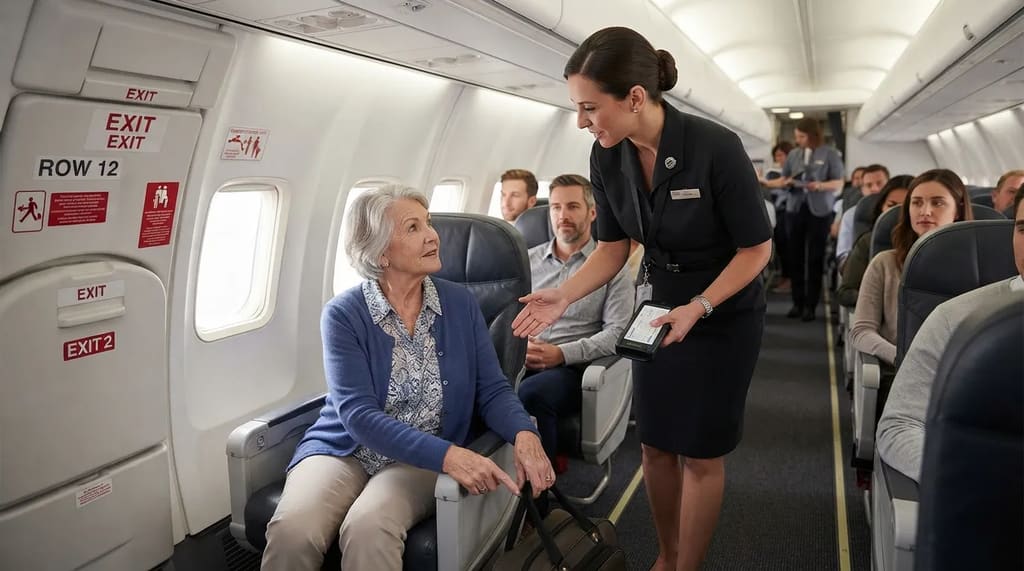
Asking to leave a seat is the one request on this list that agents welcome. Federal exit-row rules are built around whether a passenger can perform emergency tasks, such as operating the exit and helping others.2
Exit-row rules turn on what you can do. Age doesn’t enter into it. Crews are expected to reseat anyone who can’t perform those tasks, and a move can happen even after boarding. A word at check-in beats a public reshuffle at the door.
Don’t try to get around the rule. Framing an exit-row request as a disability accommodation won’t work, and it can undermine the conversation about seats you do qualify for.
The legroom has a cost, too. You can’t recline in an exit row, and some airlines restrict what you can store under the seat in front. If you have any doubt about lifting a heavy door or reacting fast, skip the exit row, whatever the legroom.
Leaving a seat you can’t staff is a change you choose. A different change, the one you didn’t ask for, can cancel a seat you already hold: a swap of aircraft.
#8 – A Seat Request That Survives an Aircraft Swap
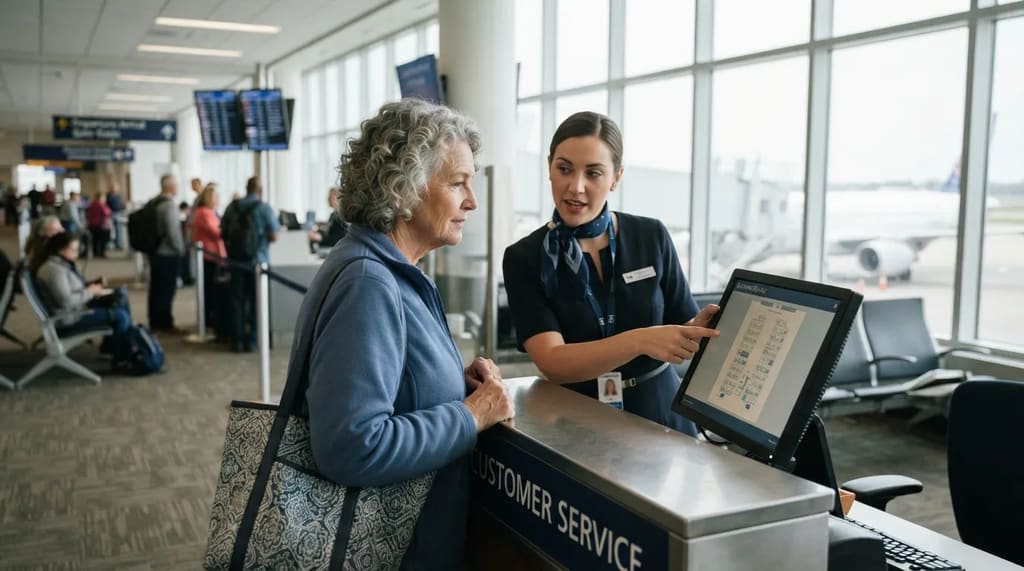
A change of aircraft can erase a seat you were promised, and the gate is where you find out. A seat that fit on one plane may not exist on another.
If you gave the airline advance notice and received a seat assignment, your request should transfer to the seating map of the replacement plane. The airline may not guarantee the exact same seat, but the new one should offer the same level of accommodation.
Ask the agent whether your accommodation moved to the new seat map. Do it before you walk to the new gate, not after you sit down.
The same logic holds after a cancellation. If you’re forced onto another flight, the airline must provide the accommodation on the new flight to the maximum extent feasible.
A swap changes the map. It doesn’t change who is supposed to sit beside you, and that seat has to be requested too.
#7 – The Seat Beside You for a Helper
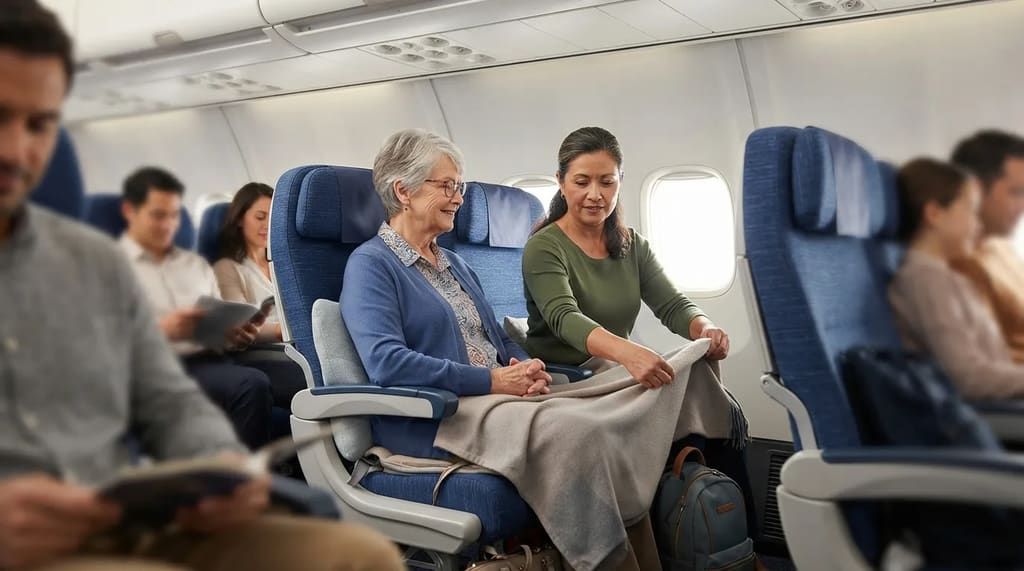
A caregiver doesn’t get the seat next to yours just because they’re a caregiver. The rules name two roles, and the request has to match one of them.
- A personal care attendant who performs a function airline personnel aren’t required to perform, such as helping a passenger eat.3
- A safety assistant, if the passenger can’t assist with their own evacuation.
Request the adjoining seat by name when you ask for assistance. The companion seat is not always blocked automatically, so don’t assume it’s attached to the wheelchair booking from the previous item.
A spouse across the aisle doesn’t meet the rule. Say which of the two roles fits, and say adjoining seat in the same sentence.
Worth Knowing
- Being a caregiver isn’t enough on its own. The helper has to fit one of the two named roles.
- The seat has to be adjoining, so across the aisle doesn’t count.
- Check that the companion seat is actually blocked before travel day.
#6 – The Service Animal’s Seat, Your Choice
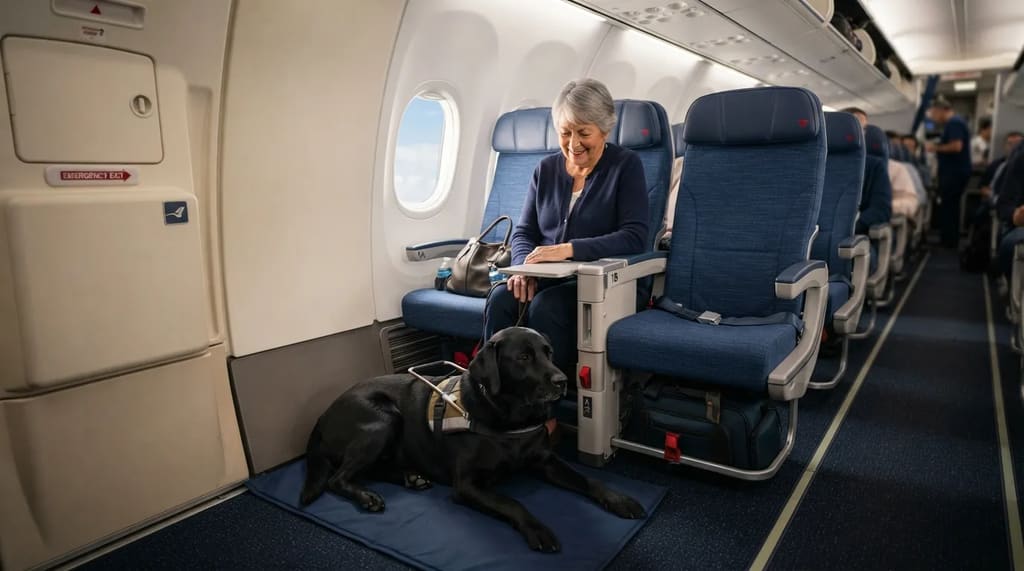
Many travelers assume a service animal goes to the bulkhead automatically. The airline must provide either a bulkhead seat or a seat other than a bulkhead seat, as the passenger requests.3
That choice is yours because handlers differ. Some prefer a bulkhead for floor space, while others want a regular row where the animal can tuck in at their feet.
Tell the agent which you want: bulkhead or regular row. Say it at booking or check-in, before the remaining seats are whatever is left, and expect the agent to ask how the seat suits you and the animal.
Choosing the seat is your right. Paying for it shouldn’t be part of the deal, and the fee screen is where travelers go wrong.
#5 – The Extra-Legroom Fee You May Not Owe
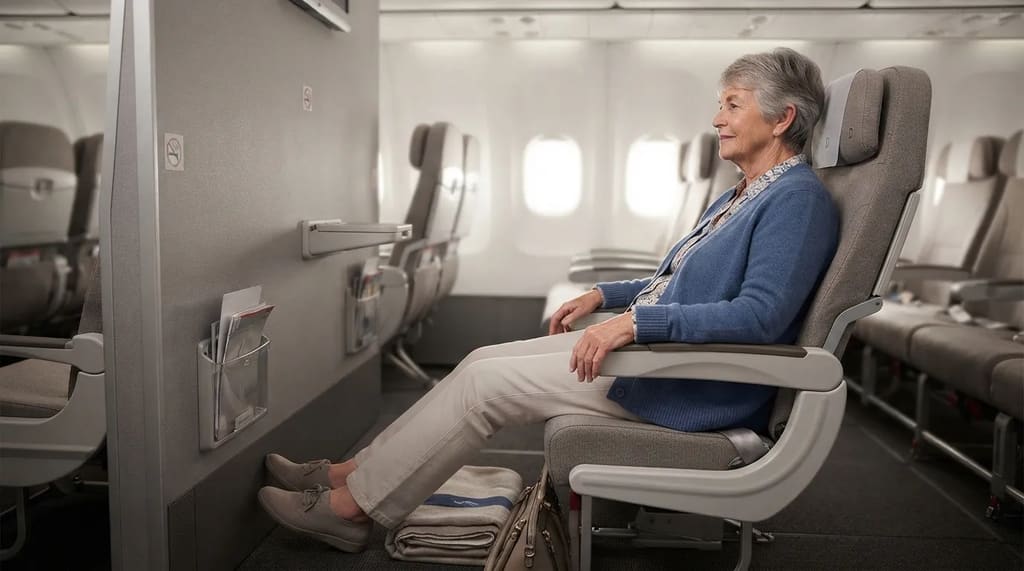
A bulkhead seat that carries a fee online can be free at the desk, if you qualify. Required seating accommodations for qualified passengers with disabilities must be provided free of charge.
If the only suitable bulkhead seat is normally sold with a fee, the airline is required to assign it free. Call and state the medical reason before you pay any seat fee.
The clearest case is a fused or immobilized leg. The airline must offer a seat with greater legroom, including an aisle or bulkhead seat, and on the side of the aisle that better fits the disability.
This covers a qualifying need. A taste for legroom doesn’t count, and the exit row is excluded, as covered earlier. Bulkhead drawbacks still apply, so ask for a seat with greater legroom and see whether the agent offers a regular row.
Fast Facts
- Cost: required accommodations are free for qualified passengers.
- Clearest case: a fused or immobilized leg.
- Seat options: greater legroom, including an aisle or bulkhead seat, on the side that fits the disability.
- Not covered: the exit row, and legroom as a simple preference.
Legroom is one kind of need. Boarding itself can be another, and the hardware that solves it is built into the armrests of the aisle seats.
#4 – The Movable Aisle Armrest
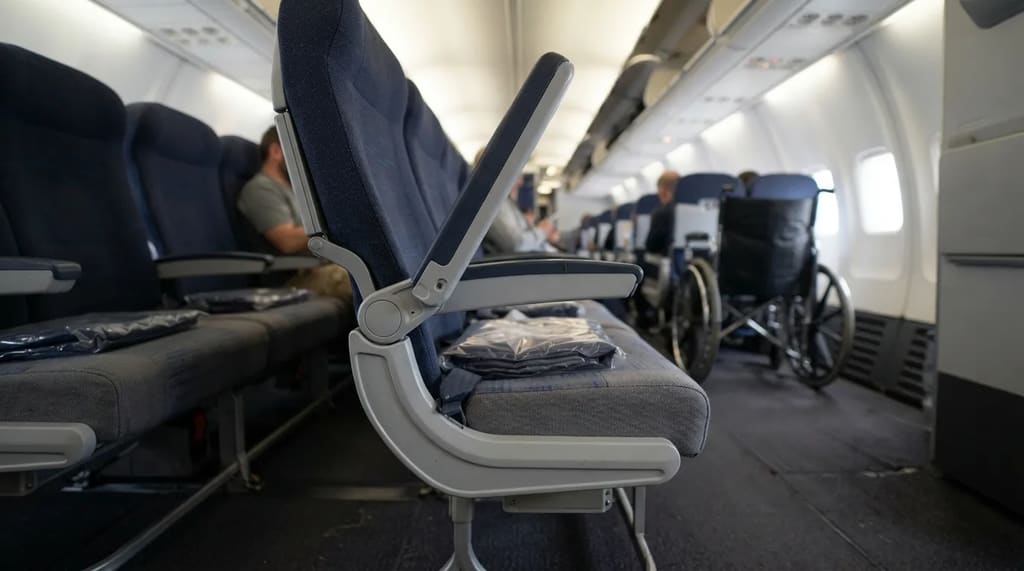
An aisle chair can’t roll past a fixed armrest, which is why some aisle seats are built with one that lifts. The request is specific, so it helps to know whether it’s yours.
It’s for a passenger who uses an aisle chair to board and cannot transfer readily over a fixed aisle armrest. If you board on foot with a cane or walker, this isn’t the right request.
Airlines must provide a seat in a row with a movable aisle armrest, and those seats must be clearly identifiable. Airlines must also give you the specific location of those seats.4
Ask the agent to confirm your assigned row has a movable aisle armrest. Ask them to double-check that the assigned seat actually has one, because an aircraft change can alter the row.
#3 – A Seat for Needs the Rules Don’t List
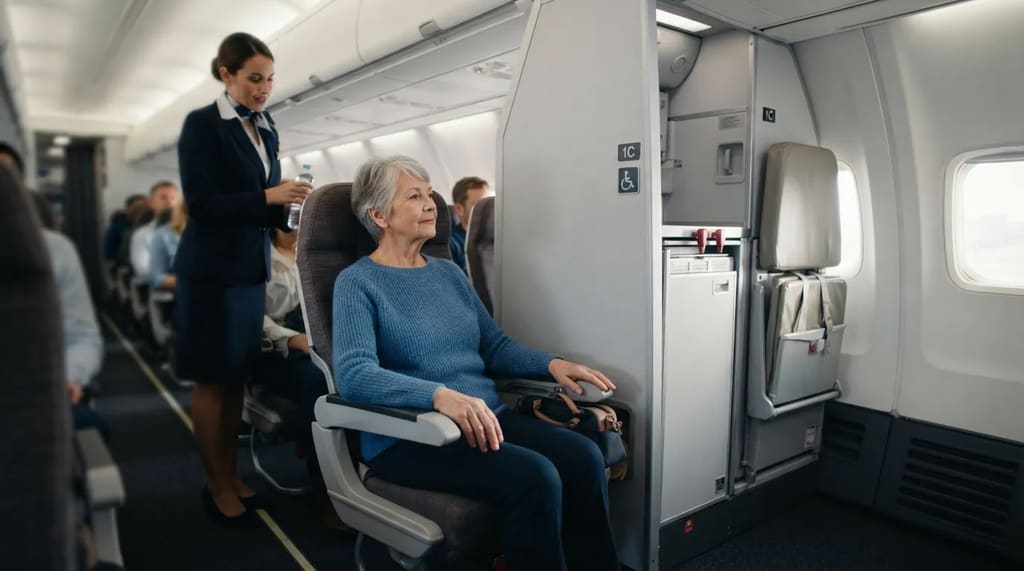
The named categories aren’t the whole list. A carrier must provide a seating accommodation to a passenger who self-identifies as having a disability outside the listed categories and needs a seat assignment to use air travel services.
That includes seats that aren’t for sale. Airlines must assign a seat that accommodates the passenger’s needs, even if the general public can’t book it at the time of the request.5 Examples include an aisle seat or a bulkhead seat.
Related Stories From Travelbinger

If your need isn’t listed, the airline must still assign the seat that fits it. Describe what you can’t easily do, such as climbing over a seatmate or standing from a low seat, and then name the seat.
That turns the aisle seat from the top of this list into more than a preference. It has a catch, though: airlines may require you to check in one hour before the standard check-in time.
A right with a clock on it is only as good as your timing. Show up late, and the airline owes you less than you’d expect.
#2 – The Deadline That Turns a Right Into a Favor

Two clocks run on every seat accommodation, one at 24 hours before departure and one at an hour before the airline’s standard check-in time. Beat both and the seat is yours by rule. Miss them and it becomes a favor.
Airlines using the block method hold the seats back. If you don’t ask at least 24 hours before departure, the airline must meet your request to the extent practicable, but it needn’t move a passenger already assigned to that seat.
The priority method works differently. The airline may require you to check in and request the accommodation at least one hour before the standard check-in time, and if you’re later, it must do its best but needn’t reassign a seat already given away.
- If seats are assigned only on the day of the flight, the priority method applies.
- If all designated priority seats are taken, the airline must reassign other passengers to provide yours.4
Ask at booking, then check in an hour before the standard check-in time. Early requests also give you time to fix a wrong answer.
Every right so far depends on how the request is worded. The final item is the sentence that works, and the person to ask for when an agent says no.
#1 – The Words That Count More Than Your Age
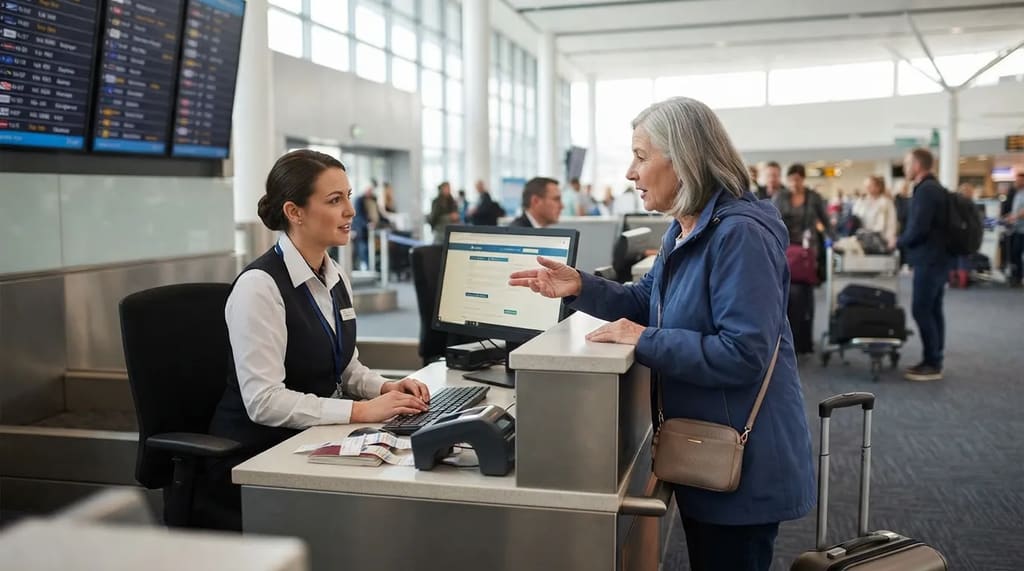
The seating rules the Department of Transportation enforces are written around needs, not birthdays. Southwest, for one, has no special boarding for seniors. Being over 65 may earn you a courteous agent. A stated need points the agent to a rule.
State the need, name the seat and name the timing in one sentence. Here’s the pattern:
- The need: what you can’t easily do, such as climb over a seatmate or sit with a leg bent.
- The seat: aisle, bulkhead, movable armrest or adjoining seat.
- The timing: when you booked, and that you’ve checked in on time.
There’s no medical certification requirement to request a wheelchair space or boarding help. Compare that with the empty row from earlier, which an agent can decline with no rule behind it. A documented need leaves the agent a rule to follow.
If the agent says no, ask for the airline’s Complaint Resolution Official. Every airline must have one available, and that person is the airline’s expert on disability-related issues.6 7 Asking for them moves the conversation from one agent’s judgment on a busy day to the airline’s own accommodation rules.
The DOT also runs a disability hotline at 1-800-778-4838.6 Each airline sets its own procedures within the federal rules, so check yours before you fly.
Quick Compare
- Weak ask: “I’m over 65. Can I get a better seat?” It gives the agent no rule to apply.
- Stronger ask: “I can’t climb over a seatmate, so I need an aisle seat. I booked early and checked in on time.”
- If the answer is no: “May I speak with the Complaint Resolution Official?”
The whole list comes down to one habit: work out what would make the flight easier on your body, then ask for the seat that does it. A seat number can be refused. A need with a name, a time and a rule behind it is much harder to turn down.
Before your next trip, put that one sentence in your phone’s notes so you aren’t improvising at a crowded counter. Keep it short enough to say in one breath.
Think back to your last long flight: what was the one need a different seat would have fixed, and did you say it out loud before boarding?
- 14 CFR 382.93 Preboarding: https://www.law.cornell.edu/cfr/text/14/382.93
- DOT Air Carrier Access Act: https://www.transportation.gov/airconsumer/passengers-disabilities
- eCFR 14 CFR 382.81: https://www.ecfr.gov/current/title-14/chapter-II/subchapter-D/part-382/subpart-F/section-382.81
- eCFR Seating Accommodations Subpart: https://www.ecfr.gov/current/title-14/chapter-II/subchapter-D/part-382/subpart-F
- DOT Seating Accommodation Guide: https://www.transportation.gov/resources/individuals/aviation-consumer-protection/seating-accommodation-guide/seating-1
- DOT Disability Bill of Rights: https://www.transportation.gov/airconsumer/disabilitybillofrights
- DOT ABCs of Accessible Travel: https://www.transportation.gov/sites/dot.gov/files/docs/ABCs_of_Accessible_Travel-Brochure.pdf