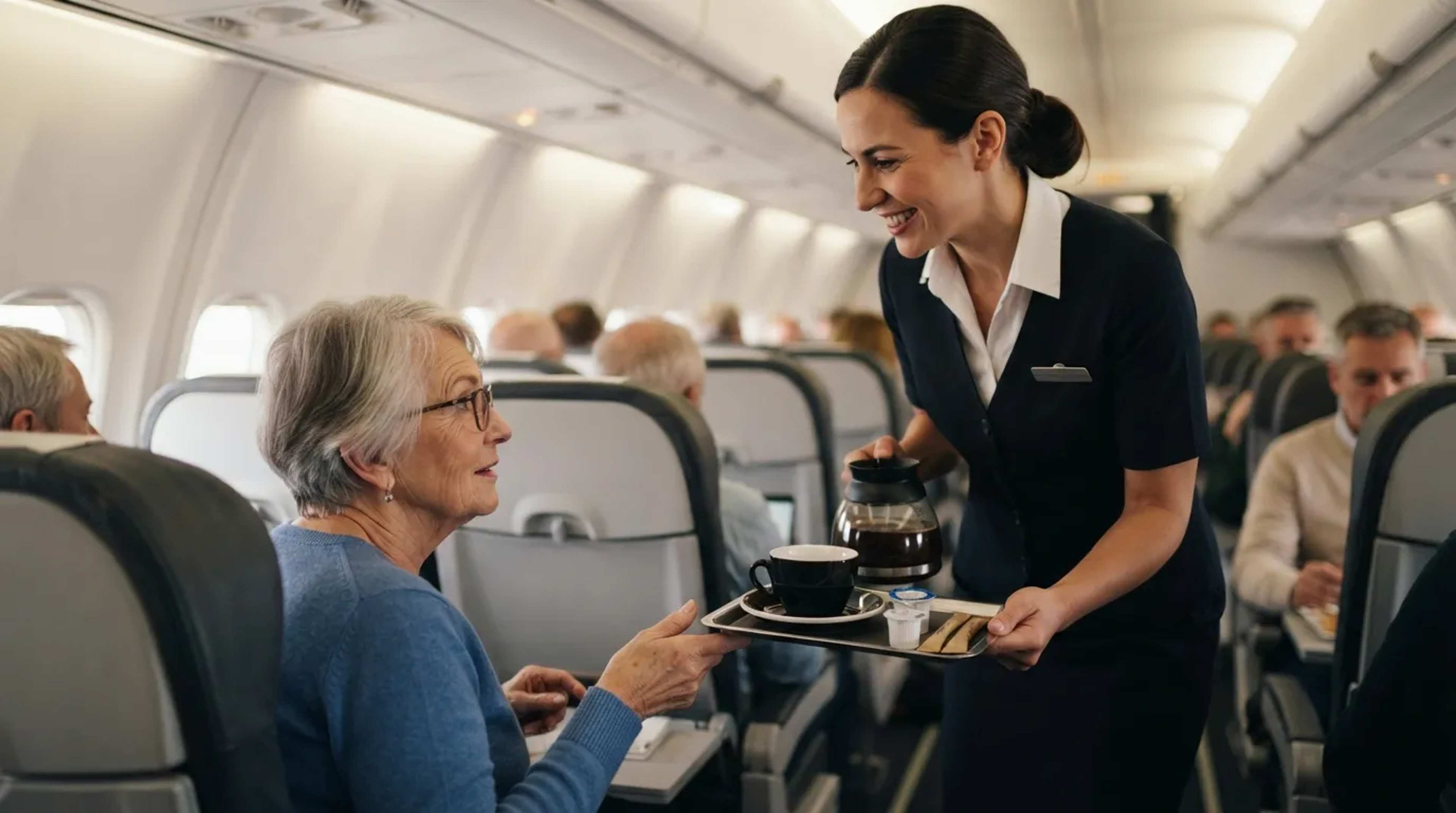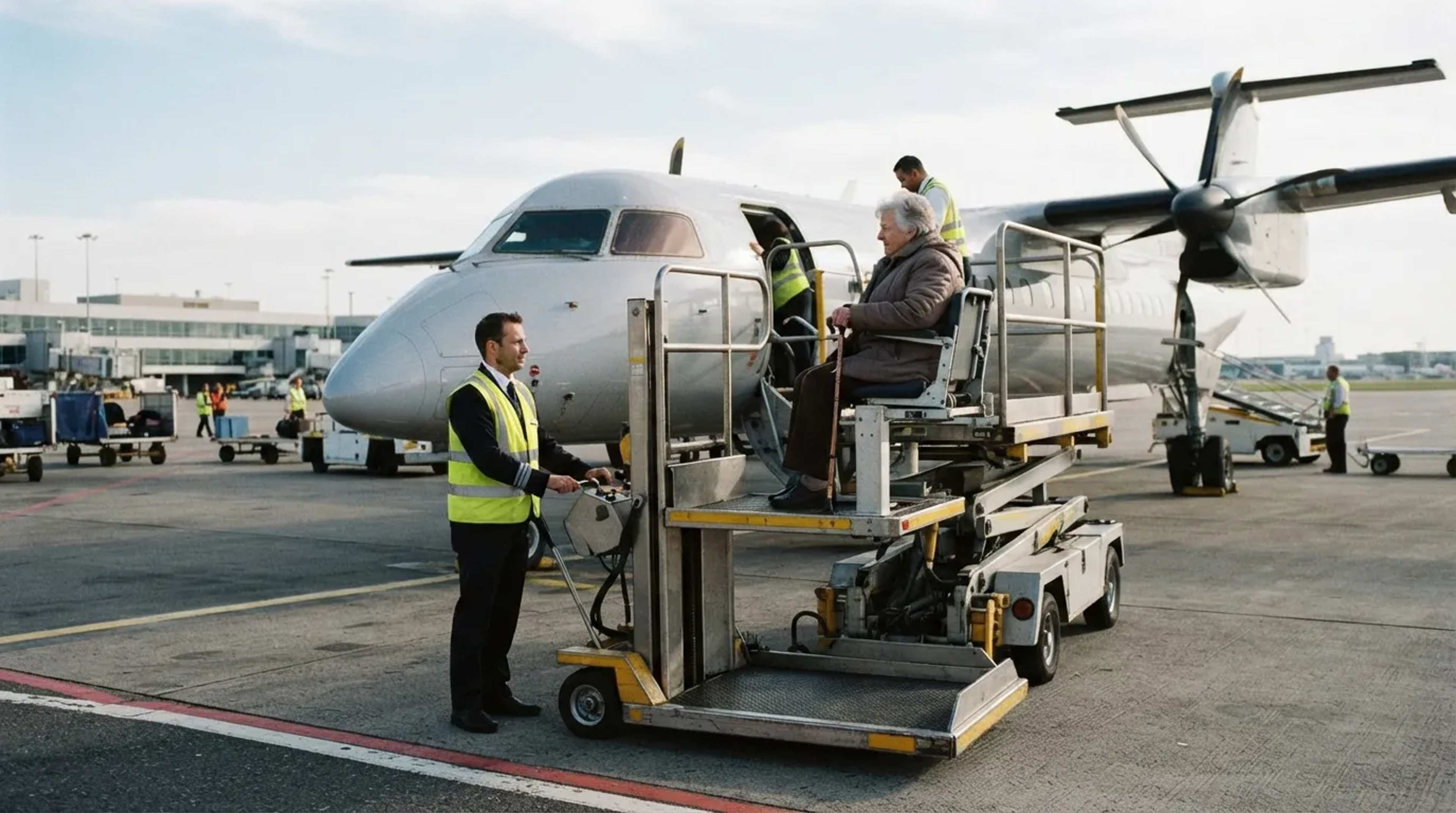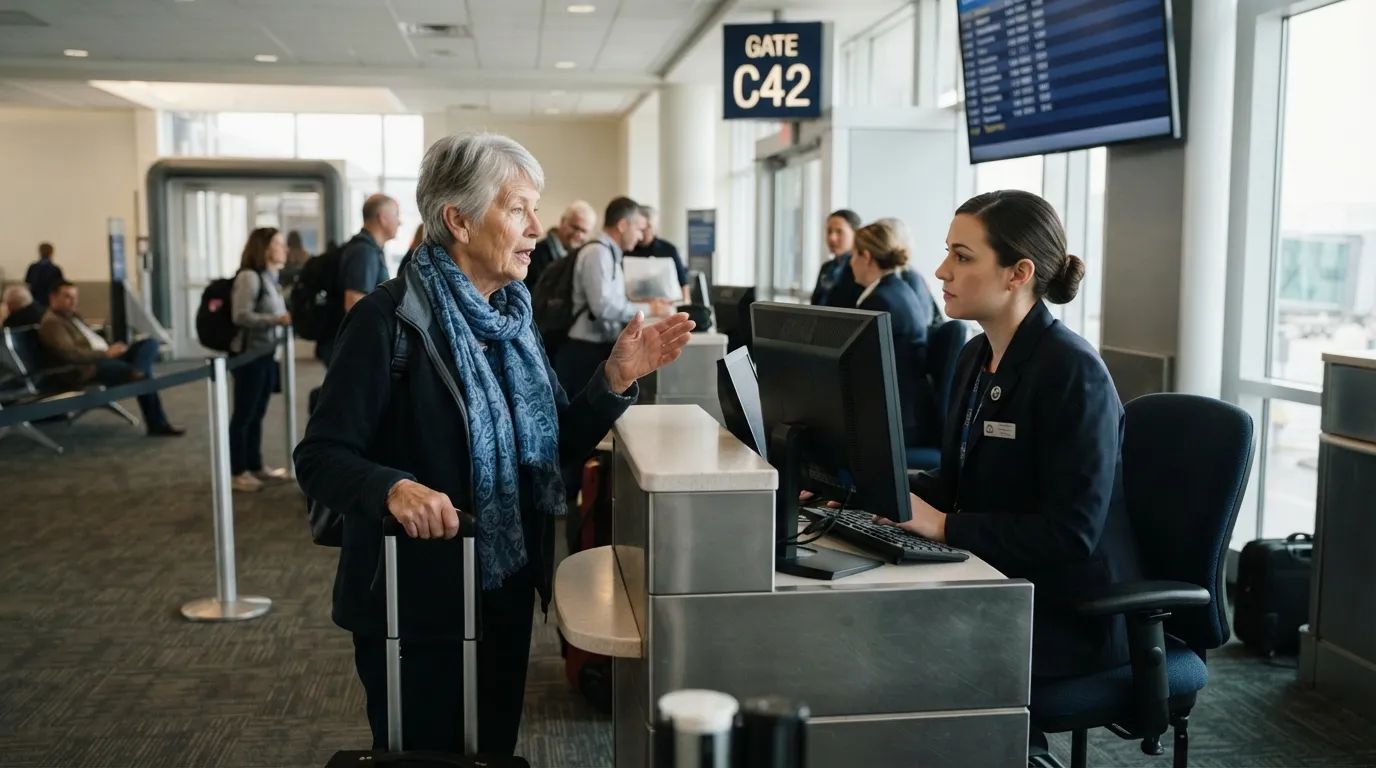
Most people assume turning 65 unlocks a quiet set of airport perks. It doesn’t. The federal rule on early boarding never mentions your age. The U.S. Department of Transportation requires airlines to let a passenger board first once that person tells the gate agent they need extra time or help.1 2
That’s the twist running through this whole list: the boarding line rewards small habits and a few well-chosen words, not your birthday. Stay for #1, which covers the single sentence that decides whether the wheelchair help you’ve booked actually finds you. First, the easiest gesture on the list.
#16 – Your Boarding Pass Open Before the Scanner
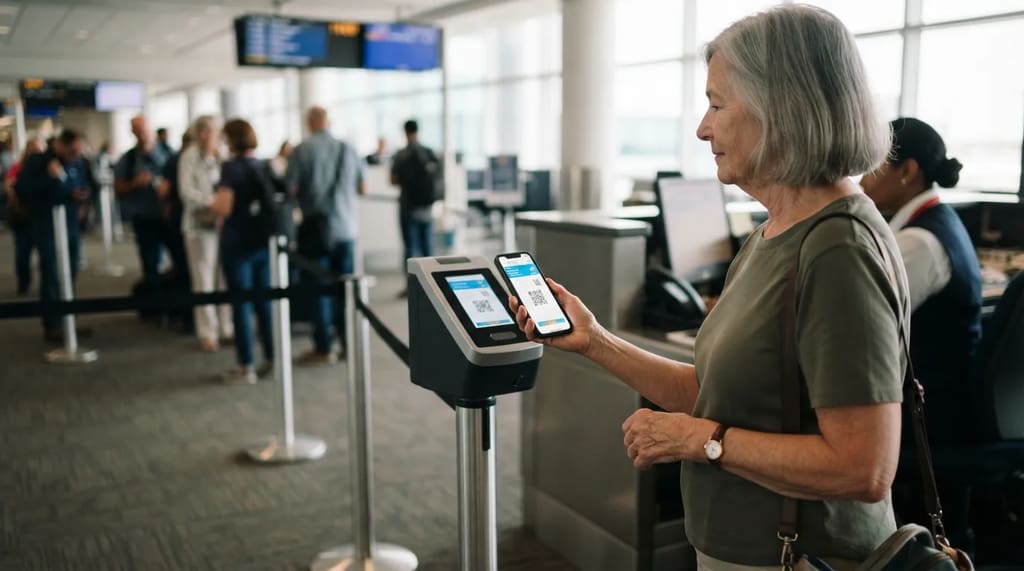
A boarding pass you have to hunt for stops the whole line behind you, and it’s the one delay you fully control. Having the pass ready to scan speeds boarding for everyone, and it spares you the pocket-patting that always seems to happen at the worst moment.
If your pass lives on your phone, open it while you’re still sitting at the gate. Turn the screen brightness up, since a dim screen is harder for a scanner to read, and make sure the phone won’t lock itself just as you reach the front.
A printed copy in your hand works just as well, and it can’t run out of battery. Open your pass before you reach the front of the line.
Once the scanner beeps, a second temptation arrives: joining the crowd at the door long before your group is called.
#15 – Staying in Your Seat Until Your Group Is Called
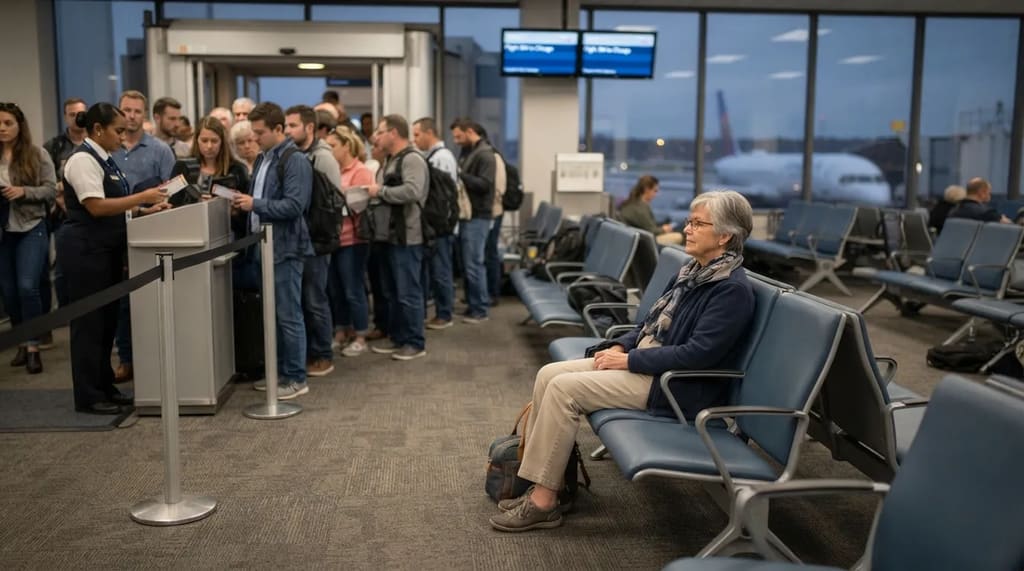
Standing at the door doesn’t get you to your destination any faster. Former flight attendant LaWana Boone told Yahoo Travel that crowding the gate can make boarding take longer, and she advises listening for your row, zone or group.
Here’s a verdict worth arguing over: a chair in the waiting area beats a spot in the crowd, especially if you have a knee, hip or back to think about. Sit near the desk and board when your group is called. You lose nothing as long as you can hear the announcements.
The exception is the early-boarding option covered later in this list. It works through the agent, not through the crowd, so if you need extra time you won’t win it by standing first in line.
When your group is called, what’s in your hands matters, because the aisle is a poor place to search a bag for your reading glasses.
#14 – Taking Out Glasses and Pills Before You Board
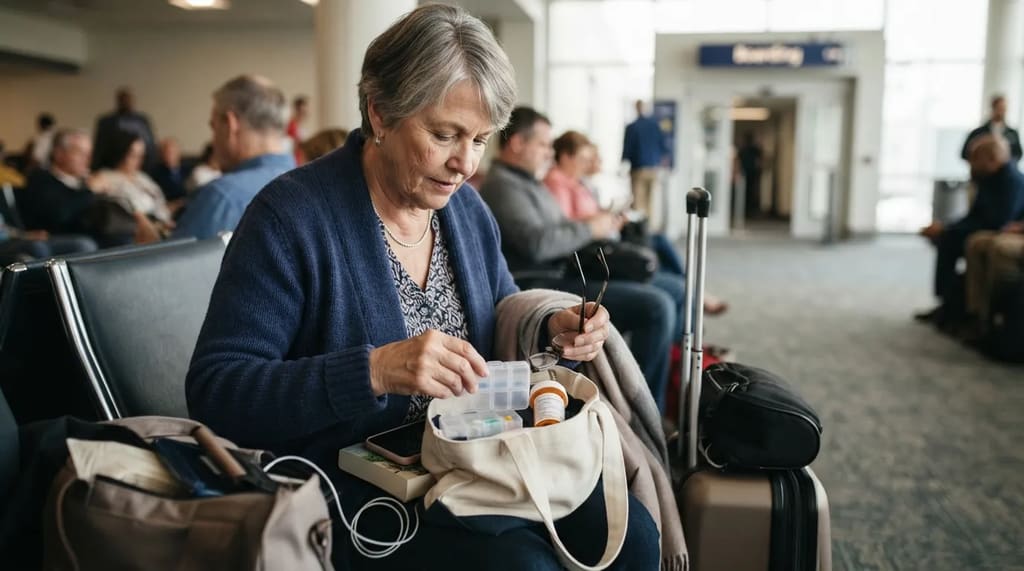
The first few minutes aboard go smoother when the digging happens before you step onto the jet bridge. Saskia Jackson, a former flight attendant and travel adviser, suggests taking out headphones, a book or medication ahead of time so the people behind you can keep moving.
For you, the list is short: reading glasses, any medication due during the flight, a phone and charger, and a light sweater, since cabin temperatures vary. All of it goes into the small bag that rides under the seat in front of you, not the overhead bin.
Move everything you’ll need in flight into one small bag at your feet. Then you never stand up mid-flight to open a bin, and repeated trips to the bins disturb other passengers and become a hazard in turbulence.
At the aircraft door there’s one more gesture, and it takes about two seconds.
#13 – A Plain Hello at the Aircraft Door
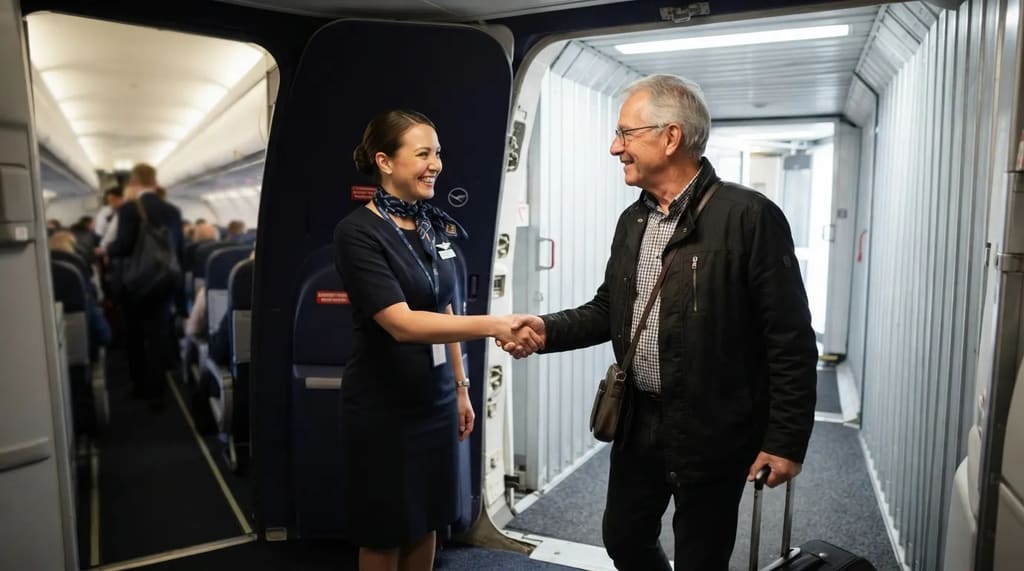
A greeting is the cheapest gesture on this list. Crews appreciate a simple hello or good day as you board, and the person you meet at the door is someone you may need later.
Flight attendants can help with more than the safety demonstration. They can assist with overhead bin space, settle disputes between passengers, and supply small items, so it pays to be on friendly terms before you need one.
Worth Knowing
- Crew can help you find overhead bin space near your row.
- They can step in when passengers disagree about seats or bags.
- Seatbelt extenders are available on request.
- Earplugs and Band-Aids are often on hand, too.
If you know you’ll want help, the door is the time to say so. Say hello, then name any help you’ll need in one sentence. Something like “Could you point me to bin space near my row?” is plenty.
Bin space depends on a bag you can lift, and that’s a test you can run in your own kitchen.
#12 – A Carry-On You Can Lift Overhead Yourself
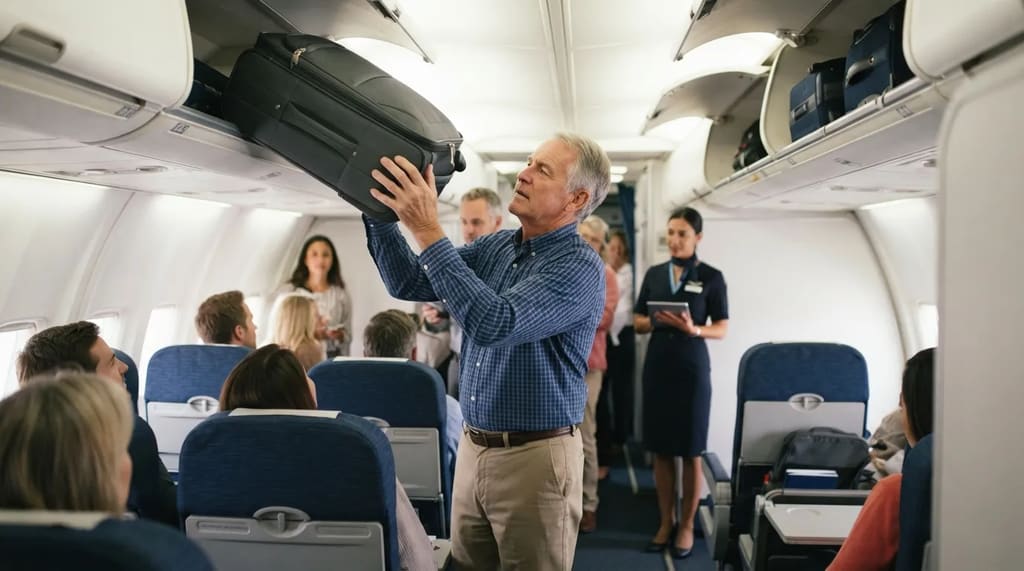
Crew can help you find bin space, but hoisting a heavy bag is another matter. Flight attendants are there for safety and service, so the bag has to be one you can handle alone.
The verdict is blunt: if a bag is too heavy to lift to shoulder height, it shouldn’t be your carry-on. Check it and carry something lighter aboard. Checking is a nuisance, but a strained shoulder on day one of a trip is worse.
Run the test at home. Pack the bag the way you’ll carry it, then lift your packed bag to shoulder height before every trip. If it wobbles, take something out.
Weight can also be split. A lighter roller plus a small bag at your feet keeps each piece manageable, and the small bag is the one you’ll reach for in flight anyway.
Lifting is half the job. The other half is whether the bag slides in on the first try.
#11 – A Bag Measured Before You Leave the House
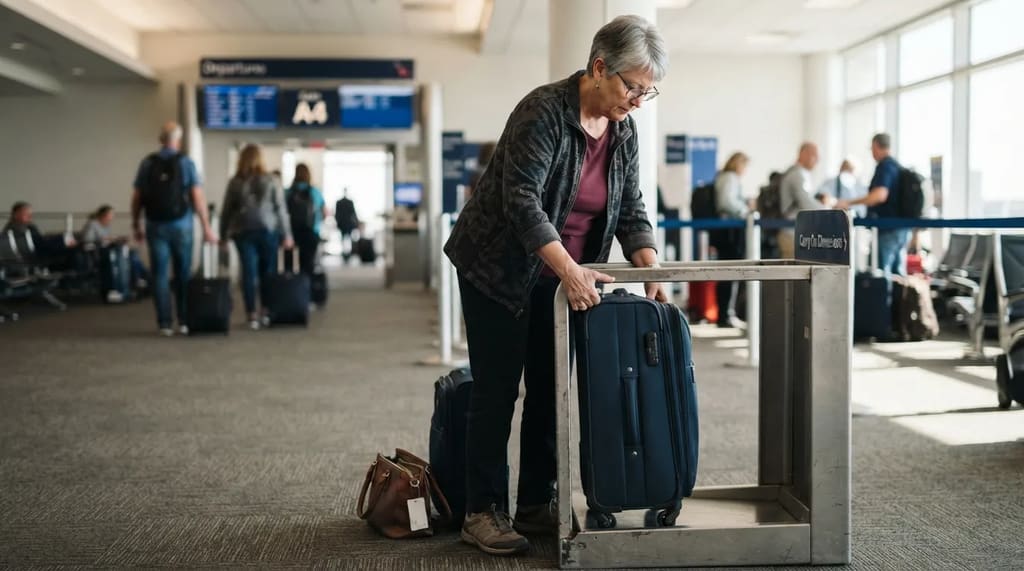
A bag that jams at the bin is a packing problem you could have caught at home. Measure and test-fit it before you board, because the aisle behind you can’t wait while you push.
Only your largest carry-on belongs overhead. Smaller items such as a handbag or laptop go under the seat in front of you, which leaves bin room for the bags that really need it.
- Largest bag in the bin, on its side and wheels first if the bin allows.
- Handbag, laptop and your in-flight pouch under the seat ahead.
- Size check against your airline’s posted limits, since they differ by carrier.
Check your bag against your airline’s carry-on size limits before you pack.
#10 – Asking Before You Move Someone Else’s Bag
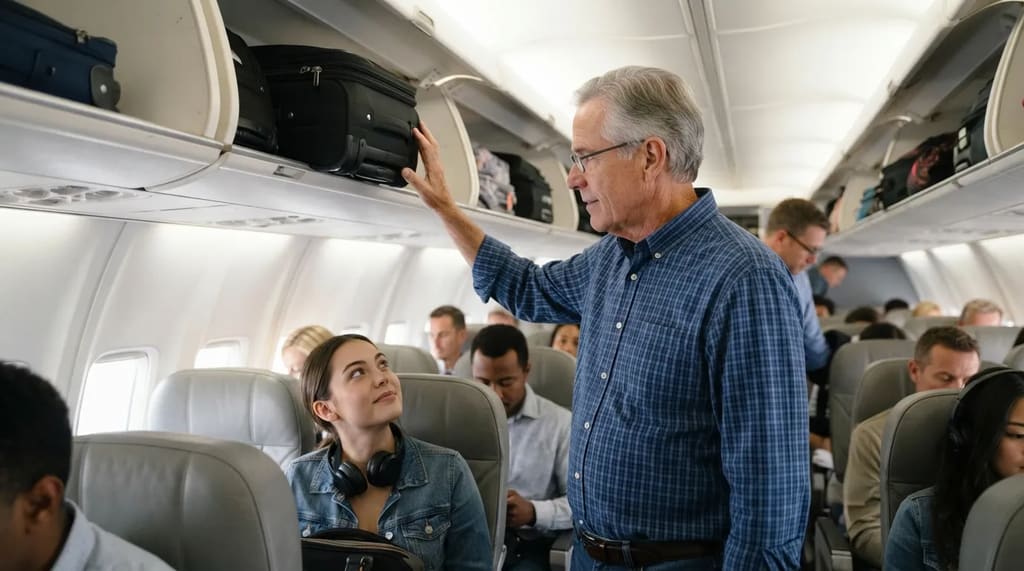
You reach a bin that looks full, and rearranging a stranger’s belongings feels like the quickest fix. Jacqueline Whitmore, an etiquette expert and former flight attendant, told Fox News Digital that passengers should never move another traveler’s belongings without asking.
There’s a practical reason beyond manners. Items shift in flight, and they can be damaged when someone shoves them aside in a hurry. Ask the owner, or a flight attendant, before you touch another bag.
Airline policy also doesn’t hand you the bin above your seat, so a spot a few rows away is fair game. The catch comes at landing, when you’ll have to retrieve it against the flow.
A bag stowed several rows away sets up a different problem at the end of the flight, when everyone wants theirs at once.
#9 – Giving the Aisle Room at Both Ends
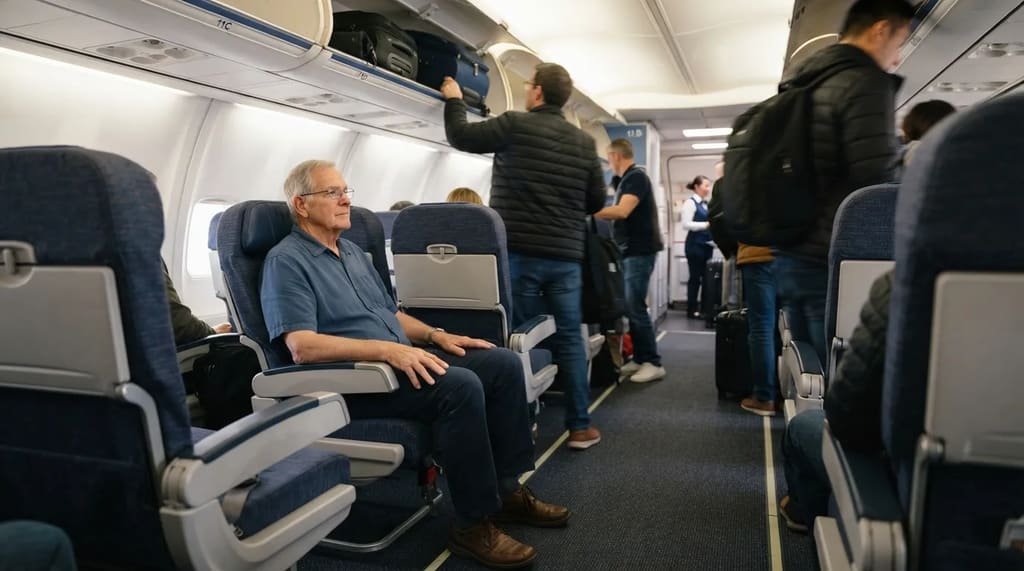
The aisle is shared twice, once at boarding and once at landing. On the way in, watch for passengers lifting bags into bins as you move toward your seat, and give them a step of room.
At landing the pressure reverses. Passengers often stand and reach for the bins before the aisle clears, and the better habit is to wait until the row ahead has moved.
At a Glance
- Boarding: pause a step back while someone lifts a bag.
- Landing: stay put until the row ahead has moved.
- Bag stored far behind you: expect to push against the crowd.
- Sore knee or hip: staying seated is the gentler choice.
If you have a knee or hip to protect, staying seated while the cabin empties is easier on the body than standing hunched under a bin. Stay seated until the row ahead of you has moved.
#8 – Medication Where You Can Reach It
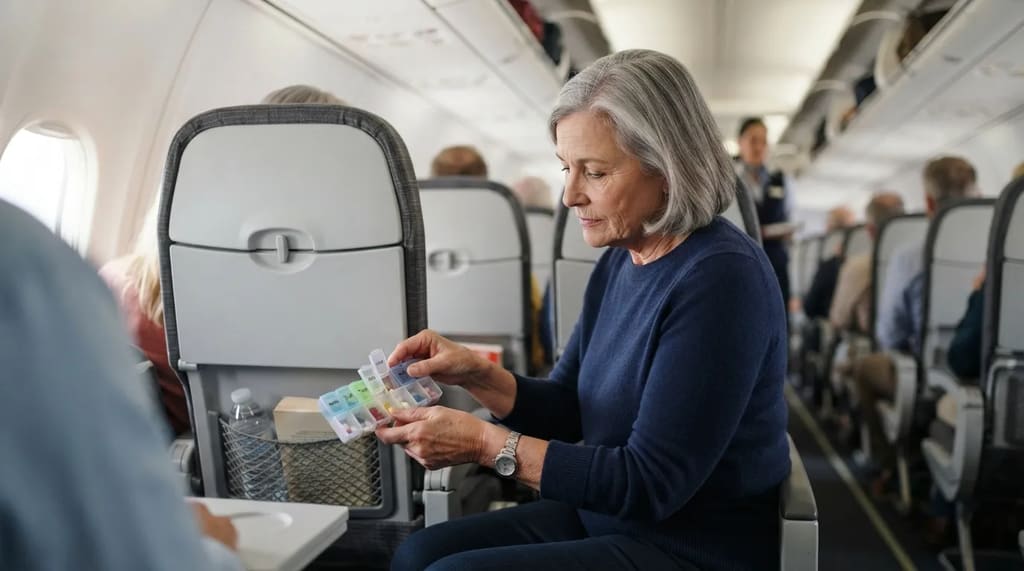
The Transportation Security Administration allows medication in both carry-on and checked bags, but it strongly recommends the carry-on in case you need immediate access.3 That makes sense, because a checked bag can be delayed or lost, and a pill due at noon doesn’t wait.
Reach matters in the cabin too. Keep the day’s doses in the under-seat pouch from earlier, not in the overhead bin, and add extra for delays and layovers. Keep every dose, plus extras, in the bag at your feet.
Pill organizers are fine for domestic flights, and TSA doesn’t require original pharmacy bottles. Some state laws govern how prescriptions are labeled, so a labeled original bottle is the safer choice if you’re unsure.
Pills pass through the checkpoint without comment. Liquid medicine is different, and it comes with a sentence you have to say first.
#7 – Telling the Officer About Liquid Medicine First
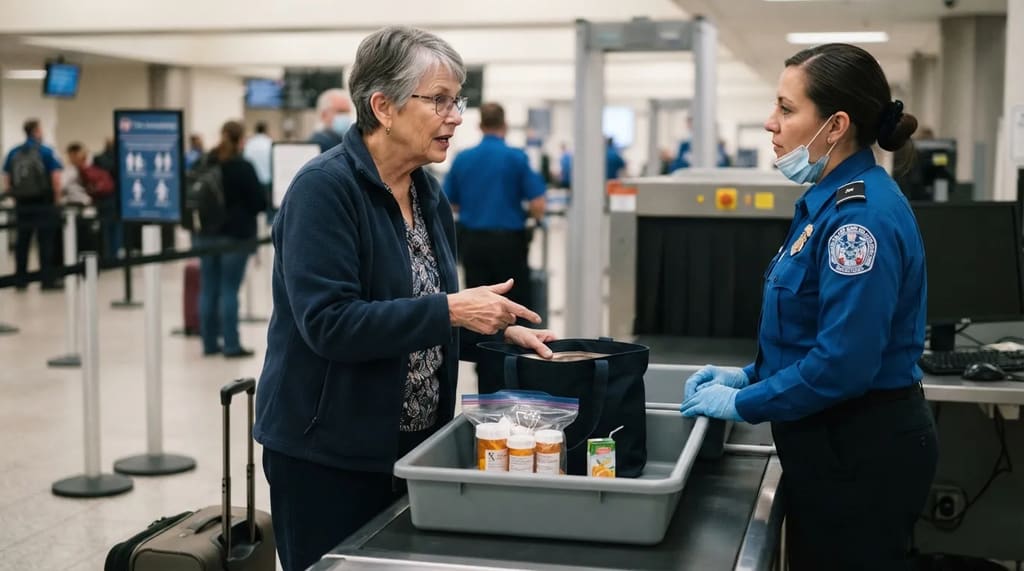
TSA says you don’t need to present medication to an officer unless it’s in liquid form.3 Liquid is the exception, and the allowance for it works only if you speak up.
Medically required liquid above the usual carry-on limit is allowed in reasonable quantities for the flight, and it doesn’t need to go in the zip-top bag. If your condition requires a juice box, that’s allowed too, but expect extra screening.
Keep liquid medicine in a separate pouch near the top of your bag so you can lift it out without unpacking. Tell the officer about liquid medicine before your bag goes on the belt. Say it at the start of screening, not after the X-ray flags something.
Once the bag is through, what the officer asks of you may depend on your birthday, and the number that matters is higher than 65.
#6 – Mentioning Your Age Once You Reach Seventy-Five
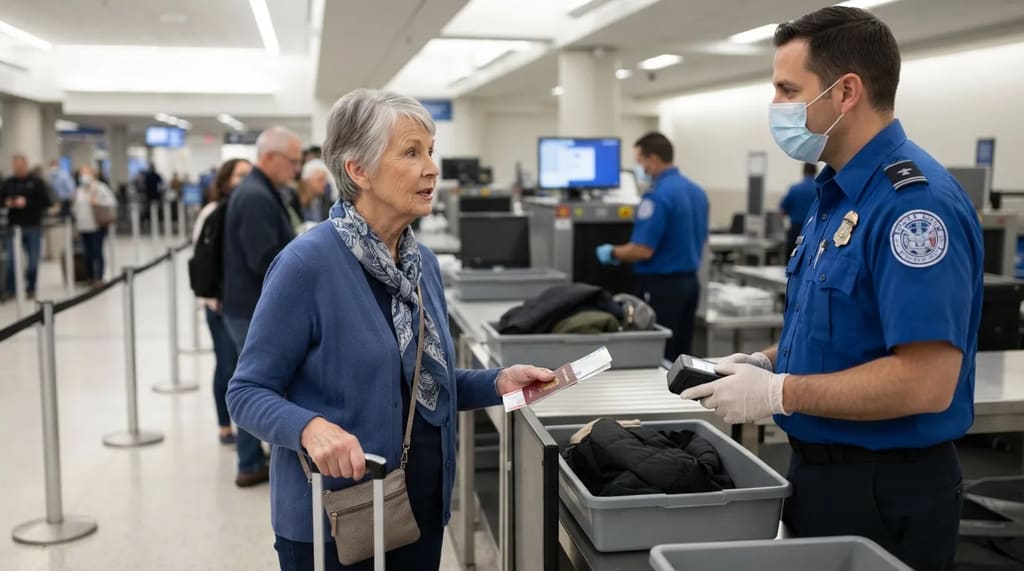
Turning 65 gets you nothing extra at the checkpoint. TSA says passengers 75 and older can receive some form of expedited screening, so anyone younger should plan on standard screening.4
Quick Compare
- Checkpoint: age matters, and 75 is the number.
- Gate: need matters, at any age.
- Your move at 65 to 74: plan on standard screening, and ask for gate help only if you need it.
That leads to a verdict: don’t build your airport morning around a senior lane at 65 or 70, because none exists. At 75 and older, state your age and ask for modified screening. The officer may not guess it for you.
If standing is hard, say so. TSA says passengers 75 and older who can’t stand for screening will be screened through other methods.4
Shoes now stay on at every age, though an officer can still ask for them after an alarm, so slip-ons make the rare request painless. Light jackets, by TSA’s guidance for travelers 75 and older, still come off for imaging scanners.
Checkpoint rules run on age. At the gate the test changes to need, and it favors whoever says so.
#5 – Asking for Extra Boarding Time in Plain Words
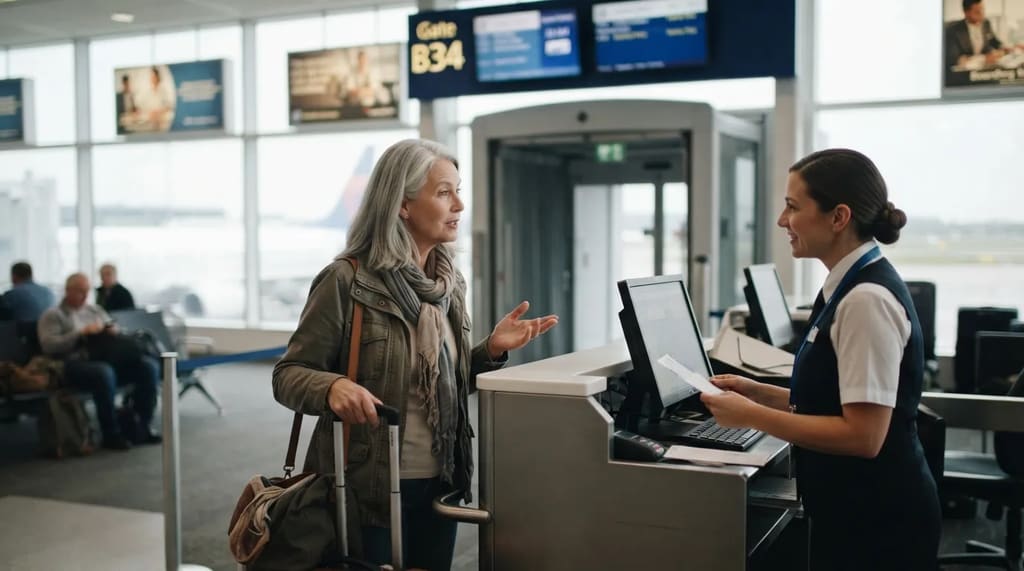
The Department of Transportation’s test for early boarding is need, not age. Airlines must let a passenger pre-board who self-identifies at the gate as needing additional time or assistance to board, stow accessibility equipment or be seated.2 5
Not every airline announces pre-boarding for special needs, even though it may be available.6 That means the request comes from you, and a specific one is easier for an agent to act on than a vague one.
Name the help: extra time on the jet bridge, a hand getting seated, assistance with a carry-on or moving within the aircraft. Walk to the desk before boarding starts and name exactly what you need.
It’s the one exception to the advice about waiting in your seat, and it’s worth using if the walk to your row costs you. On airlines with open seating, extra-time passengers may be brought on after an initial group, but still early in the process.
Pre-boarding is an option, not an obligation. You’re allowed to turn it down, and some days that’s the better choice.
#4 – Saying No Thanks to Pre-Boarding
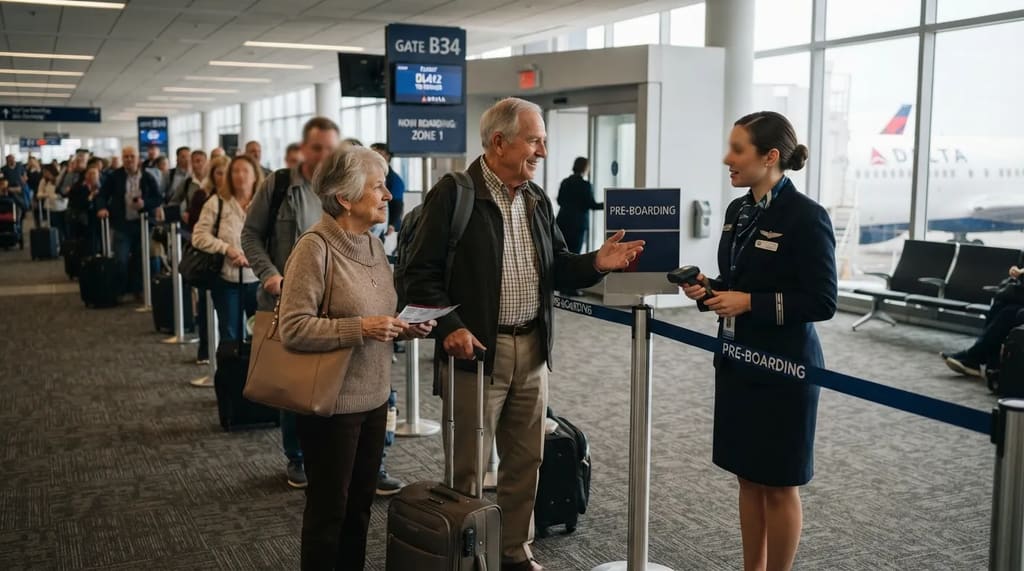
An airline can’t make you pre-board. The Department of Transportation is explicit that carriers may not require a passenger with a disability to accept special services, including pre-boarding, that the passenger didn’t request.6
So a “no thanks” at the gate is a complete answer. If you’d rather sit with your group and board at your own pace, nobody is entitled to insist.
Related Stories From Travelbinger
The sensible approach is to decide flight by flight, not once for all. On a day when a hip is complaining, ask for the extra time. On a good day, board with your group. Airlines can’t require you to accept pre-boarding you didn’t ask for.
#3 – A Seat and a Briefing Before the Cabin Fills
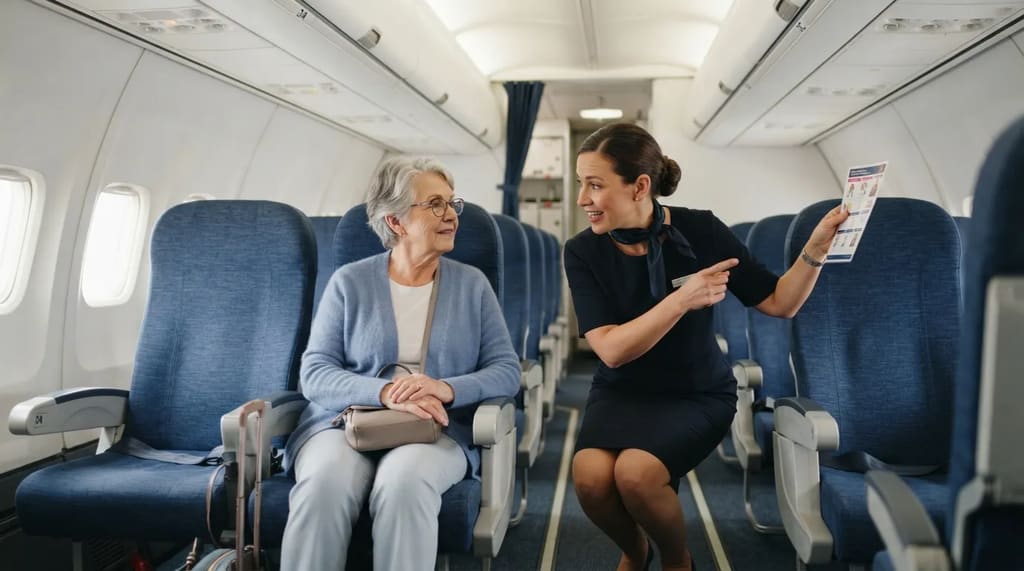
Pre-boarding buys more than a quieter aisle. If an airline doesn’t assign seats in advance, passengers who identify a seating need can pre-board, even ahead of other pre-boarders, and pick the seat that best meets that need.6
That matters on open-seating flights, where the choice of an aisle seat or a row near the front can shape the whole trip. On open-seating flights, pre-boarding passengers can choose the seat that suits their needs.
Pre-boarding can also give you a calmer moment to ask about safety. The department’s guidance for travelers with disabilities describes individual safety briefings that can be given before other passengers board, so if the standard briefing is hard to follow, ask for one at the same desk where you made the first request.
Why It Stands Out
- You can board ahead of other pre-boarders when a seating need applies.
- You pick the seat that fits your need, not whatever is left.
- A personal safety briefing can happen before the cabin fills.
- One conversation at the desk covers all three.
Seats matter even more when two people travel together, because the rule treats a spouse differently than you might expect.
#2 – Why Your Travel Companion May Board Later
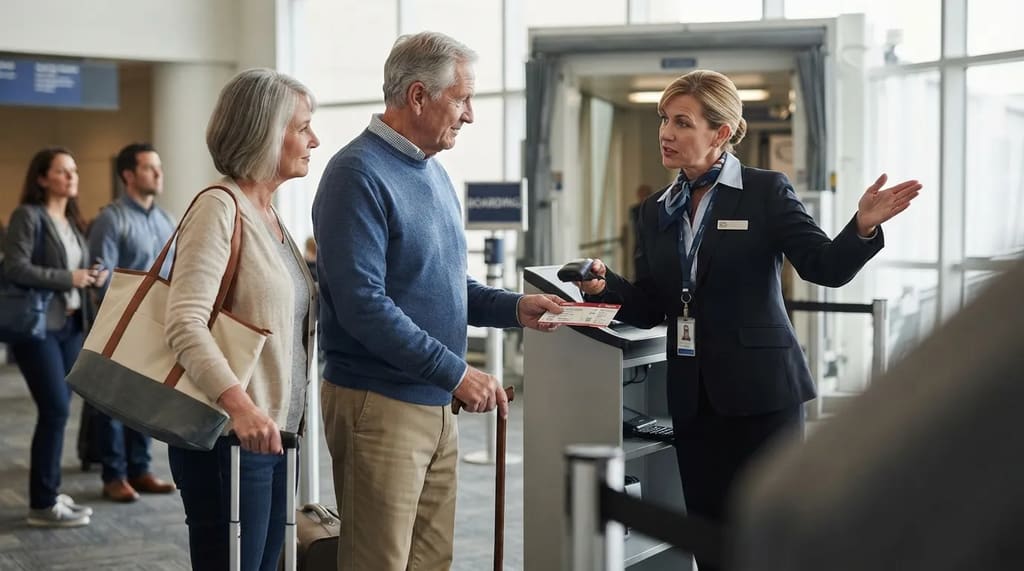
A spouse walking beside you at the gate doesn’t automatically board with you. The airline isn’t required to offer pre-boarding to people traveling with a passenger with a disability, unless the companion is a personal care attendant or safety assistant.5
That can split a couple in the jet bridge: you board early, and your partner, who’s carrying the bags, waits for the group call. Settle it before boarding by asking the agent directly whether your companion may come with you. Ask the agent directly whether your companion can board with you.
The rule sets a minimum, so asking costs nothing. If you rely on that person to stow a bag or get you seated, say so at the gate, because the level of help you need is what decides the answer.
Everything so far depends on one habit: saying what you need out loud. The final item shows what happens when you skip it, even after the help is already booked.
#1 – Telling the Airline You’re the One Who Asked for Help
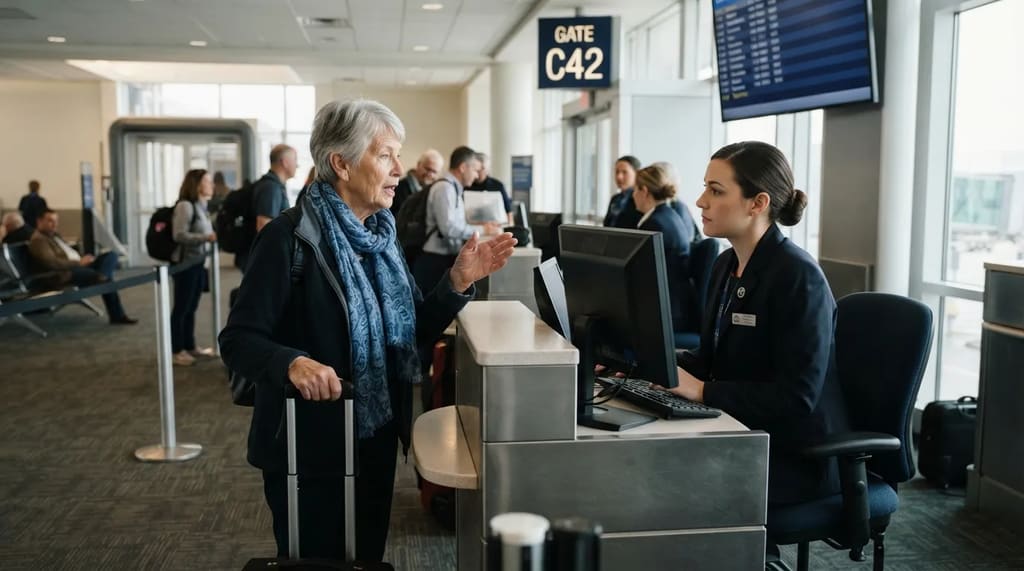
Booking wheelchair assistance doesn’t mean anyone knows who you are when you arrive. The Department of Transportation points out that an airline may have noted your request in the reservation, but it won’t know you’re the person who asked unless you identify yourself.1
So the rule is simple: Say out loud that you’re the passenger who requested help. Do it when you arrive at the airport, and again to personnel at the gate. Tell them what you need, whether that’s pre-boarding, help with a carry-on or help moving within the aircraft.1
The department also advises arriving as early as possible, so there’s time to check baggage, clear security and board without hurrying. That’s the same spoken sentence as at the desk in #5, only said earlier in the airport, and it’s the one every other gesture here depends on.
There’s a protection built in as well. If you’re not independently mobile, the airline can’t leave you unattended for more than 30 minutes, even when someone is traveling with you, unless you say it’s fine. If you’re unsure what your airline offers, call it before the trip.
Look back over the list and a pattern shows. Airlines and agencies respond to what you tell them: a pass in your hand, a bag you’ve tested, a request made at the desk. Little here switches on because of a birthday.
So treat the boarding line as the place to hand over information while it’s cheap, instead of hoping to be noticed. A bag at your feet and one clear sentence to the agent will do more than waiting for the system to recognize you.
On your last flight, what was the one item you wished you’d had within reach before the plane left the gate?
- DOT Wheelchair and Guided Assistance: https://www.transportation.gov/individuals/aviation-consumer-protection/wheelchair-and-guided-assistance
- 14 CFR Part 382 (eCFR): https://www.ecfr.gov/api/versioner/v1/full/2022-02-22/title-14.xml?chapter=II&part=382&subchapter=D
- TSA Medication Rules Overview: https://www.travelguard.com/travel-resources/travel-tips/how-to-pack-medication-for-airport-security
- TSA Air Travel for Seniors: http://travelsafely.org/seniors.html
- DOT Air Travel Disability Guide: https://www.transportation.gov/sites/dot.gov/files/docs/Developmental_Disabilities_Guide.pdf
- DOT Air Travelers Disability Guidance: https://www.transportation.gov/sites/dot.gov/files/docs/TAM-07-15-05_0.pdf