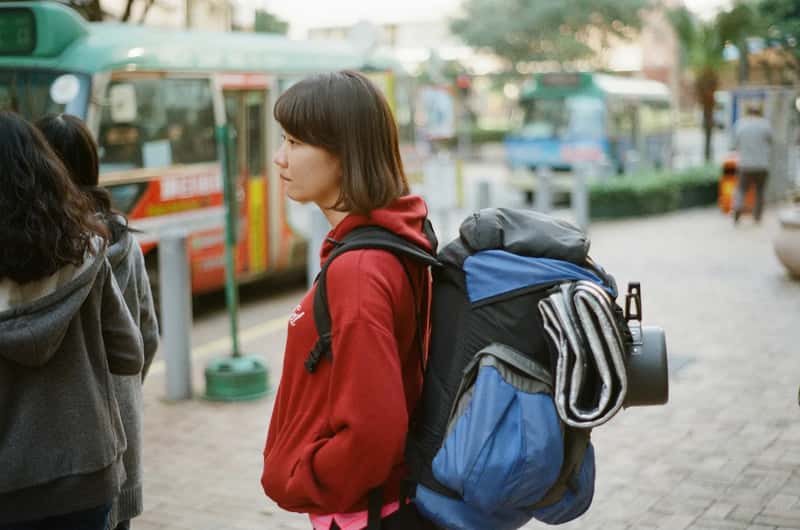
You’re standing at the bus stop.
You’ve been standing there for four minutes.
The bus is coming. You don’t know which one. And so you walk.
Forty minutes. In the rain. With a bag that’s too heavy and shoes that aren’t made for this. And you tell yourself it’s fine. You tell yourself you prefer it this way. The control. The certainty. The clean, unambiguous geometry of your own two feet moving forward.
But here’s the thing nobody says out loud: the walk isn’t about the bus. It was never about the bus.
There’s a gap that lives inside every modern traveler who moves through transit zones, foreign cities, temporary addresses, and borrowed spaces. It’s the gap between the version of you who is confident and purposeful and knows exactly where they’re going, and the version of you who is quietly, privately terrified of looking lost. Of asking. Of boarding the wrong thing in front of strangers who seem to already know where they’re headed. That gap – between who we perform and who we actually are when the itinerary falls apart – is where all of this begins.
1. The Pre-Walk Calculation
You run the numbers before you even look up the bus route.
Walk time: 38 minutes. Bus: maybe 12. But that “maybe” costs you everything.
Anxiety is associated with exaggerated threat appraisal – a bias toward evaluating threat as disproportionately greater in likelihood and severity than is actually warranted. So your brain doesn’t register “wrong bus” as a minor inconvenience. It registers it as a small catastrophe. A public failure. An exposure.
And so the math gets quietly, invisibly cooked.
The walk becomes the logical choice. Rational, even. Exercise. Fresh air. Independence. You dress the avoidance in productivity clothing and it looks so good nobody questions it – least of all you.
This is the first defensive response: the pre-emptive calculation that converts fear of vulnerability into a reasoned plan. The numbers are real. The math is clean. But the motivation underneath is something else entirely. Something that doesn’t want to stand at the curb, uncertain, while the city watches.
You arrive damp. You arrive late. You arrive proud of yourself for having chosen this.
2. The Control Disguise
Walking gives you control.
You know that. You chose it for that reason, even if you called it something else.
If you’re afraid of being emotionally or physically vulnerable, you may use hyper-independence as a defensive strategy to avoid letting others in. You may think that as long as you don’t need anyone, you can’t be let down. Apply that to transit and it maps perfectly. As long as you don’t need the bus, the bus cannot humiliate you. As long as you navigate alone, nobody witnesses the wrong turn.
The control disguise is sophisticated. It looks like self-sufficiency.
It smells like confidence. It wears sensible shoes. But peel it back and what you find is a person who learned, somewhere along the way, that needing assistance – needing information, needing direction, needing to ask someone where the number 14 actually stops – carries a cost that feels too high to pay.
And so you never pay it. You walk instead.
The city becomes a thing you conquer alone, because conquering alone means you never have to risk being seen as someone who doesn’t know.
3. The Worst-Case Rehearsal
Before you even leave the hotel, you’ve already taken the wrong bus seventeen times.
In your head. In vivid detail. You’ve missed the stop. You’ve ended up somewhere industrial. You’ve asked someone who didn’t speak your language and they looked at you with the specific pity reserved for tourists who packed the wrong shoes.
Cognitive biases can lead to inflated estimations of threat magnitude and probability of occurrence, which then manifest as pessimistic expectations and catastrophizing cognitions. Difficulty in accurately estimating future threat magnitude and probability, especially in situations of significant uncertainty, can lead to repetitive invocation of threat assessment processes.
This is the worst-case rehearsal. It runs on a loop.
It feels like preparation. Like due diligence. Like you are simply being a responsible person who thinks things through. But what it actually is – what it has always been – is a way of pre-suffering an embarrassment that may never arrive, so that if it does, you were already there waiting for it.
The rehearsal exhausts you before the day begins. And then you wonder why travel feels so heavy.
4. The Expertise Performance
You download four apps before you arrive.
You read the transit authority’s website. You study the route map until you could describe it to someone else. You become, briefly and privately, an expert in a city’s bus system – not because you intend to use it, but because expertise is armor.
Gaining more information over an extended period helps uncertainty-avoiding travelers reduce the anxiety associated with travel. But there is a point where information-gathering becomes its own form of avoidance. Where research is no longer preparation but performance – a way of feeling ready without ever having to be tested.
The expertise performance says: I am not lost because I know things.
It says: I am in control because I have done the reading.
What it doesn’t say – what it cannot say – is that you still won’t board the bus. Because knowing the route and standing at the stop, waiting, uncertain, exposed to the possibility of being wrong – those are two entirely different acts. And only one of them requires you to be actually vulnerable.
5. The Identity Anchor
I remember a trip to Lisbon.
I had researched the trams obsessively. I knew that Line 28 was the famous one, the one that rattles through the Alfama at an angle that seems structurally inadvisable. I knew the stops. I knew the cost of a single ticket. I knew everything about it except how to actually stand at the stop and wait with people who seemed to know what they were doing, and I did not board it once. I walked instead. Every single day. Beautiful walks, I told people later. I love to walk, I said. Lisbon is a walking city.
What I was actually doing was protecting my identity. The identity of someone who is a seasoned traveler. Competent. Purposeful. Not the person who boards wrong and has to ask for help in a language that isn’t theirs.
This develops into an ever-widening gap between the invulnerable version of us which strives to show no problems or flaws, and the real, inner us who lurks inside, feeling unwanted and unworthy. This is at the heart of our fear of being vulnerable – that this deeper part of us, which we have worked so hard to hide, will be seen and condemned.
The identity anchor holds us in place. It is not wisdom. It is self-protection wearing the costume of personality.
6. The Social Audience Illusion
You are convinced that everyone at the bus stop is watching you.
They are not. They are looking at their phones, thinking about lunch, half-asleep in the early morning light. But inside your head, there is a full audience assembled and they have come specifically to observe whether you board correctly.
Research found that people evaluate their own vulnerability displays much more negatively than they evaluate the same behavior in others. When someone else admits a mistake or shows uncertainty, we tend to see it as courageous. When we do it ourselves, we focus on the risk of being perceived as weak or incompetent.
The social audience illusion is one of avoidance’s cleverest tricks.
It manufactures witnesses. It populates the scene with judgmental strangers who have, in reality, no interest in your transit decisions whatsoever. But because the threat feels social – because getting it wrong feels public – the brain escalates the stakes to match the imagined audience.
And so you walk. Alone. Off the stage you built in your own mind. The audience dissolves the moment you turn the corner, but by then you are already gone.
7. The Safety Behavior Loop
You bring backup plans for the backup plans.
You have the taxi app ready. You have the address written in the local language, printed on paper, because what if your phone dies. You have a second route mapped. You have allowed forty extra minutes. And somewhere in all of that redundancy, you have quietly ensured that nothing will ever require you to improvise publicly.
You may think avoidance and safety behaviors are healthy coping strategies because they do reduce your anxiety in the moment. But the opposite is true: relying on these behaviors actually feeds and maintains your anxiety in these situations over the long run.
The safety behavior loop is self-reinforcing. Each backup plan teaches the brain that the original fear was justified.
Each contingency says: yes, this was dangerous. Yes, you were right to prepare this way. The brain notes this and next time it raises the stakes slightly higher, requires slightly more preparation, demands slightly more armor before it will agree to leave the room.
The loop tightens. The radius of what feels manageable shrinks. And you call this being organized.
8. The Narrative Reframe
You are very good at the story you tell about it.
I’m a walker. I like to see cities on foot. Buses feel impersonal. There’s so much you miss when you’re underground. I once took a wrong turn in Bologna and found the most extraordinary little place – you can’t plan that sort of thing.
People rarely experience dissonant beliefs as genuinely inconsistent for long. The rationalizing process happens quickly and often below conscious awareness, which is part of why defensiveness can feel so automatic and why the defensive person genuinely believes they’re being reasonable.
The narrative reframe is the most elegant of all the defensive responses because it is partially true.
You did find that place in Bologna. The walk was beautiful. And none of that is a lie. But the origin of the walk – the decision made not from wanderlust but from the quiet refusal to stand at a stop and risk being wrong – that part never makes it into the story.
Because the story is not about what happened. The story is about who you are. And who you are does not take wrong buses.
9. The Exhaustion That Passes for Preference
At some point in the trip, you stop asking yourself what you want.
You’re tired. Not from walking, though the walking is real. You’re tired from the vigilance. From the constant low-level threat assessment. From the way your brain has been running the risk-management software continuously since you arrived, scanning every transit decision for potential exposure, calculating exits, rehearsing the worst.
Excessive cognitive, emotional, and behavioral avoidance necessitates significant time and energy for management and control. Moreover, excessive avoidance impedes progress toward valuable goals and limits available experiences.
The exhaustion starts to shape what you call your preferences.
You say you don’t feel like going out tonight. You say the place is too far. You say maybe tomorrow. But what you mean is that the cost of navigating uncertainty again tonight is higher than you can currently afford. So you stay. You order in. You scroll through photos of the city you are technically inside.
The exhaustion that passes for preference is the quietest of all the defensive responses. It looks like introversion. It looks like rest. It is neither.
10. The Permanent Provisional Self
Here is what all nine of those responses have been building toward.
A self that never fully arrives.
A self that is always almost there – almost ready to try the bus, almost comfortable enough to ask a stranger, almost willing to stand at the stop without a backup plan printed in a language it doesn’t speak. Prospective intolerance of uncertainty is a vulnerability factor for excessive avoidance behaviors. Recent studies have shown that avoidance behavior may become excessive and inflexible – detached from its incentive value and resistant to extinction. In other words: the more you practice the walk, the more the walk becomes your only option. Not because the bus was ever really dangerous. But because the avoiding became the habit, and habits write themselves into identity over time, and identity is the hardest thing in the world to board incorrectly in front of strangers.
The permanent provisional self is the traveler who is always passing through – not just cities, but their own life. Always in transit. Never quite landed. Humans have survived and evolved partly through successfully avoiding existential harm – a survival response which comes from a more primitive environment. In this sense, vulnerability can be associated with feeling existentially threatened, producing a powerful desire to escape. And so the escape continues. From city to city, from bus stop to sidewalk, from the version of yourself who might get it wrong to the version who simply never tries.
The bus is not the point. It never was. The bus is just the moment when the gap between your performed self and your actual self becomes small enough to see – and wide enough to fall into. And so you don’t stand at the stop. You put one foot in front of the other. You count the minutes. You arrive having never risked a thing.
There is no conclusion to offer here. No checklist. No instruction to simply be braver, as though bravery were a bus route you could memorize in advance. What is true is this: the defensive responses described above are not failures of character. They are successes of protection. They kept something safe. The question worth sitting with – somewhere between one transit stop and the next – is whether what they kept safe is the best version of you, or only the most defended one.
The city keeps moving. The buses keep running their routes, indifferent to whoever decides not to board. Somewhere a door opens and closes. Somewhere a stranger scoots over to make room without being asked. Somewhere the wrong stop turns out to be exactly right.
You can walk again tomorrow. Or you can stand at the curb a little longer this time, bag in hand, watching to see which one comes.