The water is wide.
That’s the point.
You booked the flight at midnight, half-asleep, fully awake in the places that matter.
Nobody packs a bag for an island without first trying to unpack something inside themselves. The loop works like this: life accumulates weight. You go to the island. You feel free. You come home. The weight is back, slightly heavier. You start looking at flights again. For some, travel becomes a form of emotional anesthesia, numbing the pain of unresolved conflicts or unfulfilled aspirations.
The gap between who you show up as and who you actually are – that trembling, unexamined space – is the real destination. Every salt-sprayed shoreline you’ve ever chased was just a mirror you were too afraid to hold still.
The Physical Moat
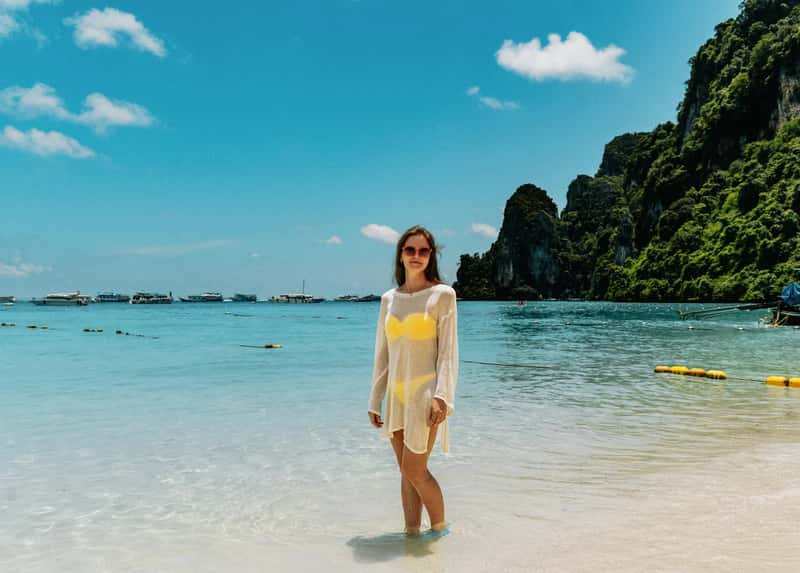
An island is not just a geography. It’s a decision.
When you choose a destination surrounded entirely by water, you are choosing a place where the terrain itself enforces your separation from everything you left behind. The ocean becomes your bouncer. Your problems technically could follow you – they always do – but the ritual of crossing water creates a psychological permission slip to pretend, convincingly, that they didn’t.
Creating a physical distance between sources of discomfort can create a feeling of safety. And islands are the most absolute physical distance available to a person without a spaceship.
The moat is not decorative. It’s structural. It tells your nervous system: *nothing from there can reach you here.* Your nervous system believes it. For a while.
The genius and the tragedy of the island choice is that water is both a boundary and a reflection. You can’t look at the sea without eventually seeing yourself in it.
The Temporary Identity
On an island, nobody knows your name. More importantly, nobody knows your damage.
You become whoever shows up with a carry-on and sunscreen. “Travel and vacations are a means to reshift and reorganize identities,” according to sociologist Karen Stein, whose research on culture and travel examines exactly this phenomenon.
The island lets you audition a version of yourself you’ve been rehearsing in private. Lighter. Louder at dinner. Someone who orders the strange thing on the menu without overthinking it.
This is not deception. It’s desire. The temporary identity reveals what you actually want your permanent one to look like.
The trouble is that most people treat the island-self as a vacation souvenir – something that gets packed back into the overhead compartment when the return flight boards. Many avid travelers claim they travel to “discover” themselves by being open to new experiences. But discovery requires you to bring something home. Most don’t.
The island self dies at customs. Every time.
The Exit Strategy
Let’s be honest about what island-booking actually is at 11:47 PM on a Tuesday.
It is not wanderlust. It is not spontaneity. It is a controlled detonation of a situation you can no longer sit inside.
Escapism in psychology is any behaviour that we use to avoid difficult feelings and emotions. And island travel is escapism in its most architecturally elegant form – because it looks, from the outside, like ambition. Like living fully. Like someone who has their life together enough to book international flights.
Nobody questions the island trip. They envy it.
Which is exactly what makes it such a perfect exit strategy. Even travel can be an escapist strategy, as researchers from the University of Surrey have indicated, especially when the objective of these trips is not to discover a new place but simply to escape from the place where we find ourselves because it is unbearable.
The exit is applauded. The unfinished business is never discussed.
The Dopamine Architecture
Your brain on a new island is not your brain at home.
Travel activates entirely different neural networks than our day-to-day routines, making it a potent escape mechanism. The sensory overload of a new place – the salt, the heat, the particular quality of afternoon light on unfamiliar water – floods the brain’s reward circuitry with enough novelty to temporarily drown out everything else.
This is not metaphor. This is neuroscience.
The stimulation and novelty of new environments can act like a psychological reset, giving us a temporary break from the realities we don’t want to face. The key word there is temporary. The reset button does not delete the file. It just minimizes the window.
The island becomes, over time, a place you need rather than a place you choose. Over time, the brain becomes addicted to this novelty – leading people to constantly seek out the next adventure, whether it’s a weekend getaway or a year-long world tour. Each island raises the tolerance. The next one has to be more remote. More surrounded. More impossible to reach from your actual life.
The Confessional Moment
I want to stop here. Because this isn’t theoretical for me.
I have booked an island trip on three specific occasions in my adult life. Each time, I told myself a story about “needing a reset.” Each time, I was also in the middle of something I wasn’t finishing – a relationship requiring a hard conversation, a career decision I’d been deferring for eight months, a grief I kept scheduling for later.
I went to the island. I felt the reset. I came home to the same open tabs.
The advantages of travel escapism – and even the mental health benefits – may still come at a cost, which is leaving certain issues unaddressed. That cost is paid later, with interest, in the form of the same problem wearing different clothes in a different season of your life.
The island was real. The relief was real. The avoidance was also real. All three things were true at once. That’s the part nobody tells you when they like your beach photos.
The Self-Discrepancy Engine
There’s a term in psychology that explains a lot of compulsive travel.
If there is a gap between who you are and who you want to be, escape can soften the sting of that reality. Rather than taking action to close the gap, you numb the pain of seeing it. Over time, the gap grows – and your need for escapism has to grow with it.
The island-seeker is often someone living inside that gap. They have a vision of themselves – resolved, free, easeful – and the ordinary Tuesday keeps disproving it. So they leave the Tuesday behind. They go somewhere the gap doesn’t feel so visible.
But the gap travels in carry-on luggage. Always.
The self-discrepancy engine runs quietly beneath every booking confirmation. You’re not flying toward something beautiful. You’re flying away from the difference between your actual life and the one you keep meaning to build.
The Islandness Construct
Researchers have actually studied what makes islands psychologically distinct as a destination category. Academics acknowledge that “islandness” is “a construct of the mind.” It lives in the imagination before it lives on any map.
This matters. Because you’re not always choosing the island for its beaches or its food. You’re choosing the idea of the island. The psychological promise of it.
The promise is containment. On an island, even the land knows where it ends. Everything has a shoreline. Your life at home has no such clean edges – it bleeds into obligations, relationships, old selves you haven’t fully shed. The island offers what your actual life refuses to: a clearly defined perimeter.
Islandness can “contour and nudge behaviours and systems,” according to research on island psychology. It recalibrates the internal compass. The question is whether that recalibration ever survives re-entry – or whether it dissolves the moment you’re back inside your own timezone.
The Avoidance Loop
Here is what psychology says about what happens when avoidance becomes the primary tool.
When you successfully avoid a hard feeling or a difficult task, your anxiety drops – for the moment. Your brain remembers that relief and nudges you to avoid the situation again in the future. Over time, avoidance shrinks your world. You begin to feel safe only when you are escaping.
This is the island loop. And it is merciless. Psychologists note that this pattern can mirror other addictive behaviors, where the pursuit of temporary relief replaces long-term problem-solving.
The island never caused the problem. But it can absolutely sustain it.
The Identity Alignment Question
There is only one honest question to ask before booking the next island trip.
Am I moving toward something? Or away from something I’m afraid to name?
Indicators of using travel to escape in an unhelpful way include: if you tend to book trips when you are overwhelmed, if you are someone who tends to avoid dealing with problems and emotions, finding that you don’t reach any new insights or perspectives on your situation when you return from your trip.
Read that list slowly. Read it like it’s written about someone you love.
Identity alignment isn’t about judging the impulse to leave. The impulse is human and ancient and often correct. It’s about being honest about what you’re aligning with. The version of you who keeps leaving – is that the one you want to become? Or is that the one who keeps delaying the becoming?
The deeper reason for travel may be identity enhancement, recognition for going places and seeing things. But enhancement and avoidance are not the same trip, even when they depart from the same gate.
The Return
This is the heaviest part. The one nobody posts about.
The return is where the island reveals its true cost.
Relying on travel to reset your brain or escape everyday stress can prevent you from developing emotional resilience and problem-solving skills for your current situation. In the long run, life’s stressors will continue to build. They don’t wait politely. They compound.
The return is the real destination. It always was. Because the thing you went to the island to escape is still sitting in the apartment, right where you left it, wearing the same expression, having not moved an inch. The relationship conversation. The unwritten letter. The grief you keep scheduling for when you have more capacity. They are loyal in the way only unfinished things can be loyal.
Constantly running will not leave fears behind; it will only exacerbate them, because there is no place in the world where you can run away from yourself.
The ocean is not the problem. The island is not the problem. The craving for horizon is one of the oldest and most honest things about being human. Freud believed it. Tolkien wrote toward it. Every civilization that ever stood on a coast looked out and felt the pull.
The problem is the thing you didn’t finish before you left. The conversation that got deferred to “after the trip.” The pattern you promised to examine “when you have more clarity.” The version of yourself you were going to become “once you’ve had some time to breathe.” The island gave you the breath. You came home and held it again.
Maybe the next trip is still worth booking. Maybe the water still has something to say to you. But this time – before you watch the coastline disappear from the airplane window – it might be worth sitting still for just long enough to ask: what is it that I keep leaving behind, and is it possible that the bravest island I could ever visit is the one inside the life I already have?