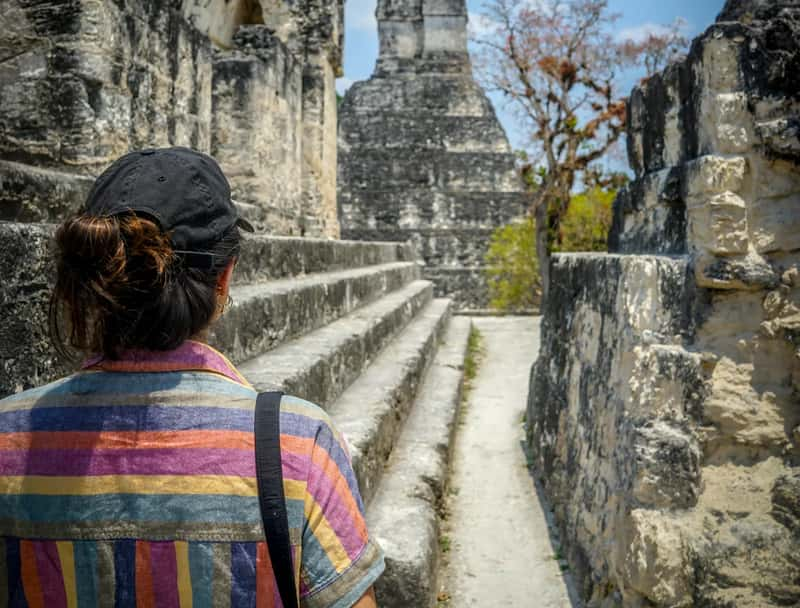
The stones don’t ask you anything.
They just stand there. Patient. Fractured. Magnificent.
You flew across an ocean to feel small.
And somehow, standing in front of a wall that has outlasted every empire, every ideology, every version of the person who built it – you feel more like yourself than you have in years.
That’s the distance between the self you perform for the world – productive, linear, purposeful – and the self that needs to stand in a field of broken columns at dusk and simply breathe. The modern world has no script for that person. No productivity metric. No LinkedIn headline. So they book a flight. They find the ruins. They go looking for proof.
1. The Ruinenlust Confession
There is a German word for this. There is always a German word.
Ruinenlust. The compulsive, aching desire to seek out what has fallen apart.
And it is not a quirk. It is not a personality type or a niche travel trend.
It is a confession. A quiet, persistent admission that the broken thing still has something to say. That you still want to hear it. That maybe – just maybe – its brokenness is exactly what makes it worth standing in front of.
The person who books a flight to Machu Picchu or Angkor Wat or the Roman Forum is not chasing history.
They are chasing permission.
Permission to believe that something can be utterly abandoned and still be radiant.
Psychologists suggest our fascination with ruins taps into deep-seated emotions about mortality, memory, and the impermanence of human achievement. But the obsession runs deeper than death anxiety. It is a belief system. A quiet revolt against the modern world’s insistence that only new things have value.
2. The Identity Gap
You have a version of yourself that the world approved.
Reliable. Presentable. On time.
And then there is the other version. The one that wanders. The one that doesn’t need wifi. The one that stands in the doorway of a 3,000-year-old temple and feels, inexplicably, like they’ve come home.
We don’t just visit ruins – we carry them. Crumbled beliefs. Past relationships. Versions of ourselves that no longer fit but still echo inside. There’s a reason these broken places move us so deeply: they reflect our inner landscapes. We are patchworks of what’s been built and what’s been lost.
The identity gap is the space between who you were supposed to become and who you actually are.
Ruins don’t judge that gap.
They inhabit it.
In contemporary times, international travel is closely linked to heritage, driven by tourists seeking a sense of security in the past amidst global uncertainties and expressing identity through historical connections. The ruin, then, is not an escape. It is an anchor.
3. The Wabi-Sabi Operating System
The West has a word for beautiful things. It just doesn’t have a word for beautiful broken things.
Japan does.
Psychologists call it ruin aesthetic, a subset of nostalgia and wabi-sabi – the Japanese worldview that honors imperfection and transience.
And when you find yourself drawn to a crumbling arch, to moss eating limestone, to a colonnade half-swallowed by jungle – you are not being morbid.
When you find a crumbling wall beautiful – genuinely, viscerally beautiful – you are rewriting your own aesthetic operating system. You are telling your brain: perfection is not the prerequisite. Survival is. Evidence of time is. The scar that proves something happened here is.
This is a radical act in a world built on polish and optimization.
The ruin-seeker is not retreating from modernity. They are quietly dismantling it, one cracked stone at a time.
The Japanese ideal of Wabi-Sabi extols the virtues of imperfection. The belief, which is closely tied to Zen Buddhism, is that nothing can be perfect and that tiny flaws can heighten the beauty of an object.
4. The Archaeology of the Self
You didn’t come to study history.
You came to study yourself.
The ruin-seeker is not a tourist. They are an archaeologist of the self. Every cracked tile speaks to a version of something that once held together. Every collapsed wall is a referendum on permanence. And somewhere in the act of walking through it all – carefully, reverently – the explorer begins to take inventory. Of their own load-bearing walls. Of the rooms in themselves they have boarded up and stopped visiting. The abandoned place is not external. Not really.
This is the intelligence the ruins carry.
They are not asking you to grieve the past. They are asking you to reckon with the present. With what you have walled off. With what you have left to decay inside yourself because the renovation felt like too much work.
The gap between who you were and who you are is not a failure. It’s architecture. And architecture, the ruins remind you, can be beautiful even when the roof is gone.
5. The Hypothesis You’re Testing
I remember the first ruin that undid me. Not a ticketed site. Not a UNESCO landmark with an audio guide in six languages.
It was a half-collapsed stone wall at the edge of a field in southern Europe. No plaque. No context. Just centuries of patient endurance, standing in the afternoon light like it had been waiting specifically for me to show up and notice it.
I stood there for longer than made sense. I couldn’t explain it then. I can now.
Every person who makes the deliberate journey to an abandoned ruin or a ghost town is, at some level, conducting an experiment. They are testing a hypothesis the modern world aggressively resists: that something can lose its original function – entirely, irreversibly – and still be worth standing in front of.
The wall had lost everything it was built to do. It protected nothing. It enclosed nothing. It was, by every functional metric, a failure.
And it was the most beautiful thing I had seen in years.
The experiment succeeded. The hypothesis held. And something shifted in me that I didn’t have language for until much later.
6. The Mortality Mirror
Here is the thing about standing inside something that has outlasted everything.
You start asking the hard questions.
When you walk through a derelict building, you are stress-testing something in yourself. You are asking: if everything fell apart, what would remain? What would be worth preserving? What would prove that we were here and that it mattered?
The ruin does not let you be abstract about mortality. It makes it physical. Tactile. You can put your hand on the wall and feel it.
Something more specific, more human: the fear of irrelevance. The fear that we were here and no one will know. The fear that the apartment we arranged with such care will one day sit empty, peeling, and silent – and someone exactly like us will stand in the doorway and feel the exact same beautiful, annihilating feeling.
The ruin is compassionate about this fear. It doesn’t resolve it. It just shows you that the fear itself has endured for thousands of years. You are not the first person to stand here feeling small. You are, in fact, part of a very long line.
7. The Sensation Seeker’s Real Hunger
We tell ourselves we go for the history. For the culture. For the Instagram shot.
We are lying, a little.
Abandoned sites practically drip with half-told tales. The peeling wallpaper, the scattered papers on the floor, or the rusted machinery each raise silent questions: Who lived here? What were their dreams? Why did they leave? These places never provide a definitive answer, which only increases our desire to learn more. It’s a continuous puzzle, and our minds can’t resist trying to piece it together. This drive is related to the psychological concept of sensation seeking – a personality trait characterized by a desire for novel, complex, and intense experiences.
But the real hunger is not sensory. It is existential.
We are hungry for proof that effort leaves a mark. That a life, even one lived in obscurity, accumulates into something someone will one day stand in front of and feel something.
Evidence that ordinary lives leave marks. That the small, domestic, unremarkable things we do each day – they accumulate into something someone will one day call a ruin. And find beautiful. And photograph. And carry home in their chest.
8. The Place That Recognized You Back
There is a psychological bond that forms between people and places that matter to them.
Not just preference. Not just affection. Something deeper.
Place attachment refers to the affective bond that develops between individuals and specific locations that matter to them. This bond evolves through emotional connections, shared meanings, and personal understandings of a specific place or its features. It is not merely about liking a location – it is a deep psychological connection that shapes behaviour, identity, and well-being.
The ruin triggers this bond with unusual ferocity. Because the ruin asks nothing of you. There is no performance required. No dress code. No correct way to feel.
I expected to feel like a trespasser. Instead, I felt – and I am still reaching for the right word – recognized. Not by the building. By myself.
That is the real gift the ruins give. Not history. Not beauty. Not even meaning.
Recognition. The quiet, devastating sense that the broken place and the not-quite-whole person standing in front of it have found each other. And that both are, improbably, still standing.
9. Nature Takes It Back
The vine doesn’t ask permission.
It just grows.
Through the window frame. Up the column. Across the mosaic floor where sandals once shuffled toward some forgotten ceremony.
One of the most hauntingly beautiful things about ruins is the way nature reclaims them. Vines threading through stairwells. Moss coating stone. Trees sprouting through floorboards like ghostly rebirth.
And we don’t fear this. We photograph it. We frame it. We post it. We stare at it on screens at 2 AM and feel something we can’t name.
There is a specific, almost unbearable tenderness in watching something green grow through concrete.
Because it is proof that the world does not need our maintenance to be extraordinary. That beauty is not a managed thing. It is a persistent thing. A thing that happens in the dark, in the wet, in the long silence between one civilization and the next.
The ruin-seeker who stands in the overgrown forum, among the weeds splitting the marble, is watching something they desperately need to believe: that even when you stop tending to something, it doesn’t disappear. It transforms. It finds a new form. Something grows through the crack.
10. The Proof You Were Always Looking For
This is the heaviest one. Stay with it.
The obsession with ancient ruins is not about the ancient. It was never about the ancient.
It is about the abandoned.
Something in us wants to believe that meaning lingers even when life does not. And the ruin – standing there in its patient, moss-covered refusal to disappear – is the most tangible proof we have that this belief is not naive. It is correct. The hypothesis holds. The experiment succeeds. The ruin is beautiful. Devastatingly, triumphantly, quietly beautiful – not despite what it has lost, but because it kept standing after losing it.
You have been abandoned too. Or you have felt that way. By a person. By a version of yourself you outgrew. By a life that didn’t go the way the blueprint said it would.
And somewhere in you, beneath the productivity and the performance and the careful curation of your public-facing self, there is a question you have been carrying for years.
Can something still be beautiful after it has been completely let go?
You fly to Rome. You walk through Pompeii. You stand at the edge of Chichén Itzá at golden hour. And the answer rises up through the dust and the moss and the long afternoon light, not as a thought but as a feeling.
Yes. Yes. The answer is yes.
These spaces demand nothing from us while offering everything – a chance to see time made visible, to feel the pull of absence as strongly as presence, to let our minds build what our hands cannot. In their brokenness, ruins become more generous than any complete structure could be. They give us room to imagine, permission to linger, and proof that even after everything falls away, meaning endures in the fragments.
The traveler who returns from the ruins does not come back with souvenirs. They come back with something more durable. A recalibration. A quiet renegotiation with the parts of themselves they had marked for demolition. The broken self, it turns out, has the same structural logic as the broken wall. It holds. It weathers. It becomes, with enough light hitting it at the right angle, something worth crossing an ocean to see.
The ruin was never the destination. You were.