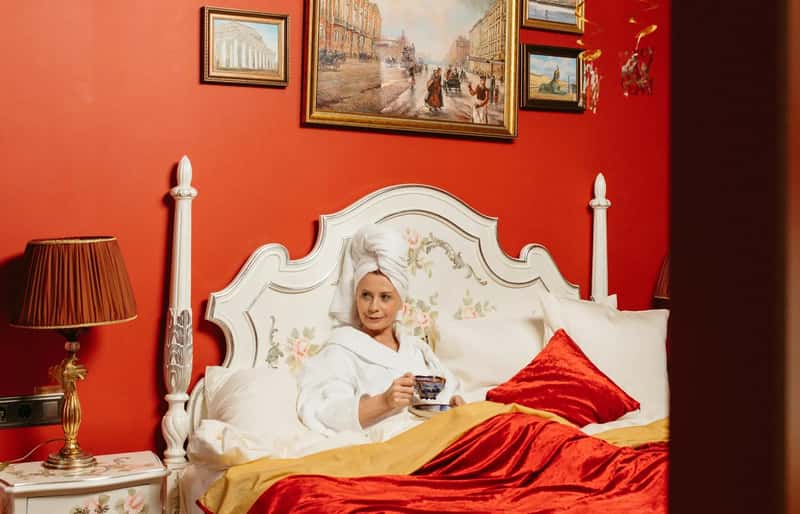
You check in alone.
No one is watching.
The room is extraordinary.
And something in your chest – something old, something pre-verbal – finally exhales.
There is a gap that exists in modern life. It lives between the person you perform in public and the person who stands barefoot on a hand-knotted rug at 11 PM, staring at a painting that was chosen by a human being, not an algorithm. The psychology of travel shows us that journeys are not simply market choices – they are expressions of identity, emotion, and personal aspiration. And the boutique hotel obsession is perhaps the most honest version of that truth. It is not about the room. It is about the question the room forces you to answer: Do I believe I deserve this?
The Permission Slip
You don’t book a boutique hotel the way you book a flight. You linger. You read reviews like you’re reading a letter from someone who already understands you.
What you are looking for isn’t a thread count. It isn’t a rainfall shower. It is something far more fundamental: proof that you are allowed to want beautiful things.
Psychologists have long recognized that our surroundings act as an extension of identity – the objects, colors, and routines that make up “home” help to stabilize our sense of self. Space is a vital component of an individual’s identity – locations can be grounds for activating certain identity content and providing a sense of security and belonging. The boutique hotel, with its handpicked art and deliberate scent, is a space that activates a very specific identity content: the version of you who always deserved tenderness. Who simply wasn’t always told so.
You book the room. You sign the slip. You arrive.
The Reparenting Room
There is a clinical concept that quietly explains everything happening when you walk through that door.
Reparenting is the act of giving yourself what you didn’t receive as a child. It sounds simple. It is, in practice, one of the most quietly revolutionary things a person can do with a Tuesday evening and a room with good lighting.
Feeling deserving of care and comfort, and the belief that your needs matter – these are learned behaviors. Some of us learned them early. Others are still in the classroom, checking into a sixteen-room converted townhouse in Lisbon, learning for the first time that the world is capable of preparing something beautiful specifically for them.
The boutique hotel is not an indulgence. It is a lesson. And some of us are very behind on coursework.
The Audience Problem
Here is what separates the boutique hotel obsessive from the luxury traveler performing for Instagram.
They don’t need you to see it.
What we yearn for is identity enhancement. We are people who can make their way in a “foreign” setting. But the boutique hotel devotee is not seeking external validation of that identity. They are seeking internal confirmation. The beauty is for them. The experience is unshared. The candle burns for an audience of one.
Many travelers curate their identities online, and every moment they capture has to be filtered, polished, and adjusted to fit their personal “brand.” But some are less inclined to go with the flow, and more likely to go their own way. They don’t want what everyone else has – they want the opposite. They are obsessed with uniqueness. The true boutique devotee has moved one step further: they want beauty that does not require broadcast. They want to experience it, full-stop, period, alone with the good lamp.
The Narrative Identity
You are, whether you acknowledge it or not, always writing a story about who you are.
Every hotel you choose is a sentence in that story.
Travel aligns closely with the psychological concept of narrative identity, which suggests that individuals construct their sense of self through the stories they tell about their lives. The boutique hotel lover is constructing a very specific narrative: I am a person who lives slowly and beautifully, in spaces chosen with care, in rooms that were designed by people who gave a damn.
That narrative may be the most truthful sentence they ever write about themselves.
Psychologists refer to this as building a “self-narrative” that shapes how we view ourselves and our experiences. Luxury travel taps into this psychological aspect by providing environments that foster personal growth and introspection. The boutique hotel is not a backdrop. It is a collaborator in authorship.
The Quiet Recognition
I remember the first boutique hotel I ever booked alone. I was thirty-one. I was in a city where no one knew me. I had just ended something long and exhausting, and I chose a twelve-room hotel above a bookshop because the website said the beds had linen that took two days to dry.
I didn’t tell anyone where I was staying. That was the point.
I sat in a chair by a window for two hours. I didn’t read. I didn’t scroll. I just existed inside the fact that someone, somewhere, had chosen that exact shade of ochre for that exact wall, and it was doing something to my nervous system that no amount of therapy had fully managed.
The anticipation of an exceptional experience triggers a sense of excitement and delight even before arrival. The feeling of being valued and pampered fosters a sense of self-worth and prestige. But in that room, alone, there was no prestige. There was just presence. And it was the first time in a long time that presence felt like enough.
The Territorial Self
There is a specific behavior that boutique hotel devotees share. They arrange things.
Not because the room is wrong. But because the act of arrangement is a declaration.
In a temporary space, psychological ownership is the brain’s workaround for the absence of time. You cannot build belonging through years of memory. So you build it through the placement of objects, and you call it home, and it almost works.
The shoes placed just so. The book on the nightstand. The bag hung, not dropped. These are not acts of tidiness. Personalization is one of the most visible expressions of territoriality – it involves adding personal items or modifications to a space to make it reflect your identity. You are not decorating. You are asserting. You are quietly, desperately insisting that a person lives here now, even if only until Thursday.
A person who deserves to live here, no less.
The Sensory Contract
Boutique hotels are built on a very specific kind of seduction. It is not the seduction of grandeur. It is the seduction of intention.
Unlike standardized chain hotels that prioritize uniformity and operational efficiency, boutique hotels focus on symbolic depth, emotional engagement, and personalized service encounters that leave enduring impressions.
Research in neuroscience and psychology shows that multisensory experiences enhance memory formation through deeper neural processing. Sensory integration theory supports this, explaining how coordinated stimuli improve perceptual fluency and recall. Boutique hotels leverage this mechanism by designing cohesive sensory environments that include ambient sound, tactile interaction, and symbolic cues.
The body remembers what it was told it deserved. A space that speaks in texture, in scent, in the warmth of a specific bulb – it is a language the nervous system understands before the mind catches up. The reparenting is happening in the body, not just the brain.
The Inner Child in Room 7
There is a child somewhere inside the person checking in alone.
That child was told, in some way – through neglect or chaos or simply the ordinary scarcity of emotional attunement – that beauty was not for them. That comfort was conditional. That care had to be earned through performance.
Reparenting, which Lucia Capacchione invented in the 1970s, offers a transformative method for healing the wounds caused by insecure attachments to our childhood caregivers. By nurturing and validating this vulnerable aspect of ourselves, we learn to provide it with the love and protection it may have lacked in childhood.
Reparenting helps you address the deeply critical internalized messaging you received during childhood. Through consistent validation and gentle nurturing, you’ll start to believe that you deserve love and are valued, improving your self-esteem and reshaping your self-image. A carefully chosen hotel room, experienced alone, in full quiet, is one of the more unexpected venues for this work. And yet. Here we all are. In Room 7. Finally arriving.
The Solo Architecture
The boutique hotel is uniquely engineered for the psychology of solitude.
A boutique hotel is an independently owned, smaller property, typically 10 to 100 rooms, designed around a distinct atmosphere, personalized service, and a deep connection to its local destination. Unlike chain hotels, boutique properties are built around the individual guest rather than a standardized brand template.
That distinction is everything. You are not a unit of occupancy. You are a specific human with a specific nervous system, and the room has been arranged in full awareness of the fact that humans have nervous systems.
When travelers set off alone, they often leave behind the comforts of home and the company of others. That means the hotel’s physical spaces can make a big emotional impact. A warm, thoughtfully designed environment can help solo guests feel at ease and reduce the sense of isolation that can sometimes come with traveling alone. It’s not just about aesthetics – it’s about creating a place where guests feel they belong.
Belonging, for a single night, on their own terms. That is the whole architecture.
The Heaviest Truth
Here is what nobody says out loud about the boutique hotel obsession.
It is grief work.
It is the ongoing, quiet mourning of every environment that was chaotic when it should have been calm. Every childhood home where beauty was an afterthought, a luxury, something that happened to other families. Every adult apartment you never quite let yourself make into something lovely because you weren’t sure you’d stay, or weren’t sure you deserved to.
Originating in the late 20th century, reparenting was developed as a response to the growing recognition of the impact of childhood trauma on adult lives. At its core, reparenting addresses how childhood experiences, especially those involving neglect or absence of nurturing, shape our mental and emotional well-being.
Deep down, you may have been longing all this time for a parental figure you never got – one you may not ever be able to have because it simply is not possible for them. The boutique hotel does not replace that figure. It does something stranger and perhaps more sustainable. It becomes an environment that holds you the way you needed to be held. Without conditions. Without performance. Without anyone watching to make sure you earned it.
The last thing you do before you leave is stand in the doorway for a moment.
You take in the room one more time. The specific way the morning light falls across the floor. The chair you moved to face the window. The small, beautiful nothing of it.
You are not trying to memorize it. You are not composing a caption. You are doing something far more private and far more important: you are letting the evidence accumulate. Evidence that beauty exists in the world and that you, specifically, are allowed to stand inside it. That the good lamp was on for you. That the linen was pressed for you. That the ochre wall was chosen, ultimately, because somewhere in the long chain of human decisions and aesthetic instincts, someone understood that a person like you would walk through that door and need, more than anything, for the room to be ready.
Check-out is at noon. You are in no hurry.