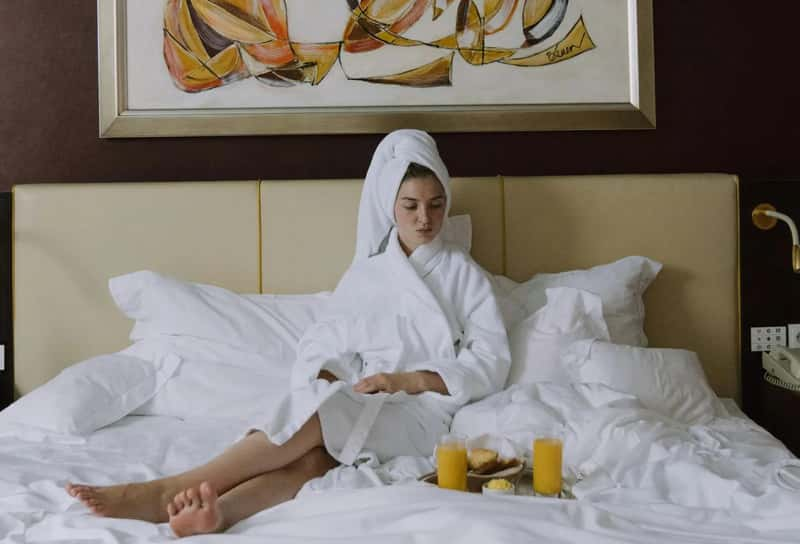
The curtains are still closed at 9 AM.
The city is already moving. You are not.
The breakfast buffet is happening without you. The itinerary says 8 AM checkout. You ignore it.
And somewhere between the hum of the HVAC unit and the soft indifference of a bed that belongs to nobody, you feel – for the first time in days – like yourself.
There is a particular kind of traveler who refuses to leave a hotel room until 11 AM. They are not lazy. They are not disorganized. They are not “bad at vacations.” They are, if you look closely enough, doing something neurologically sophisticated: using the only space on the entire trip that owes them nothing as a recalibration chamber for a nervous system that has been running someone else’s emotional software for far too long. The identity they walk around with in daily life – agreeable, available, accommodating – is a costume. The hotel room is the only place the costume comes off.
1. The Fawn Response Has a Tab, and It Always Comes Due
Before we talk about hotel rooms, we need to talk about what fills them.
Coined by therapist Pete Walker, the fawn response refers to a trauma-driven pattern of people-pleasing behaviors designed to diffuse danger when the brain senses threat – especially social or relational threat.
It looks like kindness. It feels like survival.
The fawn trauma response is a neurologically driven survival mechanism that compels individuals to prioritize others’ needs over their own to avoid conflict or danger. Rooted in chronic threat-detection patterns within the amygdala, fawning manifests as people-pleasing, boundary dissolution, and emotional suppression – behaviors researchers link directly to prolonged interpersonal trauma exposure.
Every smile you didn’t mean. Every “of course” you couldn’t afford. Every dinner party you attended exhausted, performing warmth like a second job. The nervous system keeps receipts. The hotel room is where you finally open the bill.
2. The Body Knows Before the Brain Does
You didn’t decide to stay in the room. You just couldn’t leave.
That distinction matters enormously.
Neuroception – the nervous system’s subconscious detection of safety or danger cues – triggers the fawn response automatically. When neuroception signals danger, the fawn response can activate before conscious awareness, leading to automatic appeasement behaviors.
The hotel corridor is full of strangers. The lobby is an unscripted social performance. The breakfast buffet requires you to navigate bodies, make small eye contact, perform the easy smile of a person who is fine.
The physical symptoms of social overstimulation are real: elevated heart rate, muscle tension, shallow breathing, and that hypervigilant feeling of being “on” all the time.
The room has none of that. The room just waits.
3. The Safe Container Is Not a Metaphor – It’s a Mechanism
Therapists use a technique called the “container exercise.” It involves guiding clients to visualize a secure, strong container where they can place distressing thoughts, memories, or emotions temporarily.
The hotel room is that container made physical.
Four walls. A locked door. No one who needs anything from you. No one reading your face for data. No one requiring your nervous system to stay “on.” This kind of self-soothing practice regulates the nervous system, helping you feel more calm and in control. Focusing on creating that sense of container naturally slows your breath and reduces body tension. This signals your body to shift from stressed to relaxed.
It is not avoidance. It is architecture.
The person lying in the hotel bed at 10 AM isn’t hiding from the world. They are doing biological maintenance the world never gave them time for.
4. Travel Breaks the System – Then Exposes What Was Already Broken
The airport is its own sensory assault. The check-in queue. The security line full of strangers’ moods. The gate agent who is already tired of people and it is only 6 AM.
Frequent travel isn’t just physically demanding – it’s psychologically disruptive. Even when everything goes smoothly, many travelers experience low-level tension: irritability in the airport, brain fog in meetings, restlessness in hotel rooms, or a subtle sense of disconnection. Over time, these small stress signals accumulate into travel anxiety, burnout, or emotional fatigue.
But here is the darker truth beneath the travel exhaustion.
For people-pleasers, the trip itself is just a change of stage. The performance continues. The social contracts follow you through passport control. The hotel room – finally, mercifully – does not require a performance at all.
When you repeatedly disrupt sleep, environment, and routine, your regulation bandwidth shrinks. You become more reactive not because you’re incapable – but because your nervous system is taxed.
5. I Know This Room
I have been that person.
I have lain in beds in three different countries – the curtains heavy, the do-not-disturb sign locked into place like a small declaration of autonomy – and felt my shoulders drop for the first time in days. Not because I was tired. Because I was no longer being perceived. There was no one to disappoint, no tone to manage, no energy to calculate and ration out in socially acceptable doses. The room asked nothing. And something in my chest – tightly wound for so long I’d forgotten it was wound at all – finally loosened.
I wasn’t on vacation. I was in recovery. People-pleasing has a high energy output. It is often hard for this person to be restful around others because they are constantly internally questioning what others need and how to meet those needs. The hotel room was the first place in days where I did not have to answer that question.
6. The Nervous System Has a Hierarchy, and You’ve Been Stuck at the Bottom
Dr. Stephen Porges’ Polyvagal Theory changed how we understand the nervous system’s relationship with safety.
Polyvagal Theory, developed by Stephen Porges, PhD, is a scientific framework focused on autonomic regulation – how the autonomic nervous system continuously organizes physiological state in response to environmental demands. Rather than simply describing responses to stress, Polyvagal Theory explains how autonomic regulation shapes the body’s ongoing capacity to maintain stability, support health, and adapt to changing conditions.
When humans feel safe, their nervous systems support the homeostatic functions of health, growth, and restoration, while they simultaneously become accessible to others without feeling or expressing threat and vulnerability.
For chronic people-pleasers, that ventral vagal state – the calm, connected, safe state – is rarely accessed in public. It requires an environment the nervous system can trust completely. The hotel room, for many, is the first fully trusted environment in months.
7. What the Body Is Actually Doing in There
It looks like doing nothing. It is, in fact, everything.
When you’re finally alone, your parasympathetic nervous system kicks in, allowing your body to return to its natural, regulated state.
The shoulders descend from somewhere around the ears. The jaw releases its careful clench. The breath – which has been shallow and performance-calibrated – drops down into the belly and stays there. Solitude can lower emotional intensity because fewer things are “pinging” your attention. With less input, your body gets a chance to shift gears. Heart rate settles. Thoughts line up. Your face relaxes.
This is not laziness. This is the body conducting its own audit. Quietly. On its own schedule. With the do-not-disturb sign as its only advocate.
8. You Were Never “Bad” to People. You Were Spent.
The cruelest trick the fawn response plays is making you believe the exhaustion is a character flaw.
Fawning isn’t just a personality trait – it’s a physiological state of chronic nervous system activation. And if you’ve been fawning your whole life, it’s no surprise your body is tired. Burnout is the natural result of a nervous system that’s been giving everything – and receiving nothing in return.
You did not fail at socializing. You succeeded at it so completely, so relentlessly, for so long, that the system finally demanded a reboot.
Post-social recovery isn’t a deficiency. It’s a signal that your social processing systems are sophisticated and thorough. The more attuned you are to others, the more data your brain processes, and the more recovery you need.
The hotel room at 10:47 AM is not a symbol of failure. It is a symbol of a nervous system that is finally, quietly, asking for what it has always needed.
9. The Identity Gap Lives Between the Lobby and the Room
There is a version of you that exists in public. Composed. Accommodating. Reading every room before entering it, adjusting tone and posture and energy to match what is needed. When you walk into a room, you’re not just having a conversation. You’re reading body language, managing your energy, filtering background noise, and often performing a version of yourself that fits the social context. For deep processors, this isn’t background activity – it’s front and center, demanding significant mental resources.
And then there is the version that exists behind the locked hotel room door.
That one does not perform. That one does not calculate. If you have spent a long time orienting around other people’s needs, feelings, and reactions, you can arrive at adulthood genuinely unsure of who you are. The hotel room is the only place that version gets any time at all. The gap between the lobby self and the room self is not a crisis. It is a map. It is showing you exactly where the work needs to happen – and exactly how much of yourself you’ve been leaving at the door of every relationship, every meeting, every gathering you ever attended.
10. Staying Until 11 Am Is Not the Problem. It’s the Answer.
Here is what the late checkout is really about.
A 2018 study published in Personality and Social Psychology Bulletin found that solitude, when chosen voluntarily, was associated with feelings of relaxation, creativity, and emotional regulation.
The key word is “chosen.” A locked hotel room door is a choice. Perhaps the clearest, most honest choice a people-pleaser makes all week.
Solitude is a deliberate choice to be with yourself. It’s recognizing that your own company is not just enough – it’s necessary.
Healing begins when the survivor learns that safety no longer requires self-erasure. And for those who have spent entire lifetimes earning their place in every room they entered, the hotel room – unchosen, temporary, anonymous – is the first room that requires no earning at all. You are there. That is enough. The 11 AM checkout is not a moral failure. It is a nervous system drawing a boundary, perhaps for the first time in years, without apology and without explanation.
There is something worth sitting with here – the particular quality of light in a hotel room at 10 in the morning. The muffled city sounds. The impermanence of a space that belongs to you for exactly this window and no longer. The way the mind, starved of social obligation, begins to remember what it actually thinks. What it actually wants. Who it actually is, beneath the layers of accommodation.
The person who cannot leave until 11 AM is not avoiding the world. They are recovering the self that the world spent all week borrowing without permission. They are conducting quiet, unglamorous, essential maintenance on a system that was never designed to run indefinitely on other people’s approval. The room is temporary. The repair is not.
And when they finally do open the door – when they step back into the corridor with its fluorescent hum and its strangers and its ordinary demands – they will be, in some small and unverifiable and completely real way, a little more themselves than when they came in.