Most people assume the smartest airport transfer is the cheapest one. Guides written for older passengers keep saying the opposite.
No formal poll ranks transfers by traveler age, so this list follows what accessibility guides, transfer providers and official sources say matters most after 70: fewer handoffs, known prices and real help with bags. The number one pick isn’t a vehicle at all, and it’s waiting at the end.
#15 – The Flat-Rate Pre-Booked Car

The price you see at booking is the price you pay, and that is the whole appeal.
Fixed-rate pricing removes the anxiety of surge pricing and fluctuating meters. Travelers on a fixed income know the exact cost before the trip begins.
One New York guide argues that for seniors, the best airport transportation usually means fewer transfers, more assistance, and predictable, calm rides rather than the cheapest fare. That flips the usual budget-travel advice on its head.
But the next option looks like a bargain, and the catch is easy to miss.
#14 – The Shared Shuttle

Shared shuttles are the cheapest door-to-door option on this list, and the most divisive.
The savings are real, because you split the fare with other passengers. Fares are usually fixed too.
The trade-off is time. Shuttles can take longer to reach your destination and usually make many stops along the way.
Here’s the honest split. A midday arrival with one small bag can suit a shuttle, while a red-eye arrival may not, and for many older travelers the saving can feel like a false economy once fatigue kicks in.
Quick Compare
- Shared shuttle: lower cost, but longer rides and many stops.
- Private pre-booked car: a fixed price and a direct ride, usually at a higher fare.
- Best fit for a shuttle: a midday arrival with one small bag.
- Best fit for a private car: a late-night arrival when you’re worn out.
The next option has one feature that shuttles rarely match.
#13 – The Official Taxi Stand With a Posted Fare

The old-fashioned taxi line still wins in one specific situation.
Airport taxis typically follow standardized fare structures regulated by local transportation authorities. Some airports go further and post a flat fare.
One 2026 New York guide lists a flat $70 fare from JFK to Manhattan, including tolls. Check that a flat fare exists before you queue, and steer clear of unofficial drivers who approach you inside the terminal.
Then there’s the app-based rival, and its biggest weakness may surprise you.
#12 – Rideshare, Timed Carefully

Rideshare is the option travelers over 70 argue about most.
Pricing changes with demand, time of day and traffic. One fare roundup found a weekday mid-morning ride from LAX to downtown at $35 to $42, but $80 or more on a Friday night.
There is a timing trick. Book outside peak arrival windows, or wait 15 to 30 minutes after landing and let the rush pass.
Fast Facts
- Weekday mid-morning, LAX to downtown: about $35 to $42.
- Friday night, same trip: $80 or more.
- Timing trick: wait 15 to 30 minutes after landing.
- What you can’t control: which car shows up.
The other drawback is that you don’t choose the car. Some travelers with stiff knees find a high SUV harder to climb into than a taxi, so some guides suggest skipping rideshare when mobility is the issue.
The next option solves the car problem completely.
#11 – The Early-Morning Pre-Booked Pickup

Pre-booking earns its money on the flights nobody wants to take.
One Minneapolis provider advertises an early morning guarantee for 3 AM and 4 AM airport runs. That is a marketing claim, but it points to a real gap.
A New York guide also names airport transfers and early-morning departures as situations where a pre-booked private car can be a good option. At those hours, hailing a ride on the spot can be a gamble.
Next up is a detail most people forget to ask about.
#10 – The Low, Wide-Door Sedan

The car itself can make or break a transfer for stiff joints.
One provider says it picks sedans for low ground clearance and wide door openings, which make it easier for passengers with limited mobility or joint issues to get in and out.
The catch is that nobody assigns the right car unless you ask. The same provider recommends mentioning any specific mobility concerns when you book.
Speaking of what rides along with you, the next pick is all about luggage.
#9 – The SUV or Van for Heavy Bags

Bags are the quiet reason many transfers go wrong.
For travelers with more gear, one provider points to an SUV as a spacious alternative. Another notes that private vehicles give travelers more room for luggage and personal items.
The mistake is booking the smallest car to save a few dollars. One provider warns that groups should match vehicle size to passengers and luggage, because a poor fit causes last-minute changes.
Couples with two large suitcases and a walker or cane should think this through. A bigger car often costs only a little more, but a second trip is always a hassle.
Once the car is sorted, the next pick covers what happens the moment you land.
#8 – The Baggage-Claim Meet and Greet

Landing is the hardest part of the trip, and it’s where a driver adds the most value.
Door-to-door services can include a chauffeur who handles meet and greet at baggage claim and takes you home without a wait. You don’t circle the terminal looking for a pickup zone.
These services may also assist with luggage handling, which matters after a long flight. Guides for older travelers often treat that as the main reason to pay more.
The next option is what keeps that meeting on schedule when your flight doesn’t.
#7 – The Flight-Tracked Pickup

Flights run late, and the wrong ride will punish you for it.
Some pre-booked services advertise flight tracking alongside patient, trained drivers. That means the pickup follows your actual landing time rather than the printed one.
Tracking also runs the other way. Providers describe how real-time tracking can show vehicle progress before pickup begins.
Ask whether a delay costs extra, because waiting rules are a detail many people skip. Those rules and the support options should be easy to understand before you pay.
At a Glance
- Pickup time: follows your actual landing, not the printed schedule.
- Vehicle progress: real-time tracking can show it before pickup begins.
- Ask first: does a delay cost extra, and how long will the driver wait?
- Get in writing: support options and contact details.
The next pick involves a pairing most travelers have never considered.
#6 – The Accessible Ride Paired With Terminal Help

Two services can work together, and few people plan for it.
One guide says seniors using airport-provided wheelchairs inside the terminal can still pair that with private car service outside for the door-to-door portion.
The handoff is the tricky part. Drivers can meet at designated accessible pickup points, helping seniors reunite with airport wheelchair staff at curbside.
And the wheelchair half of that combination is a service many people misunderstand.
#5 – The Curb-to-Gate Wheelchair Escort
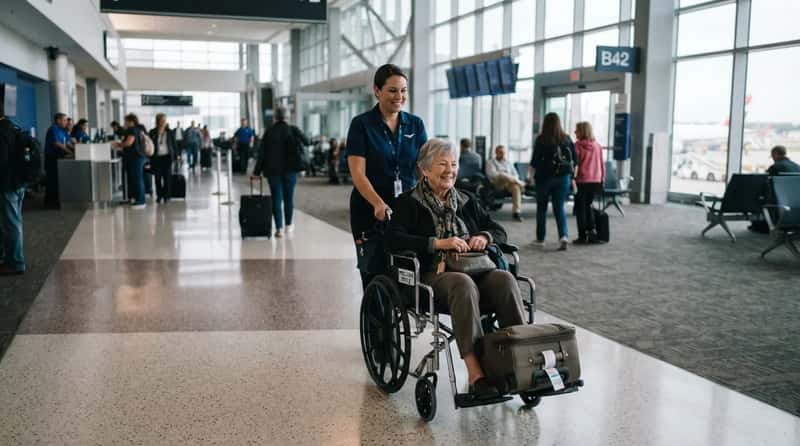
Many proud, independent travelers refuse this one, and the guidance suggests that’s a mistake.
Here is a fact people often miss: airport wheelchair service is provided by your airline, and TSA does not provide it. Help can start at the terminal entrance or vehicle drop-off point and continue to the gate.
It costs nothing, though the guidance suggests considering a tip for those who assist. Contact the airline ahead of time, and one guide suggests at least 48 hours before the flight.
The next pick covers the layover problem, which is where many older travelers get stuck.
#4 – The Gate-to-Gate Connection Transfer

The hardest transfer of many trips isn’t the ride. It’s the layover.
Airlines can often arrange gate-to-gate assistance for older travelers who may feel overwhelmed navigating a large airport alone.
It helps most during layovers, terminal changes, or busy travel periods with long walking distances and crowded boarding areas.
Arrival airports matter too. AAA advises that travelers can call the arrival airport to arrange for wheelchair assistance to meet them at the gate, and tight connections are where that tends to pay off.
The next one is a transfer you may not even book yourself.
#3 – The Ride Your Family Books for You

Sometimes the most valuable part of a transfer is who arranges it.
One guide points out that adult children or caregivers can pay from anywhere and receive receipts by email. Tipping can also be handled in advance, depending on family preference.
That takes the payment step off the traveler entirely. Families get peace of mind from knowing their loved one is in good hands.
The next option goes beyond the airport itself.
#2 – The Airport-to-Cruise-Terminal Link

Cruise days add pressure that a normal airport run doesn’t have.
One Seattle provider notes that a cruise terminal transfer can connect hotels, airports, or homes. Direct service also keeps luggage with the same travel group.
That matters at the ship. The same provider says families and seniors may need more time during boarding and unloading.
Fewer separate vehicles means fewer places for a bag to go missing or a schedule to slip. It is a practical case for one continuous transfer instead of stitched-together rides.
Why It Stands Out
- It can link hotels, airports or homes to the cruise terminal.
- Luggage stays with the same travel group.
- Fewer vehicles means fewer handoffs and fewer missed connections.
- Extra time is built in for boarding and unloading.
But the top pick goes even further, and it’s the idea guides keep returning to.
#1 – The End-to-End Escort From Door to Door

The most valued transfer isn’t a vehicle at all. It’s the absence of gaps.
Door-to-door service means travelers are picked up from their doorstep and dropped off at the correct terminal. Paid escort services extend that inside the airport.
One escort provider describes someone physically staying with the senior traveler until they board, or on arrival until they reach their car. That is the stretch where most transfers fall apart.
One caution applies. Standard airport assistance is not a substitute for a caregiver, nurse, or medical travel companion, so if you need that level of care, plan for it separately.
The Bottom Line
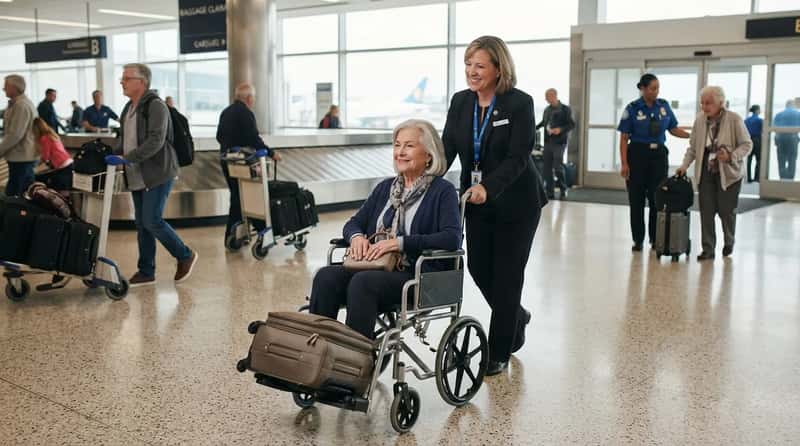
The pattern is clear across every source: older travelers are told to value fewer handoffs over the lowest fare. The ranking isn’t about luxury. It’s about removing the moments where a trip goes wrong.
Fixed prices, the right vehicle, a driver at baggage claim and free airline wheelchair help all target the same problem. Wheelchair service comes from your airline, and TSA’s special accommodations start at 75.
Would you take a longer shared shuttle to save money, or pay more for a door-to-door escort?
Bonus: The Insider Trick Nobody Tells You

Ask your airline for the right wheelchair service code, not just “a wheelchair.” Airlines commonly sort assistance requests into three levels, and the level you name decides how much help shows up.
- WCHR: you can climb stairs and walk short distances, but need help over long terminal distances.
- WCHS: you can’t manage stairs, but you can move around the cabin on your own.
- WCHC: you can’t walk and need help all the way to your seat.
Request the level when you book the flight, then call the airline again a couple of days before departure to confirm it is on your reservation. Do this for the outbound and the return flight separately.
Then give your driver the same details. Send your flight number, the level you requested, and the curbside meeting point in writing, so the car and the airport staff are waiting for the same plan.