The gate is empty at 4 AM.
Your boarding pass is in your hand for the sixth time.
The flight hasn’t moved. The departure board hasn’t changed. But your mind has already landed in three different catastrophes.
You’ve rerouted. Reboooked. Imagined the hotel room wrong, the weather wrong, the whole thing arriving slightly off – like a photograph that’s been developed in someone else’s darkroom.
This is to avoid disappointment. You think about the chasm between who you perform yourself to be – the excited traveler, the spontaneous spirit, the person who “just goes with it” – and who you actually are when structure dissolves and the unfamiliar closes in around you. Travel strips the costume. It takes your daily architecture, your routines, your ambient certainty, and it dismantles all of it.
1. The Brain That Won’t Clock Out
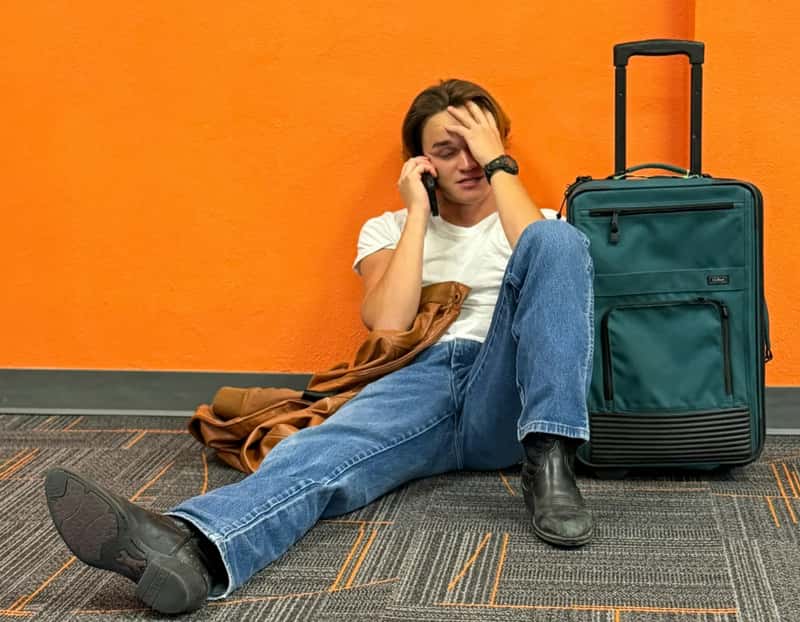
Your worry is not random. It is biological.
The brain has evolved to err on the side of caution, and its default setting is to treat the unknown as inherently aversive. It is constantly scanning for danger and remains on guard for things that may cause additional stress.
This is the ancient logic of survival dressed in modern clothes. A missed connection. A lost passport. A hotel that looks nothing like its photographs.
The brain doesn’t care that it’s a vacation. It cares that you are exposed. Unmoored. Outside the perimeter of the known.
Your nervous system reads “new city” the same way it once read “new terrain.” As potential threat.
So the worry begins. Not because something is wrong. But because your brain is performing its oldest, most loyal function: keeping you one move ahead of whatever might go sideways.
This isn’t pessimism. This is evolution wearing the wrong badge.
2. The Defensive Pessimist
There is a name for what you are doing. Psychologists call it defensive pessimism.
Defensive pessimism is a strategy that involves assuming that things will go wrong – that’s the pessimism part – and thinking through what might go wrong in concrete and specific detail – that’s the defensive part.
It is not a character flaw. It is a cognitive tool.
Defensive pessimism is a cognitive strategy in which an individual sets a low expectation for their performance, regardless of how well they have done in the past. Individuals use defensive pessimism as a strategy to prepare for anxiety-provoking events. Defensive pessimists then think through specific negative events and setbacks that could adversely influence their goal pursuits. By envisioning possible negative outcomes, defensive pessimists can take action to avoid or prepare for them.
This is not the same as believing the world is burning. It is the act of building a quiet fire extinguisher before you smell smoke.
The worrier on the plane is not afraid of flying. They are afraid of being caught off guard. There is a difference. A critical, humane difference.
3. The Tragedy Dress Rehearsal
You run the scenarios. Every one of them.
The delayed flight. The lost luggage. The restaurant that’s closed. The room with the noise. The tour that leaves without you.
For some people, this tragedy-dress-rehearsal process can turn into the extreme – constantly thinking about worst-case scenarios and overestimating the probability of a stressor occurring.
But here is the quiet truth that gets lost in the noise of wellness culture’s obsession with positive thinking.
The rehearsal is not irrational. It is preparatory theater.
By envisioning the “worst case,” individuals set a low expectation, further allowing for psychological preparedness, as anything better is less emotionally taxing.
The traveler who imagines the delay is the same traveler who already has a backup flight screenshotted. Who has the airline’s number memorized. Who won’t stand frozen at the gate, unraveling, because they already lived through this moment – quietly, at home, at 11 PM, in the dark.
4. The Expectation Gap
Social media has made travel harder for the psychologically sensitive.
We find ourselves looking up pictures of mouth-watering Japanese sushi, rolling Tuscan hills, and idyllic Swiss villages during work calls. But this puts pressure on our vacation as we cling to an idealized version in our head. Meaning anything different from this vision, in reality, inevitably feels like a disappointment.
The gap between the dream and the arrival is where the anxious traveler lives in advance.
They are not pessimistic. They are pre-grieving the gap before it forms.
High expectations baked by social media and marketing lead to disappointment if reality doesn’t match an idealized image.
The worried traveler knows this instinctively. They have been disappointed before. They remember the feeling of arrival – the specific, quiet deflation when the real thing doesn’t match the image pinned in their head.
So they lower the pin. They protect the landing zone. They cushion the crash before it happens.
5. The Weight of Old Arrivals
I remember standing in a train station in a city I’d wanted to visit for years. It was raining. The train had been delayed. The hotel was further from the center than the listing had suggested, and the “charming local neighborhood” turned out to be a construction site wearing scaffolding like a wedding veil.
I hadn’t worried enough beforehand. I had let myself hope fully, openly, embarrassingly.
The disappointment was clean and total.
After that, something shifted. Not into cynicism. Into something quieter and more functional. I began to run scenarios before I left. I began to ask: what if this isn’t what I think it is? I began, without knowing the clinical term for it, to practice defensive pessimism. And the trips that followed were richer for it – not because they went better, but because I arrived with lower expectations and genuine delight when small things exceeded them.
If something even mildly positive happens instead, you can enjoy that to its fullest. After all, you weren’t expecting anything good to happen at all, so even the smallest happiness is better than what you expected.
6. The Identity in Transit
Travel is supposed to liberate you from your identity. That’s the pitch. New city, new self.
But the self doesn’t vanish at the departure gate. It travels in carry-on.
Traveling can trigger anxiety due to being out of familiar surroundings, meeting new people, or experiencing new foods, which may make you feel insecure and worry about emotional reactions.
The anxious traveler is not afraid of the new place. They are afraid of encountering a version of themselves that doesn’t know the rules. Who can’t read the room. Who doesn’t know where the emergency exits are – metaphorically and literally.
The worry is a way of sending that version of yourself ahead. A scout. A shadow-self who walks the route first, checks the sightlines, and reports back: here’s what might go wrong. Here’s what you need to carry.
That shadow-self is not your enemy. It is your advance team.
7. The Control Paradox
Here is the paradox that defines the anxious traveler: they worry because they care deeply about the experience going well.
Travel often involves situations that are beyond one’s control, such as flight delays, lost luggage, or unexpected changes in plans, which can exacerbate anxiety.
The person who doesn’t worry isn’t braver. They just care less about the outcome.
The worry is a measure of investment. Of how much this trip means. Of how much weight has been placed on those days away from the ordinary.
People who need predictability feel threatened by travel’s many unknowns – delays, weather, crowding.
But needing predictability is not a weakness. It is a sign of a mind that has learned – often through hard experience – that the gap between planning and reality is real, and that closing that gap requires active cognitive work. It requires looking at the thing that could go wrong and staring at it until it loses some of its power.
8. The Performance of Positivity
The culture around travel demands that you be a certain kind of person.
Spontaneous. Relaxed. Hashtag-blessed.
But there is a quiet cruelty in asking the anxious mind to perform enthusiasm it doesn’t feel.
Asking people who use this coping style to instead adopt an optimistic outlook can even reduce their task performance, interfering with the management of their anxiety and causing more anxiety.
Toxic positivity on a trip is its own form of gaslighting. It tells you that your worry is the problem. That if you just believed harder, the flight would be on time. That your nervous system is an inconvenience to the vacation aesthetic.
Telling an anxious mind to not worry is as useful as trying not to get wet in a rainstorm by thinking sunny thoughts; better to just open the umbrella.
The umbrella is the worry. The preparation. The scenarios run in quiet. The anxious traveler is not ruining the trip. They are waterproofing it.
9. The Outperforming Pessimist
Here is the part the optimists don’t like to hear.
Someone who practices defensive pessimism may even outperform an optimist of similar abilities.
The anxious traveler – the one who checked the transit map three times, who confirmed the reservation, who looked up the local emergency number, who packed an extra phone charger – often has a better trip. Not because luck favored them. But because they didn’t leave anything to luck they didn’t have to.
If someone is traveling and worried about things that could go wrong, they may plan to arrive at the airport several hours ahead, double-check the confirmed housing accommodations, pack essential items in a carry-on bag, and look for travel-related updates before leaving home. This form of pessimism comes with anticipation of possible negative outcomes but also with strategies to reduce the likelihood of each occurring.
Preparation is not fear with a planner. It is intelligence in motion.
10. The Softest Armor
The heaviest truth is this: the worry is an act of love.
Love for the trip. Love for the people on it. Love for the version of yourself you are trying to protect from disappointment’s particular sting.
Lowering expectations isn’t pessimism by nature – it’s because protecting your heart becomes a form of survival. It feels safer not to hope too loudly.
The anxious traveler has been burned before. Not necessarily on trips. In life. In the accumulated weight of moments where the anticipated joy didn’t match the delivered reality. Where the thing they looked forward to arrived broken, or late, or simply smaller than the space they had made for it inside themselves.
So they wear the worry like the softest armor. Not iron. Not impenetrable. Something closer to a layer of careful attention. A quiet vigilance that says: I care about this enough to protect it from my own unmet expectations.
It’s the mind trying to stay one step ahead of disappointment. And that, at its core, is not a flaw. It is a kind of devotion.
The hard part – the part nobody writes on the travel blog or captions beneath the golden-hour photograph – is that staying one step ahead is exhausting. The mind that runs the scenarios doesn’t get to fully rest in the departure lounge. It doesn’t fully arrive, even when the plane lands. It is always somewhere between the itinerary and the contingency plan, checking, recalibrating, adjusting for what hasn’t happened yet.
What the anxious traveler deserves is not to be told to relax. Not to be handed a glass of airport wine and advised to “just enjoy it.” What they deserve is to be seen – for the cognitive work they are doing, the emotional labor of caring deeply about something while simultaneously building walls around that caring to protect it from collapse. The worry is not the opposite of joy. It is joy’s bodyguard. Unglamorous. Necessary. Quietly devoted.
Somewhere between the packing list and the passport check, between the backup plan and the boarding gate, there is a person who loves the idea of the journey so much they are willing to carry the weight of every possible version of its failure just to protect the one version where it goes beautifully right. That person is not a pessimist. They are someone who has simply decided that hope, for them, needs a parachute – and they’d rather pack it themselves.
You Might Also Like:
- People Who Can Navigate A Foreign City Alone Without Feeling Awkward Have Developed True Self-Sufficiency—But It Often Comes From Not Trusting Others To Lead
- People Who Feel Stuck In Life Usually Aren’t Missing Motivation—They’re Repeating These 10 Daily Habits That Quietly Keep Them From Ever Booking The Flight