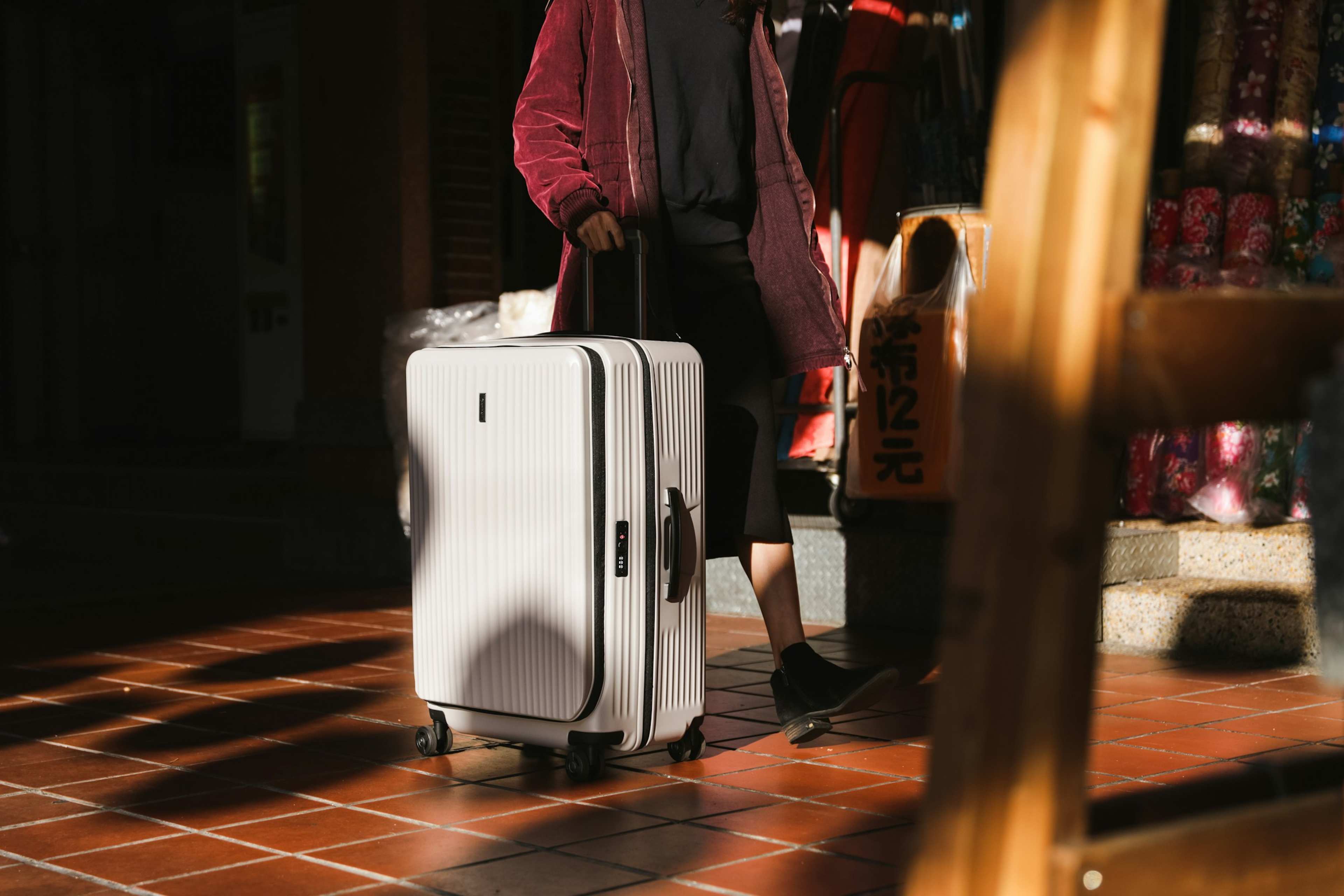
The key card blinks green.
You push the door open with your shoulder.
The room smells like no one.
Laundered neutrality. A painting that was chosen by a committee. A thermostat already set for someone who isn’t you.
And yet – within minutes – the suitcase is open on the bed, and your hands are moving fast.
Too fast for someone who’s supposed to be relaxing.
There is a gap between the traveler you perform and the person doing the unpacking. The one who books the trip with confident ease. Who posts the boarding pass to their story. Who says, casually, I travel a lot for work. And then the one who arrives – quietly frantic, pulling folded shirts from a bag like a person trying to prove something. That gap has a name. It’s called the Identity Gap. The distance between the self you project and the self that negotiates with temporary rooms.
1. The Territorial Instinct
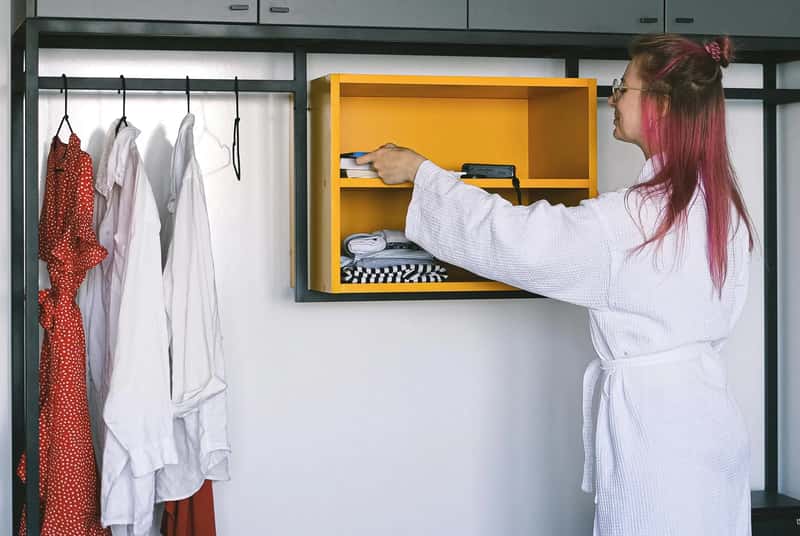
Every day, without thinking about it, we claim spaces as our own – placing a bag on a chair to “save” it, arranging personal items on a desk, feeling a jolt of discomfort when a stranger stands too close. These are all expressions of territoriality: a deeply rooted pattern of behavior in which individuals assert control over physical spaces, objects, or even ideas.
The hotel room is the purest test of this instinct.
No memories live here. No photographs on the walls. No evidence you’ve ever existed anywhere.
We are, at a cellular level, border-drawing creatures. One of the most influential explanations comes from evolutionary psychology, which argues that territoriality evolved as an adaptive strategy to help humans secure access to essential resources. Individuals who successfully defended their territory had a better chance of survival and reproduction, passing on these tendencies to future generations.
So when you unzip that bag on a Tuesday evening in a city that doesn’t know your name – understand this.
You are not being organized. You are being ancient.
The instinct is older than language. Older than maps. It is the same animal urgency that once built fires at the mouths of caves.
Now it hangs blazers in hotel closets instead.
2. The Ghost Architecture
You lay your book on the nightstand.
You plug your charger into the outlet closest to the bed – your outlet, now.
You angle the chair toward the window.
Personalization is one of the most visible expressions of territoriality – it involves adding personal items or modifications to a space to make it reflect your identity. You are not unpacking clothes. You are building a ghost of home in a room that will forget you existed by checkout time tomorrow.
This is the architecture of the temporary self. Invisible. Functional. Slightly heartbreaking.
You build it fast, because you’ve built it before. You know the blueprint by heart.
Toiletries to the left of the sink. Shoes parallel to the bed. Jacket over the chair, not in the closet – never fully in the closet, because that would mean you’ve committed.
Ghost architecture is not about comfort.
It is about the psychic need to leave a fingerprint on a room that is designed to resist fingerprints.
The hotel will bleach the sheets. The cleaners will erase you by 11 a.m.
And still, you build. Because the building is not for the room. It is for you.
3. The Belonging Deficit
There is a word for what you are actually looking for.
It is not adventure. It is not escape. It is not even rest.
A sense of belonging – the subjective feeling of deep connection with social groups, physical places, and individual and collective experiences – is a fundamental human need that predicts numerous mental, physical, social, economic, and behavioral outcomes. Fundamental. Not optional. Not a preference. A need.
And travel strips it. Surgically. Efficiently.
Here is what travel does: it removes the scaffolding of belonging with efficient, indifferent precision. New city. New bed. New light coming through different windows at a different angle. Your usual coffee shop doesn’t exist here. Your usual morning walk leads somewhere wrong. The mirrors are in different places. You look different in them.
You unpack to manufacture what the room refuses to provide.
Belonging, made from folded cotton and a travel-sized shampoo.
It almost works. Most nights, it almost works.
4. The Open Wound of the Suitcase Left Packed
Not everyone unpacks immediately.
Some people leave the bag zipped. They live around it like a fault line. They pull items out reluctantly, one at a time, as though the act of fully emptying the suitcase is a form of surrender.
This is equally revealing.
Some travelers leave the suitcase open on the floor like a wound. They pull things out one item at a time, reluctantly, as though committing to the space means surrendering to it.
To leave the suitcase packed is to refuse the room. To say: I am not really here. I can leave at any moment. My life exists elsewhere and I am merely passing through this rectangle of beige carpet.
When everything stays zipped inside the bag, your identity stays zipped too. There is something psychologically destabilizing about living out of a suitcase for days on end. Your objects are compressed, folded against each other, stripped of context. Your favorite shirt is just fabric in a dark cylinder. Your journal is just paper under pressure. Nothing has its relationship to space. Nothing has its meaning.
Two kinds of travelers. Two kinds of fear.
One is afraid of not belonging. The other is afraid of belonging somewhere that won’t last.
5. The Anchor Object
I need to tell you something personal here.
I have a notebook. Black cover. Slightly bent in the bottom-left corner from being shoved into too many bags. I have carried it to fourteen cities in the past three years. I have never finished it. I don’t write in it every night. Sometimes I go four days without opening it.
But it comes out of the bag first. Every time. Before the charger. Before the toiletries. It goes on the nightstand before anything else has a place.
I thought I was sentimental. I was not. I was anchoring.
The small object – the familiar book, the notebook, the worn toiletry bag – that you place in the room not because you need it, but because it carries information about who you are. When we step out of our everyday environments and routines, we undergo a temporary rearrangement of our identities – one that lets us imagine other possibilities for ourselves. The anchor stops the rearrangement from going too far. It holds the thread back to the person you were before you checked in.
The anchor object is not about the object. It is about the self it keeps tethered.
Find yours. You already know what it is.
6. The Control Performance
You adjust the thermostat.
Not because you’re cold. Not because you’re warm.
Because it was set at a number that someone else decided.
In a world where the room was pre-configured for a guest who isn’t you, where the art was chosen by a committee, where the mattress was selected for the average human back – the thermostat is one of the very few things you actually control. And so you control it, emphatically.
This is the control performance. A micro-drama enacted in every hotel room, every night, by millions of travelers who will never speak about it.
You move the desk lamp two inches to the left. Not because it’s obstructing anything. Because you moved it.
You rearrange the complimentary bottles in the bathroom. Smallest to largest. Or by type. Or by some internal logic that doesn’t need to be explained because it is yours.
The “fixing” behavior – tightening the loose towel bar, figuring out how the closet light works – is competence-seeking dressed as tidiness. Unfamiliar environments force your brain to create new neural pathways rather than relying on established patterns. In essence, discomfort signals your brain that standard operating procedures won’t suffice. The brain responds by solving.
Control is not a character flaw. It is the architecture of dignity in a temporary space.
7. The Identity Cartographer
You pack, and then you map.
Every item placed in a drawer is a coordinate. Every toiletry lined up on the bathroom shelf is a pin dropped into the geography of who you are when no one is watching.
The Identity Cartographer unpacks because they need to map themselves onto the new terrain. Most of us have a certain identity associated with our style and how we present ourselves, and depending on the type of trip, there may be a specific identity that is important to convey.
There is the work-trip version of you. Efficient. Compressed. Structured. Four outfits, each planned. Charger in the same pocket of the bag it always lives in.
There is the vacation version. More generous with space. The bathing suit gets a whole drawer. There is sunscreen on the windowsill like a small act of optimism.
Each version unpacks differently.
Each version is claiming a slightly different version of the room.
A slightly different version of themselves.
Stress and anxiety can cause some people to carry a greater number of familiar items from home – a place where most people feel safe and secure. This may be borne from a subconscious desire to bring something of yourself and your life to a new place. It can make those who tend to worry about venturing into the unknown feel safer, and more secure, when they are away from home.
8. The Displacement Grief
There is a name for what happens to the self when familiar space is suddenly gone.
The psychiatrist Mindy Fullilove has described the emotional consequences of displacement as comparable to grief, noting that losing a meaningful place can trigger feelings of anxiety, depression, and identity fragmentation.
This is not hyperbole. This is not overstating the drama of a business trip.
Identity fragmentation. Read that twice.
Every time you leave the space where your self is coherent – where the light falls at the correct angle, where the kitchen drawer sticks in the familiar way, where the bedroom ceiling has that crack you’ve memorized – you are sustaining a small loss.
Not a catastrophic one. Not a grief that requires casseroles and sympathy cards.
But a real one.
And so you unpack to rebuild. You reconstruct, from a carry-on’s worth of objects, the conditions necessary for the self to cohere again. You are not being fussy. You are performing emotional triage on the pieces of yourself that transit scattered.
9. The Psychological Ownership Workaround
You cannot build belonging through memories in a room you checked into three hours ago.
Memory requires time. The hotel offers none.
In a temporary space, psychological ownership is the brain’s workaround for the absence of time. You cannot build belonging through years of memory. So you build it through the placement of objects, and you call it home, and it almost works. That “almost” is doing a lot of heavy lifting in the human condition.
Psychological ownership. The sense that this space, for now, is yours. Not in the legal sense. In the deeper sense.
Space is a vital component of an individual’s identity content, as locations can be grounds for activating certain identity content and provide a sense of security and belonging – or be challenging by testing one’s physical and psychological boundaries.
You are not dramatic. You are human.
The workaround is not weakness. It is the extraordinary adaptability of a species that has always had to negotiate between the permanent need to belong and the impermanent nature of every place it has ever called home.
You place your things. You claim the space.
You survive another arrival.
10. The Real Confession
Here it is. The thing underneath everything.
The real reason the suitcase gets unpacked in a rush. The real reason the anchor object comes out first. The real reason the thermostat gets changed and the lamp gets moved and the shoes get placed just so.
It is not about the room.
It has never been about the room.
When you frantically pull folded shirts from your suitcase the second you arrive somewhere new, understand this: you are not being practical. Every suitcase you’ve ever frantically emptied upon arrival was a search. Not for a drawer to put your things in. For a self that could survive without its familiar backdrop.
A self that could survive without its familiar backdrop.
That is the real confession.
The question that lives under every hurried unpacking, every rearranged bathroom shelf, every anchor object placed with quiet urgency on a nightstand in a city that doesn’t know your name.
Can I exist here? Can I be myself here? Am I still here, even here?
Travel cracks people open. The distance from home, the altered routine, the unfamiliar faces – all of it strips away the layers of busyness we use to avoid feeling things. Suddenly, in a quiet hotel room, you feel things you didn’t know you were carrying.
And so the suitcase becomes a kind of confessional. Not the Catholic kind. The private kind. The kind where the priest is yourself, and the penance is the act of making order from chaos, making home from temporary, making self from the scattered evidence of a life in motion.
The room will be cleaned. The drawers will be emptied. The chair will be returned to its original angle, facing away from the window, facing nothing in particular.
By the time the next guest arrives, every trace of you will have been laundered away. The anchor object, the moved lamp, the thermostat set to your preferred number – gone. Corrected. Reset to neutral. As though you were never there at all.
This is the quiet violence of temporary spaces. They are designed to absorb you and release you without memory. They are professionals at forgetting. You check in. You build your small ghost architecture. You live inside it for a few days, feeling almost settled, almost home. And then checkout comes like a tide, and the room goes back to its original blankness, waiting for someone else to unpack their search into its drawers.
What stays – what always stays – is not in the room. It is in the ritual. In the specific order in which you unpack. In the way your hands know, without thinking, where the anchor object goes. In the particular quiet that settles over you when the suitcase is finally empty and everything has its place and the room, for this one night, belongs to the version of you that needed to be found.
Maybe that’s enough. Maybe the whole architecture of travel – the leaving, the arriving, the unpacking, the checking out – is just one long, circling answer to the question you keep forgetting you’re asking.
The suitcase is already open. You already know what comes out first.