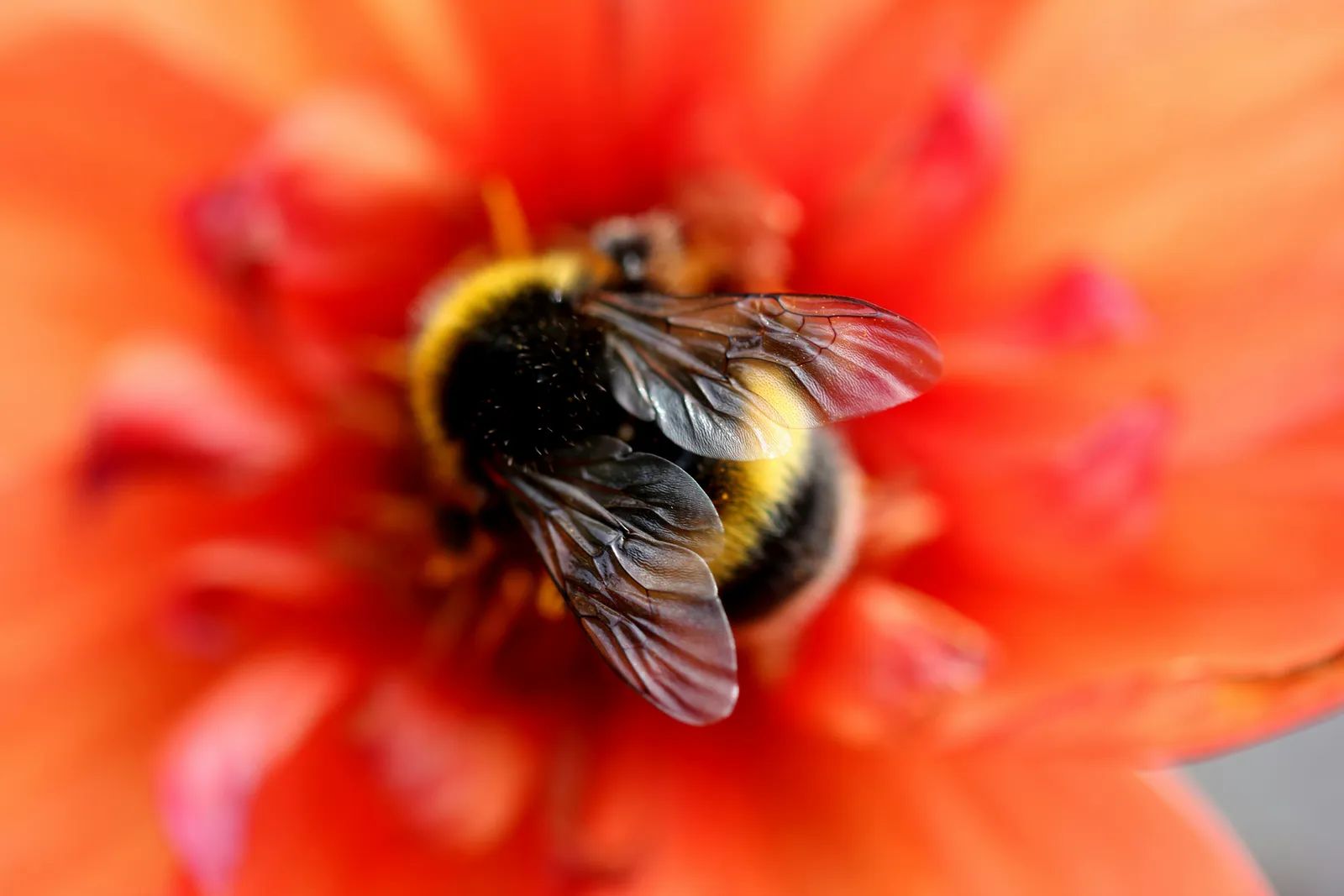
Bumblebees are more often seen drifting between garden blooms than working through a problem. A new study suggests they can do more than that. Researchers reported in the journal Science that these insects found a route to a sugary reward without any lessons on how to reach it, a finding ([1])brought to wider attention. The result points to a kind of thinking that scientists had long linked mainly to animals with far larger brains.
A reward out of reach
The experiment began with a simple association. The bees learned that a blue artificial flower held food. Researchers at the University of Oulu said the insects had no other training, only a basic understanding that a nearby ball could be moved safely.
The challenge came next. The flower was positioned overhead, beyond the bees’ reach. Some bees then rolled a small Styrofoam ball into place and climbed on top of it to get the reward, a result that was repeated consistently across the group. Nothing in their prior experience had shown them that combining an object with their own movements could open a path to food.
Why the result unsettled a long-held assumption
The test borrows from a famous idea in animal research. More than a century ago, the German psychologist Wolfgang Köhler set up experiments in which chimpanzees stacked boxes to reach fruit hanging out of reach. Those experiments became central to the idea that sudden, unlearned problem-solving was a sign of advanced intelligence. Researchers have since argued that such insight-like behavior appears in only a narrow set of species, though the bee study now challenges that boundary.
The brain size gap is what makes the finding stand out. A bumblebee brain holds roughly one million neurons, compared with about 86 billion in a human brain, which suggests that complex problem-solving does not depend on a large amount of gray matter. The lead researcher, Olli Loukola, put it plainly: “Our study suggests insects may belong in that conversation too.”
Cheating, controls, and the limits of the claim
The results were not uniform, and the researchers did not stop at the first success. Some bees skipped the problem altogether and took the reward through other means, a shortcut that the researchers recorded as part of their findings. The team also ran tests in which the ball covered the blue flower, and it repeated the main experiment under stricter conditions to rule out random pushing or a simple reaction to color. The bees still succeeded, which strengthened the case that the behavior was goal-directed.
What the study shows: Bees with no training on this specific task used a movable object to reach an out-of-reach reward. The findings do not show that bees reason like people or have human-style awareness. They show that spontaneous problem-solving is not limited to large-brained animals.
Related Stories From Travelbinger


Building on what bees already do
The new work does not stand alone. Earlier research has pointed to surprisingly sophisticated abilities in bees, and the same group has previously reported that bumblebees can work together as a team. A 2016 study showed that bees could learn to pull a string for a reward, and that untrained bees could pick up the trick by watching more experienced peers. Taken together, these experiments paint a picture of an insect that adapts, copies, and experiments.
The next questions are physiological. The researchers plan experiments that will monitor the bees’ physical responses during problem-solving, which could show whether the insects experience anything similar to a moment of sudden realization. For now, the study offers a humbling reminder that intelligence may take forms that look very different from our own, even in a creature small enough to land on a fingertip.