Somewhere around your fortieth birthday, a ten-hour flight in economy stops feeling like an inconvenience and starts feeling like an event your body needs to recover from. Nobody warns you about this shift. Travel blogs still talk about neck pillows and compression socks like that’s the whole story, but the real changes happening in your body at cruising altitude are quieter and a little more serious than a stiff neck.
This isn’t about avoiding travel or upgrading to business class every time, though that would help. It’s about understanding what’s actually different once you cross into your 40s and 50s, so the choices you make before, during, and after a flight actually match what your body needs.
Your circulation doesn’t forgive long sits like it used to

Deep vein thrombosis, the condition long nicknamed “economy class syndrome,” isn’t just travel folklore. Medical researchers have long recognized that in 1977, the term “economy class syndrome” was proposed, linking it to long-haul flights, especially in economy class, where limited space restricts leg movement, hinders blood circulation, and promotes clot formation in the veins[1]. Age is one of the risk factors doctors flag most often, with clinical sources listing being aged above 40[2] as a recognized risk factor alongside things like immobility and recent surgery.
The relationship between how long you sit and how much danger you’re in isn’t linear either. Research shows that the risk is estimated to increase by 26% for every additional 2 hours of travel[1], which means the difference between a six-hour hop and a fourteen-hour haul isn’t trivial. A cardiologist who specializes in this exact issue noted that people who travel on long-haul flights are at a higher risk because they sit for long periods of time[3], and that risk compounds with age rather than resetting each time you fly.
Jet lag lingers longer after 40
If you remember bouncing back from a transatlantic flight in a day or two during your 20s, that’s not nostalgia talking. It’s biology. Studies on circadian rhythm disruption have found that the rate of adjustment of the circadian core temperature rhythm to the new schedule did not differ between groups[4], yet middle-aged travelers still reported feeling far worse. Researchers attribute this to the fact that age slows down global physiological recovery and reduces the compensatory response to sleep deprivation[4].
Some travel health guides now put numbers on this. One recovery framework suggests that older adults over 40 should expect recovery to take 5 to 10 days, especially for long-haul flights[5], compared to a few days for younger travelers. Another model estimates that travelers 60 and older may take 30 to 40% longer to fully adapt compared to young adults[6], and the decline reportedly starts earlier than most people assume, with circadian amplitude decreasing after age 45, making resynchronization slower[6].
The seat got smaller while you got less flexible
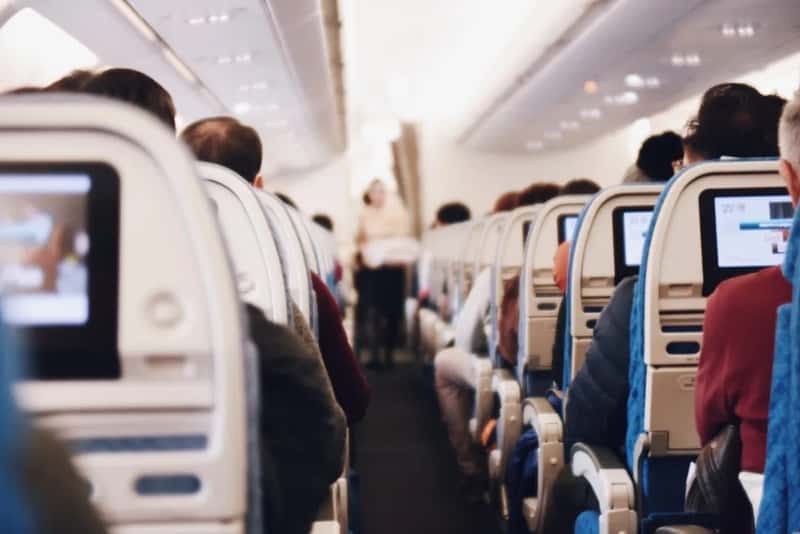
It’s not your imagination. Economy seats really have shrunk over the decades, even as the average passenger has grown larger. Industry data shows that standard economy seat pitch has shrunk from roughly 35 inches in the 1970s to about 31 inches today[7], and some ultra-low-cost carriers push that even lower.
Width has taken a similar hit. Reports indicate that average seat width on many US airlines has shrunk from 18.5 inches to 17 inches since the 1960s, despite the average American man being roughly 30 pounds heavier today[8]. For someone in their 40s or 50s dealing with a stiffer lower back or tighter hip flexors, that missing inch or two of pitch is the difference between manageable discomfort and genuine pain by hour six.
Cabin air dries you out more than you’d think, but maybe not the way you assumed
The dehydration story on planes is more nuanced than most travel advice lets on. Cabin humidity really is unusually low, with official guidance noting that humidity levels in the cabin are typically in the range of 10 to 20%, compared to around 40 to 50% in buildings[9]. Yet the same aviation health authority pushes back on the scarier claims, stating plainly that the additional insensible fluid loss amounts to approximately 150ml over an 8 hour flight, with no evidence of any change in plasma osmolality[9].
Where the real risk hides is in reduced cabin pressure rather than humidity alone. Controlled research found that low pressure on its own increased both body fluid loss and blood viscosity, while low humidity on its own didn’t affect blood viscosity at all[10]. For travelers over 40 who may already be managing blood pressure or circulation issues, that pressure-driven effect on blood viscosity matters more than the dry mouth most people complain about.
Your back and joints feel every hour of stillness

Muscles and connective tissue lose some of their elasticity with age, and that shows up almost immediately in a cramped seat. Immobility itself is a recognized driver of circulatory problems, with medical sources listing sitting still without moving your legs as something that can cause blood to pool in the lower extremities[11], which then compounds into stiffness and swelling well beyond just the legs.
What used to be a minor ache after a long flight in your 30s can turn into two or three days of lower back pain in your 40s and beyond. The combination of a shrinking seat pitch and a body that recovers more slowly from sustained pressure on joints and spine is a specific kind of discomfort that younger travelers rarely mention, mostly because they haven’t experienced it yet.
Sleep debt before the flight makes everything worse
Jet lag research increasingly points to pre-flight sleep quality as a hidden multiplier. One breakdown of recovery factors notes that outcomes depend heavily on age, direction of travel, chronotype, season, and sleep debt[12], all working together rather than in isolation.
Sleep architecture itself changes with age too, becoming lighter and more fragmented even under normal conditions. Add a red-eye flight with a stiff economy seat on top of that, and the sleep debt someone in their 40s or 50s carries into a long-haul flight tends to compound faster and clear slower than it did a decade or two earlier.
Recovery takes days, not a good night’s sleep

The general rule of thumb still applies loosely across age groups, with most guidance suggesting travelers recover within 3 to 7 days, with jet lag typically requiring about one day of recovery per time zone crossed[5]. But that baseline shifts once age and flight distance stack up together.
Direction of travel adds another layer that catches people off guard. Physicist-led modeling found that recovery from eastward travel typically takes about 50% longer than recovery from the equivalent westward trip[13], meaning a European traveling to Asia and back will feel the age-related slowdown far more on the return leg than the outbound one.
Small choices now matter more than they did at 25

None of this means long-haul economy travel becomes off-limits after 40. It means the margin for sloppy habits gets thinner. Aviation health guidance consistently points to the same basics, noting that it is reasonable for physicians to recommend regular leg muscle contractions and adequate hydration during long-distance flights[14], advice that matters more, not less, as the decades add up.
Choosing an aisle seat to move more freely, walking the cabin every couple of hours, and being deliberate about alcohol and caffeine intake are not glamorous strategies. They are, however, the difference between landing functional and landing wrecked. For travelers over 40, these small adjustments stop being optional extras and start acting as the baseline for making it through a long flight without paying for it for a week afterward.
The takeaway
Long-haul economy travel after 40 isn’t a different experience because of dramatic new dangers. It’s different because small, manageable factors, circulation, jet lag recovery, joint stiffness, sleep debt, all shift slightly and then compound over a ten or fourteen hour flight. None of it is a reason to stop flying economy or to panic before a trip.
It is, though, a good reason to stop applying 25-year-old travel habits to a body that now needs a bit more planning, a bit more movement, and a bit more patience once the wheels touch down.