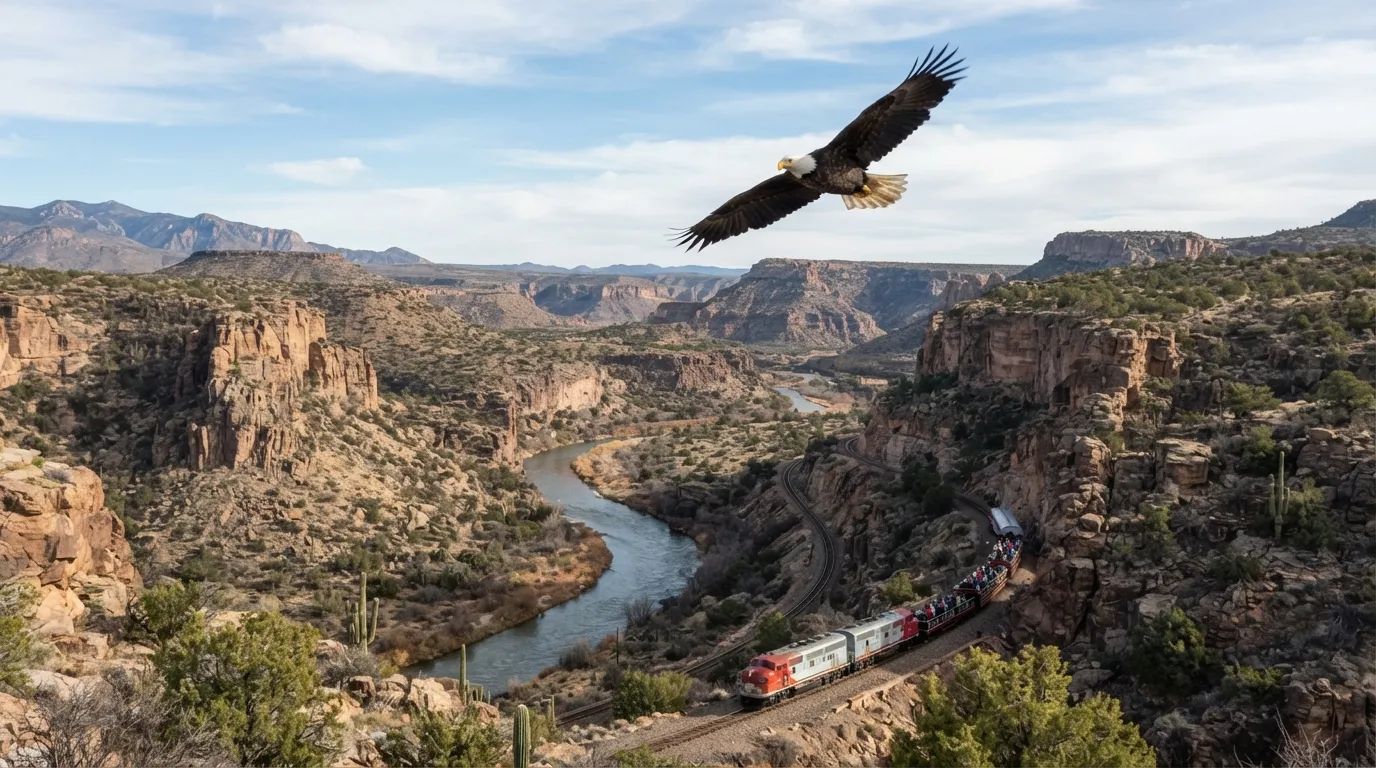
Fall color sells the tickets, but the Verde Canyon Railroad saves its rarest wildlife show for winter. The railroad’s own Eagle Watch season runs from January through March, when bald and golden eagles can be seen from the train.1 Other guides start the season in December and run it through April.2
Here’s the twist: this is not a sky full of wings. Arizona’s eagles are scattered and hard to count, which is exactly why the ones you spot feel earned. And at the end of this ride is a piece of river history, one that starts with a number so small it sounds like a typo.
A 40-Mile Round Trip Into a Canyon No Road Reaches
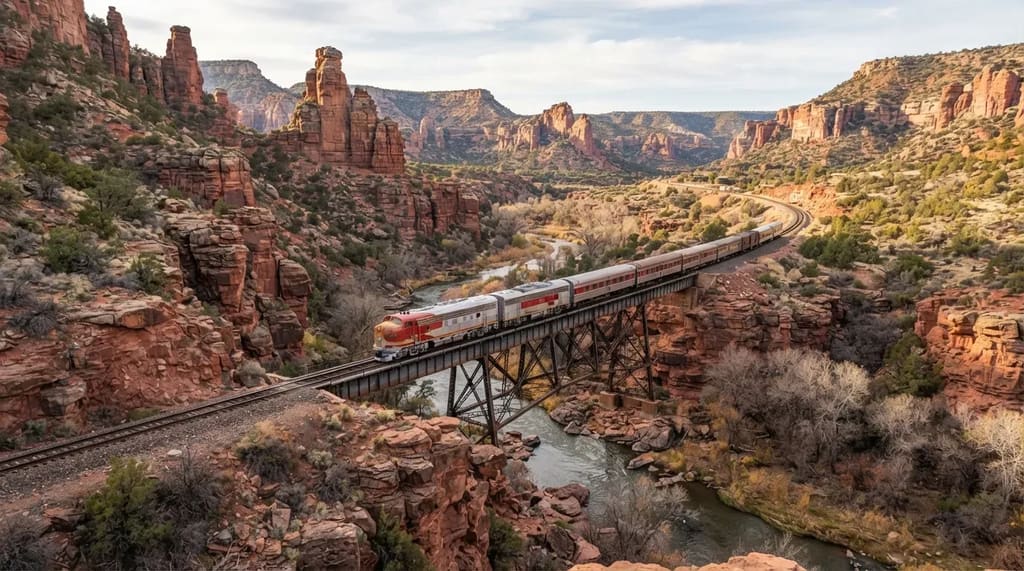
The train leaves from the depot in Clarkdale, about 25 miles southwest of Sedona, and runs to the ghost town of Perkinsville and back. It follows the Verde River past red rock pinnacles and over trestles, then through a 734-foot manmade tunnel. The canyon can’t be reached any other way except by rail or on foot, so the river corridor stays wild.
The round trip is 40 miles and takes about four hours, roughly two hours out and two back. At Perkinsville the engine disconnects and attaches to the other end of the train, and passengers stay aboard throughout. That means you pass the same river twice, which gives you two chances at a bird.1
Four hours is a long time to scan a riverbank, so the calendar matters. The railroad has a name for the stretch of winter it cares about most.
Eagle Watch Has Its Own Dates, and They Aren’t the Fall Dates
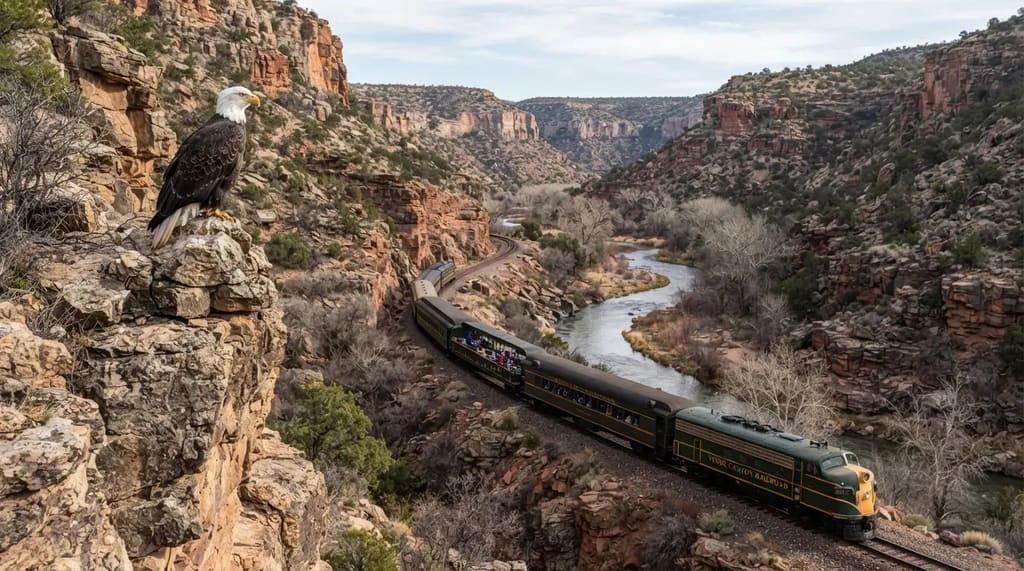
Start with January through March. That’s when the railroad says Verde Canyon is one of the few Southwest spots where bald and golden eagles can be viewed in their natural habitat. Guides disagree a little about the edges, with some starting in December and others ending in April, so the middle of winter is the safe bet.
At a Glance
- Railroad’s Eagle Watch window: January through March
- Some guides stretch it from December to April
- Birds to look for: bald and golden eagles
- Tickets that sell out most often: first class, fall weekends, eagle season and special event trains
Here’s a verdict you can argue with: if eagles are your reason for going, pick winter over the famous fall color ride. The train routinely sells out, especially first class, fall weekends, eagle season and special event trains, so choosing winter won’t buy you an empty car. It does mean you should book early.
Why does Arizona get eagles in winter at all? The answer involves ice, and it also involves an odd quirk in when the local birds nest.
Arizona’s Eagles Nest on a Different Calendar
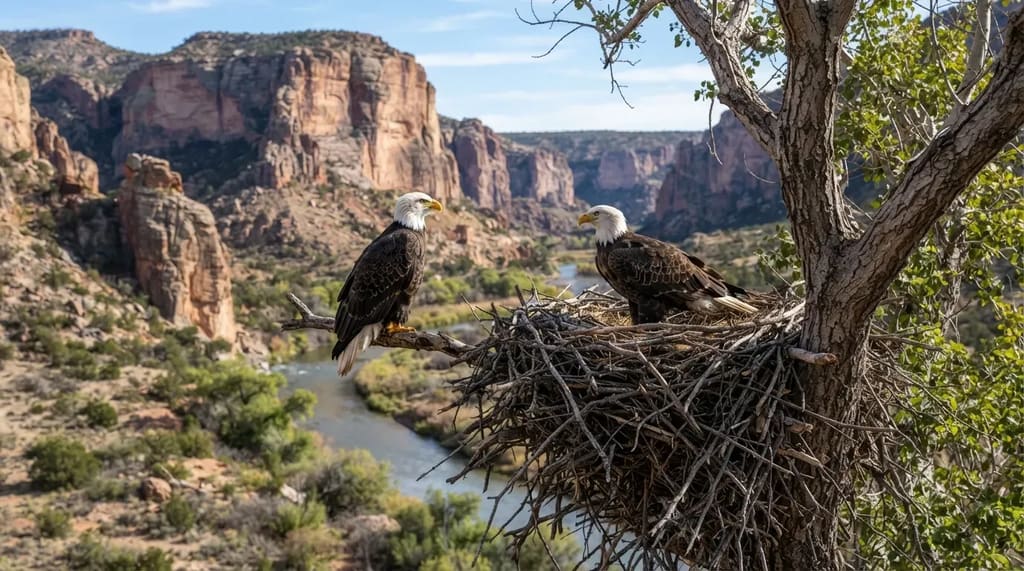
Eagles here don’t follow the northern schedule. Arizona bald eagles breed earlier in the year than northern ones. At the lowest elevations, most pairs start courting between October and December, and the first eggs are laid in late December at a few nests. By the time Eagle Watch opens, the resident birds are already busy.
Visitors join them. Wintering bald eagles follow the freeze line south to find more available prey. A river that stays open and green through desert country is exactly the kind of place that draws them, and the Verde is one of Arizona’s important bald eagle breeding corridors. Northern birds arrive just as local pairs begin nesting.
Wintering birds sound like a crowd. The statewide count is smaller than the photos suggest, and it’s worth knowing before you board.
The January Count Says Don’t Expect a Flock
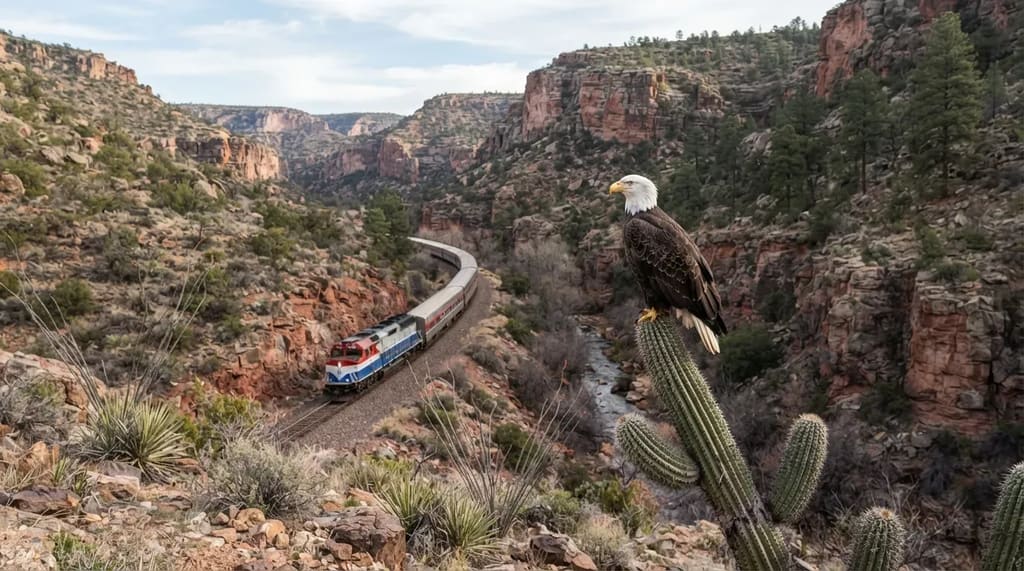
Every January, federal and state agencies, tribes and private groups help survey Arizona’s eagles during a one-week period. That week sits inside the Eagle Watch window above. The state set up 105 survey routes, and Arizona averaged 322 wintering bald eagles from 1995 to 2005, about 64 percent adults and 33 percent immature birds.3
The Arizona Game and Fish Department adds a caution. Eagles rarely concentrate in large numbers here as they do on other wintering grounds, though 30 or more can occasionally gather in one area.3 So expect a few birds, a nest, maybe a pair circling, not a sky full of wings. No train can schedule a wild bird, which makes any sighting something you earned.
Fast Facts
- 105 survey routes cover the state each January
- Average of 322 wintering bald eagles, 1995 to 2005
- Roughly 64 percent adults and 33 percent immature birds
- Groups of 30 or more can occasionally gather in one area
Luck decides how many birds show up. The better question is who’s looking for them while you’re busy admiring the scenery.
Someone on Board Is Watching the Ridgeline for You
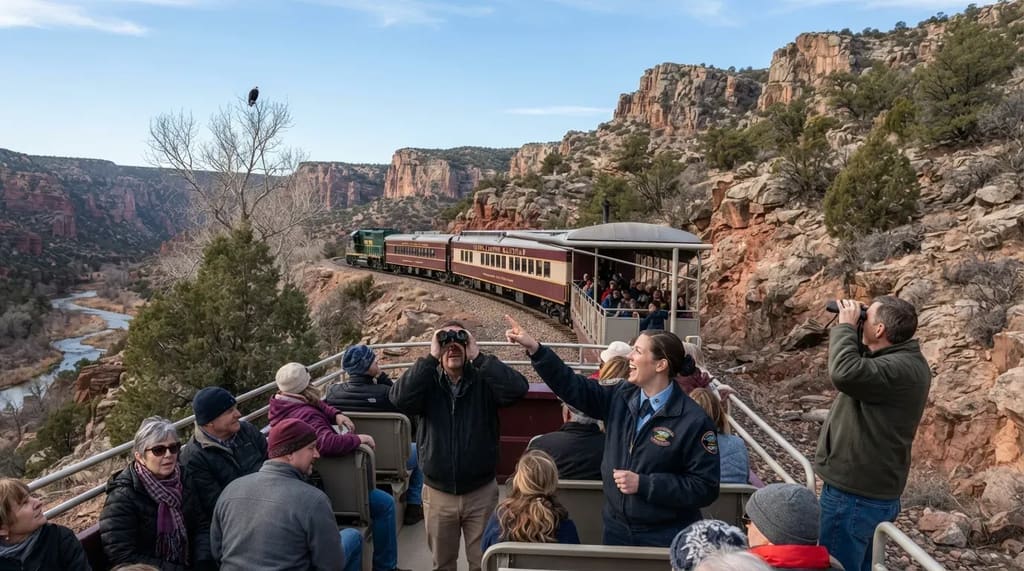
By the time you notice a dark shape over the rim, it’s usually behind the next bend. That’s why the crew matters. Attendants point out wildlife as the train rolls, and sightings are announced so passengers in other cars have time to look up.
Once you hear one, head for the open-air car. There’s no window between you and the canyon there, and it comes with the standard ticket. Bring binoculars. A perched eagle in a distant cottonwood is a small pale dot to the naked eye, and a decent pair of 8x42s turns it into a bird with a face.
Bare Cottonwoods Turn the Riverbank Into a Stage
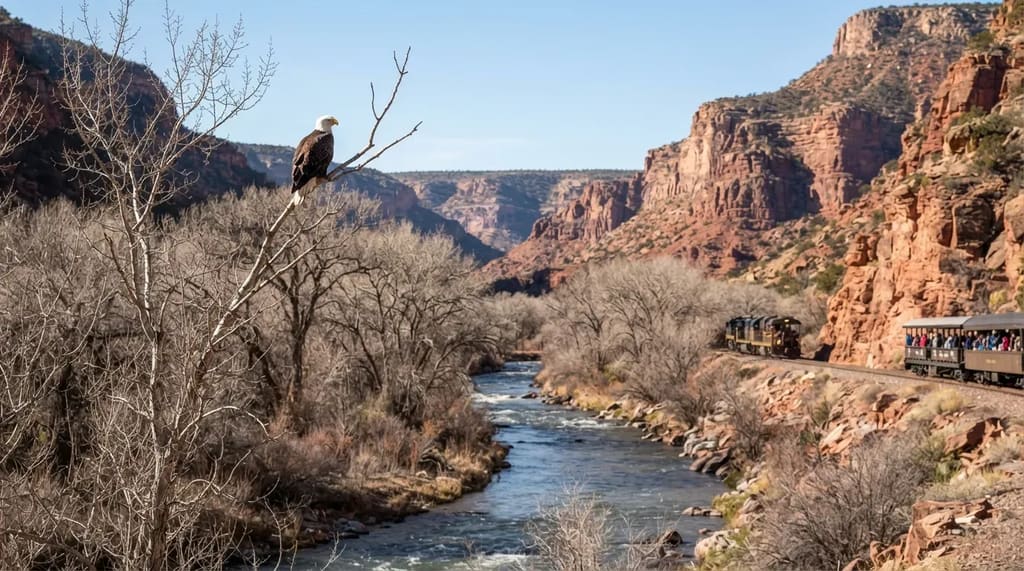
Fall gets the credit for the prettiest canyon, but winter gives it the clearest one. Cottonwoods along the Verde glow gold in October and November, then drop their leaves. By winter the riverbank is bare and the light is crystalline. Leafless branches leave perched eagles in plain view.
That matters because eagles perch in cottonwoods along the river and circle above the canyon. In summer, a leafy canopy could hide a bird like that. Winter’s crisp air also makes for clear views, so a distant branch looks sharper than it would on a hazy day.
Perched birds are the easy sightings. The better ones involve eagles in motion, and the railroad names two behaviors to watch for.
Courtship Flights Are the Show Worth Watching For
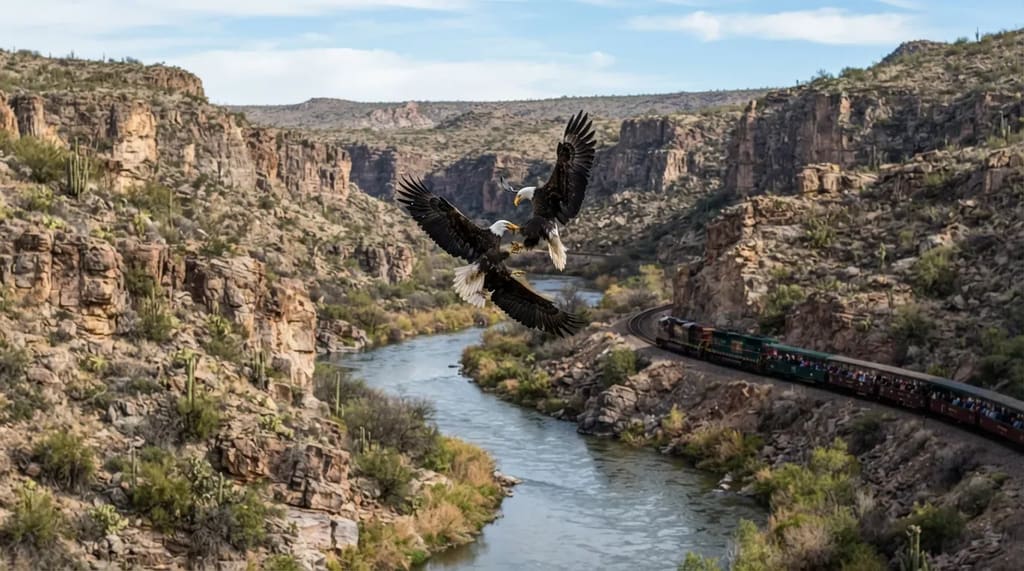
From early winter through late spring, the canyon’s raptors perform aerobatic courting rituals and hunt along the Verde River.4 For bald eagles, courtship can include a pair locking talons and tumbling through the air before letting go. Because fish are a staple, the hunting happens over the same water the train follows, which is why the river side of the car gets the action.
Treat the return leg as a second ride, not a leftover. The train retraces its route, so the bank you faced outbound is behind you coming home. Eagles also move through the day, so a bare ridge at hour one can hold a bird at hour three. If you’re in an open-air car, rotate sides.
Courting pairs eventually need a nursery, and one pair in this canyon returns to the same job every year.
A Resident Pair Raises Its Young Above the Rails
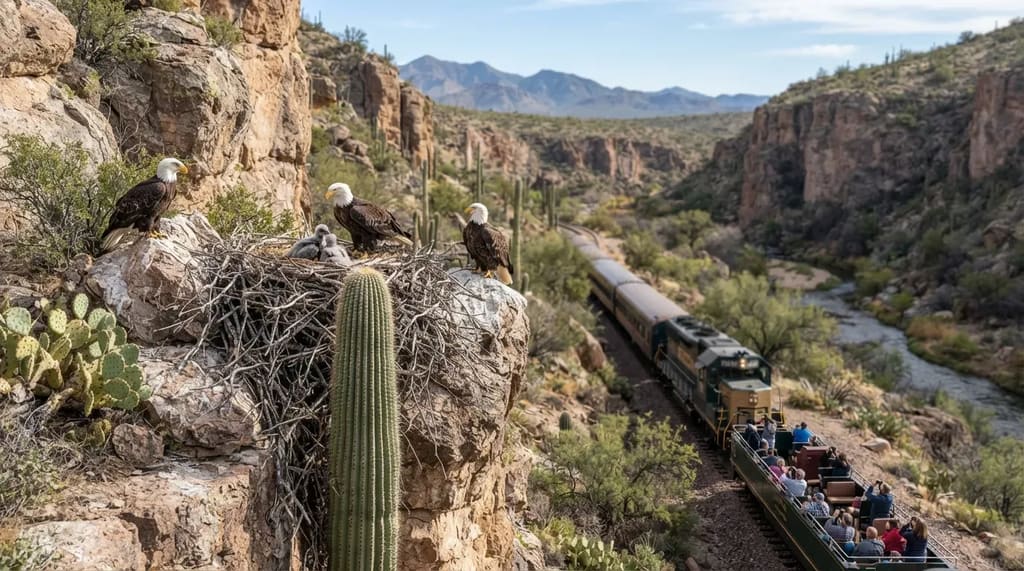
A nesting pair of bald eagles stays in the canyon all year. They raise one or two eaglets yearly, and passengers can see the young in the nest as they learn to survive.5 That makes this canyon different from most winter eagle spots, where the birds are visitors that leave in spring.
Quick Compare
- January through March ride: nest-building, courtship and incubation
- Spring ride: a better shot at meeting the chicks
- Fledging: about 12 weeks after hatching, in May and June
Timing decides what you’ll see. Eggs start appearing in late December, and eaglets fledge at about 12 weeks, in May and June. Winter gives you the setup, and spring gives you the sequel.
You don’t have to wait for the canyon to see an eagle up close, either. On certain dates one is standing at the depot before the train moves.
Related Stories From Travelbinger
A Rescued Eagle Meets You at the Depot
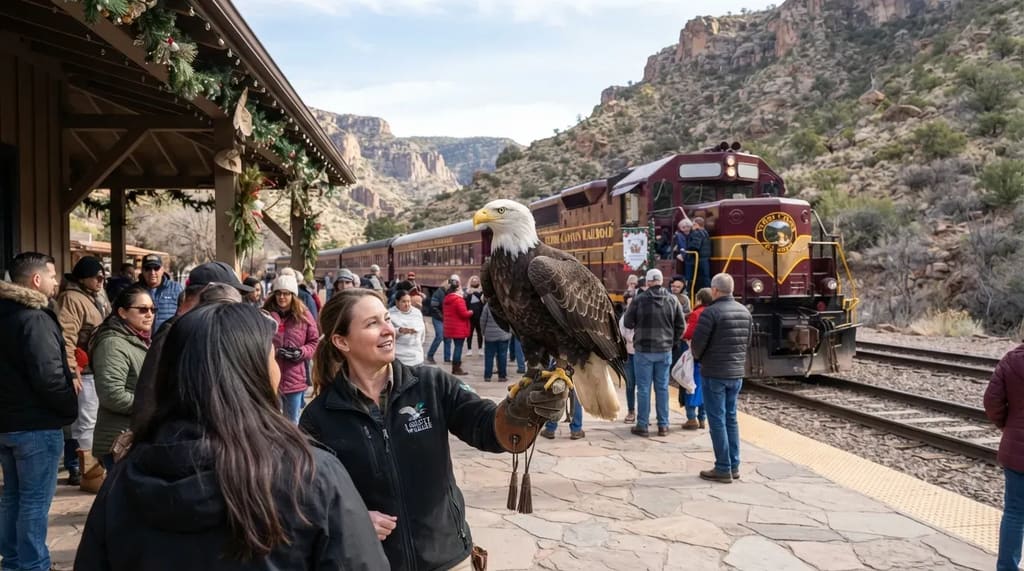
On several days each month, hawks, owls, eagles and other raptors greet visitors at the depot thanks to Phoenix’s Liberty Wildlife. The display happens before departure on the pavilion. On Saturday dates, a bald eagle joins the lineup.
The holiday run adds a star. The Magical Christmas Journey features Flurry, a real bald eagle, at the depot’s Bird’s-Eye Village.1 The 2025 holiday season listed bald eagle dates from November 28 through December 24. Given how few eagles gather in one place in this state, a planned meeting beats hoping the canyon cooperates, so I’d book a Saturday for the sure thing.
The most surprising fact about eagles on this river concerns how few there once were, and it begins with a count so low it sounds like a typo.
In 1970, Arizona’s Known Eagle Territories Were Both on This River
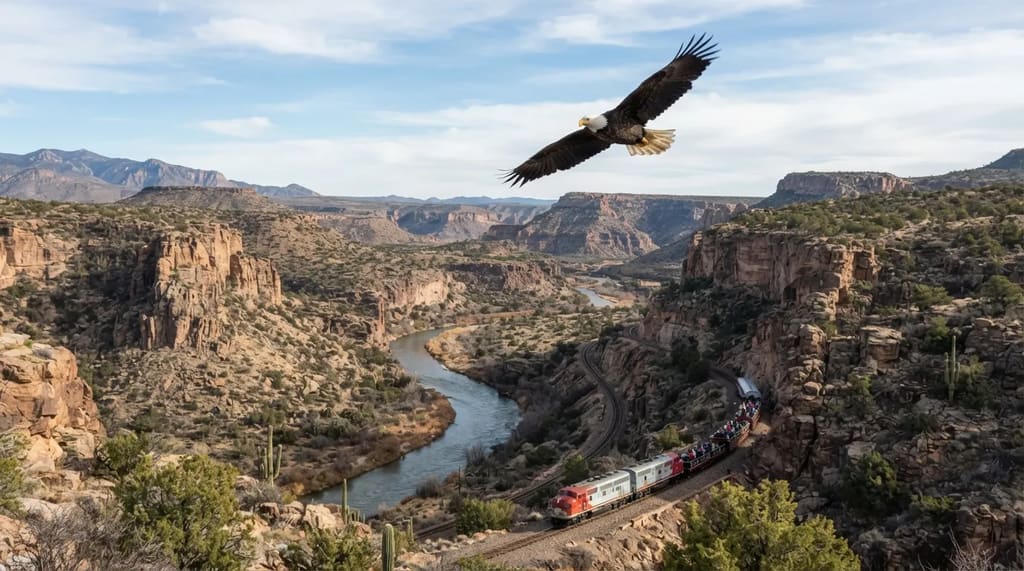
Two known eagle territories in 1970, both on the Verde. That’s how many occupied territories federal monitors found when they began tracking Arizona’s bald eagles. Think about that when a bird crosses the canyon above your open-air car. By 2011 Arizona had 62 known breeding areas, and the state reported 111 documented areas in December 2025.6 7
The river has grown with the rest of the state. The Verde went from 6 to 10 breeding areas between 2006 and 2017. Protection helps. Each year from December 1 through June 30, the U.S. Forest Service closes the Ladders area of the Verde River to protect nesting eagles. A train on fixed rails puts no boats or hikers near a nest, which is the best argument for watching from your seat.
Why One Eagle Over the Verde Is Enough
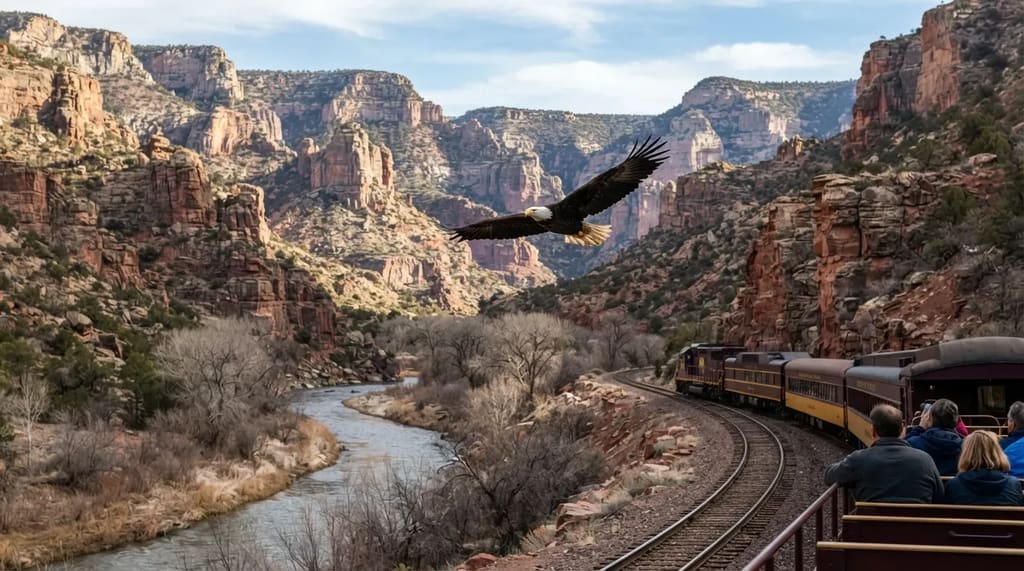
Pick a January or February departure and you’ll be riding through one of Arizona’s long recoveries, on a river that once held every eagle territory the state could document. Some days the canyon hands you a pair circling over the water. Other days you get red rock, bare cottonwoods and a long, quiet afternoon.
Either way, the birds are proof the river is healthy enough to hold them. So when one finally lifts off a cottonwood and slides across the rim, don’t count it as one bird. It’s a number that used to be nearly zero, flying right past your seat.
- Verde Canyon Railroad Seasons: https://verdecanyonrr.com/seasons/
- DesertUSA Verde Canyon Railroad: https://www.desertusa.com/desert-arizona/verde-rr.html
- AZGFD Bald Eagle Programs: https://www.azgfd.com/wildlife-conservation/conservation-and-endangered-species-programs/arizona-bald-eagle-management/bald-eagle-programs/
- Raptors and Romance Eagle Watch: https://verdecanyonrr.com/raptors-romance-verde-canyon-railroad/
- Verde Canyon Railroad Year-Round Events: https://www.railsnw.com/tours/verde/verde-canyon-railroad_year_round.htm
- Arizona Bald Eagle Q&A: https://www.swbemc.org/eagleQandA.html
- Arizona Bald Eagle Wildlife Guide: https://www.arizona-leisure.com/bald-eagle.html