Thirty days in Arizona sounds like the moment a winter visit turns into residence. It doesn’t: the one rule that truly runs thirty days is a permit for an unregistered car, and it has no movement restrictions or residency requirements.1
The clocks that actually decide your taxes, plates and health plan run six, seven and nine months, and one of them can end your coverage while you’re still enjoying the sunshine. The cheapest to check is a single phrase in a Medicare document, and it is tied to the biggest bill on this list, so we’ll count down to it.
#12 – The 30-Day Permit for an Unregistered Vehicle

The Arizona Department of Transportation describes a 30-Day General Use Permit that allows an unregistered vehicle to operate on the roadway for a 30-day period and can be issued only once in a 12-month period.1 Because it has no residency requirement, getting one does not ask you to claim Arizona as home.
The state also issues a 3-Day permit, which is restricted to travel from the vehicle’s present location to specific destinations. Neither permit is a measure of how long you may stay.
If your car is registered at home and the registration is current, you will probably never need either one. These are tools for a vehicle with no registration, and the 30-day one can be used only once a year.
That permit does not cover a car you buy from an Arizona dealer, which comes with its own paperwork.
#11 – The $15 Permit for a Car Bought Here

A nonresident who buys a car from an Arizona dealer can purchase a 90-Day Nonresident Registration for $15 from the MVD or an Authorized Third Party office.1 The $15 fee is small, but the permit has conditions.
State law says a nonresident who buys an unregistered vehicle for removal to the state of residence must obtain a special ninety day nonresident registration permit. It is valid for no more than ninety days from the date it is issued.2
You will be asked for:
- Your out-of-state identification
- The dealer invoice or assigned title
The permit assumes you will register the car in your home state, because the vehicle must be purchased to be registered out of state within ninety days.2 If you mean to keep the car in Arizona and register it here, that is a different path, and the dealer should explain it before you sign.
Buying here is optional, though, and the car you drive down from home raises a bigger question about plates.
#10 – Home-State Plates and the Seven-Month Question
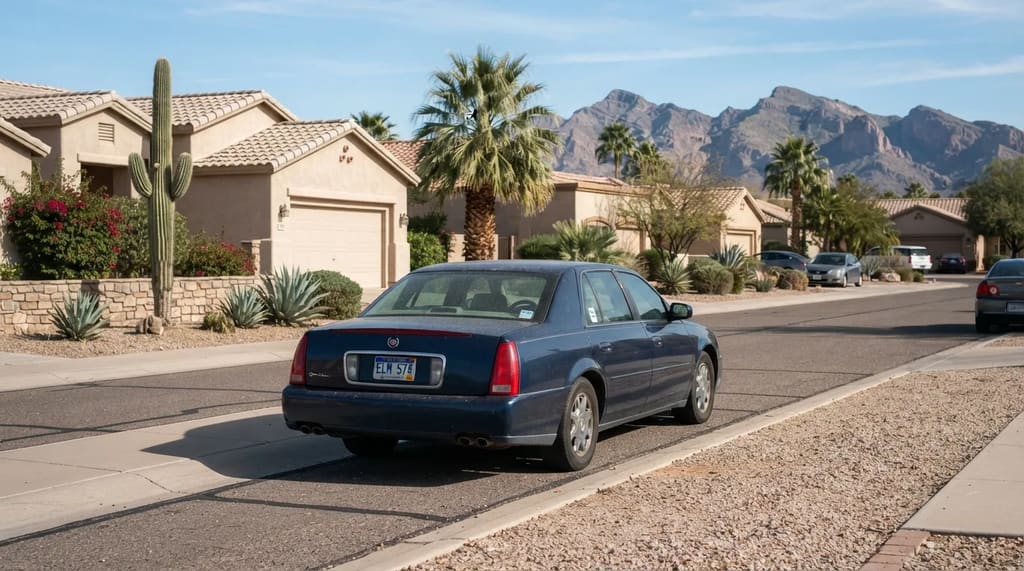
An out-of-state-registered vehicle may be driven in Arizona as long as its home-state registration is current. That is the ordinary situation for a snowbird who drives down each fall.
Where Arizona registration becomes required is murkier, because the sources don’t line up neatly. Some guides say registration becomes mandatory after more than seven months, and one law firm says anyone living in Arizona seven months or longer in a calendar year must register their vehicle.
For new residents the rule is plainer: you must register the vehicle as soon as you become an Arizona resident.3 The point is that residency, not a day count alone, starts the obligation.
A stay from November 1 to April 30 is six months, which fits under seven. A stay that starts October 1 and runs into May does not.
Quick Compare
- Visiting snowbird: keep the home-state plates while that registration stays current
- New Arizona resident: register the vehicle as soon as residency begins
- Stay past seven months: sources point toward Arizona registration, so confirm with the MVD
If your stay is well under that line and your home registration is current, there is usually no reason to touch the plates. Re-registering is a step for people who are moving, and a call to the Motor Vehicle Division is worth making first because the sources disagree.
#9 – What Makes You Need an Arizona License

The Arizona driver license manual says state law requires an Arizona driver license and registration immediately if any one of several conditions applies. The first condition on the list is that you work in Arizona, other than seasonal agricultural work.
Several of the others will never touch a retiree, such as placing children in school without paying the nonresident tuition rate. Others concern a business that bases vehicles in the state.
The list also includes remaining in Arizona for a total period of time. Secondary guides say that is more than seven months within a single year, the same figure the plate question turned on.
Anyone who does decide to switch finds the paperwork lighter than expected, and that is the easy part of the decision.
#8 – Trading In Your License Takes Little Paperwork

The manual says your out-of-state license will be used as a secondary form of identification and may waive the written and road test.3 Another source for new residents says written and road tests are not required if you provide a valid license from another state, though you may be given a vision exam.
A vehicle adds to what you carry. The manual asks you to bring:
- Required identification
- Your out-of-state title, registration and license plates3
- Your vehicle identification number
Easy paperwork is a reason to slow down, not to hurry. Unless you are moving, keeping the home-state license makes sense, because the Arizona Department of Revenue determines residency using domicile and physical presence tests, and an Arizona license is one more fact in that picture.
The license is the simple part of winter in Arizona. The money side is where the state’s reach gets more interesting.
#7 – Remote Work Done From Your Arizona Winter Home

A nonresident is taxed only on Arizona-source income, and for an employee that means wages for services physically performed inside Arizona. The location of the work counts, not the location of the employer.
So if you still hold a job you can do by laptop, the days you work from a winter rental can matter even though the company is back home. Arizona softens this for short stays with a safe harbor, under which the employer can be relieved of Arizona income-tax withholding if conditions are met.
The day limit and the employer conditions are the details that decide it. Check them with the Arizona Department of Revenue or a tax professional before you rely on the harbor, as the current limit should be confirmed.
Wages are only one kind of Arizona-source income, and a rental or a property sale is another.
#6 – Arizona Rent and Property Gains on a Nonresident Return

Owning property or spending time in Arizona does not automatically make you a resident. A nonresident with Arizona income files Form 140NR.
The examples of Arizona-source income are concrete: rent on an Arizona rental and gain on Arizona real estate. A resident, by contrast, is subject to Arizona tax on all income no matter where the resident earns it.
A snowbird who rents out a second home in Arizona therefore has Arizona income while still being a nonresident. The same is true when the winter house is sold, since the gain on Arizona real estate falls on that list.
Fast Facts
- Nonresident form: 140NR
- Taxed as Arizona-source: rent on Arizona rentals and gain on Arizona real estate
- Residents: taxed on all income, wherever earned
- Arizona’s income tax rate: a flat 2.5%
Neither situation requires you to live in Arizona. They only require that the money came from here.
That return is the mild case. The harder questions begin when Arizona asks whether you are a resident at all.
#5 – The Nine-Month Line Is Not a 183-Day Line

Arizona has no 183-day statute. Instead, spending more than nine months of the tax year in Arizona creates a presumption of residency.4 5
That is a generous line compared with the classic states where a bare majority of the year plus a permanent place of abode does it. A winter of five or six months sits well below more than nine months.
Part-year status has its own meaning. Form 140PY is for people who moved into Arizona intending to become a resident, or moved out intending to give up residency, which does not describe a snowbird who drives home each spring.
Nine months is a presumption, though, and the Department of Revenue can look at a shorter stay.
#4 – Domicile and Intent Can Outweigh the Calendar

Arizona can treat you as a resident on far fewer days if your purpose in the state is not genuinely temporary. A short stay does not protect you if the facts say Arizona is home.
Physical presence is a secondary factor the state can use to corroborate your domicile claim. Domicile, meaning the place you consider your permanent home, comes first.
The statutes do not define “temporary” or “transitory,” and the department’s own procedure, ITP 92-1, leaves those terms undefined, so facts decide.4 That is also why the license and voter questions earlier carry more weight than their paperwork suggests.
Worth Knowing
- Domicile, your permanent home, is the primary test
- Physical presence only backs up a domicile claim
- “Temporary” and “transitory” have no statutory definition
- A driver license or voter registration can become evidence
On audits, one guide says they tend to follow federal adjustments or filed part-year returns, but snowbirds who clearly exceed the nine-month presumption while filing as nonresidents remain a real risk. Counting days is the easy half of this, and the harder half is being able to show a home elsewhere.
Arizona’s reading of your calendar is only half the picture, since your home state keeps a calendar of its own.
#3 – Your Home State Keeps Its Own Calendar

Many states use a test closer to 183 days plus a permanent place of abode, and that bare-majority test differs from Arizona’s nine-month presumption. Your home state may start counting months earlier than Arizona does.
So you can be a nonresident in Arizona and still a resident at home. Arizona itself taxes its residents on all income, with a credit mechanism for taxes paid to other states, which shows how often two states’ claims overlap.
Arizona’s income tax is a flat 2.5%. With a rate that low, the home-state return deserves more of your attention, since it is the one that decides how your winter days are counted.
Related Stories From Travelbinger



Tax questions wait for a return you prepare yourself, while a health plan counts months without waiting for you.
#2 – Routine Care in an Advantage Plan Away From Home

Each Medicare Advantage plan has a defined service area, usually a group of counties. If you are enrolled in an HMO version, the plan generally won’t pay for routine care outside its local service area unless it includes a visitor or traveler program.
A PPO is more forgiving, since out-of-network care is covered but you pay more. Even so, it still won’t provide the same nationwide access as Original Medicare.
Original Medicare lets you see any provider in the country that accepts Medicare. If you spend most of the winter in Arizona and hold an HMO, it’s fair to ask whether a low premium is worth months with no routine care nearby.
Routine care is a matter of convenience until the calendar reaches the month the plan is required to act.
#1 – The Six-Month Clock on Your Advantage Plan

Federal rules generally require a Medicare Advantage plan to drop a member who stays outside its service area for more than 6 consecutive months, even without a permanent move. A plan without an approved visitor or traveler program has no discretion here.6
That leaves a seven-month Arizona winter exposed, because without a qualifying traveler benefit, seven consecutive months in Arizona can cost you the coverage you kept up north. Disenrollment generally takes effect the first day of the month after the period has passed, and one walk-through of a November 1 arrival ends with a June 1 drop.
The loss is not limited to the plan itself. Drug coverage ends immediately and must be replaced separately, and a Part D plan that cannot confirm your residency can drop your coverage if it doesn’t hear back within six months.
Original Medicare is the fallback, and it puts no six-month limit on a winter stay. But it has no out-of-pocket cap, and 2026 hospital deductibles reach $1,736 per benefit period.
The check costs nothing. Before you leave:
- Search your Evidence of Coverage for “visitor/traveler,” and if you can’t find the term, assume the six-month limit applies6
- Get in writing that the program’s area includes your winter address, which providers you must use and how long you can stay away
What to Write on the Winter Calendar Before You Leave

Asking how many days you have been in Arizona only goes so far. A better habit is to list each rule that touches your winter and the month at which it acts, because those dates differ and the earliest one usually matters most.
At a Glance
- 30 days: the one-time permit for an unregistered vehicle
- 90 days: the $15 nonresident registration for a car bought here
- More than 7 months: where plate and license questions tend to start
- More than 9 months: Arizona’s presumption of tax residency
- More than 6 consecutive months: the usual limit for an Advantage plan without a traveler benefit7
By that measure, the date you need first is the one in your health plan documents. The tax lines and the plate questions give you more room, though they depend on facts you can start recording now.
Thirty days turned out to be a car permit, while the real deadlines hide in months. How many consecutive months does your own health plan let you be away from home, and where did you find that number?
- ADOT Vehicle Permits: https://azdot.gov/mvd/services/vehicle-services/vehicle-registration/vehicle-permits
- ARS 28-2154 Special Registrations: https://www.azleg.gov/ars/28/02154.htm
- Arizona Driver License Manual: https://www.usdriving.org/drivers-manual/arizona-driver-license-manual.pdf
- ADOR Residency Procedure ITP 92-1: https://azdor.gov/sites/default/files/2023-03/PROCEDURES_INDIV_1992_itp92-1.pdf
- ARS 43-104 Definitions: https://www.azleg.gov/ars/43/00104.htm
- Snowbird Medicare Advantage Six-Month Rule: https://247wallst.com/personal-finance/2026/09/30/she-left-minnesota-for-arizona-on-november-1-without-a-traveler-benefit-her-medicare-advantage-plan-will-drop-her-june-1/
- Medicare Interactive Traveling: https://www.medicareinteractive.org/understanding-medicare/medicare-covered-services/medicare-coverage-overview/traveling-with-medicare