
Every January, more than 5,000 people pull on boots and hike through the Hocking Hills gorges to look at ice. That’s in Ohio, a state most people picture as cornfields and flat highway. The winter version of this park is a different place entirely.
The cold turns the whole area into a gallery. This list runs from a giant stone arch to a dark-sky park to a free holiday fire in a cave. The last entry is the sight those thousands of hikers are walking toward, and you can reach it without hiking six miles.
#12 – Rockbridge’s Giant Stone Arch Needs No Waterfall
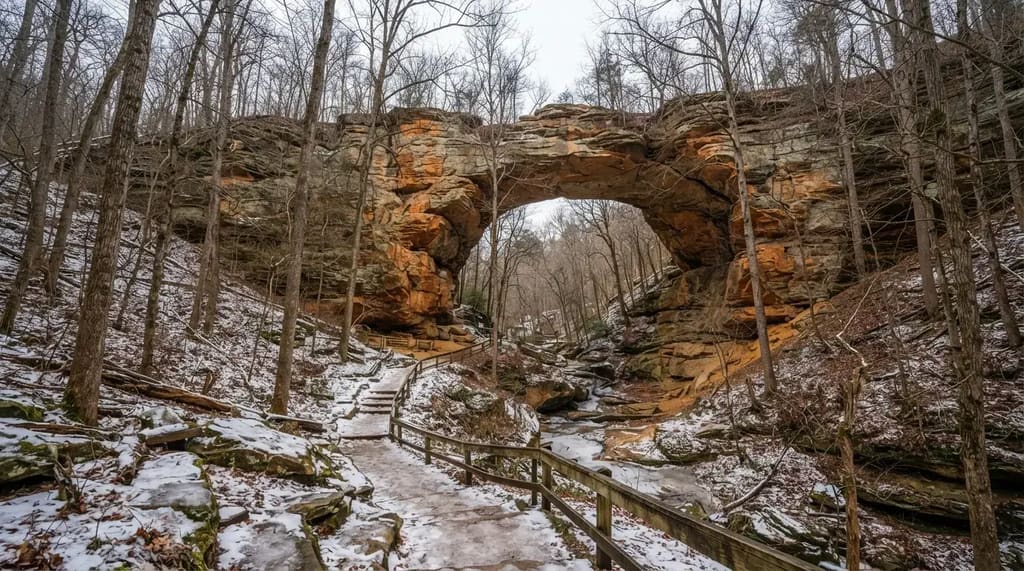
A sandstone arch doesn’t need a creek to impress you. That makes Rockbridge State Nature Preserve a smart stop when the weather has messed with the water. The arch is the largest natural bridge in Ohio1, and the stone looks the same whether the week has been wet, dry or frozen.
That matters here, because the steep hills shed rain quickly and a waterfall can stop flowing soon after a storm. Bare branches also open the view, so you see the whole span instead of pieces of it through summer leaves.
At a Glance
- Ohio’s largest natural bridge
- Stone looks the same wet, dry or frozen
- Bare winter trees show the full span
- A good backup when the waterfalls run thin
The trails around it have some age on them. A Civilian Conservation Corps crew known as Company 526 did work at Rockbridge, Cantwell Cliffs and Rock House, so you’re walking Depression-era labor that still holds up.2 Plan Rockbridge around the arch, not the water, and the weather can’t spoil it. The next stop swaps open sky for narrow, stair-lined passages between rock walls.
#11 – Cantwell Cliffs’ Narrow, Stair-Lined Rock Passages
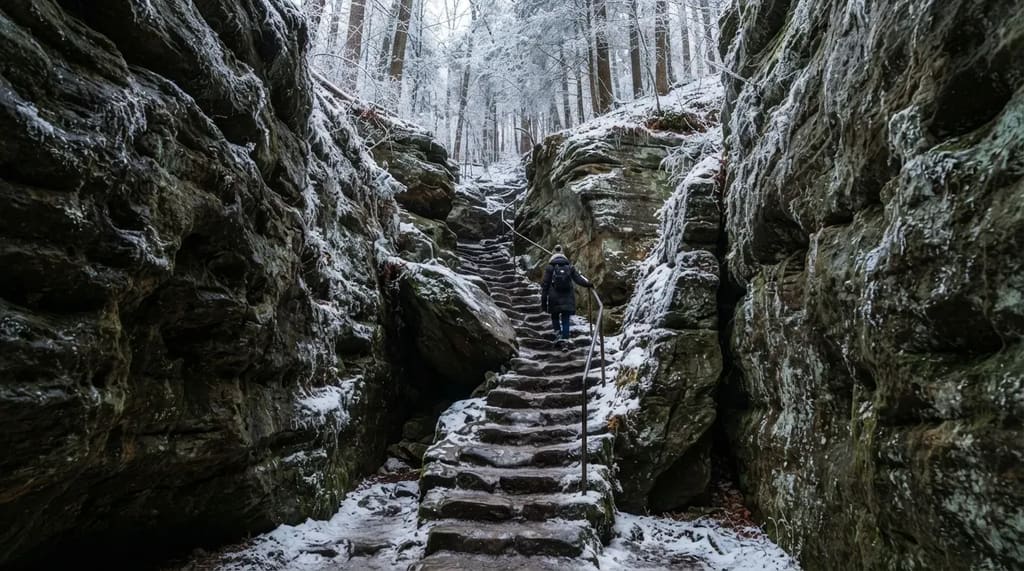
Cantwell Cliffs is a good bet when you want a trailhead with room to park. It’s one of the quieter areas of the park, and it usually has space when the busier lots are jammed. The payoff is a route through tight, stair-lined passageways. In winter that means rock walls with snow or frost on every ledge.
It sits a good drive from the Old Man’s Cave area, so give it its own part of the day instead of squeezing it between other stops.
Don’t mistake the quiet for easy. Cantwell Cliffs is the more challenging winter hike, with steep climbs and views of snow-flocked forest. Pack traction cleats for the stairs, because they’re the part that ices first. The next cave only opened to the public in 2017, and the walk back from it is harder than the walk in.
#10 – Whispering Cave and Its Honeycomb Walls in Winter
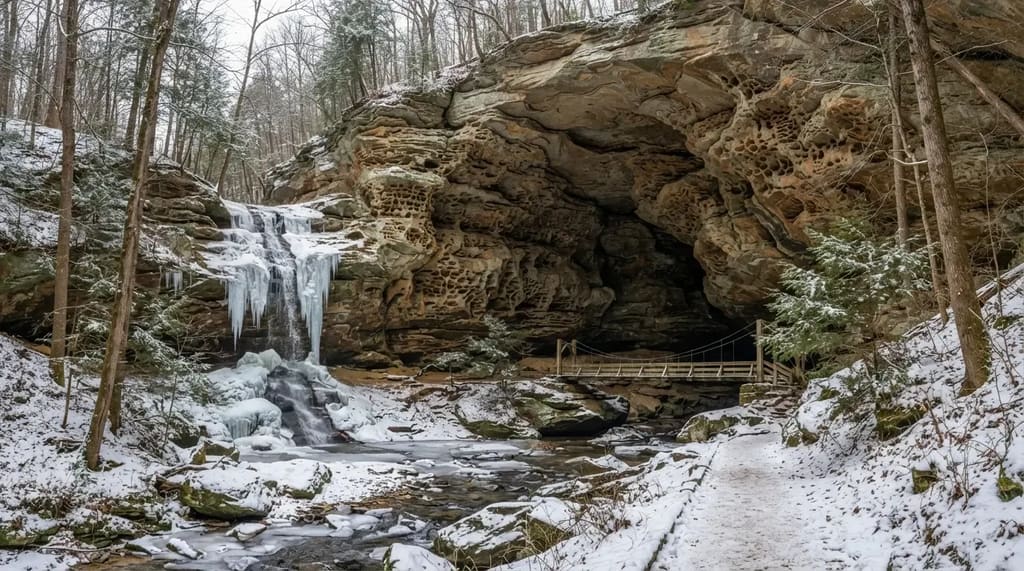
Whispering Cave is the newest piece of the park’s trail system. It opened for public access in 2017 via the Hemlock Bridge Trail.3 The area is known for its honeycomb rock walls, and winter is a good time to see them.
Whispering Cave Falls stays beautiful in the cold. Bare trees open views of cliff formations that leaves hide in warmer months. The loop leaves from the Old Man’s Cave parking area, so it’s easy to reach.
Getting there is easy, but finishing the loop takes legs. Expect steep climbs between the cave and the visitor center, and know that some guides rate the hike moderate to difficult in winter. Treat Whispering Cave as a second-trip hike, not a first-timer’s. Do the famous gorge first, since cold makes steep, shaded stretches slower than the trail map suggests. The next gorge has two trails, and in January only one is a good idea.
#9 – Conkle’s Hollow’s Gorge Floor Beats the Rim in Winter
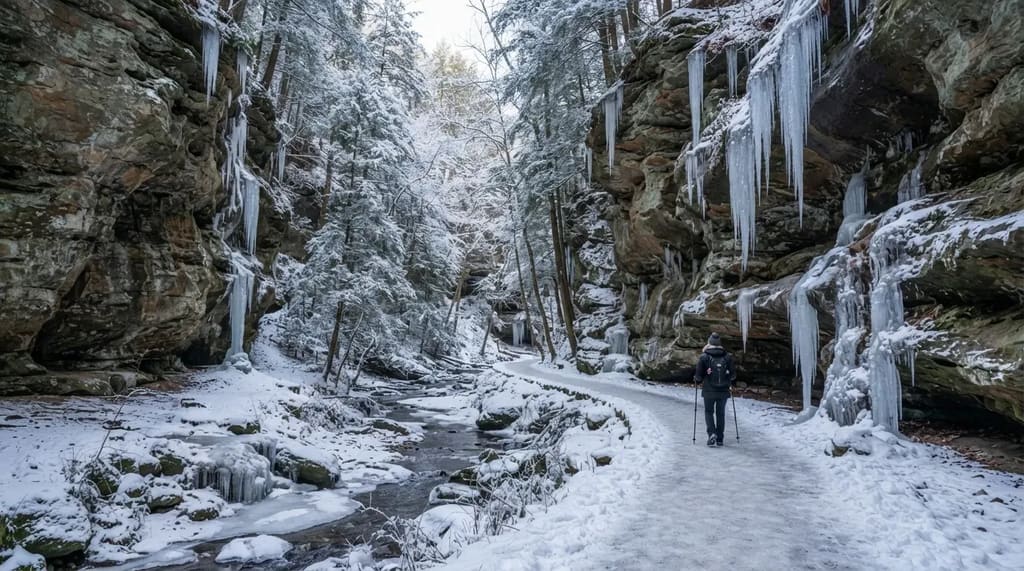
Conkle’s Hollow comes with a choice. The Gorge Trail is a paved path beside a small creek, with sandstone cliffs rising high above it, and the hollow is one of the deepest gorges in Ohio. The Rim Trail runs 2.5 miles along the cliff tops with sweeping views.
That sounds like the better deal, until the cliff edge is slick with frost and one wrong step has a long way to fall.
Skip the rim in winter. Down on the gorge floor you get icicles hanging from the sandstone and a hush that carries. Take the Gorge Trail in winter and leave the Rim Trail for a dry day. Water levels vary with recent weather, so expect a different creek each visit. Our next stop is a sandstone corridor that was once a hideout, with window-like openings.
#8 – Rock House, the Only True Cave in the Hills
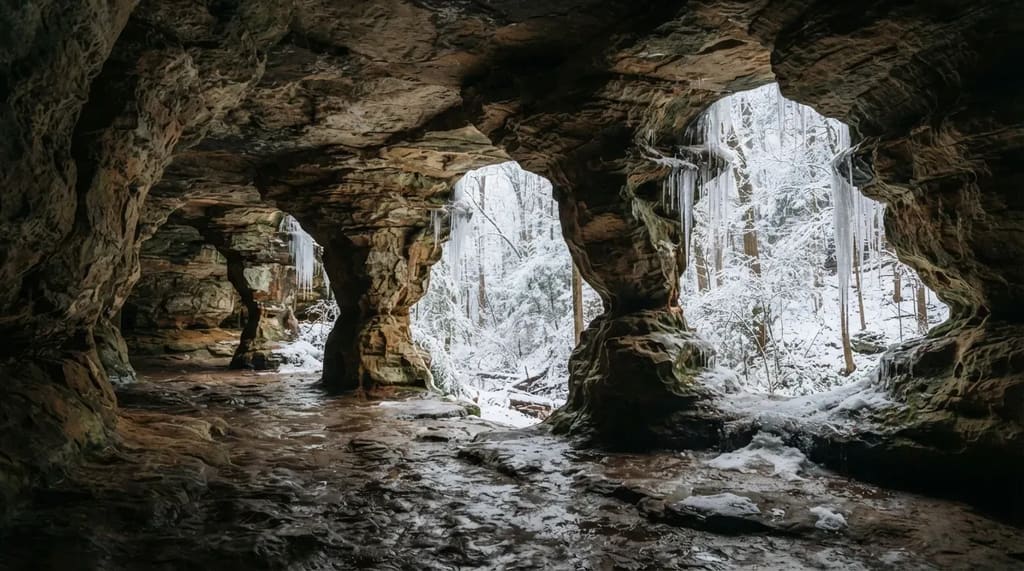
Rock House is the one place in Hocking Hills that counts as a true cave. It’s a tunnel-like corridor and a reputed old hideout. The name fits: window-like openings and sandstone columns holding up the roof make it look like a house carved into the cliff.
In winter you step out of frosty woods and into a shelter out of the wind. It’s a strange kind of comfort, with ice outside the windows and still air inside.
Why It Stands Out
- The park’s only true cave
- Window-like openings frame the frosty woods
- Sandstone columns hold up the roof
- Shelter from the wind on a bitter day
The walk to it is a half-mile loop, moderately challenging. In cold months the approach is a quiet corridor lined with icicles and snow-draped pines. Rock House was built up by the same Depression-era crew that worked at Rockbridge, Company 526. Rock House is the park’s only true cave, and the loop to it is half a mile.
#7 – Dark Skies Near Old Man’s Cave After Dusk
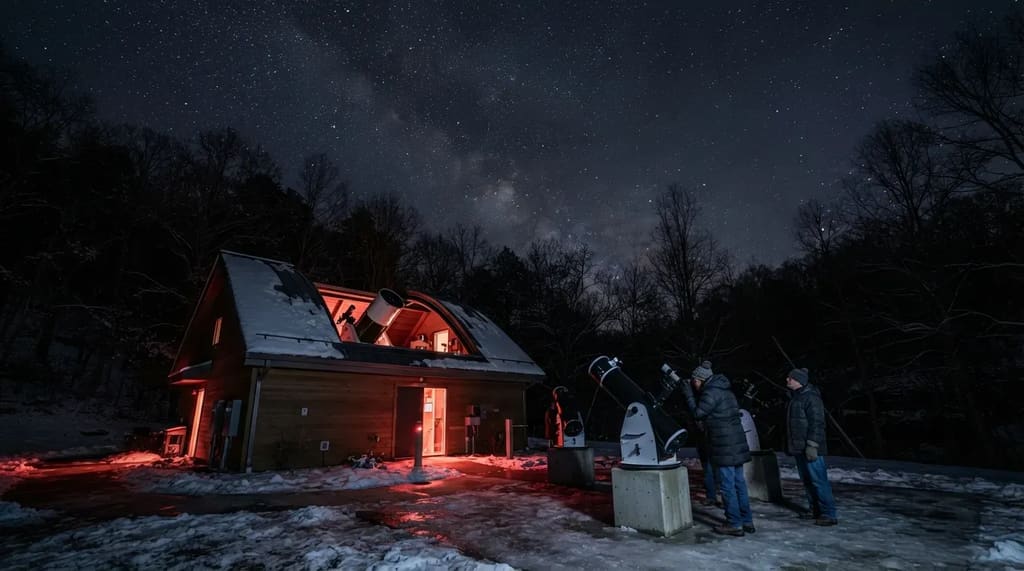
All seven Hocking Hills State Park areas close at dusk, and rangers enforce it. In December, dusk comes early, so you can lose the best light of the day in the middle of a hike. That’s a good reason to keep one stop for the evening hours, and the area has one built for exactly that.
John Glenn Astronomy Park is a purpose-built astronomy park about a mile from the Old Man’s Cave visitor center, under some of Ohio’s darkest skies.4 Cold winter nights are long, so you don’t have to stay up late to enjoy it. Every state park trail closes at dusk, so save the stars for after. By day, the next sight needs no hiking at all, and some of it you can see through the windshield.
#6 – Frozen Waterfalls You Can See From the Car
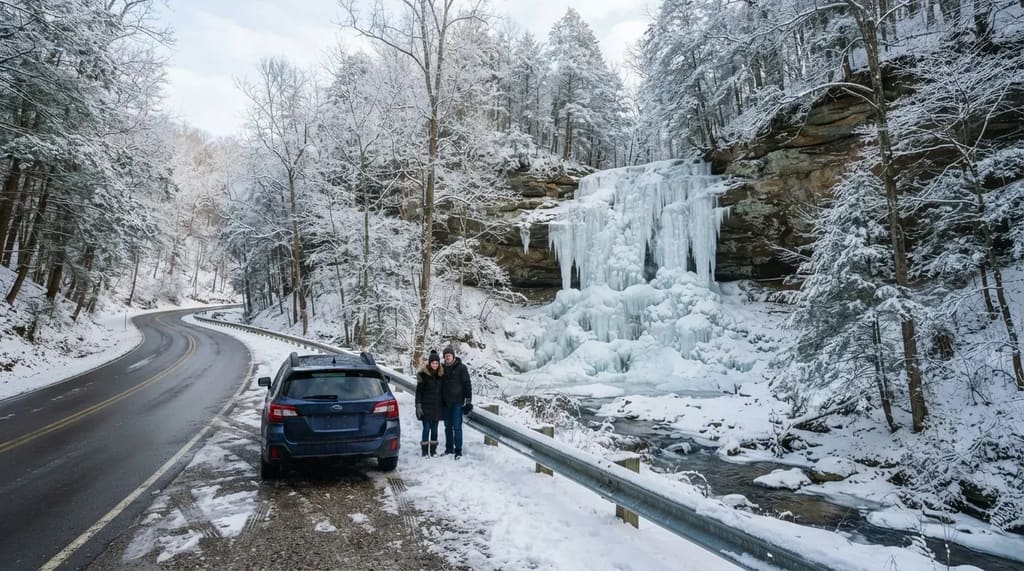
You don’t have to be a hiker to see Hocking Hills ice. One local driving route was designed so visitors can see the region’s waterfalls from the car. Most can be viewed without getting out, or by walking only a few feet.
In winter, those falls freeze into formations that are hard to describe. It’s a real option if you have a bad knee, a slick day or a passenger who’d rather stay warm.
On a day when the park steps are icy, this drive beats a trail. Falls freeze on a back road just as well as in a gorge, and the pull-offs don’t have stairs. These falls are most likely to be flowing in spring, so winter ice is the one sure thing. Most of these falls can be seen from the car or a few steps away. After the drive, the gorge that started it all is waiting, with a hermit’s name on it.
#5 – Old Man’s Cave and the Hermit Behind the Name
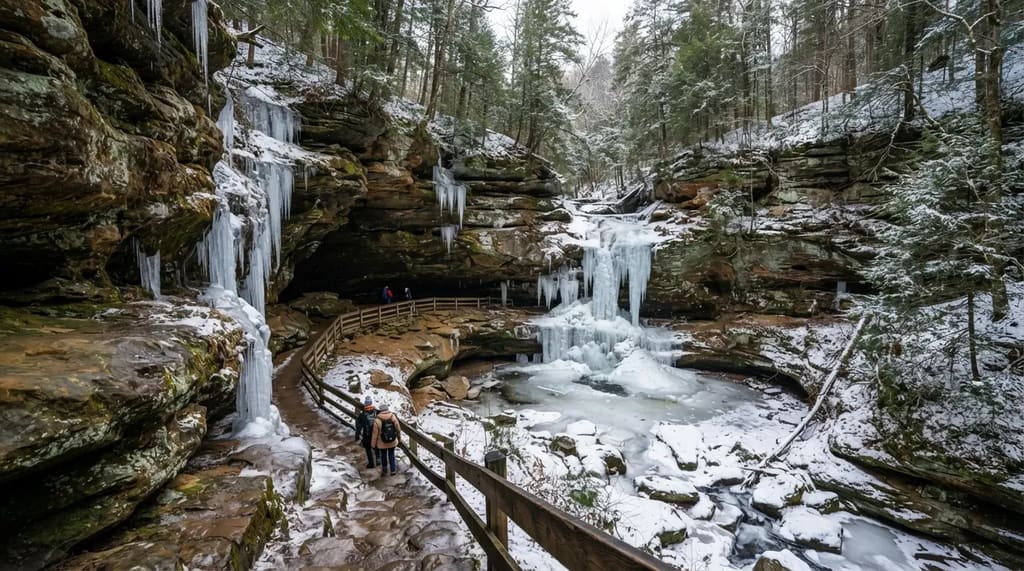
The cave is named for a man, not a rock. Old Man’s Cave takes its name from one of its first inhabitants, Richard Rowe, an area hermit.5 6 The trail descends by rugged stone steps into the gorge, past Devil’s Bathtub, stone tunnels, cliffs and the recess cave itself.
In winter, the gorge collects impressive ice after a few days of below-freezing temperatures. It also holds winter longer than the ground above it. Even with no snow on the surface, you may find snow and ice structures still intact once you step inside.
The park is open year-round from dawn to dusk, though visitor center hours are shorter in winter. The cave stays open all winter, but the stone steps can ice over. On one January Saturday this gorge fills with more than 5,000 people, in a tradition that began with 140.
#4 – The January Hike That Draws Over 5,000 People
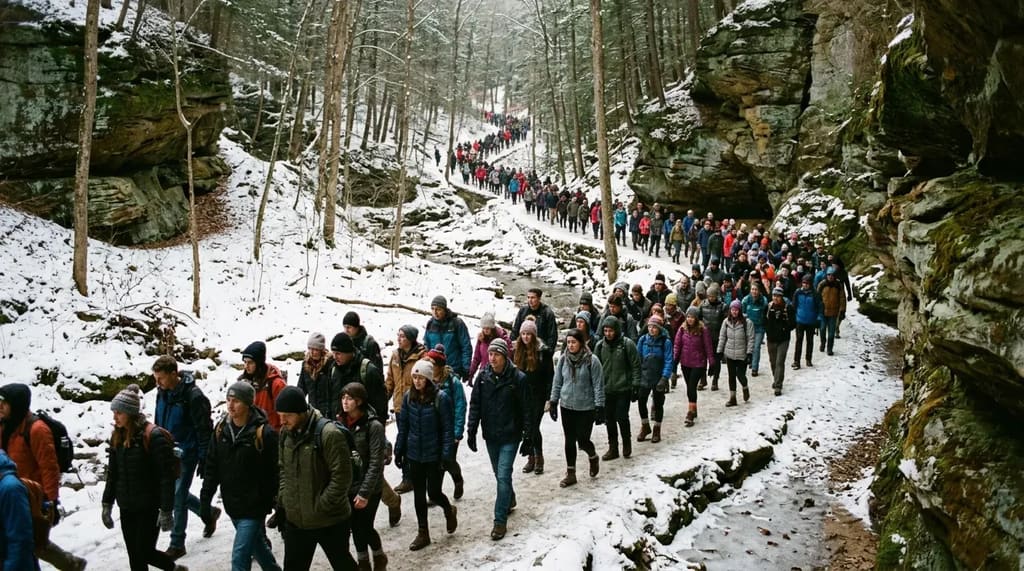
The Winter Hike started small. It grew from 140 participants in 1966 to 2,500 in 1973, which forced organizers to reverse the hiking direction to ease parking.2 Now more than 5,000 outdoor enthusiasts take part.2
The 2027 date is Saturday, January 16, with continuous starts between 9 and 11 a.m. The route covers about six miles, from the Upper Falls of Old Man’s Cave to Cedar Falls, where bean soup and cornbread are served, and on to Ash Cave.
It’s free, with donations encouraged for the refreshments and the return ride to Old Man’s Cave. If all you want is the cave at the end, you can skip the six miles, because it’s easy to park close to Ash Cave. Join the hike for the crowd and the soup, not just the destination. The lunch stop is a waterfall that doesn’t always freeze solid, which makes it the most changeable sight on the list.
#3 – Cedar Falls and Its Not-Quite-Frozen Curtain of Ice
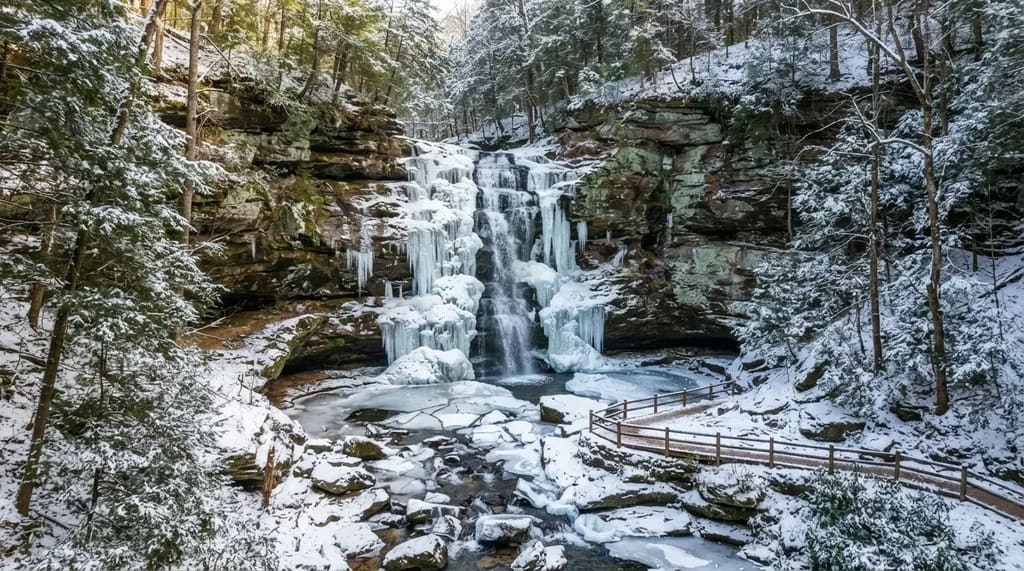
Cedar Falls is a 50-foot waterfall and carries more water than any other fall in the region. That volume has a side effect: it doesn’t always freeze solid. You may see water trickling between massive ice sheets, or a frozen column against the cliffs.7
Before the falls freeze completely, the sound of water slipping through the ice makes the whole gorge feel strangely calm. The walk in is only a half-mile.
The half-frozen version may be the best one. Solid ice is pretty, but moving water adds sound, and each visit looks different. That’s what makes winter at Cedar Falls worth repeating. Cedar Falls usually doesn’t freeze solid, so each winter visit looks different. It’s also the midpoint of the six-mile Winter Hike route from #4.6 The next sight needs no cold snap at all, only a fire, some carolers and a cup of cocoa.
Related Stories From Travelbinger


#2 – Christmas in Ash Cave Comes With a Real Fire
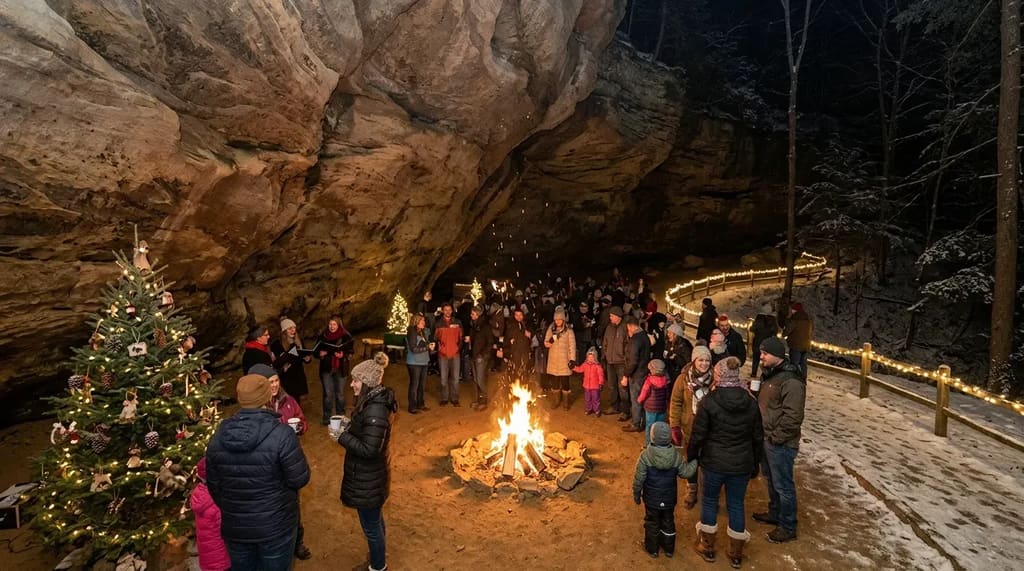
In December, the cold gets a party. Hocking Hills State Park hosts a free holiday walk to Ash Cave, with carolers, hot chocolate and a fire near the cave. Families stroll up under festive lights, and children decorate a wildlife-themed Christmas tree.
Ash Cave is the largest recess cave in Ohio, so a fire at the foot of that rock roof is a scene you can’t get in summer.
Worth Knowing
- Free to attend
- Held in December, so check the park calendar for the date
- The walk in is flat, so it suits strollers and little legs
- Expect carolers, cocoa and a crowd around the fire
Like the Winter Hike, this one costs nothing, but it asks a lot less of you. The path to Ash Cave is a flat quarter-mile by one resort’s count, and other guides say about half a mile, so allow a little more time than you expect. Christmas in Ash Cave is free and held in December. Check the state park‘s calendar for the exact date. The biggest sight on this list is in the same cave, and it needs a different month.
#1 – Ash Cave’s Towering Ice Column Beside a Paved Path
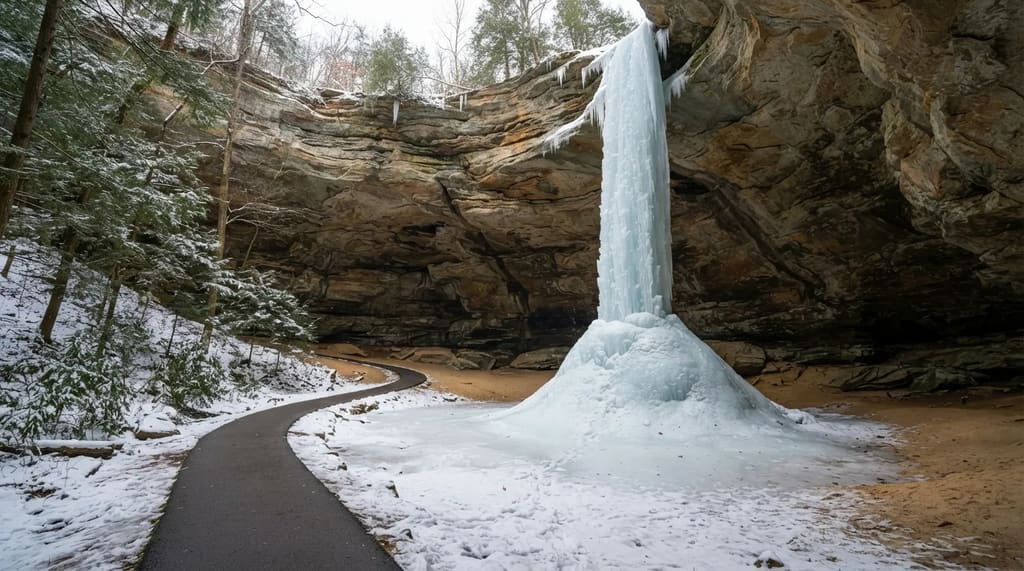
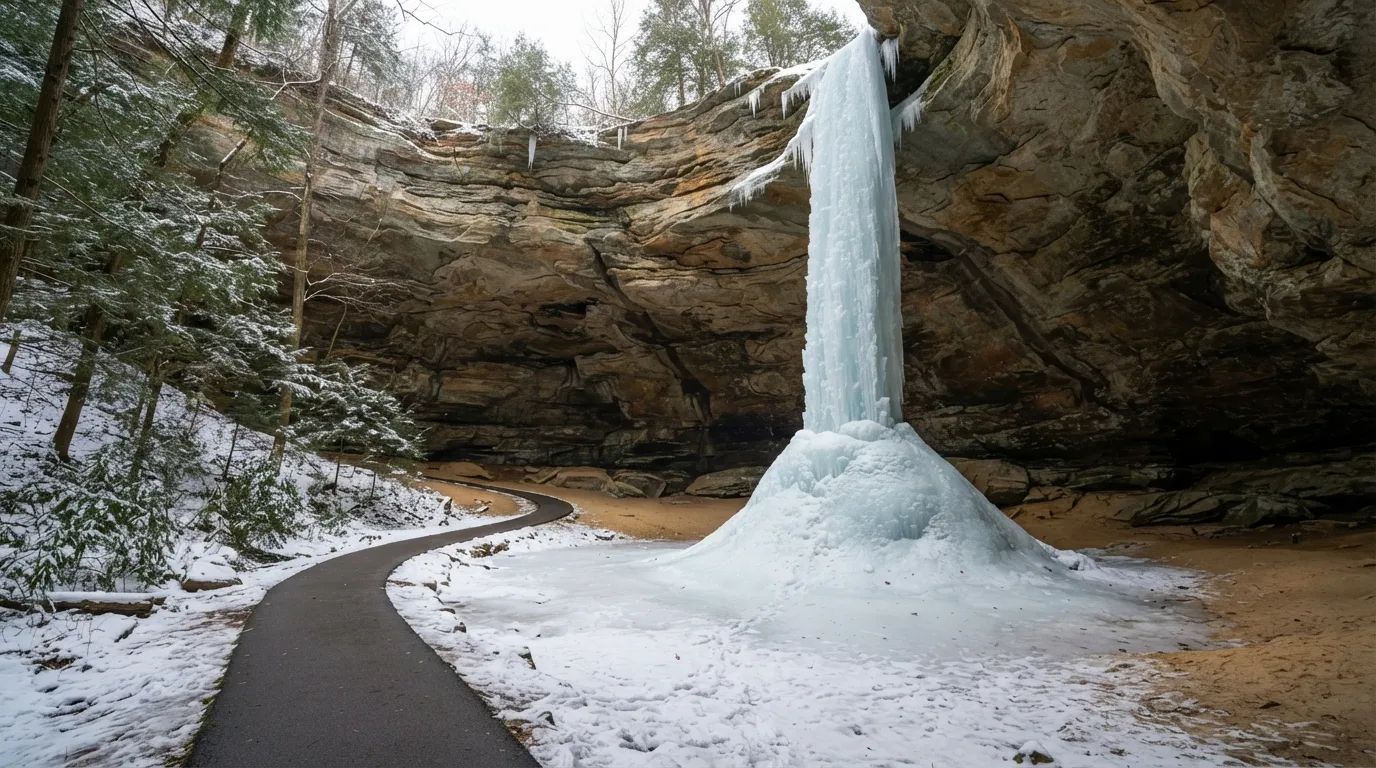
Each winter, the 90-foot Ash Cave waterfall can freeze into a towering column of ice, though other guides measure the drop at 83 feet. In January and February, water flows over the edge of the park’s largest recess cave and freezes at the bottom into a dome of ice that grows thicker through the season.7
The sand floor adds to the effect. Between the sand and the ice formations, Ash Cave can feel like a snowy beach. It’s a bigger sight than the Rockbridge arch from #12, and it takes far less effort to reach.
It’s also the easiest winter payoff on the list. Ash Cave is the most accessible waterfall to visit in winter, and the path is paved and wheelchair friendly.8 The one catch is timing. The column forms during sustained cold snaps, and the falls often run dry in summer, so what you see depends on the week you pick.
Quick Compare
- Ash Cave: ice column, paved path, needs a sustained cold snap
- Cedar Falls: 50-foot fall, half-mile walk, often only part frozen
- Rockbridge: stone arch, looks the same in any weather
Ice needs several days below freezing, so check the forecast before you drive. Go on a cold week, and you get the biggest sight of the season for the shortest walk.
The trick to Hocking Hills in winter is to stop treating the park like a place and start treating it like a calendar. Water, cold and time build every sight on this list, and none of them is promised. If a falls looks bare, a cave is still a cave, and an arch is still an arch.
Which sight would you drive the farthest for: the ice column, the fire in the cave or the stars after dusk?
- ODNR Rockbridge Preserve: https://ohiodnr.gov/go-and-do/plan-a-visit/find-a-property/rockbridge-state-nature-preserve
- Hocking Hills Wikipedia Overview: https://en.wikipedia.org/wiki/Hocking_Hills
- Ohio.org New Trails 2017: https://ohio.org/travel-inspiration/articles/find-these-new-trails-at-hocking-hills-state-park
- John Glenn Astronomy Park Guide: https://www.hockinghillsohio.org/blog/john-glenn-astronomy-park.html
- Old Man’s Cave History: https://www.hockinghills.com/old_mans_cave.html
- Hocking Hills Winter Hike Overview: https://www.hockinghills.com/featstory/winter_hike.html
- Ohio Magazine Winter Waterfalls: https://www.ohiomagazine.com/travel/article/3-waterfalls-in-ohio-to-visit-this-winter
- Ash Cave Accessibility Guide: https://www.hockinghillsrealmedia.com/blog/ash-cave-guide