
Most people picture the first big trip after quitting work as a victory lap: no alarm, no boss, no limits. Then the suitcase won’t roll over the cobblestones, the prescription is in a bag that landed in another country, and the hotel “bargain” turns out to be a long, expensive cab ride from everything. Retirees describe these moments with a laugh now, but some of them cost real money.
Here are the 13 mistakes retirees and the experts who study them say come up most often. A few are small and almost funny. One is about a coverage gap that surprises nearly everyone. And the one at the very top has nothing to do with luggage, hotels, or even money.
#13 – The 28-Inch Suitcase That Became a Cobblestone Nightmare

The first confession retirees make is the one sitting in the hallway. One couple on a first retirement trip to Europe traveled with a carry-on bag, a purse, a backpack, and two checked bags, one of them a 28-inch giant. They hauled it through airports, train stations, and cabs, then up stairs on cobblestone streets. Somewhere around the third staircase, they realized it was simply too much.
Tour operators who work with older travelers say the same thing. Heavy suitcases create stress at airports, hotels, train stations, and cruise terminals, and small wheels do not love old stone streets. Chances are you’ll come home wondering why you packed half of what you did. Plenty of seasoned travelers would argue the “just in case” outfit is the most overrated item in any bag.
But the bag is only half the story. The next mistake started long before anyone reached the airport…
#12 – The “Bargain” Hotel That Quietly Ate the Savings

Everyone loves a deal, and first-time retiree travelers often book like it’s a game. The trouble is that the cheapest listing isn’t always the cheapest trip. A hotel that saves $30 a night but sits miles from the city center can mean daily taxi fares, long commutes, and less time actually seeing anything.
The same trap shows up in the sky. A discount airfare with multiple connections can turn a travel day into an endurance test, and the “savings” quietly become a day of your trip spent recovering. Operators who run retiree tours say real value means looking at the whole experience, not just the price tag.
Quick Compare
- Sticker price: $30 a night cheaper, far from the city center.
- Real price: daily taxi fares, long commutes, and less time seeing the sights.
- Cheap flight: multiple connections and a travel day that feels endless.
- Better flight: fewer connections and a first day you can actually enjoy.
Cheap flights are one thing. But the next mistake is about something retirees only notice after they’ve already paid…
#11 – Packing Every Day Like It Was the Last Vacation Day Ever

For decades, vacations meant squeezing everything into a few precious days off. That habit follows people right out the door of the office. In retirement, nobody is counting down a limited number of vacation days, yet many first-timers still schedule like the clock is running. The result is a trip of 7 a.m. alarms, packed tour buses, and tired feet.
Retirees who’ve been through it say the fix is slowing down. Slower-paced itineraries let you actually savor a place instead of just checking it off. The first big trip is rarely perfect, and a day with nothing planned is often where the best stories come from. Some of those unplanned hours become the memories people bring up for years.
But rest is the least of your worries if the pills you need never arrive. That’s #10…
#10 – The Medication That Went Into the Checked Bag

This is the packing mistake older travelers warn each other about most. Checked bags get lost, delayed, or rerouted more often than anyone wants to admit. Now imagine that bag holds your daily prescriptions, and you’re standing at a baggage office in a country where you don’t speak the language.
A missing suitcase is an inconvenience. Missing medication can be a medical problem. The simple rule retirees swear by is to keep every prescription in the carry-on, in the original bottles, so there’s never a question about what they are.
And if you think the stress ends once you’re packed, wait until you see what retirees say they did wrong when booking flights…
#9 – Booking Flights Like They Still Had a Boss

Here’s a secret retirees only figure out later. They no longer have to fly when everyone else does. Freed from the school calendar and the workweek, they can fly at off-peak times, on days when prices tend to be lower, typically a Tuesday or Wednesday.
The reason is simple. Historically, business travelers book Sunday and Thursday evening flights, which pushes those fares up. That trend has lessened somewhat, but you can still find better prices by avoiding those days. Some first-timers end up paying a premium for the exact schedule they just escaped.
Worth Knowing
- Retirees can choose off-peak days instead of following the workweek.
- Tuesday and Wednesday flights are typically cheaper.
- Sunday and Thursday evenings have long been favorites of business travelers.
- The pattern has softened, so compare fares across several days.
Flying midweek is a small win. But the next mistake is the one that quietly drains a travel fund without anyone noticing…
#8 – The Tourist Strip Lunch and the Surprise Card Fees

First trips often leak money in small, boring ways. One of them is the card in your wallet. Money experts point to cards with no annual fee and no foreign transaction fees as an easy way to avoid pointless charges every time you tap to pay overseas.
The other leak is lunch. Travel writers say neighborhood gems can be reasonably priced, so you spend $10 to $15 rather than $30 to $40 on the tourist strip. That’s a gap of up to $25 a meal, and it’s the kind of thing you never notice until the credit card statement arrives.
And speaking of budgets, the next mistake is what separates calm trips from stressful ones…
#7 – Treating the Travel Fund Like an Afterthought

Retirees dream about travel, yet many never turn it into a real number. In a Boldin survey, 11% of subscribers said they hadn’t formalized travel costs in their spending plan, compared with 42% of a national panel. That gap is where the surprises live.
The stakes are real. AARP found cost remains the top hindrance to travel, with expected spending of $6,847 for 2025. The people who planned the most also felt the most confident: 86% of Boldin subscribers felt at least somewhat confident in their travel budget, compared with 56% of the national panel.
But a budget can’t protect you from the next mistake, because it involves a policy most people buy too late…
#6 – Buying Travel Insurance After It Was Too Late to Matter

Most people assume travel insurance works like car insurance. Buy it anytime, and you’re covered. Turns out the timing matters. Many policies require purchase soon after the first reservation, or the coverage is limited and likely won’t include pre-existing conditions.
There’s a second trap. Standard cancellation insurance often doesn’t cover overseas medical care properly, so the policy that protects your deposit may not protect your health. Operators note that illness, weather delays, injuries, family emergencies, and airline disruptions can all hit when you least expect them.
Which brings us to a surprise that catches almost every retiree with a supplement plan…
#5 – Trusting the Medigap Safety Net Without Reading the Fine Print

Some retirees feel covered because they bought a supplement plan. They’re partly right. Most current Medigap plans (C, D, F, G, M, and N) cover 80% of emergency medical expenses abroad after a $250 deductible, with a lifetime maximum of $50,000.
Some summaries add that coverage applies only to emergencies that begin within the first 60 days of a trip. A $50,000 cap sounds generous until you price a long hospital stay overseas. Medicare Advantage is a different story entirely, since coverage outside the U.S. depends on the specific plan.
But the coverage gap gets bigger once you learn what Original Medicare does at the border. That’s #4…
#4 – Assuming Medicare Boards the Plane With You
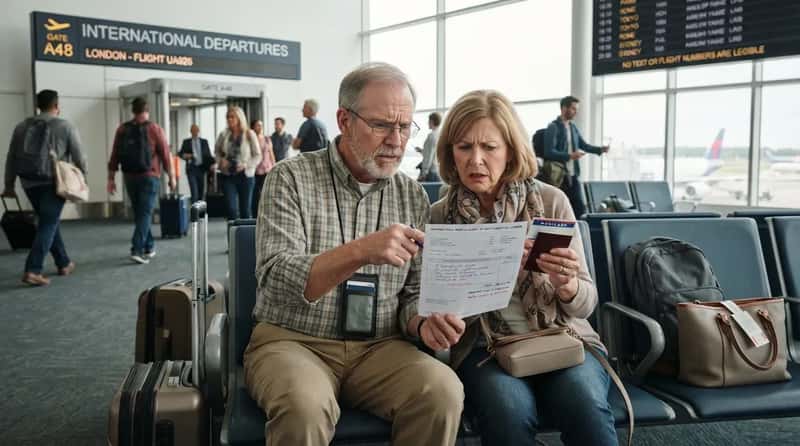
This is the mistake that costs real money. Many retirees believe “Medicare travels with you,” only to face full bills abroad. Medicare covers the 50 states, Washington, D.C., Puerto Rico, the U.S. Virgin Islands, Guam, American Samoa, and the Northern Mariana Islands. Beyond that, it generally doesn’t.
The exceptions are narrow. Limited coverage may apply near the Canadian or Mexican border, or for care on a cruise ship within six hours of a U.S. port. Even where Medicare does apply, you may have to pay the bill first and file a claim afterward.
Health is one thing. But the next mistake is about who gets left at home, and retirees say it hurts the most…
#3 – Leaving the Person They Most Wanted to Go With at Home

Ask older travelers what they’d redo, and this one comes up quietly. The people you assumed would always be free for that “big trip” may no longer be. It’s the regret that hits deepest, because no late booking can undo it.
Cornell gerontologist Karl Pillemer asked 1,000 seniors for life advice, and the message to travel early and often came up again and again. No amount of savings can bring back a travel partner you waited too long to invite. Others say fear of going solo kept them home, and their advice is not to let the dread of eating alone stop a life-changing trip.
If that stings, brace yourself. The next two mistakes are the ones retirees repeat most often…
#2 – Letting Money Fears Freeze the Whole Plan

Worry about money is understandable. But retirees say it can swallow the trip itself. AARP found cost is the biggest barrier to travel for 45% of respondents, followed by health at 29% and weather at 23%.
Financial advisers describe a familiar scenario. A couple spends the first eight years of retirement delaying international travel because they’re worried about market volatility. By the time they feel comfortable, one spouse has mobility challenges that make the trips much harder. Health often runs out before money does.
At a Glance
- Cost: the top barrier, cited by 45% of respondents.
- Health: the second biggest hurdle, at 29%.
- Weather: the third, at 23%.
- The catch: waiting for the market to calm down can cost the years when travel is easiest.
That brings us to the single mistake retirees mention more than any other…
#1 – Waiting for the “Right Time” That Never Came

This is the big one. In a survey of 2,000 people commissioned by Icelandair, the biggest regret among people over 50 was simply not having traveled more. Not the money spent. Not the bags. The trips never taken.
The pattern holds in other research. An Explore Worldwide survey found 62% of people 70 and older said there’s somewhere in the world they regret never visiting. The regret that keeps surfacing is waiting, not spending. The perfect window, retirees say, was always an illusion.
Overpacking, bad timing on insurance, and a Medicare gap that surprises almost everyone are all fixable. The suitcase can be repacked, the policy can be bought, and the budget can be rewritten.
Nearly 90% of Boldin members who prioritize travel expect to do most of their traveling in the first half of retirement. That’s the window retirees say they wish they’d used. The year you didn’t go is the one mistake nobody can rebook.