You’d think a currency-exchange counter is one of the most impersonal spots in an airport: quote the rate, print the receipt, next customer. But watch a busy kiosk for twenty minutes and you’ll notice something the rulebook never mentions. When an older traveler pauses a beat too long, squints at the display, or asks the same question twice, the whole rhythm of the transaction changes.
None of it is written in an employee handbook, and most of it never gets reported to corporate. It’s a set of quiet, almost invisible adjustments that experienced staff make on the fly, often without the traveler ever noticing it happened. Here’s what actually goes on behind the counter when someone over 60 looks unsure.
#13 – They Slow the Math Down Instead of Just Pointing at the Screen
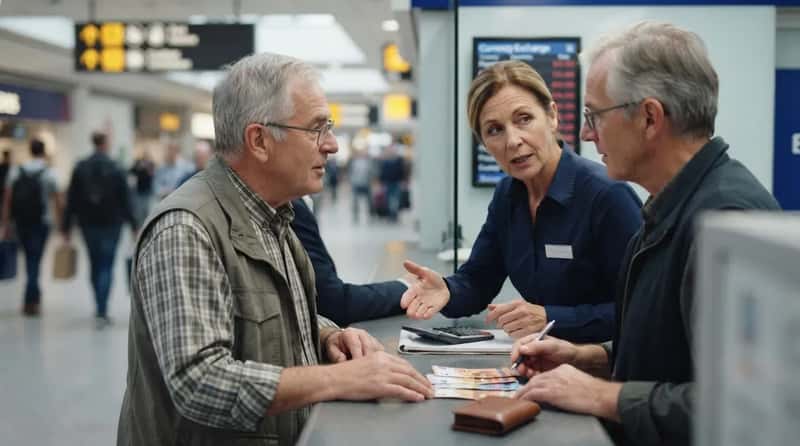
Rushed math is where confusion starts. Younger travelers tend to accept whatever number flashes on the digital display, but staff say older customers are far more likely to ask, “wait, how much is that in real dollars?” When that happens, experienced clerks stop typing and start talking.
Instead of pointing at the screen, they’ll say the numbers out loud, step by step, walking through the conversion instead of just displaying it. Staff describe it as the difference between a transaction and an explanation, and unsure travelers almost always prefer the explanation. That one small shift is often enough to catch an error before it turns into a complaint.
#12 – They Write the Total by Hand on a Receipt or Notepad
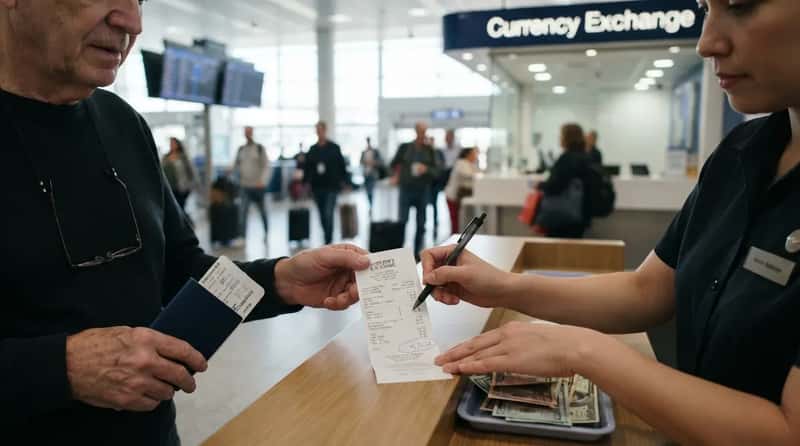
Digital displays are fast, but they vanish the moment you look away. For a traveler already juggling a boarding pass, a passport, and reading glasses, that’s a real problem. Some counter staff have started jotting the final total on a scrap of paper or circling it on the printed receipt before handing it over.
It sounds minor, but it gives the traveler something physical to double-check later, whether that’s on the plane or back home unpacking their bag. It costs the clerk ten seconds and can save the customer a stressful phone call afterward. Many say they picked up the habit after watching a confused customer walk away, only to return minutes later asking to recount everything.
#11 – They Steer Older Travelers Away From “Guaranteed Rate” Offers
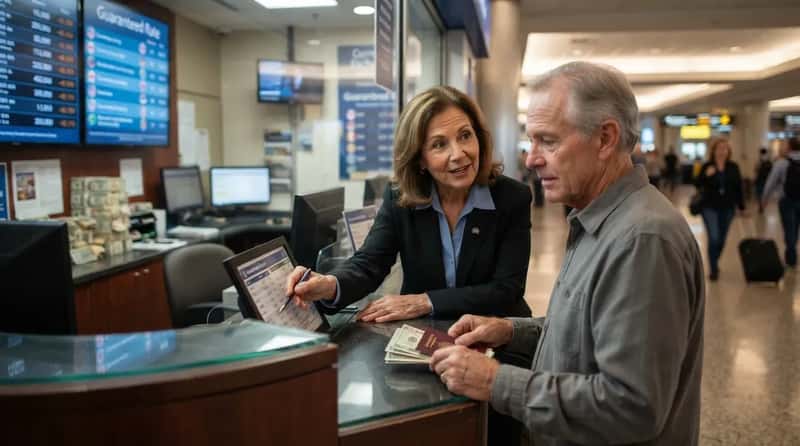
Airport kiosks love advertising a locked-in “guaranteed rate” as a premium perk, and it sounds like a genuine deal. In reality, those guaranteed-rate offers typically deliver rates only two to three percent better than the standard rate, not the competitive market rate travelers imagine they’re getting. It’s a small print detail that most customers never think to question.
Staff who’ve been at the counter long enough know this, and some quietly steer unsure older travelers away from paying extra for the “guarantee” tier. They’ll simply say the standard rate is close enough that the premium option isn’t worth the added cost. It’s a small moment of honesty that runs against the sales script, but it happens more often than corporate would probably like.
Quick Compare
- Standard rate: the same number every other customer gets that day
- “Guaranteed” rate: usually locked in just 2-3% above standard, not a real bargain
- Bottom line: the upgrade fee often costs more than travelers actually save
#10 – They Warn Them About the “Pay in Dollars” Trap Before It Happens
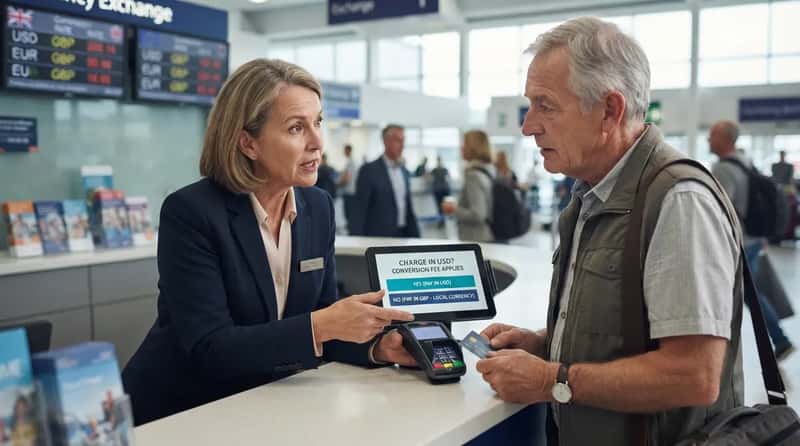
This is one of the most common ways travelers lose money without ever realizing it. At payment terminals and ATMs abroad, a prompt appears asking whether to be charged in home currency or local currency. That practice is called dynamic currency conversion, where the overseas merchant or ATM operator sets its own exchange rate instead of using the traveler’s bank rate.
Choosing dollars over local currency typically means paying three to five percent more in hidden conversion fees. Experienced exchange staff who notice an older traveler seems uncertain will often mention this proactively, telling them flatly to always choose the local currency, no matter what the screen suggests. It isn’t part of any script, but staff say it’s the single tip that saves travelers the most money on a trip.
#9 – They Break Big Exchanges Into Smaller, Easier-to-Track Batches
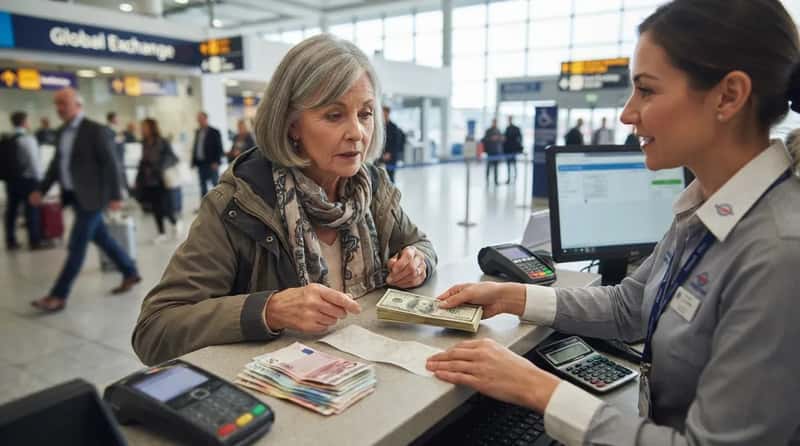
A traveler handing over $800 in one lump sum can lose track of the math fast. Some counter workers will quietly suggest splitting a larger exchange into two smaller transactions instead, especially when a customer seems overwhelmed by the total in front of them.
It’s slower for the clerk and technically inefficient for the counter, but it gives the traveler two receipts and two smaller totals instead of one big number that’s hard to verify at a glance. Several employees describe this as their unofficial way of “showing your work” for someone clearly doing the math in their head. It rarely gets offered to younger, more confident customers.
#8 – They Count the Cash Out Loud, Twice
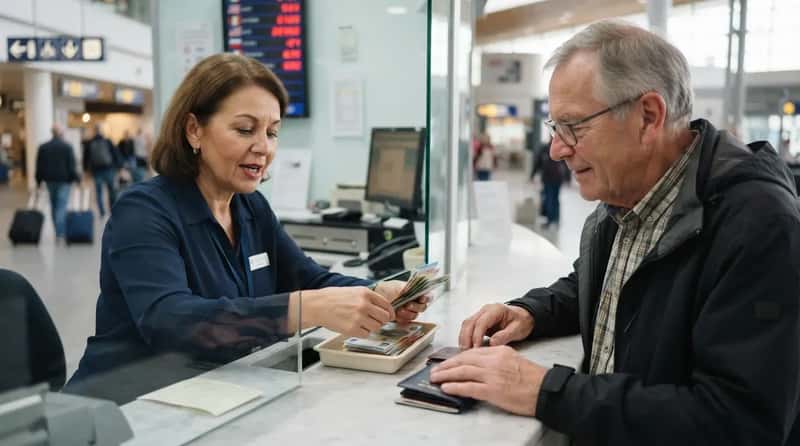
Shortchanging complaints are a real problem at busy exchange counters, and confusion during counting is often the actual root cause. Staff who deal with older travelers regularly will count bills out loud, slowly, and then count them again before sliding the stack across the counter.
It’s a habit that protects both sides of the transaction. The double count out loud isn’t standard training, it’s something experienced clerks added on their own after one too many disputes at the window. Travelers rarely ask for it, but staff say offering it unprompted almost always gets a visible sigh of relief in return.
#7 – They Read Confusion as a Cue to Quietly Call Over a Supervisor

Sometimes a traveler isn’t just unsure about math, they seem genuinely disoriented, forgetful, or they repeat the same question three or four times in a row. Staff at busier counters say this is a moment they’ve learned to take seriously rather than rush through like any other line.
Quietly waving over a supervisor, a security officer, or even airport medical staff isn’t about suspecting the traveler of anything. It’s a safety check, because confusion at a counter can sometimes be an early sign of a medical issue, not just ordinary travel stress. Most exchange staff won’t say this out loud to the customer, but they’ll make the call if something feels off.
Worth Knowing
- Repeating the same question three or more times in a row
- Losing track of the conversation mid-sentence
- Appearing unsteady, unusually quiet, or disoriented
- Not recognizing a boarding pass or passport moments after handling it
#6 – They Skip the Upsell Script Entirely
Currency counters are commercial operations, and staff are often trained to mention add-ons like prepaid travel cards, travel insurance, or premium exchange tiers. But many employees admit they quietly drop the upsell the moment an older traveler looks like they’re already struggling to follow the main transaction.
Adding another product into the conversation right when someone’s overwhelmed just creates more confusion, not more sales, as one longtime exchange worker put it. Instead, staff will finish the core exchange, hand over the cash, and let the traveler go, even if that means missing a bonus tied to selling add-ons that’s technically part of the job.
#5 – They Nudge Them Toward the ATM Instead of Their Own Counter
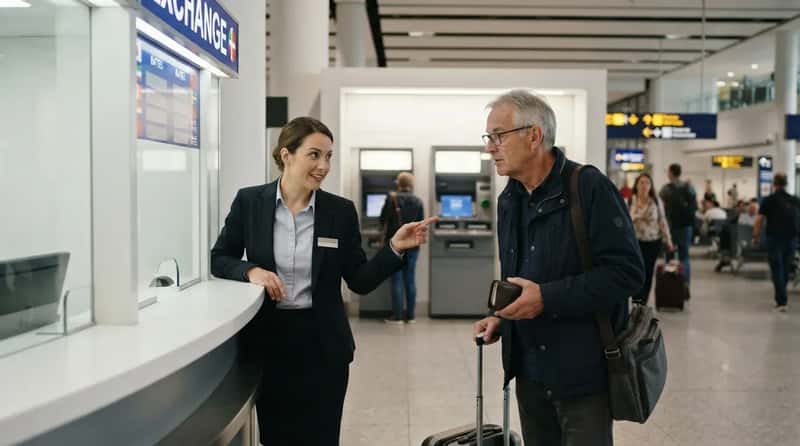
This is the one that surprises most people: some counter staff will actively tell a hesitant traveler to skip their own booth and use the ATM instead. It sounds counterproductive coming from someone paid to make exchanges, but it’s often the more honest recommendation.
Withdrawing money directly from a local bank’s ATM is typically more affordable than visiting an airport kiosk, even after accounting for withdrawal fees and foreign transaction charges. Staff who genuinely care about repeat, word-of-mouth trust will say this quietly, almost like a secret, because it goes directly against what their employer wants them to sell. It’s one of the clearest examples of an insider tip that isn’t supposed to leave the counter.
Quick Compare
- Airport kiosk: fast and convenient, but often the priciest exchange of the whole trip
- Local bank ATM: usually closer to the real market rate, minus a flat withdrawal fee
- Smart middle ground: a small kiosk exchange for immediate cash, then an ATM later for the rest
#4 – They Keep a Stash of Small Bills Ready for Tipping and Taxis
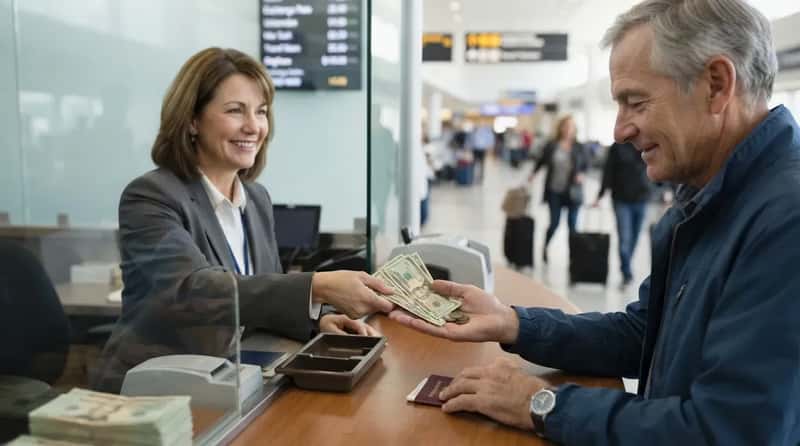
Older travelers heading somewhere unfamiliar often worry less about the big exchange and more about the small stuff, like tipping a porter, paying a cab, or buying a bottle of water at arrival. Staff who’ve learned to spot this concern will proactively break part of the exchange into smaller bills and coins, even when the traveler never asked.
It’s a small gesture, but it solves a real problem before it starts. Nobody wants to hand over a $50 note for a $3 taxi tip in a country where they don’t recognize the currency yet. Staff describe this as one of the easiest, lowest-cost ways to make an unsure traveler feel taken care of.
#3 – They Hand Over a Printed Rate Sheet Instead of a Rushed Verbal Quote

Rates change constantly, and currency exchange rates can shift minute to minute, though most banks only update their posted rates once each business day. That fluctuation is confusing enough for confident travelers, let alone someone already unsure of the process from the start.
Some staff keep a printed sheet at the counter specifically for travelers who seem hesitant, rather than reciting numbers verbally and moving on to the next customer. It gives the traveler something to hold, reread, and compare later without the pressure of a line forming behind them. It’s a five-second habit that turns a confusing verbal exchange into something the traveler can actually verify on their own time.
#2 – They Watch for Phone Scam Behavior in Real Time
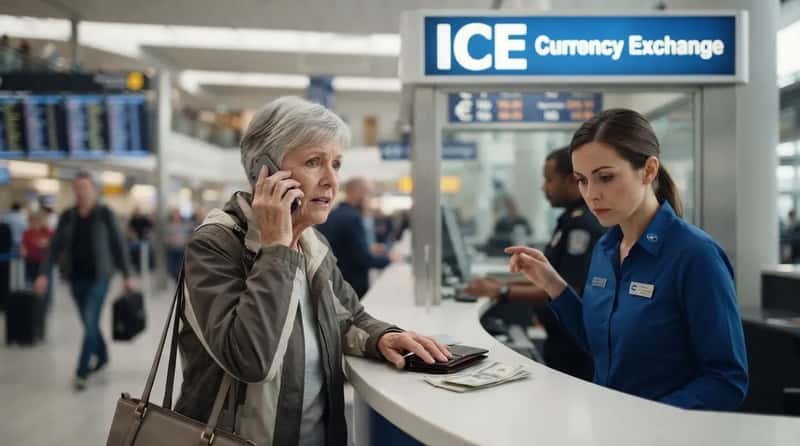
This is one staff rarely talk about publicly, but many say it’s become far more common in recent years: an older traveler on the phone at the counter, being coached by someone claiming to be from “the bank” or “the government,” asking them to withdraw or exchange cash urgently. Modern scams often look perfectly legitimate at first glance, blending old-fashioned pressure tactics with new technology to catch even experienced travelers off guard.
Experienced staff have learned to recognize the pattern: urgency, secrecy, a phone that won’t come off the ear. Some will deliberately slow the transaction down, ask extra questions, or quietly alert security, not because the traveler did anything wrong, but because that traveler may be the target of a scam happening in real time. It’s one of the more serious things staff say they’ve had to learn to spot on the job.
Worth Knowing
- A caller claiming to be from “the bank” or “the government” demanding urgent action
- Pressure to withdraw or exchange cash immediately, with no time to think it over
- Instructions to keep the call secret from family, friends, or staff
- A phone that never leaves the traveler’s ear throughout the transaction
#1 – They Walk Them Back Toward Security or Their Gate

The last one is the simplest, and staff say it’s the one that means the most. When an older traveler finishes the transaction and still looks lost, unsure which direction to go, worried about running out of time, some counter employees will step out from behind the booth and personally walk them back toward security, a gate, or an information desk.
It’s not in the job description, and corporate certainly doesn’t track or reward it. It’s a two-minute favor that costs the employee nothing on paper but often means everything to a traveler who was quietly panicking about missing a flight. Staff describe it as the moment the job stops feeling like a transaction and starts feeling like something closer to hospitality.
None of this is official policy. There’s no training manual that says “slow down for travelers over 60” or “skip the upsell if someone looks confused.” It’s a pattern experienced currency-exchange staff built on their own, transaction by transaction, because rushing an unsure traveler through a confusing process tends to backfire for everyone involved.
The bigger lesson may be this: the safest way to handle currency exchange isn’t to count on a kind employee noticing you’re unsure. It’s to walk in already informed, know the rates, decline the dollar-conversion trap, and ask questions before handing over cash. Have you ever noticed this kind of quiet extra care at an airport counter, or had the opposite experience? Tell us in the comments.