

Most passengers walk past the guest services desk on day one assuming it’s a glorified information stand. Then a zipper splits, the cabin upstairs starts thumping at midnight, and the desk turns out to be closer to a rescue counter. On many ships it’s still called the purser’s office, though the signs may read Guest Services or Reception, and the staff have more room to say yes than the brochure suggests.
Almost every fix here comes with a clock, and the clock decides whether you get help or a bill. Some options vanish the moment the gangway goes up. Stay for #1: it’s the costliest item on the list, it happens on a pier, and the protection takes seconds on your phone. Start with the smallest fix, which is free.
#13 – Free Seasickness Pills Waiting Behind the Desk
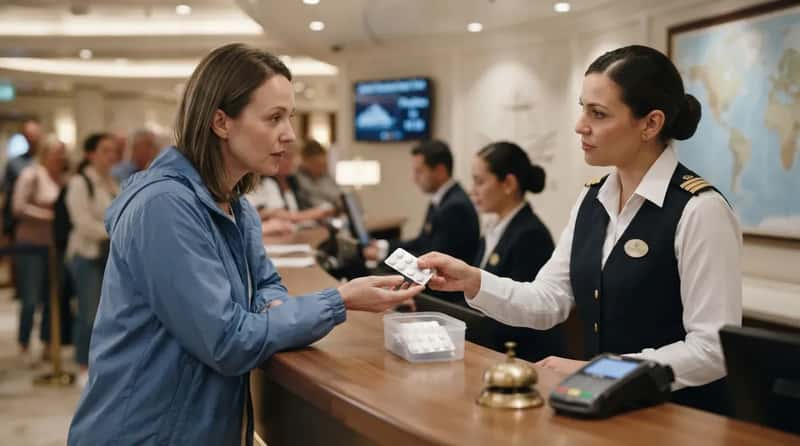
A rolling ship is a bad time to start asking around. Guest Services often keeps a stash of basic over-the-counter seasickness tablets it’s happy to hand out, and can often provide them free.1 On some ships the desk may direct you to the medical center instead, which is the better stop if you take other medications or the tablets don’t settle things.
The catch is supply. The tablets aren’t always advertised and stock can be limited, so the time to ask is before the water gets rough. Policy differs by line, so a polite question works better than an assumption.
This is the cheapest fix on the list, and one that can run out: ask early, because supplies can be limited. Settling your stomach costs nothing. Settling the paperwork for your flight home can cost nothing too, if you know which sheet to bring.
#12 – Your Flight Home, Printed at the Desk
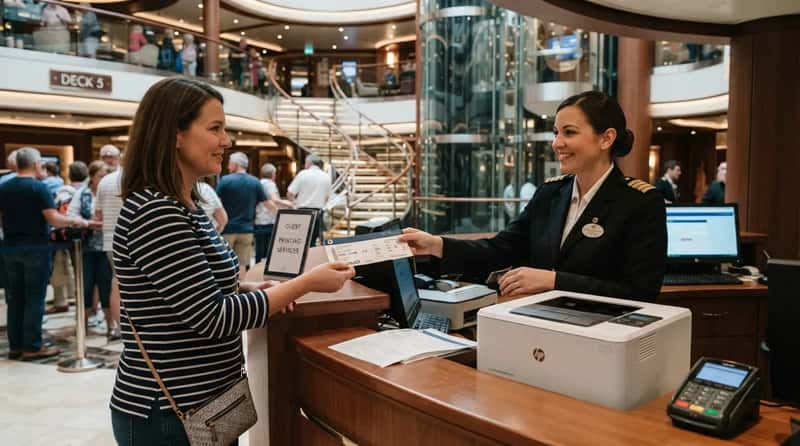
A ship at sea is a poor place to find out your flight home needs a paper copy. Forward the confirmation email to Guest Services and they can print it, sometimes for free and sometimes for a small fee if you have a lot of pages.2 A few pages are usually free, which covers a boarding pass and a transfer voucher.
The same desk can reprint excursion confirmations, so a soggy printout from a tour isn’t a reason to skip a port. Do this early in the cruise, because the queues at guest services swell the night before and the morning of departure.
Ask what the fee is before you hand over a long document. A few pages are usually free; a long stack may cost a fee.
Fast Facts
- How: Forward the confirmation email to Guest Services.
- Covers: Boarding passes, transfer vouchers and excursion confirmations.
- Cost: A few pages are usually free; a long stack may carry a fee.
- Timing: Queues swell the night before and the morning of departure.
#11 – A Broken Suitcase Fixed Before the Flight Home
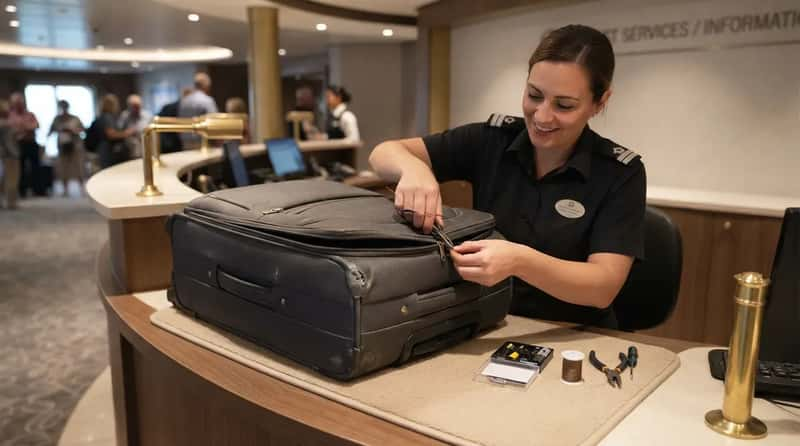
A split zipper on day three doesn’t have to ride home with you. Bring the bag to Guest Services and they can often fix zippers, pop out dents or repair the damage on the spot.2 Bigger jobs take longer, but they may be able to fix it within a day or two.1
If the bag can’t be saved, they can usually give you a form to request compensation.3 That form is the real prize, because it turns a broken suitcase into a documented claim while the crew who saw the damage are still on board. Once you’re home there’s no desk to hand it to, so ask for the compensation form if the repair fails.
Luggage is the easy case. The harder complaint is the one you hear through the ceiling at midnight, and it has two possible fixes.
#10 – A Noisy Cabin Doesn’t Have to Stay Yours

Midnight thumping overhead isn’t something you have to live with. If you have issues with your cabin, such as noise, Guest Services wants to hear about it. They may send an engineer to fix the issue or move you to a different cabin if one is available, and that last phrase carries the weight.
A full ship has few spare cabins, so the earlier you report, the better your odds of a move. Wait until the final night and there’s nothing to move you into, which turns a fixable problem into a complaint the desk can only note.
Report noise the first night it happens, while a spare cabin may exist.
Sleep is the easy part. The color of the tag on your suitcase decides whether you make your flight.
#9 – The Luggage Tag Color That Sets Your Exit
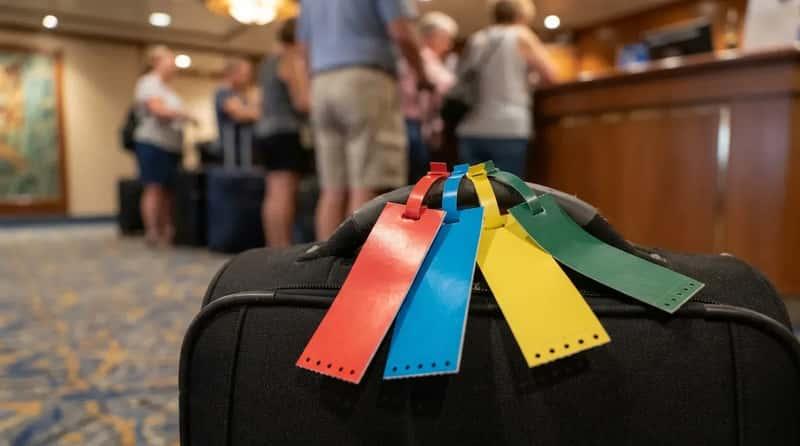
Your departure morning is set by a color on a paper tag, not by your flight time. Ships release passengers in groups, and on many ships the group follows the color of your luggage tag. If that color has you leaving later than your flight allows, Guest Services can usually switch you to an earlier group. The swap takes a short conversation.
Bring proof. The flight confirmation you printed back in #12 shows why the swap matters. Ask before the final evening, when everyone else is also asking the desk for something.
Booking an early flight and hoping your assigned group works out is a gamble you don’t have to take, because Guest Services can usually move you to an earlier group.
At a Glance
- Who to ask: Guest Services.
- What changes: Your disembarkation group, often tied to your luggage tag color.
- What to bring: Your printed flight confirmation.
- When to go: Before the final evening rush.
#8 – A Spending Cap on Your Teenager’s Card
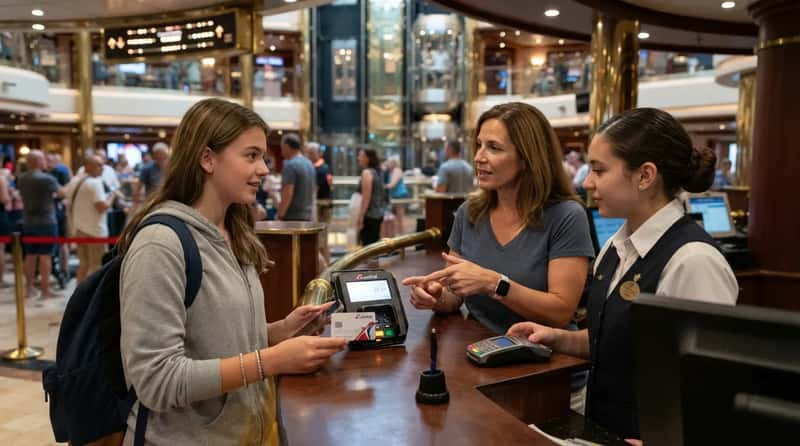
Hand a teenager a cruise card and you’ve handed over a tab. Guest Services can set a spending limit on a child’s or teen’s account so there’s no surprise bill at the end of the cruise. On Carnival, parents can visit the desk to adjust the amount their children can spend on Sail & Sign accounts.
Charges on those cards land on your bill, not theirs, which means the first time you see them may be the last night. The Points Guy points out that noticing on day two lets you talk with your child and cap the card then. A limit set on embarkation day beats a family argument on the final evening.
Parents can set or adjust a child’s spending limit at the desk.
Those are charges you chose to allow. Some arrive uninvited, and the line to dispute them gets long fast.
#7 – The Wrong Charge on Your Onboard Bill
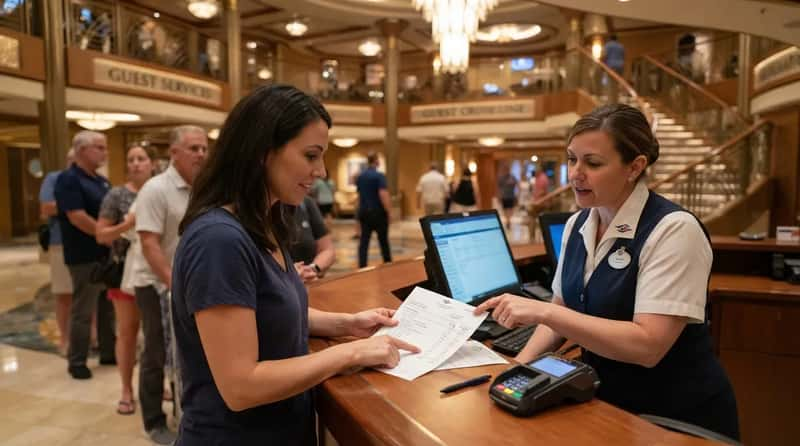
The night before you leave is the worst time to find a charge you never made. The Points Guy reports that many cruisers wait for the paper bill the night before disembarkation, which creates huge queues at guest services that night and the next morning.4 Anyone who waits joins that line with a problem and a deadline.
Fix it while it’s small. Customer service back home doesn’t always have access to your onboard bill, so the desk aboard is often your best chance at a correction. A Cruise Hive writer reported spotting an incorrect shore excursion charge on Disney Dream and adjusting the account at the desk.
Check your folio every evening and dispute errors the same day.
Wrong charges can be reversed. One charge you can change on purpose is the daily tip, but only until a deadline.
#6 – Daily Tips You Can Adjust Before You Leave
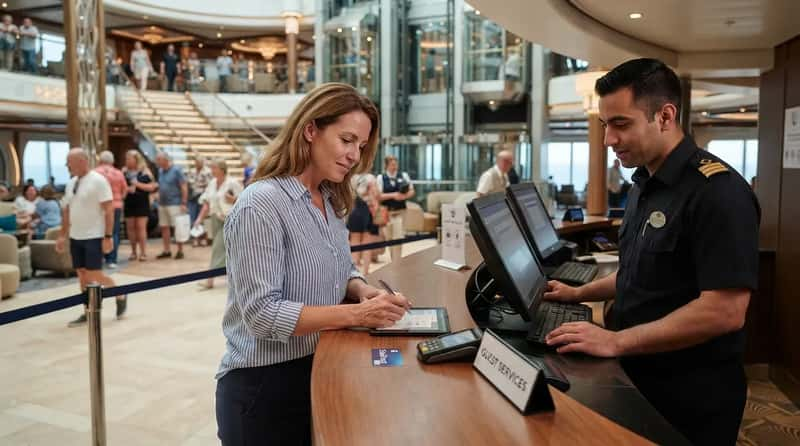
Those automatic daily tips aren’t fixed forever, but the window to change them closes. Royal Caribbean guests who haven’t prepaid gratuities generally have daily charges added to their onboard accounts. On some lines, you can go to guest services before the sailing ends and ask to have them altered or removed, and Princess explains that adjustments must happen before disembarkation.5
Prepaid tips are a different animal, since prepaid gratuities and percentage-based service charges may follow different rules. Think before you strip the charge, too. Norwegian describes its daily service charge as supporting restaurant employees, stateroom stewards and behind-the-scenes workers.
Pulling it to hand a favorite bartender a few dollars isn’t the same as paying the crew you never meet. Adjustments must happen before you disembark.
Money questions get settled at the desk. Belongings take a longer road, and a found phone doesn’t end up where a found sweater does.
#5 – Where a Lost Phone Ends Up
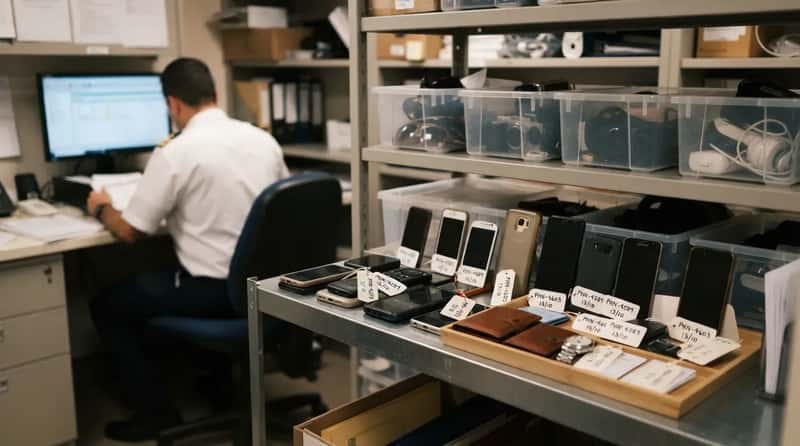
A forgotten phone follows a set route, and it ends on land. Guest Services logs found items and holds them until the end of the voyage, while valuables such as phones, jewelry and passports go to Security or the Purser’s Office. After the voyage, items are sent to a central land-based lost property office.
That’s where the delay starts. Most lines post items by courier at the guest’s expense, and the wait runs from one to six weeks depending on where the ship is. So report it on board, in person. Tell the desk what the item is, where you last saw it, when you noticed and your cabin number.
Report it on board; the return trip can take one to six weeks.
Forgotten phones are a nuisance. Canceled ports upend a day you may have paid for, and a separate desk handles that.
#4 – The Excursion Desk Behind a Canceled Port

When a port call is canceled or changed, someone has to sort out what you booked. Many cruise lines have a dedicated shore excursions desk to help with changes to your port plans, which is most useful when a call is canceled or adjusted. That’s your first stop for a tour you paid for in a port the ship no longer visits.
Booking through the ship has a second advantage. If the delay happens on a cruise-line excursion, the ship usually waits or arranges your transport, while an independent traveler’s ship departs at all-aboard. In a port where the sights sit far from the pier, that safety net can justify any extra the ship’s tour costs.
A ship-run excursion usually means the ship waits or arranges your ride back.
Quick Compare
- Ship-run tour: If you’re delayed, the ship usually waits or arranges your transport.
- Independent tour: The ship departs at all-aboard, with or without you.
- Canceled port: The shore excursions desk is your first stop for changes.
Tours can be rebooked at a desk. Passports can’t be replaced there, and a missing one involves an embassy.
#3 – A Missing Passport Mid-Cruise Is Fixable
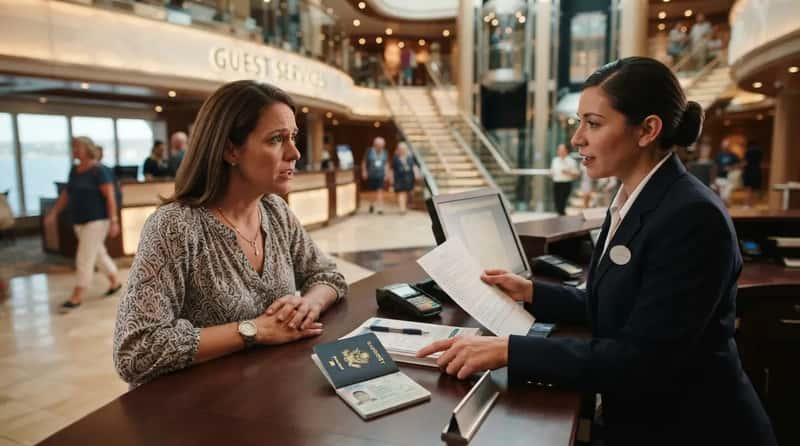
Losing a passport at sea sounds like the end of the trip, and it usually isn’t. The first move matches the lost phone in #5: report it right away to ship security or guest services, who log the incident and connect you with port agents or authorities.6 When the ship docks, you’ll contact the nearest U.S. embassy or consulate.
A copy speeds things up, because a photocopy or digital scan can help with replacement. If you lose it ashore instead, you’ll need a local police report for the embassy paperwork. Travel insurance may cover replacement costs such as fees, photos and taxis, though not negligence like leaving a passport unattended, so check your own policy.
Report it at once, and keep a copy of your passport.
Crew will hunt for a missing passport when you ask. When you’re late back, they hunt for it unasked, with a master key.
#2 – The Crew Searches Your Cabin When You’re Late
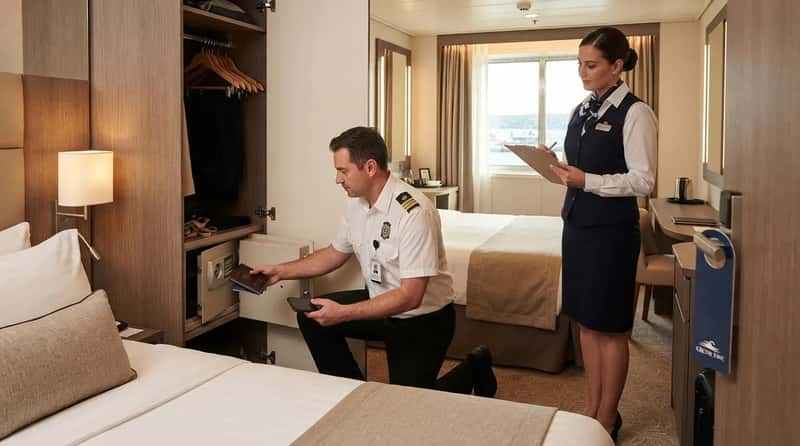
A passenger who’s overdue doesn’t just get a shrug from the gangway. When someone can’t be reached, a guest services member goes with a security officer to check the cabin, then looks for the passport, using a master key on the safe. They look there because many passengers lock their passports in the safe on embarkation day.
If the passport turns up, it goes to the ship’s agent so you have it when you reach the pier. Cruise Critic adds that crews often remove essentials such as passports, phones and medication and leave them with port agents. So a cabin safe is a sound home for your passport on a tour day, unless a port requires you to carry it.
Crews often leave your passport, phone and medication with the port agent.
That covers the passenger who’s late. The one already watching the gangway rise pays for everything that follows, and the final item is the costliest on the list.
#1 – The Ship Leaves and You’re Still on the Dock

A cruise ship can leave without you, and it will if you’re late. That doesn’t mean you’re stranded. A port agent, a local representative of the cruise line, is based at each port of call, and the daily program lists the agent’s name and phone number every morning the ship is in port. The agent can help you contact the cruise line, arrange lodging and find ways to catch the ship at its next port.7
Here’s the catch that makes this the costliest item on the list. The port agent might help with arrangements, but you pay the travel expenses, and you shouldn’t expect reimbursement for missed days.8 Ask the agent first whether your passport is already in their hands, as in #2, and use official port staff, the cruise line or the agent rather than a stranger offering a fix.
The cheap protection comes before you leave the ship: photograph the planner page with the all-aboard time and port agent number.
Walk past the guest services desk on day one and it looks like a hotel counter. It works like one too, with a single difference: the answers expire. A request on day two often gets a fix, and the same request on the last night gets a form.
So ask early, and photograph that planner page before you step off the ship. The desk can do a lot, but it can’t turn back the clock.
- Mad About Cruises Freebies: https://madaboutcruises.com/cruise-freebies/
- Life Well Cruised Guest Services: https://lifewellcruised.com/free-things-you-didnt-know-you-could-ask-guest-services-for-on-a-cruise/
- Cruise with Leo Freebies: https://cruisewithleo.com/list-of-things-you-can-request-for-free-at-guest-services-on-cruises/
- The Points Guy Last Day: https://thepointsguy.com/cruise/last-day-of-cruise-tips
- Cruise Hive Princess Gratuities: https://www.cruisehive.com/princess-cruises-gratuities/153440
- Hollett’s Lost Passport Guide: https://hollettsatsea.com/lost-passport-on-cruise-guide/
- Cruise Port Advisor Missed Ship: https://cruiseportadvisor.com/what-happens-if-you-miss-your-cruise-ship/
- Points Guy Missed Ship: https://thepointsguy.com/cruise/cruise-ship-leave-without-you/