Everyone assumes first class belongs to tech executives and people who bill by the hour. Then you spot a retired couple sliding into the wide leather seats up front, sipping something bubbly, and you realize they paid the same coach fare as everyone else stuck in row 34. It’s not luck, and it’s definitely not a scam – it’s a set of quiet habits airlines never put on a billboard.
The strangest part is how ordinary these tricks actually are. No hacking, no begging at the gate, no lottery odds. Just a handful of small moves that most travelers over 60 either never learned or gave up on after one bad experience. Here’s what’s actually happening behind the curtain.
#13 – The Free Sign-Up Most Retirees Skip Entirely
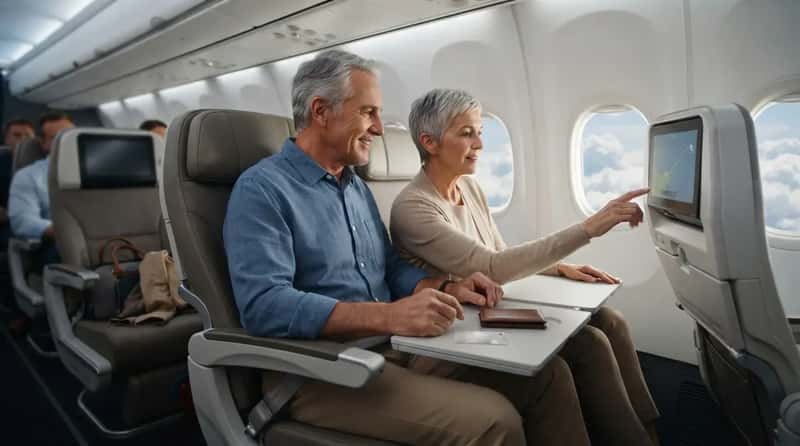
Thousands of travelers over 60 never bother joining an airline’s loyalty program, assuming it’s only useful for people who fly every week for work. That single skipped step quietly locks them out of perks that cost absolutely nothing. Airlines use these free profiles to flag returning customers for early boarding, better seat selection, and upgrade offers that never show up for a guest checkout.
There’s no fee, no minimum spend, and no fine print worth worrying about. The account itself is the unlock. Skip it, and you’re invisible to a system built to reward exactly the kind of loyal, repeat traveler most retirees actually are.
#12 – Booking Direct Instead of Through a Discount App

Saving nine dollars on a third-party travel app can quietly erase your entire shot at an upgrade for that trip. Airlines routinely deprioritize passengers who booked through outside consolidators when it comes to complimentary bumps, seat changes, or loyalty perks. The ticket looks identical at the gate, but behind the scenes, it’s coded as a lower priority.
Retirees who book directly through the airline’s own website or call center are the ones who actually show up on the upgrade list. Even flyers with elite status get stripped of benefits when they book the wrong way, which tells you how strict this rule really is. It’s a small habit change that quietly protects everything else on this list.
#11 – Dressing the Part Actually Still Works

It sounds old-fashioned, but gate agents notice more than most travelers assume. When aircraft change or seats need reshuffling, agents and flight attendants have real discretion over who gets the free bump – and that discretion tends to land on passengers who are calm, polite, and put-together.
A suit won’t guarantee a seat in row two, but travelers over 60 who stay pleasant during delays and dress neatly at the counter get remembered. Remembered passengers get the call when a seat opens up. Whether it’s officially a myth or not, it keeps happening to real people at real gates.
#10 – The Seat Map Trick That Turns Coach Into Comfort
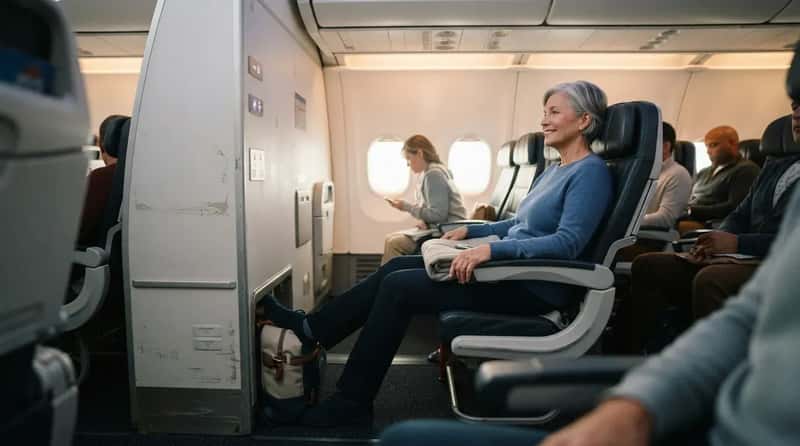
Not every economy seat is created equal, and airlines count on nobody noticing. They charge the same price for entire rows, even though some seats quietly offer extra legroom, better recline, or faster exit access if you know exactly where to look.
This is where travelers over 60 quietly outsmart the system without spending an extra dime. A five-minute search on a free tool like SeatGuru or AeroLOPA before booking can mean the difference between a cramped middle seat and a bulkhead row with room to stretch. It’s guaranteed comfort instead of a gamble, and it costs nothing but a little patience.
Fast Facts
- Bulkhead and exit-row seats typically offer noticeably more legroom than standard economy rows.
- Seat map tools show which rows have misaligned recline, obstructed views, or no window at all.
- Checking the seat map before booking is free and takes only a few minutes.
- The same fare class can land you in a cramped middle seat or a roomy aisle, depending only on which seat you pick.
#9 – Flying the “Wrong” Week on Purpose

Retirees have a scheduling advantage most working travelers can’t touch: total flexibility. Airfares and hotel rates can run 20% to 40% cheaper during shoulder season, and that savings gap is exactly what quietly funds an upgrade later in the trip.
Cost is still the biggest hurdle for this age group. A 2025 AARP poll found that while 70% of seniors plan to travel, 45% cite cost as their biggest barrier. Shoulder-season flying solves both problems at once – cheaper base fares free up cash for a paid upgrade bid, and tools like Google Flights or Skyscanner make it easy to track the dip.
At a Glance
- Shoulder-season airfares and hotel rates can run 20% to 40% lower than peak-season pricing.
- 70% of seniors say they plan to travel, according to a 2025 AARP poll.
- 45% of seniors in that same poll named cost as their single biggest travel barrier.
- Fare-tracking tools like Google Flights and Skyscanner make it easy to spot the cheapest travel weeks.
#8 – The Companion Ticket Nobody Talks About

Certain travel credit cards quietly hand out a perk that can offset an entire second ticket every single year. Cardholders can claim a companion certificate on a Delta First, Comfort, or Main Cabin round-trip flight annually, paying only government taxes and fees of roughly $22 to $250.
For a retired couple traveling together, that’s essentially a free companion seat funding the upgrade for both of them. It’s one of the least-discussed perks in the entire loyalty world, mostly because people assume “free companion flight” offers are gimmicks. They’re not – they’re contractual, renewed every year, and often go unused simply because the traveler forgets to book it.
#7 – Borrowing Elite Status From an Airline You’ve Never Flown

This is the one most travelers over 60 have genuinely never heard of. The United MileagePlus Premier Status Match Challenge, open through the end of 2026, can grant matches up to Premier 1K along with instant Star Alliance Gold for 120 days while the traveler works toward the full requirement.
Status earned with one airline over decades can be borrowed and instantly applied to a completely different carrier. For someone who built loyalty with an airline they barely fly anymore, this turns dormant status into fresh upgrade priority almost overnight – no new miles required, just a short application window.
Worth Knowing
- The United status match challenge runs through the end of 2026.
- Matches can go as high as Premier 1K, United’s top elite tier.
- Approved travelers get instant Star Alliance Gold status for 120 days.
- No new miles are required upfront – just proof of existing elite status elsewhere.
#6 – The Credit Card That Pretends to Be Elite Status
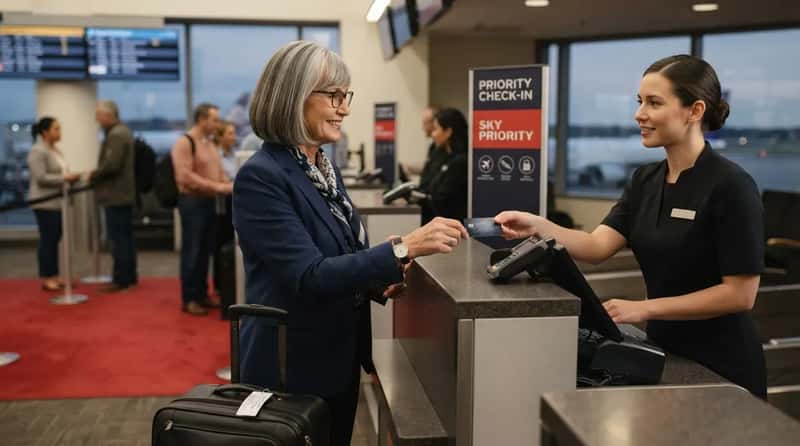
Some cards don’t just help you earn status – they hand you status-like treatment the moment the card arrives. Certain cobranded airline cards act almost like elite status without the guaranteed first-class upgrade, unlocking free checked bags, priority boarding, and lounge access simply for carrying the plastic.
That’s a meaningful shortcut for travelers over 60 who don’t fly often enough to earn organic elite status through miles alone. The card essentially substitutes for years of loyalty most retirees never plan to rack up. It’s one of the most overlooked categories in travel, mostly because people assume status has to be earned mile by mile instead of simply carried in a wallet.
#5 – Getting Into the Lounge Without a Business Class Ticket

Most travelers assume airport lounges are locked behind a premium fare, and that assumption is quietly outdated. There are at least five different ways to get inside without a business or first-class ticket, and some of them cost nothing beyond a credit card you may already own.
The most common route doesn’t even require elite status. Many premium credit cards include lounge access as a standard perk, and Priority Pass, the largest network in the world, covers 148 countries and more than 1,400 lounges. For a retiree with a long layover, that’s hours of quiet seating and free food before the flight even boards.
#4 – Bringing a Spouse or Grandchild in for Free

The best-kept secret in lounge access isn’t getting yourself in – it’s getting your travel companion in without paying a second fee. The Capital One Venture X allows authorized users to carry their own Priority Pass cards, and certain Amex Platinum benefits cover children under 18 for free at Centurion Lounges.
For grandparents traveling with grandkids, or couples traveling as a pair, this quietly eliminates what would otherwise be a $30 to $50 guest fee per person, per visit. The smart move is checking a card’s guest policy before assuming that fee is unavoidable. Plenty of travelers carry these cards for years without ever realizing the benefit was already included.
#3 – Paying for a “Boring” Fare That Secretly Unlocks Upgrades
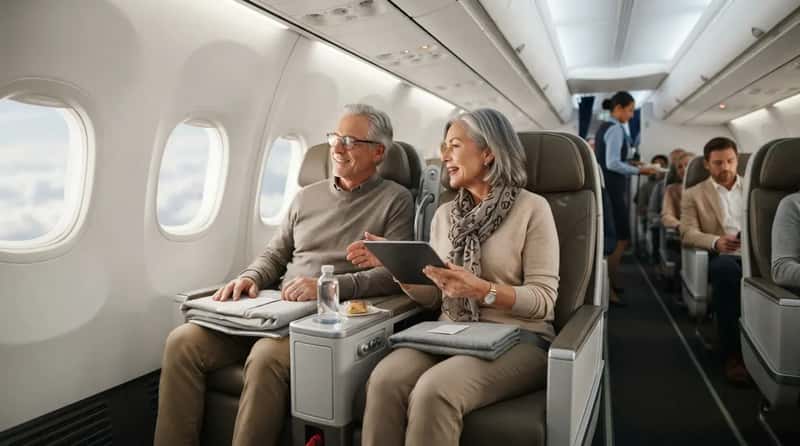
Not every fare class is created equal, even inside the same cabin. Buying an upgradeable fare and then applying banked miles is one of the clearest paths to a better seat, and it works even for travelers who don’t fly often enough to earn elite status naturally.
Certain fare codes qualify for mileage-based upgrades – think American’s SWU certificates, Delta’s GUCs, or United’s PlusPoints – while rock-bottom basic economy fares are usually locked out entirely. Paying slightly more upfront for the right fare code, then applying miles, often lands a traveler in a roomier cabin for less total cost than buying that seat outright.
#2 – The Quiet Auction Happening Before Your Flight
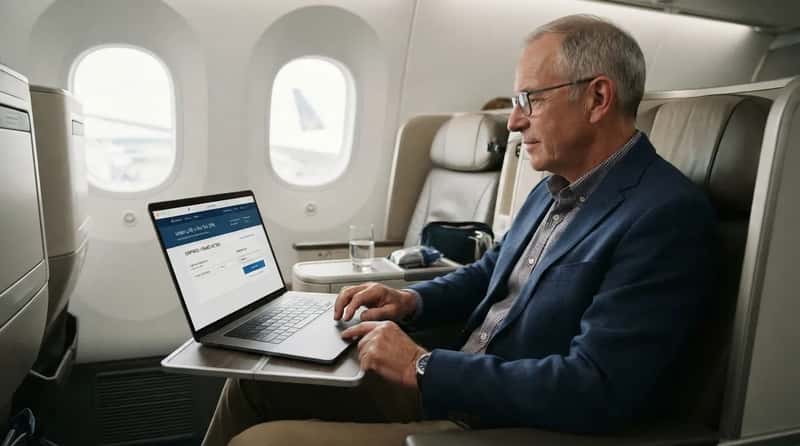
This is the one that surprises almost everyone the first time they hear it. Frequent flyer programs let travelers redeem points for upgrades, and seniors who’ve quietly stockpiled miles over the years can use them to move into a better cabin. But beyond points, several airlines run something even less known.
Before departure, some airlines let passengers bid for an upgrade directly, often through a link buried in a confirmation email. It’s a silent auction most travelers never think to check, and the winning bids are frequently shockingly low compared to a walk-up first-class fare.
Quick Compare
- Miles redemption: Uses stockpiled points, no cash required, but seats can be limited.
- Upgrade bidding: Uses cash, often through an emailed link, and can beat walk-up upgrade prices by a wide margin.
- Best for retirees: Pairing both methods – bid low first, fall back on miles if the bid fails.
#1 – Stacking Every Hack Into One Trip

Here’s the real secret nobody advertises: the travelers who fly first-class most often aren’t relying on one trick. They’re stacking three or four small ones into a single itinerary – a status-matched elite tier for upgrade priority, a companion certificate to cover the second seat, a lounge-access card for the wait, and a shoulder-season fare that keeps the base cost low.
None of these tricks alone guarantees a first-class seat. Combined, they quietly turn a coach budget into a first-class experience almost every time. That’s the real difference between travelers who get lucky once and travelers who do this on every single trip – they’ve simply learned to layer the system instead of leaning on a single lever.
None of these thirteen tricks require deep pockets or a corporate expense account. They require patience, a little homework, and the willingness to ask one extra question at the counter that most travelers never bother asking. The people over 60 pulling this off aren’t special – they’ve just learned which levers actually move, and which ones are just marketing noise dressed up as a perk.
Which of these have you actually tried, and did it work? The next person booking a trip might need exactly the trick you learned the hard way.