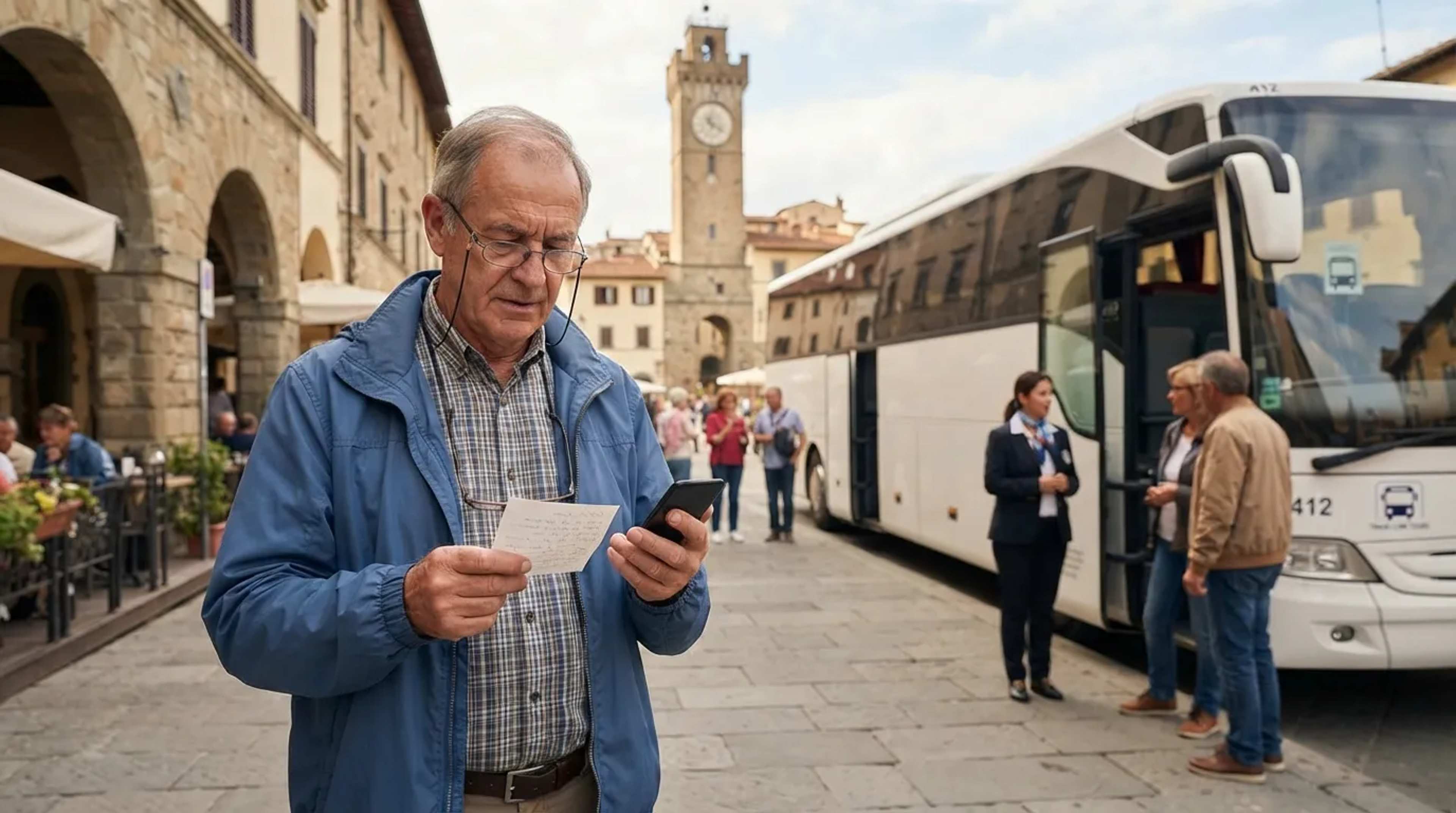
A coach can’t leave a rest stop until every seat is filled, so one passenger walking back for something forgotten holds up dozens of others. Drivers know that moment well, and the cure is usually something small enough to fit in a day bag.
Stay for the final entry, because it’s the one that keeps working when your phone doesn’t, and it settles where you’re headed next and when the coach leaves. First, though, comes the item that makes the seat itself easier to sit in.
1. A Foldable Seat Cushion for Long Stretches
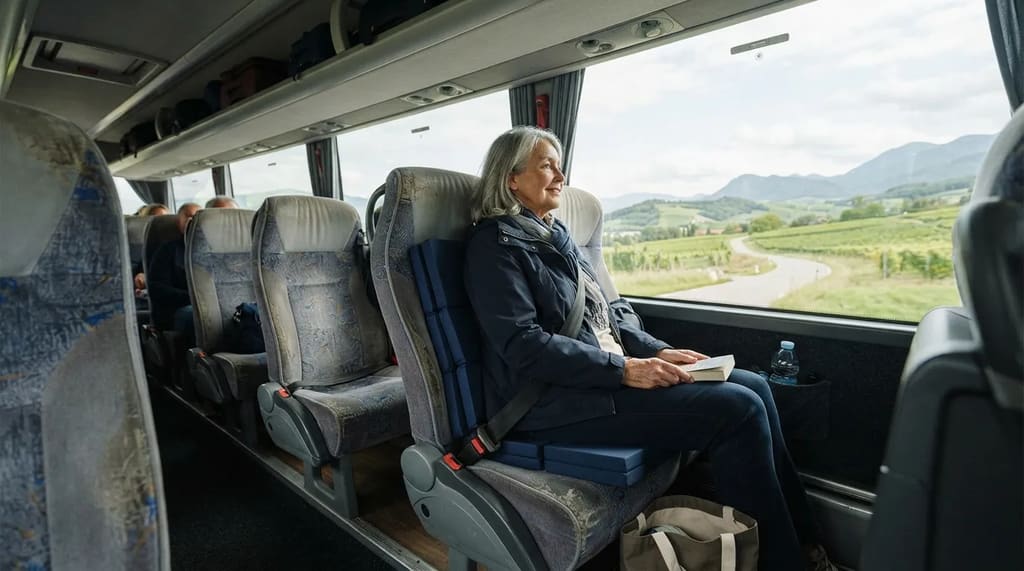
Coach seats are designed with an average passenger in mind, and a long touring day with hours between stops is anything but average. By the afternoon, a seat that felt fine at the hotel door can feel like a wooden bench.
A thin foldable cushion adds padding and a little height, which matters most when the itinerary has two or three long stretches between stops. It also gives you an easy way to shift position without climbing out of your seat.
Size is the only real limit. Pick a cushion that folds or rolls small enough to ride in your day bag, because a bulky one ends up in the aisle or on the seat beside you.
A rolled-up sweater or small blanket can do a similar job behind your lower back if you’d rather not carry another item. Either way, set it up when you board and leave it in place until the day is done.
A cushion keeps you comfortable inside the coach. The trouble on touring days starts outside it, where a sudden shower meets a walk of several minutes from the door.
2. A Compact Umbrella That Fits the Day Bag
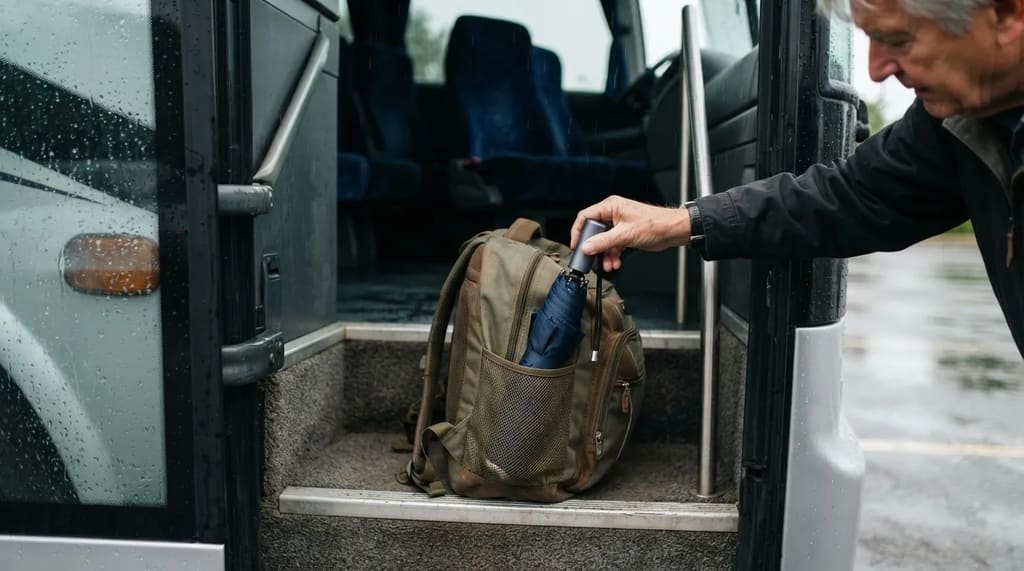
Rain on a touring day tends to arrive on the stretch between the coach door and the entrance, which is exactly where you have no cover. A full-size umbrella is the wrong answer, because it won’t fit under a seat and nobody wants it dripping down the aisle.
A compact model that opens with one hand and collapses to about the length of a water bottle rides easily in your day bag. Test it at home first, since an umbrella that sticks halfway open is no help in a crowd.
Wet gear creates a second problem once you’re back on board. Shake it out at the bottom of the steps and slip it into a bag or sleeve before you climb in.
Coach steps are narrow and a wet floor is slippery for everyone behind you, so a few seconds of tidying at the door protects the whole line. It also keeps your seat and your cushion dry for the next stretch of road.
Wet weather leaves other small messes behind, and a rest stop restroom doesn’t always have what you’d need to deal with them.
3. Tissues Kept in a Pocket, Not the Bag
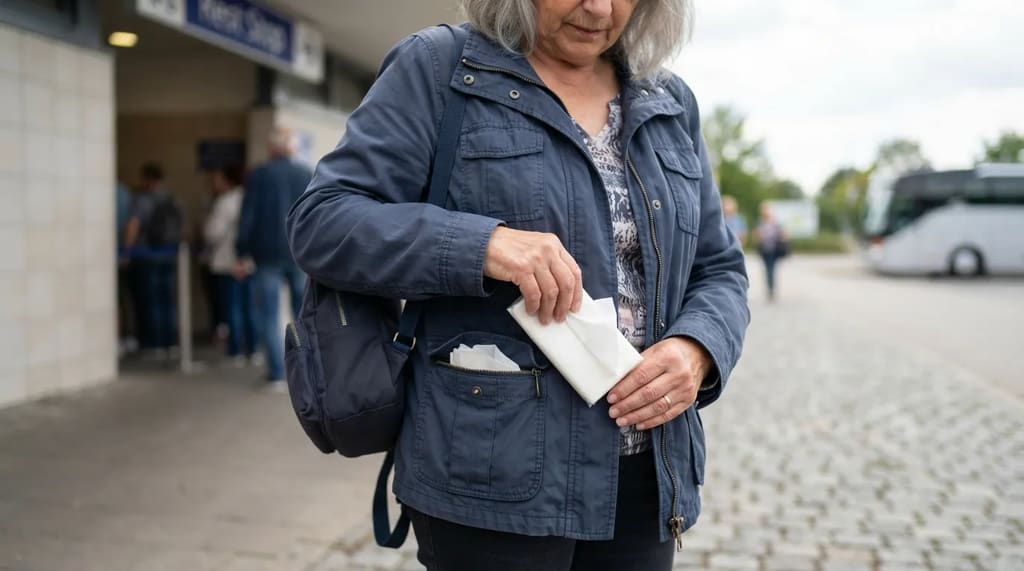
Rest stop restrooms are stocked differently from one stop to the next, and the coach won’t wait while you find out. A small pack of tissues turns that gamble into a non-event.
Tissues have other jobs on a touring day. They handle a sneeze in a quiet museum, sticky fingers after a snack, a smudged pair of glasses and a damp seat after a shower.
Where you keep them matters more than the brand. Carry the pack in a jacket or pants pocket, not at the bottom of the day bag, because the moment you need one is rarely a moment when you can dig around.
That habit also keeps the bag closed and off the floor while you wait in a busy restroom line. Refill the pack at the hotel each morning so it’s never empty by the second stop.
Worth Knowing
- A slim travel pack beats a bulky box, because it slides into any pocket.
- A second pack in the day bag covers you if the first runs out.
- Restroom stops are the moment most people reach for them first.
- Tuck a few loose in a zip bag if the weather is wet.
Tissues take care of what’s in your hands. Glare is the problem for your eyes, and the label on the lenses matters more than how dark they look.
4. Sunglasses With the Right Label on the Lens
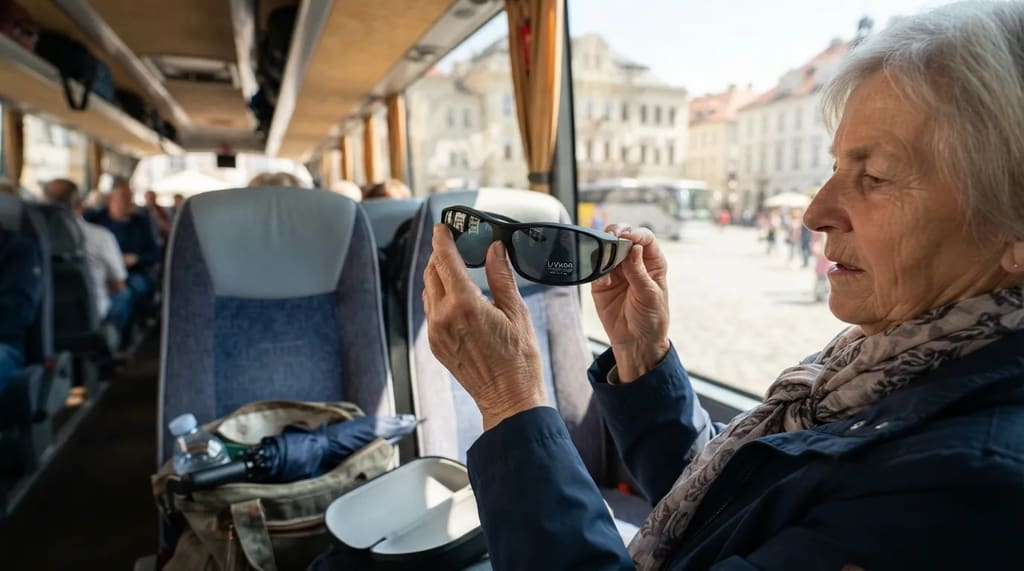
A very dark pair of sunglasses can still be a poor one, because lens darkness says nothing about UV protection. What counts is the label on the lens.
The FDA says to look for a “UV400” rating or “100% UV protection” on the label. Check for UV400 or 100% UV protection before you pack them.
The CDC says wrap-around sunglasses work best because they block UV rays from sneaking in from the side.1 That matters on a coach, where a window seat can put the sun on one side of your face for hours.
Keep them in a case in the day bag, so they’re not crushed under the bottle or the umbrella. Put them on before you step off the coach, not after you’ve squinted through the first ten minutes of the stop.
Sunglasses cover the eyes, but your ears and neck are exposed at every outdoor stop, and the most popular hat on a tour does little about it.
5. A Hat With a Brim All the Way Around

A baseball cap is a fine hat for a ballgame and a poor one for a walking stop on a tour. The CDC’s travel guidance says standard baseball caps don’t protect the ears or neck.1
The best choice has a brim all the way around, made of tightly woven fabric such as canvas, and avoids straw with holes that let sunlight through. A darker hat may offer more UV protection.1
Timing makes this more than a summer concern. In the continental United States, UV rays are strongest from 10 a.m. to 4 p.m. daylight saving time, which covers most of a touring day’s outdoor stops.1
A soft-brimmed hat that crushes flat slips into your day bag, so you can put it on at the coach door instead of deciding at the hotel. A stiff hat that won’t flatten ends up on your lap for the whole ride.
Sun is only half of a long outdoor day. The other half is the gap between one stop and the next, when any drink has to come from your own bag.
6. A Refillable Bottle You Top Up at Stops
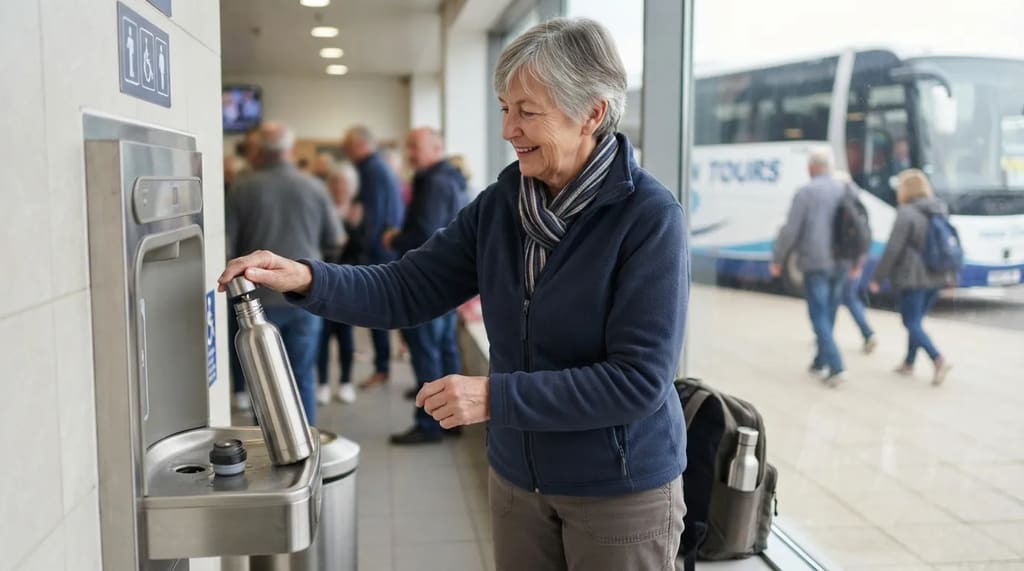
Coaches differ on what they carry aboard, so the bottle in your day bag is the one drink you can count on. Refilling it at stops keeps one bottle in your hand all day instead of a pile of empties in your bag.
Look for a lid that closes firmly and a size that fits in the seat pocket or the side of your day bag. Skip glass, since some operators don’t allow glass bottles on the coach and a broken one on a moving vehicle is a hazard for everyone.
Quick Compare
- Screw-top or locking lid: stays shut in the bag. A loose pop-up lid leaks when it tips.
- Slim body: fits the seat pocket. A wide bottle rolls into the aisle.
- Plastic or steel: survives a drop on the steps. Glass may not be allowed aboard.
Sip steadily through the morning, then top up at the first stop, rather than gulping at the last minute and asking for an unscheduled break. Drivers work to the clock, and rest stops are where the group’s restroom timing gets built.
Fill the bottle at every stop before you walk back to the coach. That one habit puts the refill in the same trip as the restroom and the stretch, so it adds no time to the stop.
Rinse it each evening at the hotel so tomorrow’s water doesn’t taste like yesterday’s. Water handles thirst, but hunger comes with more rules.
7. A Snack That Won’t End Up on the Floor
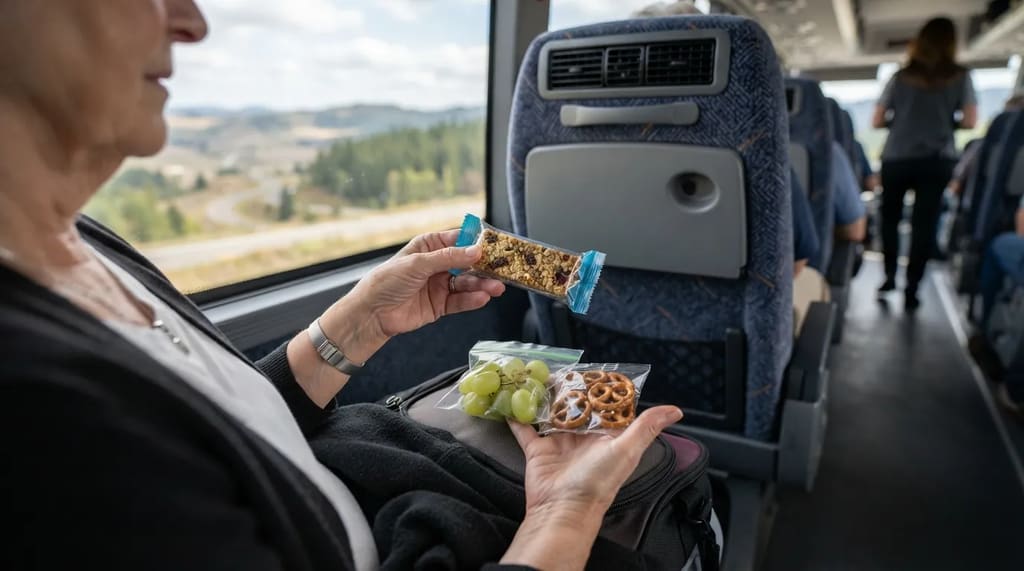
The test for any food on a moving coach is whether you can eat it with one hand, without crumbs and without a smell. Most of what looks like a snack at a gas station fails it.
Granola bars, grapes and pretzels pass, and so does a wrapped cracker. A sandwich is a meal, not a snack, and a coach seat is not a table.
Rules differ from one operator to the next, so ask the driver or guide at boarding whether food is welcome on the coach. Some operators limit certain foods, and it’s easier to learn that before you’ve unwrapped something.
Choose dry, wrapped food that leaves no crumbs and no smell. Keep the bottle from the last entry within reach, since salty snacks send you looking for it.
Snacks carry you for a few hours. Your phone is the other thing that runs down over a long day, and the coach may not be the place to count on topping it up.
8. A Phone Charger and Cable in the Day Bag
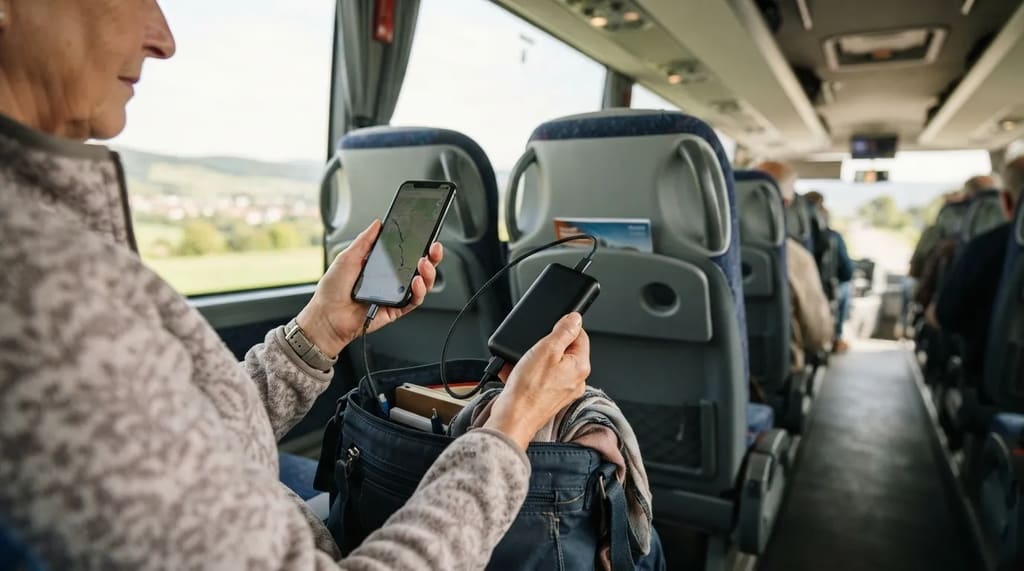
By mid-afternoon, the phone that took your first photographs of the day is often running low. It’s also how family reaches you and how you check a map when the group scatters at a stop.
Touring guides tell travelers to bring their devices and to remember the chargers. Some coaches have outlets at the seat, but you can’t count on one working or sitting within reach, so a portable power bank and a short cable in your day bag settle the question.
Use the phone with some consideration once you’re aboard. Text instead of calling, keep the phone silent, and bring headphones for anything with sound.
Start the day with a full battery and a power bank in your bag. At the hotel, plug in the phone and the power bank together, so neither is left half full in the morning.
All of this has to ride somewhere, and the wrong bag creates its own trouble in a narrow aisle.
9. A Small Day Bag Instead of a Backpack
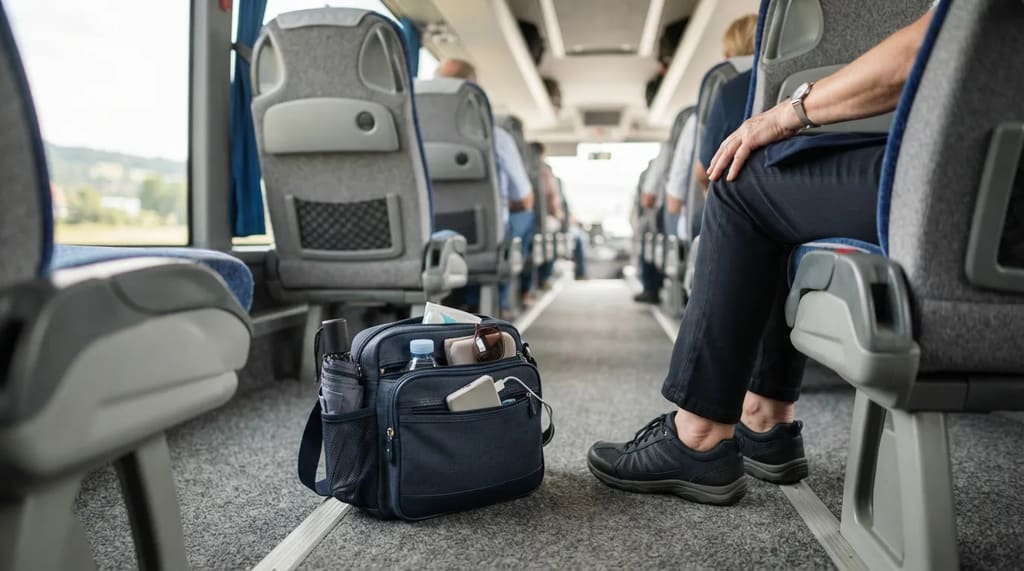
A full-size backpack is not a day bag. In a narrow aisle it swings into every seat you pass, and it won’t fit at your feet.
Your main luggage will likely be stowed in the cargo bay until you reach the hotel. So anything you want before then has to travel in a soft, compact shoulder or crossbody bag that fits at your feet or in the overhead space.
- the umbrella in an outside pocket, and the tissues in your own pocket
- the bottle and one dry snack
- the power bank and cable
- sunglasses in a case, and the hat if it crushes flat
If you’ll need it before the hotel, it goes in the day bag, not the luggage bay. Keep the total light enough to carry on foot through a town or a museum, because you will carry it at every stop.
The bag holds the extras, but one item belongs on your body or in your lap. The coach’s temperature changes while the bag is out of reach.
10. A Light Layer You Can Take Off Seated
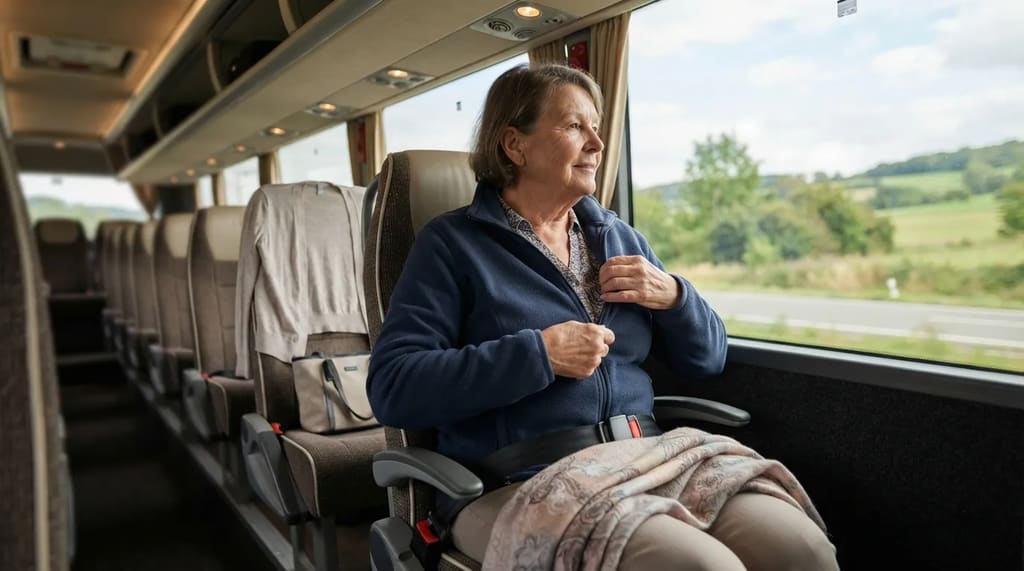
Whatever the thermostat says, someone on the coach is uncomfortable. One operator notes it is difficult to keep a coach at a temperature that suits everyone, and suggests a light jacket.
That’s why a light jacket, cardigan or zip-up top belongs on every touring day, even in summer.2 A coach can run cold while the afternoon stop is warm, and one layer handles both ends of that range.
A zip front beats a pullover in a narrow seat, where you can’t swing your elbows. Choose a zip-front layer you can remove without standing up.
Keep it on your lap or the seatback rather than in the overhead space, so adjusting takes seconds instead of a request to the whole row. A lightweight pashmina can double as a pillow or a way to block out light.
A layer handles the air inside the coach. What happens on the ground outside it falls to your feet.
11. Shoes You’ve Already Walked In
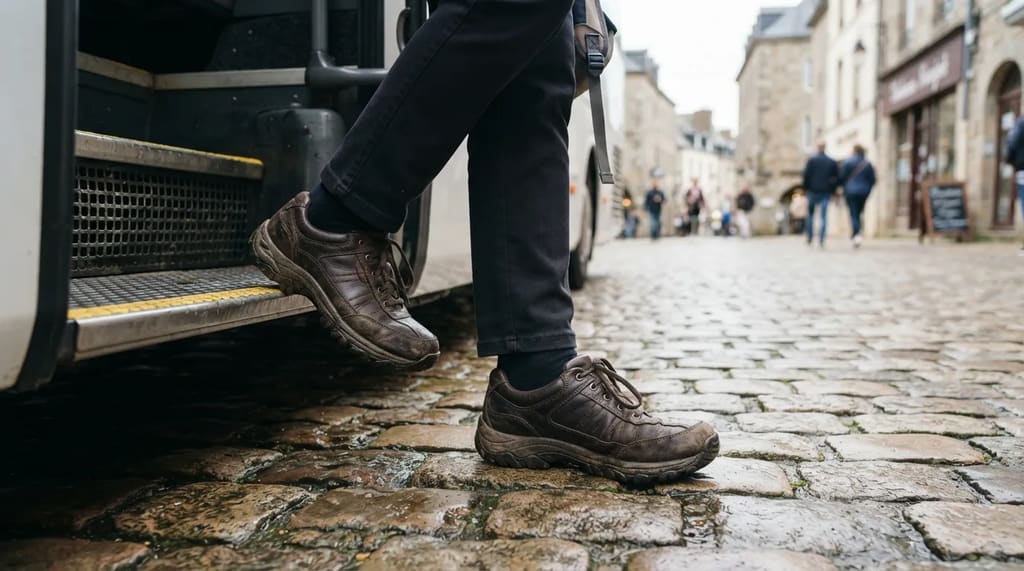
The ground outside a rest stop is rarely as flat as the coach floor, and a town stop can mean cobbles, slopes or gravel. Blisters and long walking days don’t mix, which is why touring guides tell travelers to bring broken-in footwear.3
Wear shoes you’ve already walked in, never a new pair. The first morning of a tour is a poor place to find out that a new shoe rubs.
Grip matters as much as cushioning, because coach steps are narrow and often wet. A closed heel and a non-slip sole make the climb steadier, and a shoe that laces or straps keeps its fit through a long day.
At a Glance
- Broken in over several short walks before departure
- Closed heel, so the shoe stays put on narrow steps
- Non-slip sole for wet steps, cobbles and gravel
- Laces or straps that hold the fit all day
If you’re unsure about a pair, break it in over several short walks at home before the trip.4 A spare pair with a different shape lets you rotate if one rubs, and it takes little room in a suitcase.
Shoes get you to the meeting point. Remembering the time and place to meet is a job for something that weighs next to nothing and rides in a shirt pocket.
Related Stories From Travelbinger
12. A Pen That Clicks Shut in Your Pocket
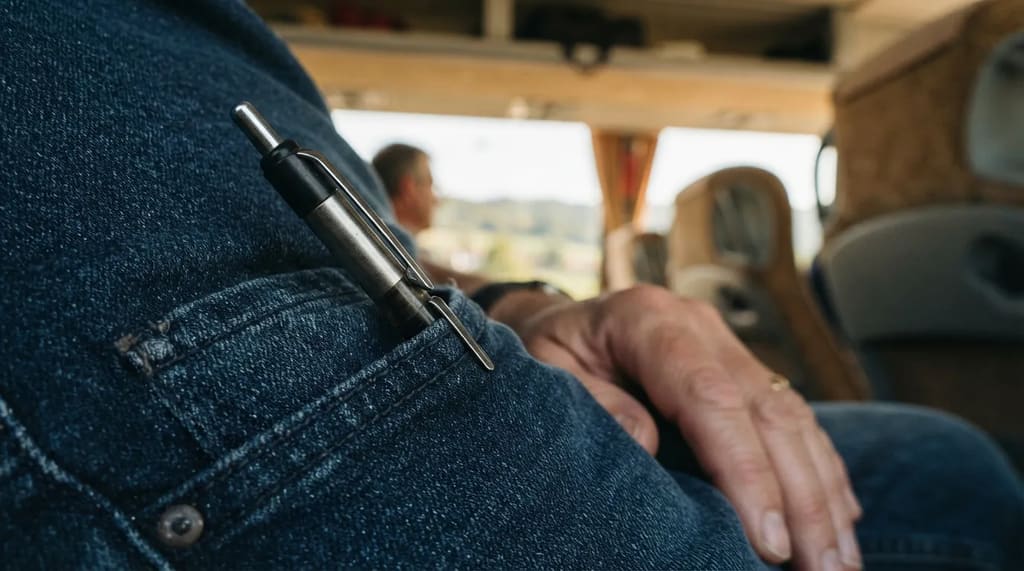
A pen is the tool that turns a spoken departure time into something you can check. Departure times are usually announced aloud, often while people are already heading for the restrooms.
Touring companies list a pen or pencil and something to write on among the basics.4 A retractable pen has no cap to lose and won’t leak in a pocket the way a loose capped pen can.
Keep it in a pocket, not the day bag, for the same reason as the tissues. Write the departure time down the moment it’s announced.
A pen also handles forms, hotel cards and the occasional postcard, so it earns its place several times a day. It’s the smallest item on this list, and it still works when a phone battery is low.
A pen needs something to write on, and a loose scrap of paper has a way of ending up in the wrong pocket by the second stop.
13. A Pocket Notebook for Times and Coach Details
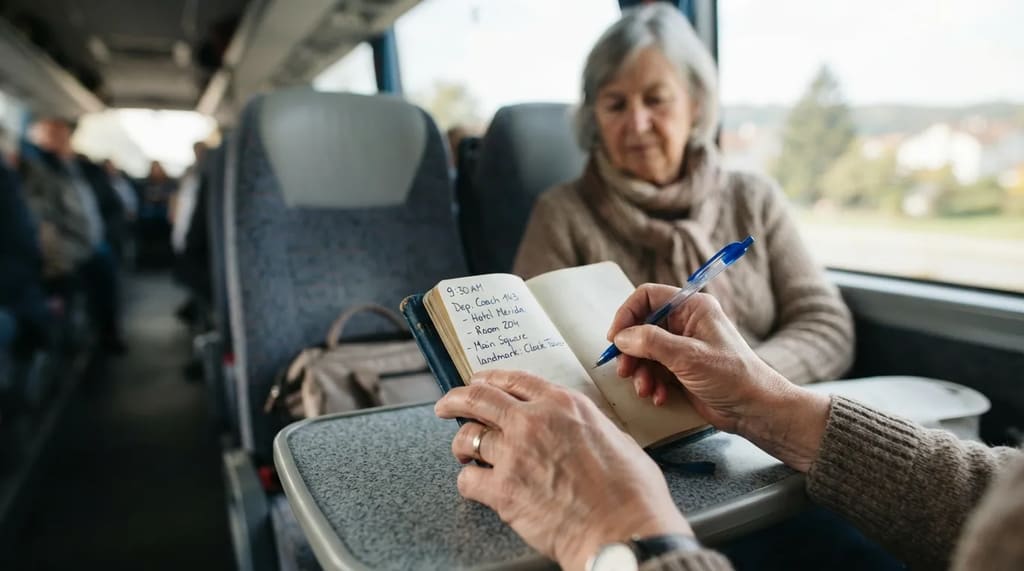
One small page per day is all it takes. A pocket notebook gives that pen a place to write, along with everything else that changes from stop to stop.
- the departure time at each stop
- the coach’s number or a marking you can spot from a distance, plus the nearest landmark to where it parked
- the hotel’s name and your room number once you check in
Note the coach’s parking spot and the departure time at every stop. Coaches don’t always park in the same place twice, and a landmark written down is easier to find than one you’re trying to recall.
Choose a notebook small enough for a pocket, with a spiral or sewn binding that lies flat while you write on a coach seat. A hard cover helps if you’re writing on your knee.
A notebook holds what you collect during the day. The most useful item on this list holds the plan for the whole day, and you should have it in your hand before the coach leaves the hotel.
14. A Paper Copy of the Day’s Stops
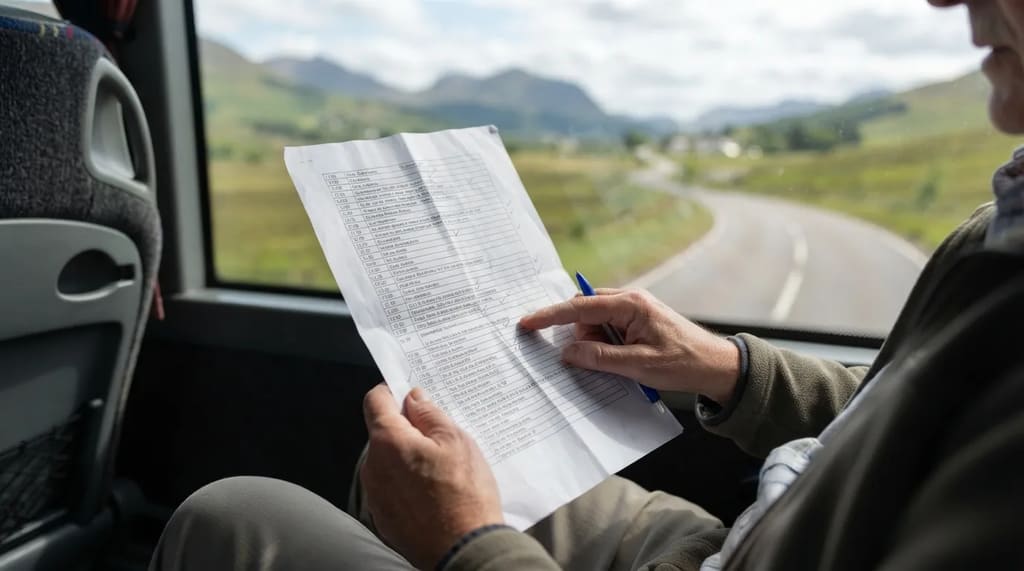
A paper copy of the day’s stops answers three things at a glance: where you’re going, in what order, and when the coach leaves each place. Every other item here makes your own day easier, but this one helps the whole group, because a coach leaves on time only when every passenger knows the same number.
Ask for the day’s itinerary at the hotel or print it before you leave, and fold it into the day bag with the pen from earlier. Write the departure time beside each stop as it’s announced, so the page becomes a record of the day as well as a plan.
A phone is a fine backup and a poor primary. Paper doesn’t run down like the battery from the charger entry, doesn’t lose signal on rural stretches, and can be handed to a companion who has lost track.
Carry the day’s stops on paper, with the departure time marked beside each one. If you do get separated from the group, the page tells you which stop comes next and when the coach leaves it, and you should tell the guide or driver as soon as you can.
Closing Thoughts
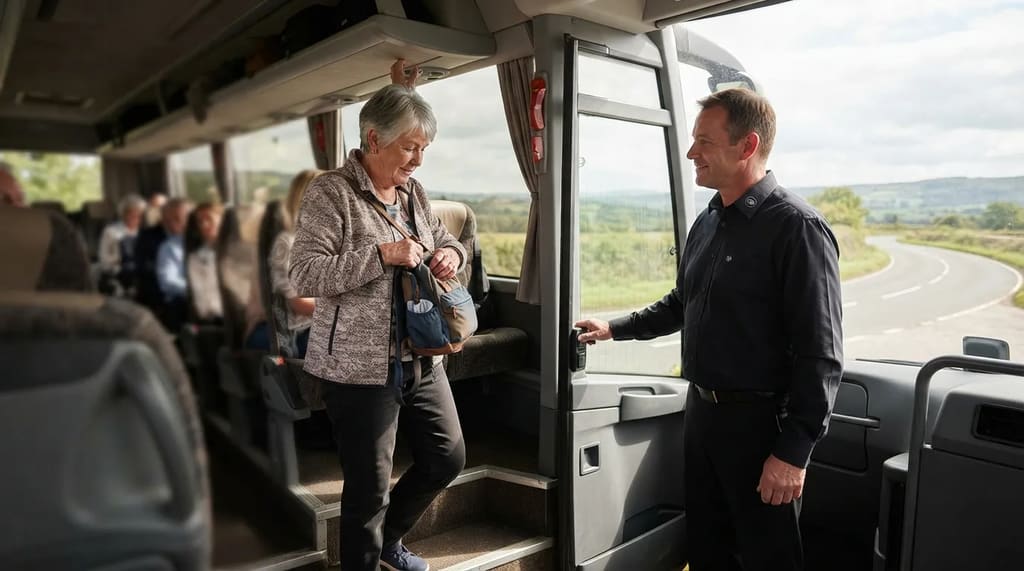
Each of these items shortens a moment that would otherwise land on someone else: the driver waiting at the door, the person beside you, or the guide counting heads. Pack for the group’s clock as well as your own comfort, and the comfort tends to follow.
Before your next touring day, lay everything on a table and see which pieces already live in your day bag and which you’d have to hunt for. Which of these would you have been missing on your last long day aboard a coach?
Bonus: The Back-to-the-Coach Routine Nobody Tells You About
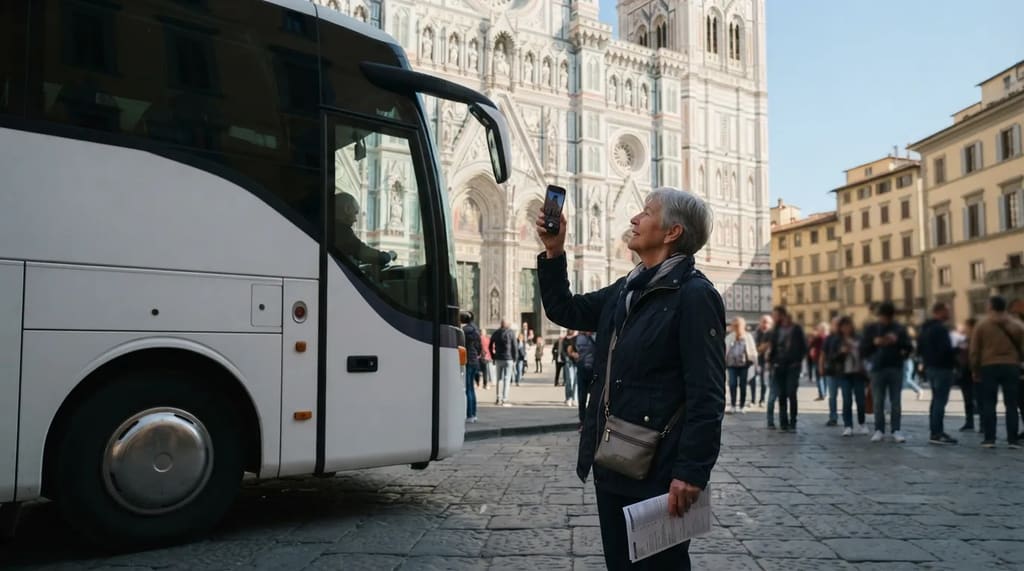
The one thing that separates relaxed travelers from rushed ones is a two-minute routine done at the start of each stop. It works because it gives you a way back to the group even if your phone is dead and the schedule slips.
- At boarding: ask the guide or driver for a mobile number to call if you’re ever separated. Write it at the top of your paper itinerary and save it in your phone.
- On stepping off: look at the front of the coach and note any number or marking on it. Take one photo of the coach with a landmark behind it, such as a sign, a statue or a distinctive building.
- Before you wander: set a phone alarm for ten minutes before the stated departure time, and write that earlier time in your notebook beside the real one.
- On the way back: start walking when the alarm goes off, not when the departure time arrives.
If a stop is crowded or the walk back is longer than expected, that ten-minute cushion is what keeps you from being the last one to the door. Do it at the first stop of the morning and it becomes automatic by lunch.
- CDC Sun Safety Facts: https://www.cdc.gov/skin-cancer/sun-safety/index.html
- Coach USA Clothing Advice: https://help.coachusa.com/portal/en/kb/articles/what-clothing-should-i-bring-on-a-tour
- Dream Vacation Tours Packing Guide: https://www.dreamvacationtours.com/en/ultimatepackingguide
- Group Tour Packing Essentials: https://torontobusrentals.ca/tour-group-travel-essentials-your-complete-packing-guide/