Most people assume jet lag is just something you push through with coffee and stubbornness. But travelers over 60 who’ve logged decades of long-haul flights know that’s backwards – the ones who step off the plane sharp and ready aren’t the toughest passengers on board, they’re the most strategic.
They’ve quietly figured out a handful of small, specific moves that make the difference between landing wrecked and landing ready to explore on day one. None of it is complicated, but almost nobody does all of it – here’s what experienced flyers actually do differently.
#14 – They Pick Flights Based on Light, Not Price

Seasoned travelers don’t just book the cheapest seat – they book the arrival time that works with their body clock. Many find that evening departures are easier to adjust to, because it sets up better sleep timing on the other end. The CDC’s own travel guidance backs this up: choosing a flight that arrives at a time that gives you the optimal amount of timed light exposure is one of the first recommendations from sleep researchers.
Most people book flights around layovers and legroom. Experienced flyers over 60 treat departure and arrival time like a medical decision. It sounds fussy until you land at 6 p.m. instead of 6 a.m. and realize you’re not fighting to stay awake through an entire foreign afternoon.
#13 – They Start Shifting Their Clock Before They Even Pack

The real work happens days before takeoff, not on the plane. Sleep researchers recommend gradually moving bedtime and wake time later by 30 to 60 minutes a day, and maximizing evening light while minimizing morning light in the days before a westward trip. Older adults are often advised to shift their sleep schedule a few days out to match the destination’s time zone.
Younger travelers tend to skip this step entirely – they figure they’ll just sleep on the plane. Frequent flyers over 60 know that’s a gamble that rarely pays off on a nine-hour flight. The shift starts at home, not at 35,000 feet.
Fast Facts
- Shift bedtime and wake time by 30-60 minutes a day, starting 3-5 days before departure
- Before westward trips, seek evening light and avoid bright morning light
- Full circadian adjustment generally takes about one day per time zone crossed
- Starting the shift at home cuts recovery time noticeably versus waiting until landing
#12 – They Skip the Free Wine and the Extra Coffee

It’s tempting to treat a long flight like a mini vacation with unlimited drinks, but experienced travelers know that’s exactly backwards. Harvard Health specifically warns to stay hydrated and avoid caffeine or alcohol on flights, since both promote dehydration, which worsens jet lag symptoms and disturbs sleep. For older travelers, the advice is repeated everywhere: stimulants and alcohol disrupt sleep patterns, and herbal tea is a far better choice.
This is one of the more controversial tips, honestly. Plenty of travelers swear a glass of wine helps them relax into sleep on a red-eye. The data says otherwise – it just delays the crash and makes it worse a few hours later.
#11 – They Chase Sunlight the Moment They Land

The single cheapest jet lag tool isn’t a supplement – it’s the sky. Morning sunlight helps reset the body clock by signaling that it’s time to wake up and adjust to the new time zone. Circadian researchers describe light as the dominant signal the brain uses to recalibrate itself after a long flight.
Experienced travelers build this into their itinerary on purpose – a walk outside before checking into the hotel, breakfast on a patio instead of in a dim room. Skipping this step is the biggest mistake casual travelers make. They head straight to a dark hotel room to rest, and accidentally confuse their body clock even further.
#10 – They Keep Naps Short and Ruthless

A nap sounds harmless. Done wrong, it wrecks the whole trip. The rule frequent travelers follow religiously: if you really need a nap, keep it to 20 minutes, because short naps recharge you without messing with nighttime sleep. Official travel medicine guidance agrees – long daytime naps at the destination make it harder to sleep that night.
This is where a lot of well-meaning travelers sabotage themselves. They lie down for a minute and wake up four hours later, with local nighttime already ruined. The 20-minute nap is non-negotiable for anyone serious about adjusting fast.
#9 – They Use Melatonin Like a Tool, Not a Sleeping Pill

Melatonin has a reputation as a mild, harmless sleep aid, but experienced travelers use it with far more precision than that. Research shows melatonin supplementation combined with personalized light exposure is effective at realigning circadian rhythms and reducing jet lag severity. Clinical guidance suggests taking 0.5 to 5 milligrams at the destination’s local bedtime – not home time – for three to five nights after arrival.
Here’s the part most people get wrong: they take it whenever they remember, not at the destination’s actual bedtime. Timing matters more than dose, and that mismatch quietly cancels out the benefit. Since supplements aren’t FDA-regulated, the CDC also notes the actual dose can vary from the label, so it’s worth a quick check with a doctor first.
Quick Compare
- Wrong: taking melatonin at your old home bedtime
- Right: taking it at the destination’s local bedtime instead
- Wrong: reaching for a high-dose, slow-release formula
- Right: a low dose, 0.5 to 5 milligrams, fast-release, for 3-5 nights
#8 – They Get Up and Move Every Couple of Hours
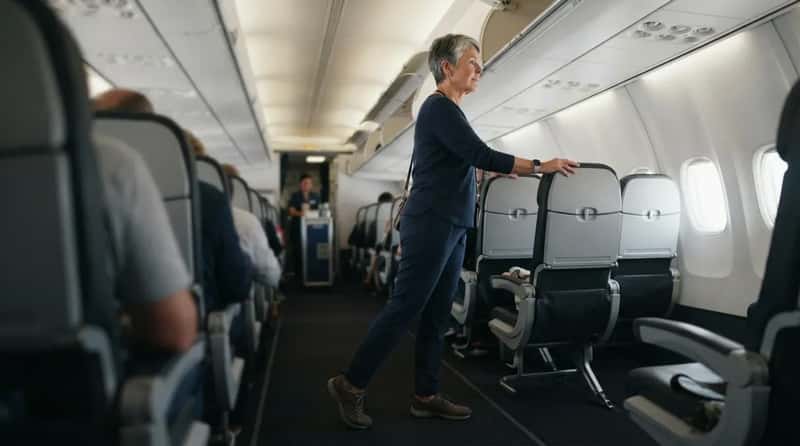
Sitting still for ten hours doesn’t just stiffen joints – it makes jet lag noticeably worse. Travel experts note that standing, walking the aisle, or gently stretching every couple of hours keeps circulation strong and prevents that heavy, sluggish feeling. After landing, the same logic applies: light activity or a short walk increases alertness and helps the body adjust to the new time zone.
Frequent flyers over 60 treat aisle walks as mandatory, not optional. Some will set a phone timer just to make sure it happens. Skipping movement is one of the quietest ways travelers sabotage their own recovery without realizing it.
#7 – They Eat on Destination Time, Not Departure Time

Meals are a bigger circadian signal than most travelers realize. Researchers point to chrono-diet strategies as a real, evidence-backed piece of the puzzle, working alongside light and melatonin to support circadian alignment. Older travelers are specifically advised to shift meal times to the local schedule right away, rather than eating on autopilot from home-time hunger cues.
This one’s simple but easy to ignore mid-flight when snacks are handed out constantly. Eating a midnight meal because it’s snack time back home is a jet lag mistake almost everyone makes at least once.
#6 – They Loop In a Doctor Before Mixing Anything

Experienced travelers over 60 don’t self-medicate blindly, and that caution pays off. Medical guidance is direct: for seniors, staying hydrated, avoiding heavy meals, and checking with a doctor about medications are key parts of managing jet lag safely. This matters more with age, since low-dose, fast-release melatonin is generally preferred – slow-release formulas and higher doses can linger in the system and confuse the circadian clock further.
It’s an unglamorous tip, but it’s the one that prevents a real problem: mixing melatonin with blood pressure medication or sleep aids without asking first. A five-minute phone call beats a groggy, disoriented first day abroad.
#5 – They Build In a No-Plans Buffer Day

New travelers often schedule a big excursion for day one. Veterans know better. Jet lag tends to hit harder as people get older, and research shows older flyers are affected more by time zone changes than younger passengers, so a light, low-stakes first day isn’t laziness – it’s strategy.
This is a slightly controversial stance among tour groups that pack day one with activities to maximize the trip. Many experienced travelers now argue that jammed first-day itineraries are the single biggest reason people remember a trip as exhausting instead of exciting. A slow first morning almost always pays for itself by day three.
Worth Knowing
- Jet lag symptoms often peak on day two, not the day you land
- Older adults’ circadian rhythms tend to be less flexible than younger travelers’
- A rule of thumb: budget roughly one day of adjustment per time zone crossed
- A quiet first morning tends to speed up recovery for the rest of the trip
#4 – They Hydrate Like It’s a Job, Starting Before Takeoff

This tip shows up in almost every credible source for a reason: dehydration is a huge, underrated driver of jet lag symptoms. Drinking plenty of fluids keeps the body from feeling the worst effects of a long flight, and starting before boarding – water, juice, even light snacks like fruit or nuts – helps keep energy steady.
Cabin air is famously dry, and most travelers don’t drink nearly enough during a flight. Chronic mild dehydration, not the time change itself, is often what makes jet lag feel so much worse than it needs to.
#3 – They Refuse to “Sleep Off” the First Day

The instinct to collapse into bed after landing is strong, and almost always the wrong move. Sleep specialists are blunt about this: avoiding long daytime naps at the destination makes it far easier to fall asleep at night, with only short naps recommended in the meantime. The better move is pushing through until local bedtime using light and activity instead.
Plenty of tired travelers think a long afternoon nap will reset them. It actually delays adjustment by another full day, which is exactly why so many people feel off for their entire trip instead of just the first 24 hours.
#2 – They Accept That Direction Changes Everything

This is the fact most casual travelers never learn, and it changes how experienced flyers plan entire trips: eastward travel is generally harder than westward travel, because you’re advancing your body clock instead of delaying it. Circadian research confirms it – eastbound flights across multiple time zones are noticeably tougher to adjust to than the same distance flown west.
Most people assume all jet lag is equal, that a flight is a flight. It isn’t, and treating an eastbound flight to Europe the same as a westbound flight home is one of the most common planning mistakes travelers make. Seasoned flyers build extra buffer time specifically for eastward legs.
At a Glance
- Eastbound: the body clock must advance, which is the tougher adjustment
- Westbound: the body clock delays, which most people find easier
- Crossing six or more time zones makes symptoms harder regardless of direction
- Seasoned flyers often add an extra buffer day specifically for eastbound trips
#1 – They Time Melatonin and Light Together, Not Separately

The single biggest gap between casual travelers and true veterans is this: melatonin alone, or light alone, is far weaker than combining both with precise timing. Studies show that melatonin paired with strategic light exposure produces two to three times faster adjustment than melatonin alone. For eastward trips specifically, sleep scientists recommend taking melatonin roughly 11.5 hours before the body’s temperature minimum, avoiding light in the hours before that point, and maximizing light right after it to nudge the body clock forward.
This is the tip almost nobody follows correctly, because it takes actual planning instead of guesswork. Most people take melatonin whenever and expect sunlight to happen naturally, then wonder why jet lag still hits hard. Frequent travelers over 60 who map this out ahead of time are consistently the ones who show up at breakfast the next morning looking suspiciously well-rested.
None of these tricks are secret, exactly – they’re just consistently ignored. The travelers who beat jet lag almost every time aren’t lucky or naturally resilient. They’re the ones who treat the flight itself as part of the trip, not just the annoying part before it.
Which of these have you actually tried, and which one are you still skeptical about? Drop it in the comments.