


Air Canada has charged $30 per passenger, plus taxes, to book by phone since Oct. 15, while its website and app carry no surcharge.1 If you would rather talk to a person than tap an app, that fee lands squarely on you.
Asking really can make some airline charges disappear. The catch is that age alone unlocks very little, because the waivers that work follow a specific rule or situation.
The only benefit tied in writing to a birthday comes from a federal agency, not an airline. It waits at #1, and the phone fee comes first.
#15 – The $30 Fee for Booking by Phone

Air Canada’s fee is non-refundable.1 United’s phone fee is listed at $25 per ticket, with exemptions for Premier elite members and for technical website errors.
Neither fee is tied to age. Air Canada’s exemptions are for accessibility,1 and preferring to speak with an agent does not guarantee a waiver.
If you are comfortable booking online, the plainest way to avoid these charges is to book there. A waiver you have to argue for is a poor thing to plan a trip around.
The situation that does give you a real argument is a website that would not let you finish.
#14 – The Phone Fee Dropped After a Website Failure

JetBlue charges $25 per person, non-refundable, when a customer changes, cancels or books a trip by phone. It says it will waive the fee for customers who tried online and ran into technical trouble.
That waiver is a judgment call by the agent, so treat it as a courtesy rather than a right.
One comparison says agents at American, United and JetBlue have internal overrides for technical failures. Another report says United will not waive its fee just because a booking could not be completed online.
Because the reports disagree, ask politely and have your facts ready.
A technical glitch earns goodwill. A disability that blocks online booking earns something stronger.
#13 – The Phone Fee Federal Law Waives

If an airline’s website is not fully accessible to screen readers, or a disability prevents a passenger from completing a reservation online, the airline must waive any telephone reservation fee. Airlines with inaccessible websites must allow reservations another way, such as by phone, without additional charges.
This rests on disability, not on turning 65. A vision or dexterity problem that stops you from using the site could qualify.
Say so at the start of the call, before the booking is completed.
Quick Compare: Phone Booking Fees
- Air Canada: $30 per passenger plus taxes, non-refundable.
- United: $25 per ticket, with exemptions for Premier elites and website errors.
- JetBlue: $25 per person, waivable if online booking failed.
- Any U.S. airline: must waive the fee if a disability or inaccessible website blocks online booking.
The few fares that carry an age label are the other reason to pick up the phone.
#12 – The Delta Senior Fare You Won’t See Online

Delta offers senior discounts on certain domestic markets for passengers 65 and older. The fares are not displayed on delta.com, so you must call and ask.2
Delta’s own fares-and-discounts page says certain discounts “are not available at delta.com.” None of the three airlines that still file senior fares, American, Delta and United, publishes what the discount is worth or which flights carry it.
A call is worth ten minutes only when the date and route are fixed and the public fare is not already low.
United handles the same idea differently, with a menu choice on its own website.
#11 – United’s Senior Box and the Basic Economy Catch

On united.com you choose “Senior (65+)” from a dropdown, and a 2026 guide puts United’s discounts at 5 to 25 percent. CNN Underscored notes that new memberships in United’s old senior program ended in 2007, but 65-plus discounts continue on select routes.
Basic Economy fares are excluded, so a senior fare can end up priced above the cheapest ticket on the same flight. That cheaper ticket carries tighter rules, so compare what each one allows before you decide.
The option does not always appear in the booking flow, which is when the phone becomes the fallback.
#10 – American’s Narrow Senior Fare and Southwest’s Missing One

American’s website says it does not offer senior discounts on all flights, but does on some. One guide describes the program as limited mainly to Latin American routes and closed to U.S. passport holders on most of them.
Another lists it as 10 to 15 percent on select international routes through Advanced Search. If you fly mostly within the United States, American’s senior fare is not worth a long search, especially since it is often not cheaper than a sale fare.
Southwest retired its senior fares, and any site still promising one is out of date.
At a Glance: Where Senior Fares Stand
- Delta: certain domestic markets, 65 and older, by phone only.
- United: “Senior (65+)” dropdown on select routes, Basic Economy excluded.
- American: some flights only, mostly select international routes.
- Southwest: retired its senior fares.
A senior pass sold by a European airline works on a different principle, with an annual price attached.
#9 – The €49 Air France Senior Pass

Air France’s Senior Pass is for travelers 65 and older, costs €49 a year, and offers up to 30 percent off.3 It applies only within Europe, with U.S. routes excluded.
That makes it an age discount you pay for rather than one you simply ask for. If the full 30 percent applied to the fare, the pass would earn back its price after about €165 in eligible tickets, and smaller discounts would take longer.
I would not buy it for a single trip. It makes sense only if you plan several flights within Europe in the same year.
None of this helps with a seat charge, which federal law treats on a different basis than age.
#8 – A Seat Assignment That Fits Your Disability

Under the Air Carrier Access Act, a free seat assignment that meets your disability-related needs is among the accommodations airlines must provide.4 It does not cover every paid upgrade.
A 2026 guide notes that only some airlines waive upgrade fees for disability-related needs. Requesting these services in advance is essential, so ask before the seats you need are taken.
Some travelers need more than a seat, and a companion’s ticket is its own question.
#7 – The Extra Ticket for a Required Attendant

If an airline decides a passenger must travel with an attendant, contrary to the passenger’s own assessment, the carrier must not charge for the attendant’s transportation. This covers the airline’s insistence, not a companion you choose to bring.
If an agent demands an attendant and quotes a price, the Complaints Resolution Official, covered further down, is the person to ask for.
#6 – Wheelchair Help From Curb to Gate
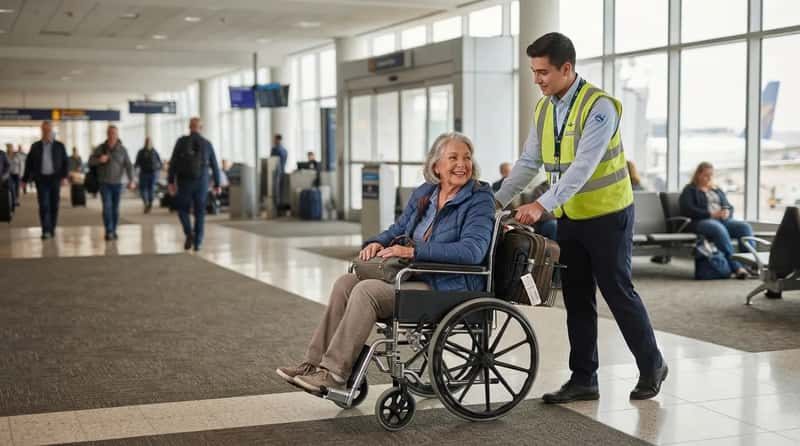
The Department of Transportation says airlines must help passengers whose disability limits their mobility, including moving through the airport from the entrance to the gate.4 Airlines can’t charge for it and generally can’t require advance notice.
They may ask for a credible verbal assurance that you need the service, but shouldn’t ask about the nature of your disability. This is the request that works at a counter, because it rests on need.
If distance is the problem, asking costs nothing and spares you a long walk.
The help covers the passenger, while the passenger’s own equipment travels under separate rules.
#5 – Free Checking for Your Own Wheelchair or Walker
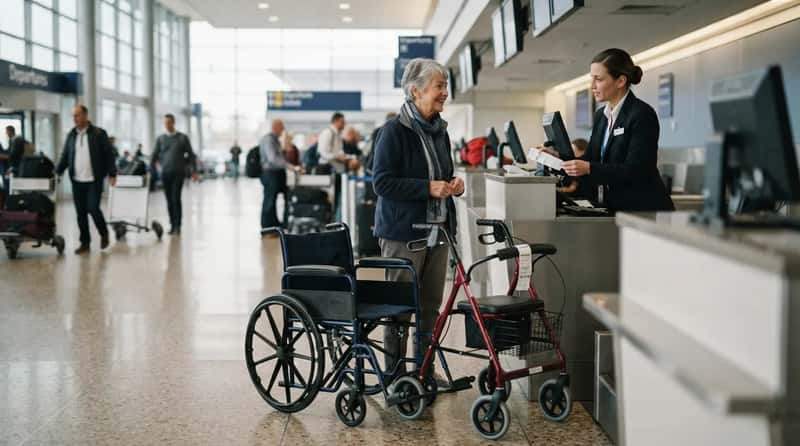
Airlines must provide free and safe transportation for personal wheelchairs and mobility devices of any size or weight, so long as they fit in the cabin closet or cargo compartment.5 Carrier personnel must not require you to sign a waiver of liability for damage to or loss of the device.
If you are handed such a form, you do not have to sign it. Allegiant’s policy adds that walkers and canes do not count toward your carry-on allowance and are checked free.
Worth Knowing
- Personal mobility devices travel free, whatever their size or weight, if they fit the cabin closet or cargo hold.
- You should not be asked to sign a liability waiver for damage or loss.
- Allegiant does not count walkers or canes toward your carry-on allowance.
Damage is the other half: a chair that comes back bent leaves you needing a replacement mid-trip.
#4 – The Loaner When Your Chair Is Damaged
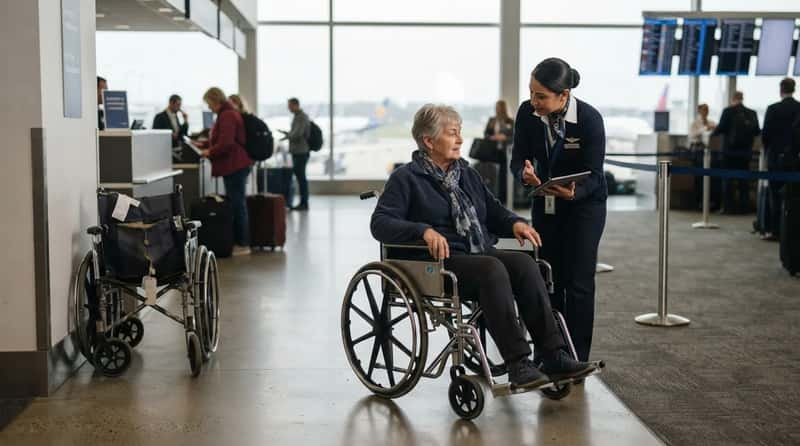
Airlines must return checked wheelchairs in the condition they were received. A December 2024 rule calls for the airline to consult with you on a suitable loaner and to pay for it until your device is returned, repaired or replaced.
DOT has paused enforcement of four disability-rule requirements, so do not assume every part of that rule is in force.
A rule stated clearly on paper can still stall, as the federal requirement to show every fee up front has.
#3 – The Fee Disclosure Rule Stuck in Court
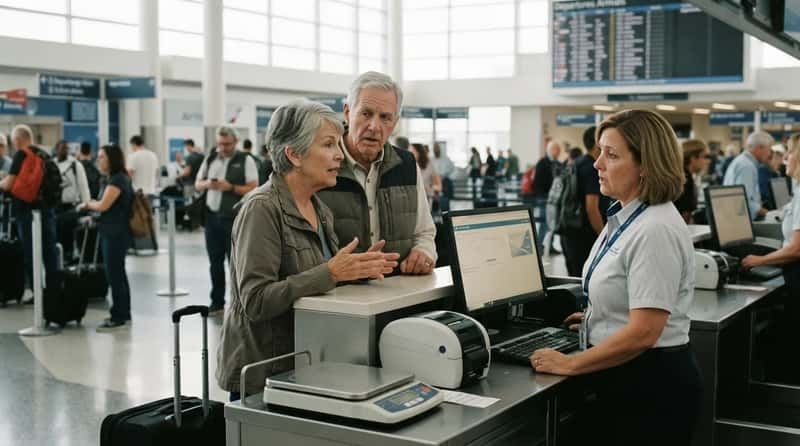
The Department of Transportation finalized a rule requiring airlines to show all fees upfront, but airlines challenged it and a federal appeals court paused it. AARP has told federal regulators that hidden fees hit older adults hard, especially those on fixed incomes.
Until the rule is settled, the first price you see may not include the extras. The phone fees from earlier are exactly this kind of charge, so look up bag, seat and booking costs on the airline’s own pages before you pay.
When a charge appears that should not, the agent at the counter is not always the person who can remove it.
#2 – The Complaints Resolution Official

A Complaints Resolution Official is the airline’s expert on disability issues. Airlines must make one available at the airport or by phone during operating hours at no cost.
That makes the CRO the right person for the wheelchair, attendant and seat disputes covered above. A plain age-based question, such as a senior fare, is not their job, and the phone desk handles it.
None of this reaches the security checkpoint, where the rules come from a different agency and a firm age line.
#1 – The Age Line at Security Is 75
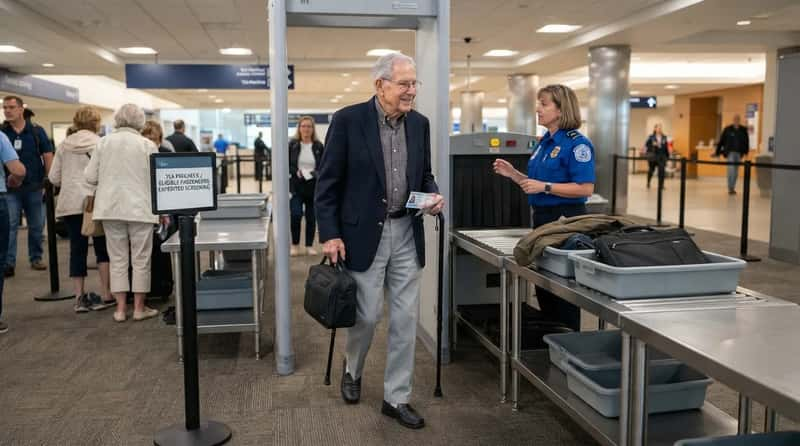
TSA says passengers 75 and older can receive expedited screening. They may leave their shoes on, though light jackets come off for Advanced Imaging Technology.6
If an alarm sounds, they may have to remove shoes or accept a pat-down, and they can ask to sit during that step.6 It is the one benefit in this list tied in writing to a birthday, and it saves time, not money.
The line is 75, not 65. A traveler aged 65 to 74 still gets standard procedures, although since July 2025 all travelers may keep their shoes on at standard checkpoints.7
Asking “do you have a senior discount?” gets you little at most counters. Naming your situation gets you further: a website that failed, a disability that blocks online booking, a chair that needs checking, or a charge that a Complaints Resolution Official can review.
Most of what disappears when you ask does so because the situation qualifies, not the birthday. So before your next trip, write down the one thing that would make flying harder for you and find out which rule covers it.
Which charge on your last flight surprised you, and did asking about it change what you paid?
Sources

- TSA: Screening for Passengers 75 and Older
- Yahoo Finance Canada: Air Canada phone booking fee
- CNN Underscored: Flight discounts for senior travelers
- Passport Pro Travel: Airline senior discounts 2026
- Budget Seniors: Best discounted flights for seniors
- WheelchairTravel.org: Summary of the Air Carrier Access Act
- Upgraded Points: Air travel with a disability
- DOT Technical Assistance Manual on the ACAA (hosted by Animal Law)
- Air Canada Contact Centre Fee: https://www.aircanada.com/us/en/aco/home/book/travel-news-and-updates/contact-centre-booking-fee.html
- Budget Seniors Discounted Flights: https://www.budgetseniors.com/travel-transportation/best-discounted-flights-for-seniors/
- Air France Senior Pass: https://wwws.airfrance.fr/en/information/offres/cartes-de-reduction/carte-senior
- DOT Traveling With Disability: https://www.transportation.gov/individuals/aviation-consumer-protection/traveling-disability
- WheelchairTravel ACAA Summary: https://wheelchairtravel.org/air-travel-air-carrier-access-act-summary/
- TSA Screening 75 and Older: https://www.tsa.gov/travel/tsa-cares/screening-passengers-75-and-older
- AARP TSA Shoe Policy: https://www.aarp.org/travel/travel-tips/tsa-shoe-policy/
