You booked the room, got the confirmation email, and assumed the hard part was over. For the people working the overnight desk, that’s often where the trouble starts. After dark, a handful of small arrival details decide whether you get a key in two minutes or stand outside dialing a phone at 1 a.m.
The strange part is that almost none of it is secret. It’s buried in fine print, handover lists, and a nightly accounting routine most guests never hear about. Below are 15 of those details, counted down from the quiet misunderstandings to the one that keeps a tired employee watching the door.
#15 – Your Booking Covers the Night It Starts, Not the Date on the Clock

The most common late-night mix-up begins with a calendar. Hotels sell rooms by the night, not by a rolling 24-hour period. If your reservation begins on October 10 and you arrive at 1:00 a.m. on October 11, you are still checking in for the night of October 10.
Plenty of travelers do the opposite. They book the date they land, not the night they sleep. Book October 11 instead, and you could be left without a room until that afternoon’s regular check-in time. Night teams watch this play out at the desk with an exhausted guest holding a perfectly valid confirmation for the wrong night. The fix is dull but effective: book the night you’ll actually need the bed.
But the next myth is even more widespread, and it involves what happens when the clock strikes twelve…
#14 – The “Midnight Rule” Is Mostly Folklore

Ask ten travelers when a hotel gives up on them and most will say midnight. It sounds official. It isn’t universal. The exact timing and procedure vary from property to property.
Some hotels pick a specific hour. Others say “after midnight,” and some base it on staffing, occupancy, and local demand. One hotel front-desk training guide describes a late check-in as starting at 2 a.m., not midnight. The cutoff you assume is probably not the one in your hotel’s own policy. Assuming is the mistake, and asking takes thirty seconds.
And while the cutoff moves around, there’s something on the desk that rarely does…
#13 – Night Staff Already Have a List With Your Name on It
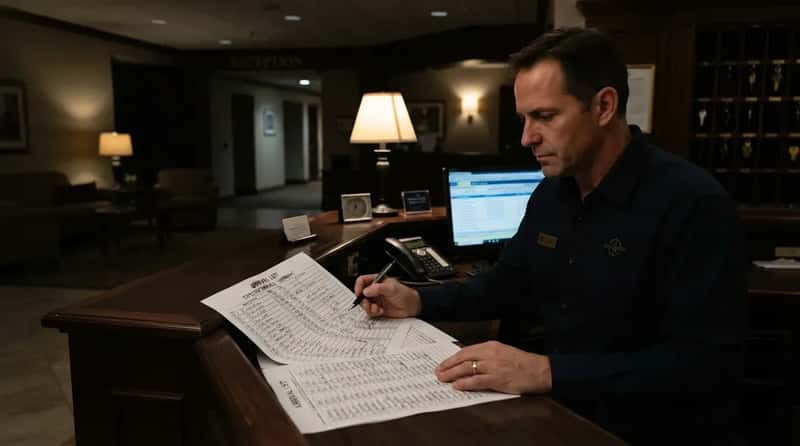
Your arrival isn’t a surprise to the overnight team, at least when someone has told them about it. Long before a guest walks in at 2 a.m., the night porter has usually reviewed a list of everyone expected that evening. That list is a handover from the day shift, updated as guests come in.
That’s why a call matters. Give the front desk your name, confirmation number, and estimated arrival time. The “arrival time” box on a booking site is closer to wishful thinking than a plan, because a typed note can sit in a system nobody opens after dark. Direct acknowledgment from a human is far more reassuring.
- Call the hotel directly, not just the booking site.
- Give a realistic arrival window, not an optimistic one.
But even a perfect phone call can’t fix the word most guests trust the most…
#12 – “Guaranteed” Is the Most Misunderstood Word in Hotel Booking

Guests hear “guaranteed” and relax. Night teams wince. A guaranteed reservation is generally more secure than an unguaranteed hold, but what guaranteed means can vary by hotel and rate. It’s a promise with fine print.
Even a card on file has limits. If you never arrive, the hotel can still mark you as a no-show and charge according to the booked terms. One night-porter explainer says some hotels hold guaranteed rooms until around 6 a.m., but that varies by property. Guaranteed often protects the hotel’s revenue more than your pillow.
Which brings us to what actually happens to the reservations nobody claims…
#11 – The System Can Bill You for a Stay You Never Started

Somewhere between midnight and dawn, a quiet process decides who showed up. Hotels run a nightly accounting routine, often called the night audit, and reservations not yet checked in may be reviewed or marked as no-shows. There’s often no human drama involved. It’s a checklist.
The cost can sting. One travel-industry explainer says many hotels charge the first night as the no-show penalty, while others use a flat fee or a percentage. Arrive without notice, and the hotel can mark you as a no-show and release the room. You can lose both the room and the money in the same night. Policies differ, so your own confirmation email is the real authority.
Still, the hotel can only bill you if it can get your card. That’s where things go sideways…
#10 – Your Card Can Get Tested Before You Walk In

Some hotels check payment cards before you even show up. One front-desk training guide tells staff to authorize cards for expected arrivals at 6 p.m. The authorization covers one night’s stay plus 20%. That’s one property’s process, not a universal rule, but it shows how common the practice is.
When the check fails, the booking can unravel. If a pre-authorization attempt is declined, the reservation can be flagged and, after the cutoff, released as a no-show. The guest may be on a plane and have no idea. Your room can be at risk while you’re still somewhere over the Rockies. A card that’s expired, frozen, or near its limit is a surprisingly common culprit.
Fast Facts
- One training guide has staff authorize cards for expected arrivals at 6 p.m.
- That hold covers one night plus 20%.
- A declined attempt can flag the booking before you land.
- Expired, frozen, or nearly maxed-out cards are the usual troublemakers.
The card problem has a cousin that’s even trickier, and it involves someone who isn’t even there…
#9 – Someone Else’s Credit Card Stalls More Check-Ins Than You’d Think

Gift stays, company bookings, and “my parents are paying” all create the same trouble at 1 a.m. The person at the desk can’t reach the payer. The payer is asleep two time zones away.
Hotels have rules for this. One training guide tells staff to explain the policy on an outside party paying and to offer to send a form before the stay. Many hotels also want the registered guest’s ID and a payment card at check-in. The paperwork is often fixable in daylight and nearly impossible at 2 a.m. The night team usually has no authority to waive it.
Of course, paperwork is useless if you can’t get through the front door…
#8 – After Hours, Some Hotels Lock the Front Door
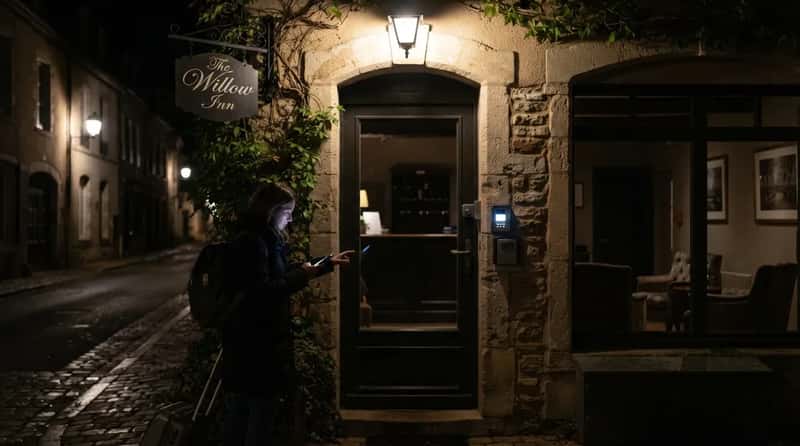
Not every hotel has a lobby that stays open all night. Smaller properties may lock exterior doors or switch to a separate after-hours procedure. Guests who picture a bright lobby and a smiling clerk can end up on a dark sidewalk.
The workarounds vary. You might need an after-hours code, a lockbox, or a number to call from the door. That information often lives in a pre-arrival email nobody opened. The biggest late-night crisis is sometimes a guest who has the booking but not the door code. Roadside inns, boutique hotels, and bed-and-breakfasts are the usual suspects.
And if the door isn’t locked, the person behind it may be doing more than you realize…
#7 – A Flight Delay Doesn’t Pause Your Room

Airlines know your flight is late. The hotel usually doesn’t. Unless you tell the desk, the night team sees only the arrival time you originally gave them, or none at all.
That gap is where rooms go missing. The safest move is to contact the property as soon as you know you’ll be late, share your new estimate, and ask the desk to note the reservation. A tarmac delay, a missed connection, and a long rental-car line can each push your arrival hours past the original plan. The hotel’s cutoff doesn’t care that your plane was grounded. One short call can turn a likely no-show into an expected late arrival.
Quick Compare
- You call ahead: the desk logs a late arrival with your new estimate.
- You say nothing: the night team sees only the old time, or no time at all.
- Likely outcome: an expected guest versus a possible no-show.
Once you do arrive, though, you might be surprised who’s handling you…
#6 – The Person Greeting You Is Probably Also Running the Audit
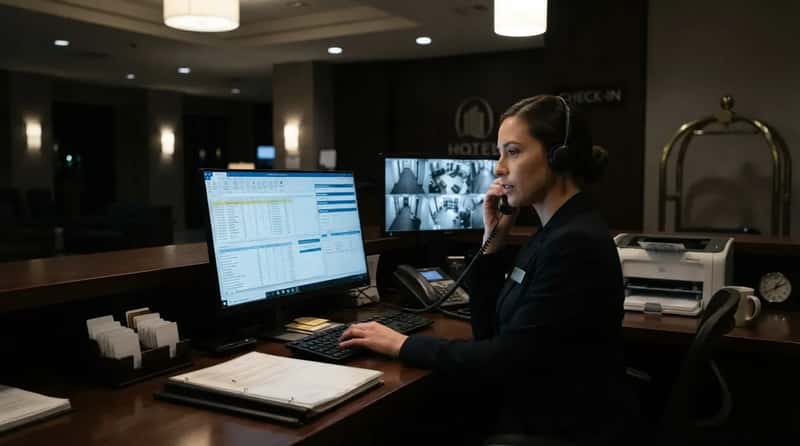
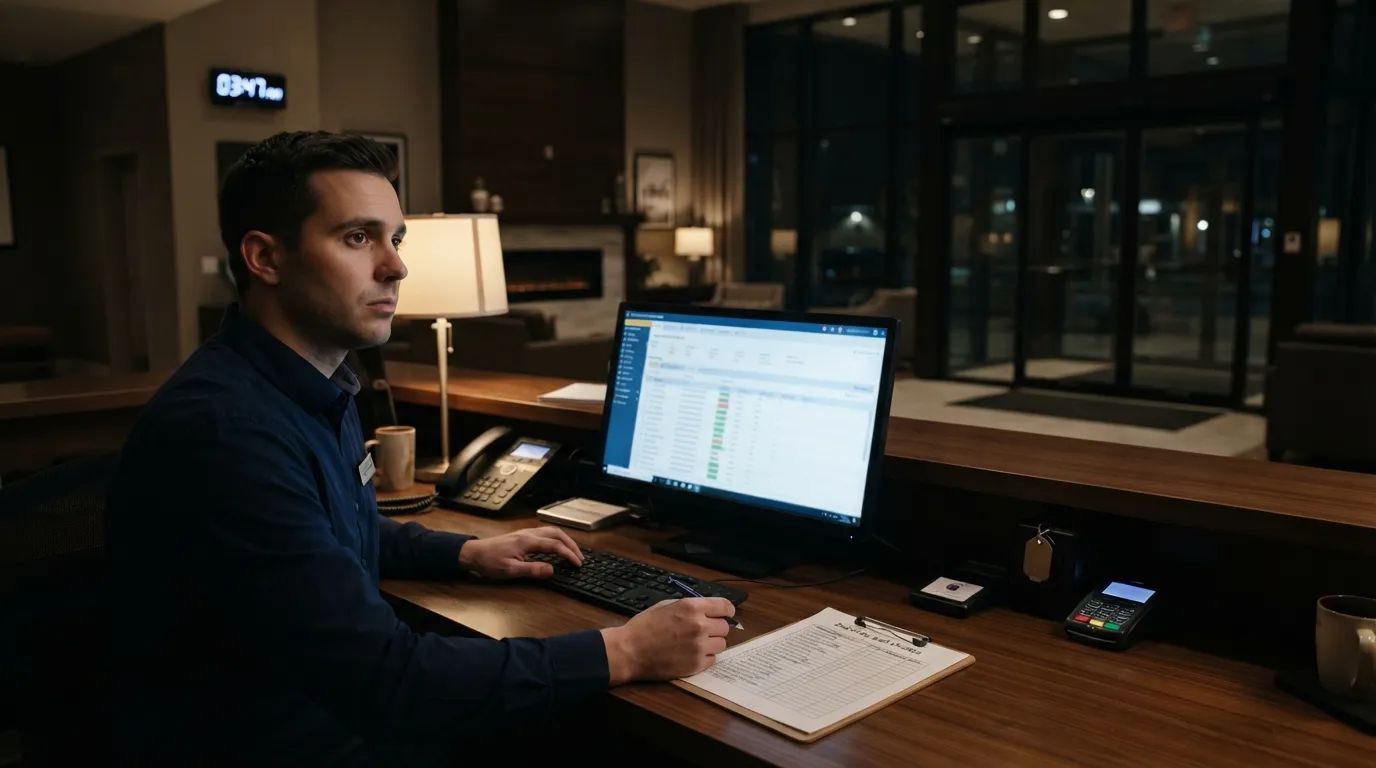
The overnight agent is rarely just “the front desk.” One real job posting for a Houston hotel describes the role as welcoming late guests, handling reservations, and completing the nightly audit that closes each business day.
The same posting also lists watching surveillance feeds and maintaining strict key control, including reporting unusual activity. One person may be checking you in, answering the phone, and watching the cameras. Hotels differ by size, and larger ones have more staff overnight. But at many properties the night team is small, which explains the occasional slow line.
That audit isn’t a formality, either, and it can change what shows up on your bill…
#5 – Charges Follow the Business Day, Not Your Sleep Schedule

The night audit does more than track arrivals. It reconciles charges to the right guest folio, rolls the date forward in the system, and confirms that no-shows are processed and arrivals resolved. The date rolling is the part guests rarely hear about.
For you, that can mean a late-night purchase lands on a different day’s charges than you expected. Night auditors balance and post daily charges, including room, tax, payments, and outlets, to guest ledgers. A midnight snack and a 12:05 a.m. one can look surprisingly different on a folio. If a line item looks off, ask the next morning. Daytime staff can see the same records.
At a Glance
- Daily charges get posted to guest ledgers: room, tax, payments, and outlets.
- The system date rolls forward during the audit.
- No-shows are processed and arrivals are resolved.
- Questions about a charge are easiest to settle with the day team.
But if the hotel is packed, there’s a bigger worry for a late arrival…
#4 – A Full House Makes Late Arrivals Nervous

Nobody likes to talk about overbooking. Hotels sometimes oversell rooms as a business strategy, betting that some guests will cancel or never show up.
That’s why late arrivals matter on sold-out nights. A guest who calls ahead is a known quantity. An unreported late guest is a gap in the plan. On a full night, “I’ll just show up when I show up” is the riskiest sentence in travel. Rules and compensation vary by hotel and brand. Loyalty status and a guaranteed booking can help, but neither makes a room appear out of thin air.
Then there’s the opposite problem: guests who show up way too early…
#3 – A 6 a.m. Arrival Meets a Room That’s Still Someone Else’s

Some guests step off a red-eye and walk straight to the desk expecting a bed. The night team knows the room is probably still occupied. Check-out hasn’t happened yet, and housekeeping hasn’t started.
Most U.S. hotels set standard check-in in the afternoon, and your booking covers a night, not a morning. Night staff can often store bags and point you toward coffee. They can rarely conjure a clean room out of an occupied one. Early arrival is a request at most properties, and it depends on what’s vacant, not on how tired you look.
But the detail that causes the most quiet disappointment isn’t about timing at all…
#2 – Your Special Request Is a Note, Not a Promise

“Quiet room, high floor, extra pillows.” Many guests type it into a box and consider it done. In practice, it’s a request that travels through the handover. A job listing for one overnight role mentions preparing for upcoming arrivals and making sure VIP and special requests are in place.
But by midnight, inventory is thin. Housekeeping is gone, and the best rooms are often taken. A request noted at booking and a request fulfilled at 1 a.m. are two different things. The night team will usually try, but they can only work with rooms that are clean and available right then.
And the biggest reason all of this matters comes down to one unfinished checklist…
#1 – The Audit Can’t Close Until They Know Where You Are

Here’s what most guests never picture. Somewhere behind the desk, a clerk is waiting on you. A standard end-of-day checklist includes a final check that no non-guaranteed arrivals are still expected. Non-arrivals that haven’t been prepaid have to be processed as no-shows.
That means your mystery arrival is an open loop. The desk team may need to run audit tasks overnight, and they want a clear list of who is still coming. A guest who never called can keep a tired employee glancing at the door for hours. Hotels run this differently, but the pattern is common. A two-minute call isn’t just etiquette. It lets someone finish their shift.
Worth Knowing
- Give the name on the booking and your confirmation number.
- Share a realistic arrival window, then update it if plans slip.
- Ask the desk to note it so the overnight team sees it.
- Save the hotel’s direct number before you leave home.
The shocking part isn’t a secret rule. It’s how small the fixes are. Your booking covers a night, not a calendar day. Midnight isn’t a universal cutoff. “Guaranteed” has fine print. And the overnight desk is often one busy person waiting on a list that you can change with a single call.
Nearly every late-night disaster night teams describe could have been avoided with a short heads-up and a saved phone number. The people on the other side of that door usually want nothing more than to hand you your key.