
A resort fee of $55 a night adds $275 to a five-night stay before tax, and it is only one line on a folio that can run several pages. Some of the lines around it, and a few at the golf shop, really do get corrected or reduced when a guest speaks up.
The reasons are specific: a billing error, a closed pool, or a senior golf rate with a published age cutoff. A birthday alone does far less of the work than most people expect.
The largest line on the bill is also the one hotels defend hardest, and what decides it is paperwork, not a birthday. We will get to that one last.
First comes the smallest charge on the list, a few dollars for an in-room safe.
#15 – The Three-Dollar Charge for an Unused Room Safe

An NBC News consumer guide to hotel extras listed a $3 charge for having a safe in the room, billed whether or not you ever used it.1 The amount is small enough to slide past a tired traveler, and it sits on the folio alongside bigger extras such as the groundskeeping surcharges the same guide warns about.
At $3 a night, the charge comes to $15 over five nights. That is real money, but not worth a scene at the desk.
Ask what the line covers, and if the safe was missing or unusable, say so once and leave it there. The same guide advises that you allow plenty of time at checkout to review the charges, because negotiating before you sign gives you a much better chance of getting one removed.1
A polite question is usually enough for a hotel extra, but a reduced rate at a golf shop often depends on a registration you had to complete before you paid.
#14 – The Cart Fee at the Senior Rate

At the Rutgers University golf course, an electric cart costs $22 per person for 18 holes, while a registered senior pays $18.2 The nine-hole price is $14 either way, so the senior discount disappears on a short round.
A hand cart is $6 regardless. The senior rate requires you to be 65 or older and registered with the course.2
If you are registered and the register still rings the standard cart price, ask for the senior cart rate by name. A clerk working through a line of golfers has no reason to guess your age or your status.
This is one course’s price list. Other courses set their own amounts and their own cutoff ages, so ask what yours charges.
#13 – Duplicate Lines on the Resort Fee
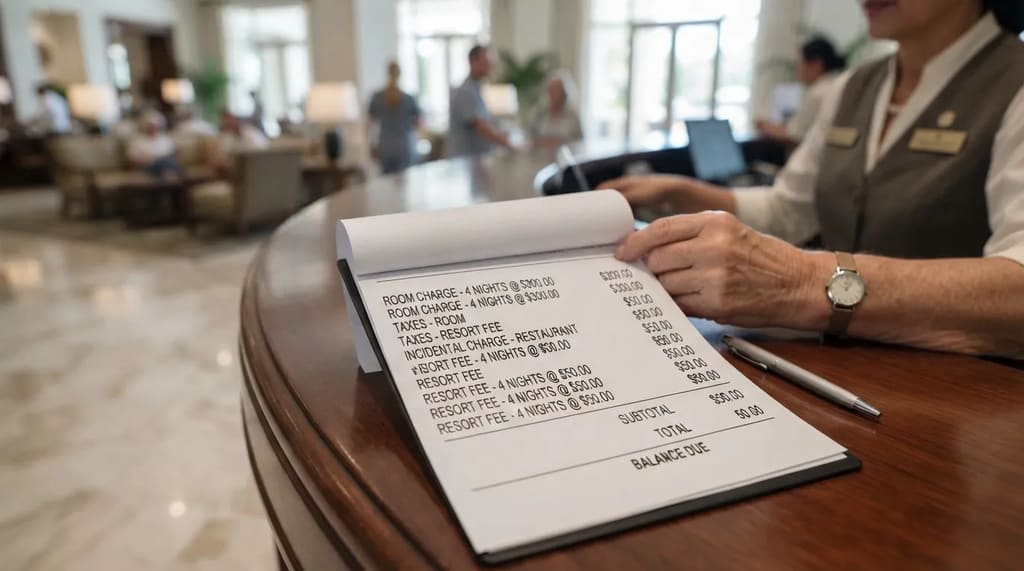
Before you argue about whether a fee is fair, check whether it was added up correctly. Review the number of nights charged, the number of rooms, the fee description and any credits already applied.
A duplicate or mathematically incorrect fee should be presented as a billing correction, not as a courtesy waiver you are asking for. That framing matters, because a desk clerk can fix an error without having to approve a favor.
A resort fee is typically charged per room, per night, so a solo traveler pays the same as a family of four. That makes a room move or a changed departure date a natural place for an extra night to slip in.
Ask for a preliminary folio before your last morning. Reviewing it before checkout leaves time to correct errors.
A folio check covers the hotel’s own arithmetic, but a round of golf booked through the resort comes with its own price list and its own ID rules.
#12 – The Senior Card That Costs Money First

Rutgers charges $20 per calendar year to register as a senior, and you sign up in person at the pro shop. Los Angeles County sells an annual senior card to golfers 65 and older, and the card fee does not include any greens fees.3
In both cases you pay to qualify before you save anything. Whether the card is worth buying comes down to how often you play on weekdays.
If you play two or three rounds a year, skip it. If you play every week, it pays for itself quickly.
The LA County card is nontransferable and works only for the person it was issued to, so a spouse who also plays needs a separate card.3
The card fee is one you choose to pay, while the groundskeeping surcharge on a resort bill is one the property chose for you.
#11 – The Groundskeeping Surcharge

The NBC guide flagged a charge that fits resorts with big grounds: if your resort has acres of lawns, gardens or golf courses, you could be paying a groundskeeping surcharge.1 It is a mandatory charge like any other.
That means if it was not disclosed to you in writing, you can point it out to the hotel staff and ask for it to be removed. The label may not say “groundskeeping,” though.
Hotels use the names resort fee, destination fee, facility fee, amenity fee or urban fee, so look for any of those in your confirmation email. If the charge appears there, the hotel is more likely to enforce it, and if it does not, you have a reason to ask.
Since May 2025, U.S. hotels have been required to show resort, destination and other mandatory charges in the full price before payment information is entered.
Fast Facts
- The same fee can appear as a resort, destination, facility, amenity or urban fee.
- Your confirmation email is the first place to look for it.
- Mandatory charges now belong in the total shown before you pay.
- Fees you were never told about in writing are worth pointing out to staff.
A groundskeeping surcharge at least carries a name, but a service charge on a restaurant or spa tab can pass for a tip, and that is a different question.
#10 – The Service Charge That Already Covers the Tip

When a service charge is meant as a stand-in for the gratuity, the NBC guide’s advice is that you can skip the additional tip, or ask for the fee to be removed so you can tip at your own discretion. The risk is paying twice.
A check with a service charge line and a blank tip line invites exactly that. Ask what the charge is for and whether it is meant as a gratuity.
If it is, pay once and decide for yourself whether to add more. A resort fee is a different thing.
The hotel keeps the entire resort fee, so it does not stand in for a tip to housekeeping, and it is worth leaving cash for the person who cleans your room if you would have anyway.
#9 – The Booking Site’s Service Fee

Not every extra on a trip comes from the hotel. In the NBC example, three booking sites collected taxes and service fees, and these were charged by the booking sites, not the hotel.1
Meanwhile, the resort’s own site showed a separate $35 per night resort fee.1 That means two different parties are billing you, and the front desk can only correct one of them.
If the fee belongs to the booking site, take the complaint to the site. Ask it to review whether the mandatory fee was shown before checkout and whether the listing matched the final bill.
To make that easy, take screenshots of the room rate, the total price and the checkout page before you pay. If the room price is about the same either way, booking direct also means one fewer middleman, and it gives you the best chance of fee waivers.
Quick Compare
- Booking site charges: taxes and service fees, so the complaint goes to the site.
- Resort charges: its own resort fee, $35 a night in the NBC example, so the complaint goes to the front desk.
- Either way: screenshots of the rate, total and checkout page are your proof.
The site’s fee is settled with the site, but the resort’s own fee depends on what the property actually had open during your stay.
#8 – A Resort Fee for a Closed Pool

A resort fee nominally covers access to the pool, the gym and Wi-Fi. When the pool is closed for renovation or the gym is out of order, you are being charged for amenities the hotel is not providing.
Raise it politely at checkout and ask for the fee to be removed. Be specific with the dates, the amenity and the daily amount, because many hotels will remove the fee on the spot to avoid negative reviews or corporate complaints.4
This is a stronger argument than telling the desk you did not use anything. Simply not using the amenities does not automatically eliminate the fee.
The difference is availability. Skipping a pool you could have used is your choice, while a pool that was closed is the hotel’s.
If the desk says no, make sure the receipt notes your dispute, and write the reason on the signature line.
A closed pool answers for the fee on one stay, while membership in a hotel loyalty program can answer for it before you arrive.
#7 – The Waiver Tied to Status or a Suite

Some resort fees are waived for particular guests. On the Las Vegas Strip, the Bellagio’s $55 a night fee is waived for Gold, Platinum and Noir MGM Rewards members.5
More broadly, some hotels waive the fee at elite loyalty tiers, and in some cases booking a suite or premium room category includes a waiver. Points stays are less clear, because the chains differ.
One table shows Hilton waiving the fee on award stays, while another shows Marriott and IHG charging it even on points redemptions. Confirm with the specific property before you book.
Do not pay for a suite just to avoid a fee unless the price difference is smaller than the fee total for your stay. At $40 a night over five nights, the fee is $200, and a suite that costs more than that extra is a bad trade.
Waivers settle the hotel side of the bill, but the golf side has fine print of its own.
#6 – The Cart Fee Added Beside the Senior Rate

Course listings often show a senior rate with a separate cart fee noted next to it. That means the rate shown does not include the cart.
At Rutgers, the cart is priced per person, with a hand cart at $6. A $38 greens fee can turn into a much larger total once a cart is added, and you may see the difference only at the counter.
At a Glance
- 18-hole electric cart: $22 per person, or $18 for a registered senior.
- Nine-hole electric cart: $14 for everyone.
- Hand cart: $6 regardless of age.
- Senior pricing requires age 65 or older plus registration with the course.
If you walk, you may not need the cart at all. Many courses allow walking, though some do not, so ask.
If a cart is what lets you play comfortably, it is a fair cost, and the goal is simply to know the figure before you pay. Ask whether the quoted cart price is per person or per cart, since the two can differ by a factor of two.
The cart is the visible extra, while the day and time limits on the senior rate itself decide whether it applies at all.
#5 – The Senior Rate on the Wrong Day or Hour

Senior golf rates come with calendar limits. At Rutgers, the discount is valid only for weekday play.2
The LA County card is valid only for non-holiday weekday play, Monday through Friday. General listings add that senior rates are usually offered Monday through Friday and may be restricted during peak weekend hours.
The county card also has a time rule: card holders may play or make a reservation before 7:00 a.m. and after 9:00 a.m.6 A tee time booked between those hours may not qualify.
The qualifying age varies by course too, and some set it at 60 or 65, so always bring an ID. Confirm the senior price when you book, because that is when you can still move the round to a day that qualifies.
Golf is settled at the counter on the day you play, but a hotel charge can still post after you have gone home.
#4 – A Charge That Posts After You Check Out

Sometimes a fee turns up on your card after departure. The sequence matters: contact the hotel directly first, then dispute through your credit card company if it is unresolved.
The hotel can often fix its own mistake faster than a card issuer can investigate one. That is also why asking before checkout beats everything else on this list, since staff can still investigate and correct the folio.
If the fee was never properly disclosed, you may be able to dispute it with your credit card company. Keep notes, names and times from every call, along with your confirmation and booking-page screenshots.
Card issuers set time limits on disputes, so a post-stay charge should not sit unchecked for weeks.
Worth Knowing
- Start with the hotel, which can often correct its own error fastest.
- Move to your card issuer only if the hotel does not resolve it.
- Save names, call times, your confirmation and booking-page screenshots.
- Check your issuer’s dispute deadline as soon as the charge appears.
When a hotel does bend, it is usually because a manager had a reason to say yes.
#3 – The Resort Fee After a Bad Stay

A hotel’s willingness to bend is greater after a stay that went badly. Many hotels have discretion to waive the fee for loyalty members, dissatisfied guests or those who can document non-use.4
Related Stories From Travelbinger



If the first person at the desk cannot do it, asking to speak with a manager may help. The request is likelier to succeed when you stay calm, have documents, and point to the missing fee on your confirmation.
Be clear about what the complaint is. Explain whether the dispute concerns inaccurate pricing, inadequate disclosure or a billing error.
A reduction or partial credit is a more realistic ask than total removal, and asking the desk to remove or reduce the fee gives the manager an easier yes. Big chains also often have internal complaint systems that may take hidden-fee complaints seriously.
A manager’s discretion works best when your complaint rests on a record, and the strongest record is whatever the booking confirmation said in writing.
#2 – The Fee That Appeared Only at the Front Desk

The NBC guide gives a plain rule: if you discover fees at checkout that were not disclosed to you in writing, point them out to the staff and ask for them to be removed. Look at your reservation confirmation first.
Many confirmations include a section explaining that a daily resort or destination fee will be collected at the property. If the fee appears there, even in fine print, your chances of getting it removed are lower, even if the disclosure was easy to miss.
If the fee is not there, ask the hotel to show where it was disclosed during the booking process. You can also ask the desk to put the fee in writing, on the folio or in an email, so there is a record before you sign.
The same request works by phone before you arrive, which spares you the surprise at checkout.
Even a fee that appears in writing has a second test, which is whether the total price you saw when you booked included it.
#1 – The Resort Fee Itself, When It Wasn’t in the Price You Saw

Since May 12, 2025, U.S. hotels and short-term rental sites have been required to show the full price of a room, resort and destination fees included, before a traveler enters payment information. That comes from the Federal Trade Commission’s rule on unfair or deceptive fees, and it does not cap or ban any fee.7 8
A property can still charge a resort fee, but it has to be folded into the total at the top of the listing, not revealed later. That gives you a clear lever.
Compare your booking screenshot with the folio, and if the total you were shown left out a mandatory fee, ask for the folio to match it. If the hotel refuses, you can ask for proof of disclosure, escalate to the brand or booking site, and consider a card dispute.
The amount at stake is real. A 2025 NerdWallet study of more than 400 hotels put the national average at around $33 to $35 a night, or roughly $165 to $175 over five nights, and most major Las Vegas Strip hotels charge $45 to $55 before tax.
Age by itself is not a ground a hotel has to accept, and a disclosed mandatory fee can still be charged. What a hotel cannot easily argue with is its own advertised total.
At the front desk, the screenshot of your booking price does the work that a senior ID does at the pro shop.
Keep the Booking Screen Until the Bill Is Paid

The paperwork that wins a fee dispute is created weeks before the trip. Take a screenshot of the total price at booking, save the confirmation email, and keep both until the final charge has cleared your card.
At the front desk, your question is whether the bill matches what you were shown. At the pro shop, the question is whether you have the ID and registration the senior rate requires.
Neither question depends on how long you have stayed or how well you argue. When you last checked out of a hotel, did you compare the final folio with the total you were shown at booking, and what did you find?
- NBC Hidden Hotel Fees: https://www.nbcnews.com/id/wbna25200077
- Rutgers Golf Course Fees: https://ipo.rutgers.edu/business-services/golf-course/fees
- LA County General Golf Information: https://parks.lacounty.gov/general-golf-information/
- SneakyFees Resort Fee Guide: https://sneakyfees.com/guides/fees/resort-fees.html
- Las Vegas Resort Fees Guide: https://www.lasvegasjaunt.com/resort-fees/
- LA County Golf FAQs: https://parks.lacounty.gov/golf-faq/
- PIRG Junk Fees Rule: https://pirg.org/edfund/articles/junk-fees-finally-new-protections-against-surprise-charges-for-event-tickets-hotels/
- FTC Junk Fees Rule Summary: https://shorenewsnow.com/travel-news/what-the-ftc-s-junk-fee-rule-actually-changes-about-your-beach-hotel-bill/