

The agent behind that airline check-in counter is sitting on a stack of accommodations, quiet policies, and discretionary favors that never get announced over the intercom. Most travelers over 60 hand over their ID, check their bag, grab their boarding pass, and walk away without a single one of them. They were available the whole time. Federal law protects some of them. Airline policy covers others. And a few just require the right sentence spoken in the right tone.
What separates the senior traveler who glides through the airport from the one who spends the day exhausted and frustrated almost never comes down to ticket price or elite status. It comes down to vocabulary. The 16 things below are what check-in agents keep to themselves – and what they’ll quietly hand over the moment you ask the right way.
#16 – The Free Curb-to-Gate Escort That Requires Zero Paperwork
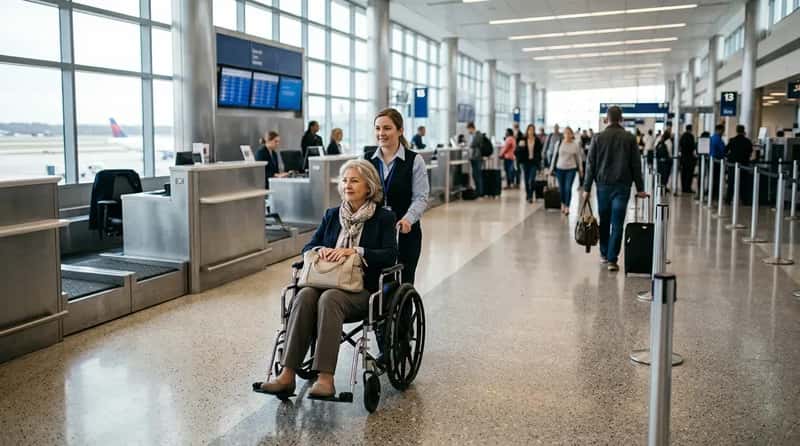
Most people assume wheelchair escort service is reserved for passengers who genuinely can’t walk. That assumption costs older travelers enormous amounts of unnecessary stress. Under the Air Carrier Access Act, any traveler who self-identifies as needing assistance is entitled to a free escort through security, help with carry-ons, expedited checkpoint processing, and priority boarding. This is a federal legal protection – not an optional airline perk – and the carrier must provide it the moment you ask.
You don’t need to look unwell. You don’t need a doctor’s note. Even if you walk just fine on a normal day, requesting a wheelchair escort can unlock what amounts to VIP airport access: met at the curb, escorted past check-in lines, priority TSA screening, guided straight to your gate – all for free. One sentence at the counter is all it takes. Most people never say it.
At a Glance: What the Escort Service Actually Covers
- Curb-to-gate escort at no charge – no documentation required
- Assistance moving from the curb to the departing flight, between gates for connections, and from the arriving flight back to the curb
- Help with carry-on items and assistive devices during transit
- Priority security screening lane access
- One travel companion may accompany you through the entire process
- Federally mandated under 14 CFR Part 382 – the airline cannot refuse a self-identified request
#15 – The Senior Fare That Lives Inside the Reservation System (Not Online)

Booking online feels efficient. It may also be costing travelers over 60 real money on every single trip. Many airlines quietly maintain special fares for older travelers that never appear on any booking page – they live inside reservation systems that only phone agents can access, and they surface when a real human decides the conversation calls for it. A checkout screen will never make that decision for you.
American Airlines offers senior fares for passengers 65 and older on select domestic and international routes, and they are not always visible online – calling directly or using an advanced search is often the only way to find them. United Airlines lists senior fares on certain routes as well, with availability that varies by flight. The phrase that opens the door: “Can you check for a senior fare for a passenger over 65 on this route?” Seven words. Sometimes worth hundreds of dollars.
#14 – A Seat Reassignment Framed as a Comfort Request, Not an Upgrade

Here’s where framing makes all the difference. Walk up to a check-in counter and ask for a “free upgrade” and you’ll get a polite no. Describe a genuine physical need and you’ll often get somewhere completely different. Under sensitive traveler policies, gate agents at Delta, United, and Alaska Airlines can quietly move senior passengers to exit rows, aisle seats, or even premium economy at no charge – if the request is framed as a comfort or mobility need rather than an upgrade ask. The words you use matter enormously.
Try: “I have some difficulty with mobility – is there any chance of a seat closer to the front or with a little more room?” You’re not angling for a perk. You’re describing a real need. Airlines strongly prefer preventing in-flight discomfort over managing a situation at 35,000 feet, and agents know it. Seniors who ask politely and specifically during off-peak check-in often find themselves moved to seats that cost other passengers real money to reserve.
#13 – The ACAA Seating Rights That Are Law, Not Courtesy
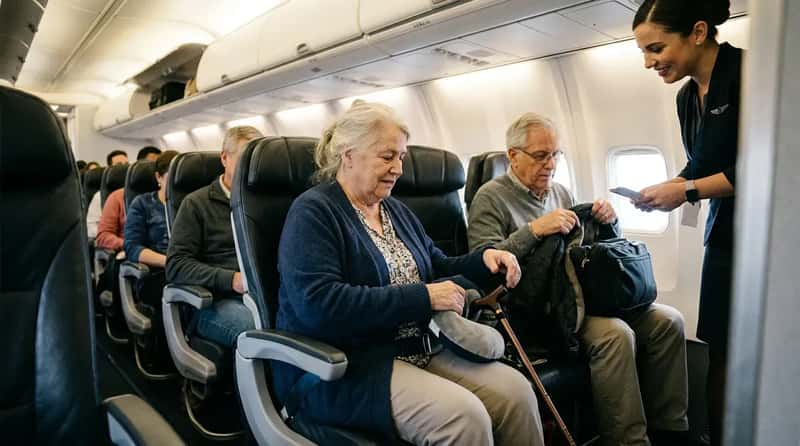
Most senior travelers don’t realize that certain seating accommodations aren’t optional extras that agents can choose to grant or deny. They’re federal requirements. The Air Carrier Access Act mandates that airlines provide specific seating at no extra cost to passengers with qualifying conditions – aisle seats for easier mobility, bulkhead seats for passengers whose legs cannot bend, and adjacent seats for personal care attendants. If you live with arthritis, fused joints, neuropathy, balance issues, or chronic pain, those rights exist whether the agent mentions them or not.
The phrases that activate federal protection: “I require an aisle seat due to a medical condition” or “My leg cannot fully bend – I need a bulkhead seat as a disability accommodation.” No begging. No extra fee. Just claiming what the law already guarantees. For advance seat assignments, making the request at least 24 hours before departure is recommended – but even at the gate, the airline must satisfy the request if at all possible.
Quick Compare: Seating You Can Claim vs. Seating You Have to Pay For
- Free by federal law: Aisle seat (mobility condition), bulkhead seat (immobilized leg or service animal), seat adjacent to a personal care attendant
- Often waived at agent discretion: Seats closer to the front, seats with extra legroom when framed as a comfort need
- Requires purchase or status: Formal first-class or business-class upgrades, preferred seats with no medical basis stated
- Key phrase: “as a disability accommodation” – those four words signal you know your rights under 14 CFR Part 382
#12 – The Medical Equipment Baggage Fee Waiver Most Travelers Never Claim
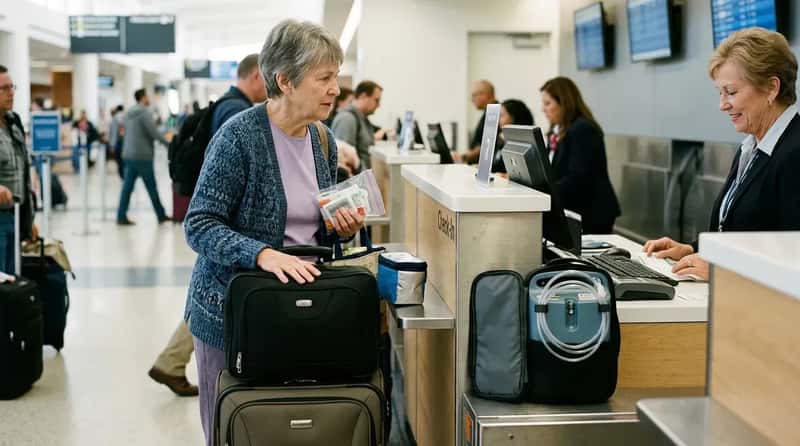
Millions of older Americans travel with CPAPs, portable oxygen concentrators, insulin coolers, and medication bags – and pay baggage fees they were never legally required to pay. Federal law under the Air Carrier Access Act requires airlines to allow medically necessary devices on board without counting them against your luggage allowance. Many travelers have been entitled to this exemption for years without ever knowing it existed.
At the check-in counter, the language is simple: “This item is medically necessary” or “I’m traveling with medical equipment that’s exempt from baggage fees under the Air Carrier Access Act.” CPAP equipment in its own case, for instance, does not count against your carry-on limit under federal amendments to that law. If an agent tries to charge you anyway, don’t back down. Policy can be waived at a supervisor’s discretion. Federal law cannot be ignored.
#11 – The Companion Who Boards Early for Free (Without Asking Twice)
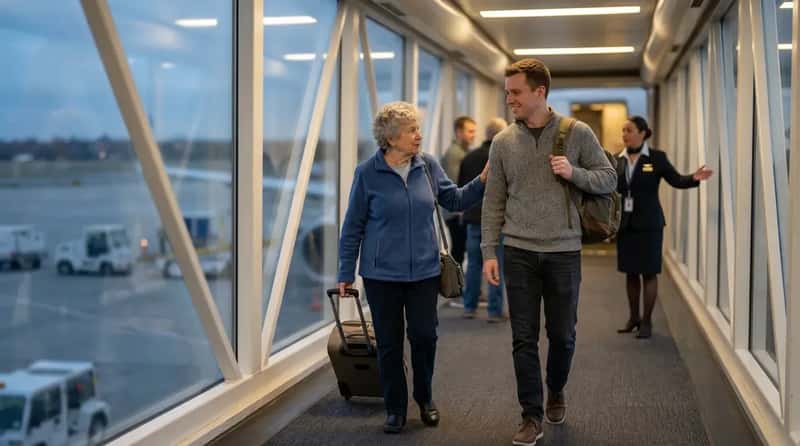
Here’s one most senior travelers hand back without realizing what they’ve been given. When a traveler over 60 qualifies for pre-boarding – which requires no documentation, no doctor’s note, and no formal disability designation – most airlines also allow one travel companion to board alongside them at no charge. Your spouse, adult child, or travel partner boards early, claims overhead bin space, and settles in without the crowd – just because you asked.
Federal regulations under 14 CFR §382.93 require airlines to offer pre-boarding to any passenger who self-identifies at the gate as needing additional time or assistance to board or be seated. The companion perk that comes with it is real, and it’s significant. The key is saying something before your boarding zone is called – not after the crowd has already formed and the agent is focused on scanning 200 boarding passes as fast as possible.
#10 – The Courtesy Lounge Pass During Long Delays

When a flight gets delayed, most passengers collapse into terminal chairs and stare at the departures board. Experienced travelers over 60 do something different. When a delay stretches past an hour, quietly asking the airline’s customer service desk for a courtesy lounge pass – mentioning your age and the extended wait – works far more often than most people expect. You don’t need a first-class ticket. You don’t need elite status. You need to ask calmly and specifically.
Senior travelers with medical considerations can sometimes gain lounge access by explaining their needs at check-in or the service desk. The phrase that opens the door: “I’m a senior traveler with some medical considerations – are there any accommodation options available during this delay?” After a significant disruption, the airline is already in goodwill mode. The worst answer you’ll get is no, and you’re no worse off than you were staring at a gate that isn’t moving.
#9 – The Single Flag at Check-In That Follows You Across Every Connection
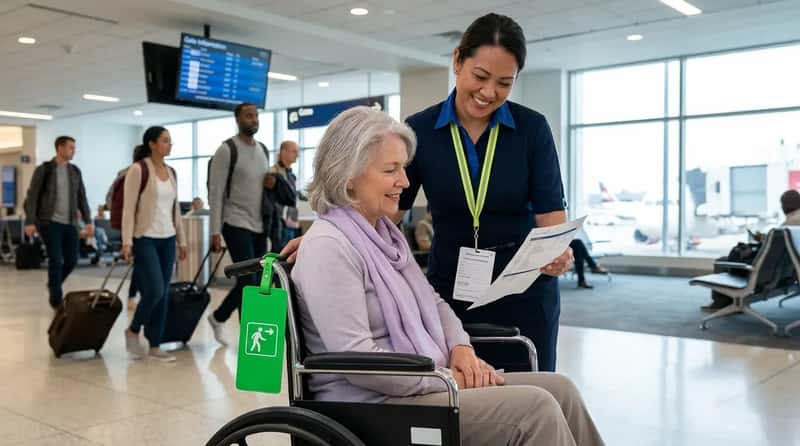
One of the most exhausting parts of senior travel is re-explaining your needs at every gate, every connection, every leg. Most travelers don’t know there’s a way to stop doing that entirely. When a passenger requests assistance at check-in, the airline is required under the Air Carrier Access Act to provide continuity of that help – from the terminal entrance, through security, onto the aircraft, and all the way to any connecting flight. One conversation activates a chain of care across your entire itinerary.
When that flag is in your reservation record, you’re not chasing help at every checkpoint – the help comes to you. The gate agent at your connection isn’t hearing your story for the first time. They already know your needs, your flight, and what you’ll need to board comfortably. That’s a fundamentally different travel experience. And it costs nothing to request it at the counter before you walk away with your boarding pass.
Fast Facts: What the Assistance Flag Actually Does
- A single request at check-in triggers legally required continuity of care across every flight leg
- Connecting airport staff receive your assistance needs in advance – no re-explaining required
- Covers wheelchair escort, cart transport, gate-to-gate guidance, and boarding help
- Airlines cannot leave a passenger unattended in a ground wheelchair for more than 30 minutes under federal rules
- Best practice: request the flag at booking, not the morning of your flight
#8 – The Courtesy Cart Ride Most Seniors Walk Right Past

Those electric golf carts cruising through airport terminals? Most travelers over 60 assume they’re reserved for passengers in wheelchairs or with serious mobility problems. That assumption costs a lot of senior travelers a lot of unnecessary walking – and unnecessary exhaustion before a flight that hasn’t even boarded yet. Courtesy carts run through airports nationwide for any passenger who needs extra help or has a tight connection. The key is simply asking – at the gate, at the service desk, or at the terminal entrance when you arrive.
A senior’s travel companion gets to ride along on that cart even if they aren’t the one requesting assistance – and both typically get early boarding as well. That means you and your travel partner arrive at the gate together, rested, without having sprinted through a terminal the size of a small city. For complex layovers or terminal changes, many airlines can also arrange gate-to-gate assistance specifically for older travelers navigating a large, unfamiliar airport under time pressure.
#7 – The TSA Cares Hotline That Gets a Supervisor Briefed Before You Arrive
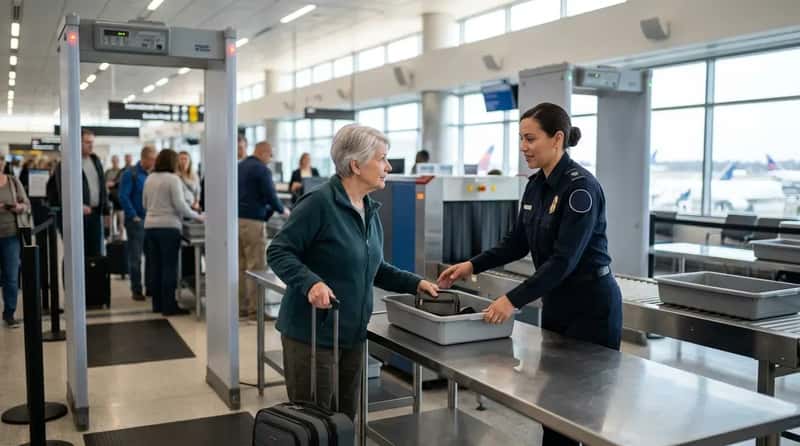
Most travelers have never heard of TSA Cares, and that’s exactly the problem. TSA Cares is a free federal assistance program that assigns a dedicated Passenger Support Specialist to meet you at the checkpoint – someone who guides you through screening, helps organize your items, answers questions in advance, and makes the whole experience dramatically less stressful. The travelers who know about it move through security in a completely different way than those who don’t.
Call TSA Cares at (855) 787-2227 at least 72 hours before your flight. You can flag your situation, ask about specific procedures for medical devices or implants, and arrange in-person support in advance. Same terminal, same lines, completely different experience. The only thing separating those two groups of travelers is knowing this option exists. One phone call before your trip and the checkpoint stops being the part of the airport you dread most.
Worth Knowing: TSA Rules That Already Favor Travelers 75+
- Passengers 75 and older are eligible for expedited screening – shoes and light jackets can stay on
- Those unable to stand may remain seated in a mobility device while officers conduct checks
- TSA Cares Passenger Support Specialists have specialized training for passengers with disabilities and medical conditions
- You can also request a PSS on the spot at any checkpoint by asking a TSA officer or supervisor – no advance call required
- Medically necessary liquids over 3.4 oz are permitted in carry-ons when declared at the checkpoint
- TSA notification cards (free, downloadable at tsa.gov) let you privately communicate conditions before screening begins
#6 – The Compassionate Rebooking Option on a “Non-Refundable” Ticket
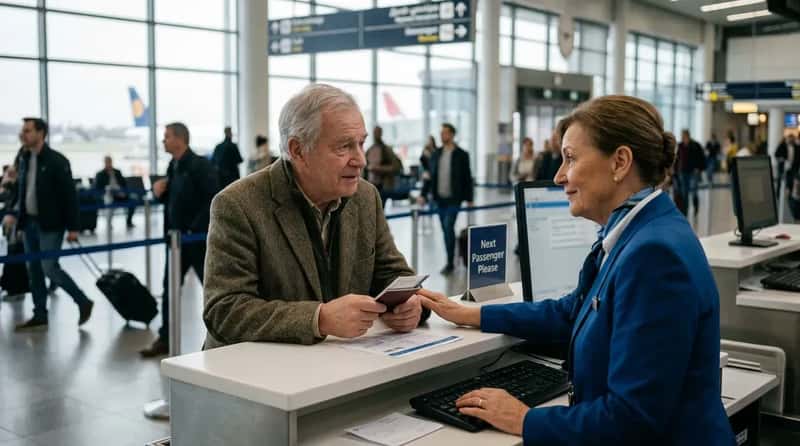
The words “non-refundable” feel final. They aren’t always. Airlines maintain unpublished policies that allow travelers to rebook or cancel flights without penalty due to health concerns, family emergencies, or extenuating circumstances – and these policies are almost never advertised. The move is to call, calmly explain your situation, mention your age, and ask specifically. It works far more often than most people expect, especially when the request is made politely and directly rather than through a chatbot or automated system.
Medical emergencies, a death in the family, or a sudden health development can qualify you for exceptions – particularly when you have documentation and when you ask during off-peak hours when the representative isn’t handling twelve calls at once. A useful opener: “I understand my booking is non-refundable, but I’m hoping you can help me – [briefly explain]. Is there any flexibility available, such as a travel credit or a rebooking option?” You’re not demanding. You’re giving them a chance to do right by you. They often take it.
#5 – The Checked-Bag Waiver for Mobility Aids That Most Agents Don’t Volunteer
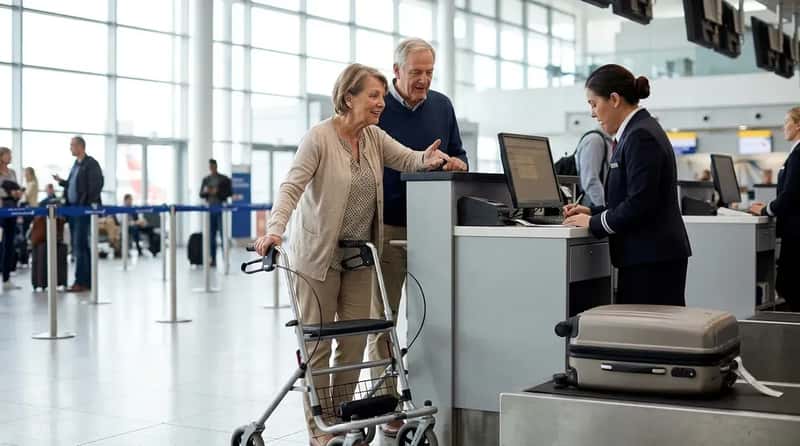
Wheelchairs, walkers, rollators, and scooters don’t just get checked – they get priority. And they don’t cost a cent. Airlines are legally required to allow assistive devices to be surrendered and returned as close as possible to the boarding door of the aircraft, and those devices have priority over other luggage in the baggage compartment. If you’re traveling with a wheelchair or mobility aid, it is checked for free and does not count against your baggage allowance. Most agents will not tell you this unprompted.
When a traveler over 60 needs to check an additional bag because carrying it on creates a genuine mobility or safety concern, agents have documented discretion to absorb that fee as well. Some airlines also extend senior bag allowances on long-haul international routes – and simply asking at the counter whether a senior baggage allowance exists can be enough to open that conversation. The travelers who get these waivers aren’t the ones with the most expensive tickets. They’re the ones who asked.
#4 – The “Courtesy Boarding” Phrase That United, Delta, and Southwest All Recognize

There’s a specific phrase experienced travelers over 60 have quietly added to their airport vocabulary, and it doesn’t appear on any ticket, boarding pass, or airline website. “Courtesy boarding” is a real practice at multiple major U.S. carriers. United has a formal courtesy boarding option that includes senior travelers upon request. Delta and Southwest follow similar practices. It’s entirely separate from disability-based pre-boarding and entirely separate from elite frequent-flyer status. It’s discretionary hospitality, and it’s activated simply by asking before the crowd forms at the gate.
Walking up to the gate agent calmly and saying “I’d like to request pre-boarding assistance due to mobility needs” means you board before the main rush – no overhead bin scramble, no being jostled in the aisle, no rushing. Agents hear hundreds of requests a day, and the ones phrased clearly and politely almost always get a yes. And the passenger who boards early, settles in quietly, and treats the crew warmly is exactly the kind of traveler flight attendants remember when small opportunities to help come up later in the flight.
#3 – The Complaints Resolution Official Most Passengers Don’t Know Exists
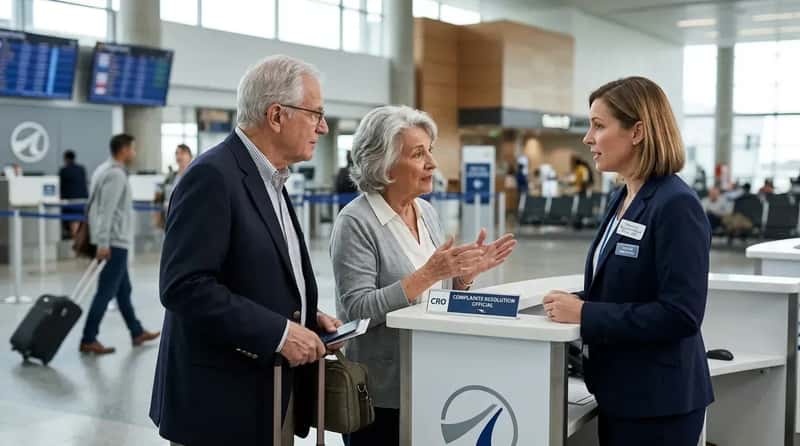
When something goes wrong at the airport – a denied accommodation, a seat that should have been reassigned, a baggage fee that should have been waived – most travelers either escalate at the counter until everyone is frustrated or walk away feeling powerless. There’s a third option almost nobody uses, and it has real teeth. You can ask to speak with a Complaints Resolution Official, or CRO. This is not a supervisor in the general sense. It’s a federally mandated role with authority a standard gate agent simply does not have.
Every U.S. carrier is legally required to have a CRO available at each airport it serves during all hours of operation – in person or by phone at no cost to you. The CRO has the authority to overrule the decision of any other airline personnel except the pilot-in-command on safety matters. Simply saying “I’d like to speak with your Complaints Resolution Official” signals clearly that you know your rights under the Air Carrier Access Act – and that knowledge alone often resolves the situation before the CRO even arrives. You’re not making a scene. You’re using the system the way it was designed to be used.
#2 – The Hidden Disabilities Card That Handles What’s Hard to Say Out Loud
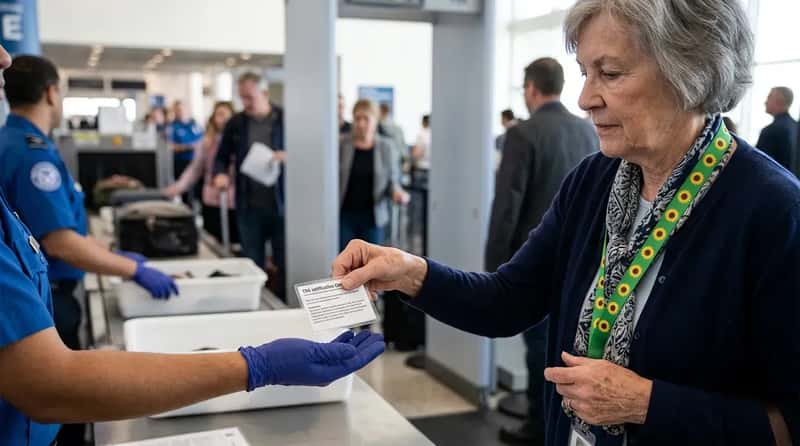
For travelers managing conditions they’d rather not explain loudly at a busy checkpoint – cognitive changes, anxiety, hearing loss, chronic pain, memory difficulties – there’s a quiet tool most people have never heard of. The TSA notification card is a downloadable PDF available free on the TSA website that lets you privately inform officers about medical devices, implants, or conditions before screening begins. No enrollment. No approval process. No fee. You print it, fill it out, and hand it silently to the officer.
There’s also the Sunflower Lanyard – a globally recognized symbol for hidden disabilities that discreetly signals to airport staff that you may need more time, clearer instructions, or a quieter interaction. A caregiver can hand either tool to an officer on behalf of the traveler, which means an older parent doesn’t have to overhear a clinical explanation of their own condition delivered to a stranger in a crowded security line. Fill out the TSA card before your next trip. It takes five minutes and can prevent an extraordinarily difficult moment at the checkpoint.
#1 – Asking the Check-In Agent to Flag Your Entire Itinerary Before You Leave the Counter
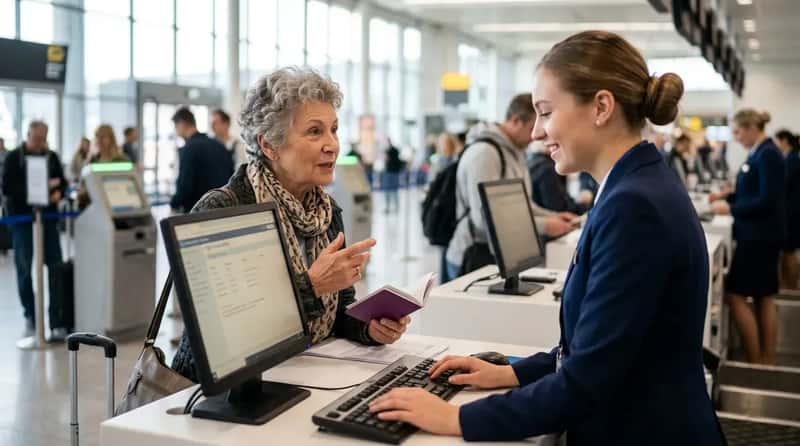
Every item on this list becomes more powerful when it’s locked into your reservation before your travel day even begins. The single most underused move for travelers over 60 is also the simplest: ask the check-in agent – at booking, at the counter, or on the phone – to add a special assistance note that travels with your record through every leg of your trip. Federal regulations require airlines to provide continuity of assistance from the terminal entrance all the way through connecting flights. One conversation activates a chain of care across your entire itinerary. Most travelers never start that conversation.
Seasoned travelers over 60 have figured out that locking in accommodations at the time of booking – not the morning of the flight, not frantically at the gate – is what actually changes the experience. Most airlines allow passengers to add mobility or special assistance requests during the booking process itself, under “accessibility needs” or “special services.” When that’s in place, a crew member is assigned before you arrive at the curb. Your needs are already known. The help comes to you. That’s the difference between hoping for a smooth travel day and engineering one before you leave the house.
Why It Stands Out: The 5 Moves That Change Everything
- Flag your itinerary at booking – one note covers every leg, every connection, every handoff
- Call TSA Cares at (855) 787-2227 at least 72 hours out – a Passenger Support Specialist will be waiting
- Name your rights by law – phrases like “as a disability accommodation” and “Air Carrier Access Act” move conversations fast
- Ask for the CRO if any agent says no to something federal law guarantees – they have authority to overrule staff on the spot
- Arrive with the TSA notification card already filled out – hand it silently, skip the explanation in a crowded line
The check-in counter holds more power than most travelers over 60 ever realize. Escorts, waived fees, reassigned seats, compassionate rebookings, courtesy boarding, lounge access during delays – none of it gets announced over the intercom, and almost none of it requires documentation. What it does require is knowing it exists and asking calmly, specifically, and early. The gap between a stressful airport day and a smooth one is almost never about luck. It’s about vocabulary. If you’ve discovered a move that’s worked for you, drop it in the comments – someone on their next trip will be glad you did.