Most people think a yacht charter is a blank slate every time – new guests, fresh start, no memory. Deckhands know better, and the tell begins the second crosses the passerelle.
Experienced crew have logged hundreds of embarkations, and they’ve learned to clock the habits that separate someone who’s done this before from someone just pretending. Here’s what they actually notice – and the list might make you rethink your last trip.
#16 – The Luggage That Boards Before They Do

The luggage alone is one of the fastest tells a deckhand uses to size up new arrivals. It signals whether the guest has done the groundwork, or whether the week ahead means constant hand-holding.
Soft-sided duffel bags collapse flat and slide under most berths, but hard-shell suitcases often jam in narrow interior doorways and lockers. Cabin storage on most yachts is tight, so lighter packing always beats formal packing.
A returning guest rolls up with exactly what fits – no overstuffed trolleys, no matching luggage sets clearly packed for a hotel. First-timers treat the cabin like a walk-in wardrobe; returning guests treat it like a well-organized kit bag.
Fast Facts
- Soft duffels stow flat under most berths; hard-shell cases often don’t fit at all
- Crew typically stow bags before the welcome tour even begins
- Overpacking is one of the most common rookie giveaways crew mention
- Interior doorways and lockers on most yachts are built for compact luggage
Crew usually stow the bags before the welcome tour even starts, so the first impression is made by whoever isn’t even there yet. What happens the moment those bags disappear? That’s next.
#15 – How They Walk Across the Passerelle

The passerelle – that narrow gangway connecting dock to deck – is the first physical test, and returning guests pass it without even thinking about it.
A first-timer grips the rail, glances down at the water, and shuffles across sideways. A returning guest walks it like a hallway, already scanning for their favorite sun spot.
That confident stride tells the deckhand on watch this person has boarded a moving vessel before, probably many times. It’s a small thing, but it quietly reshapes how much attention crew redirect toward guests who actually need it.
The next sign is just as instant – and it happens the moment shoes hit the deck.
#14 – Shoes Off Without Being Told

Most charter yachts run a barefoot policy, since heels and hard soles chew up teak decking fast. A returning guest doesn’t wait for the reminder.
They step aboard, slip their shoes off, and drop them in the basket in one fluid motion. First-timers routinely wander halfway up the side deck before a crew member has to awkwardly stop them.
That single moment costs everyone a beat of discomfort. For deckhands who maintain the exterior, this one habit says everything about how the rest of the week will go.
The pattern continues inside, in a way most guests never even consider.
#13 – They Know Which Areas Are Off-Limits

Guests get the run of most of the yacht, but crew have their own space to sleep and work – and the galley, where the chef lives mid-service, is part of that space. A returning guest never drifts toward crew quarters out of curiosity.
They’ve internalized the invisible boundary and stay on their side of it without making a performance of it. First-timers sometimes wander into the galley just to “say hi to the chef” – well-intentioned, but a genuine disruption mid-service.
Deckhands notice who respects these unspoken zones immediately. It tells them whether the charter needs constant low-level boundary management, or none at all.
What comes next plays out before the anchor even drops.
#12 – How They Handle the Safety Briefing

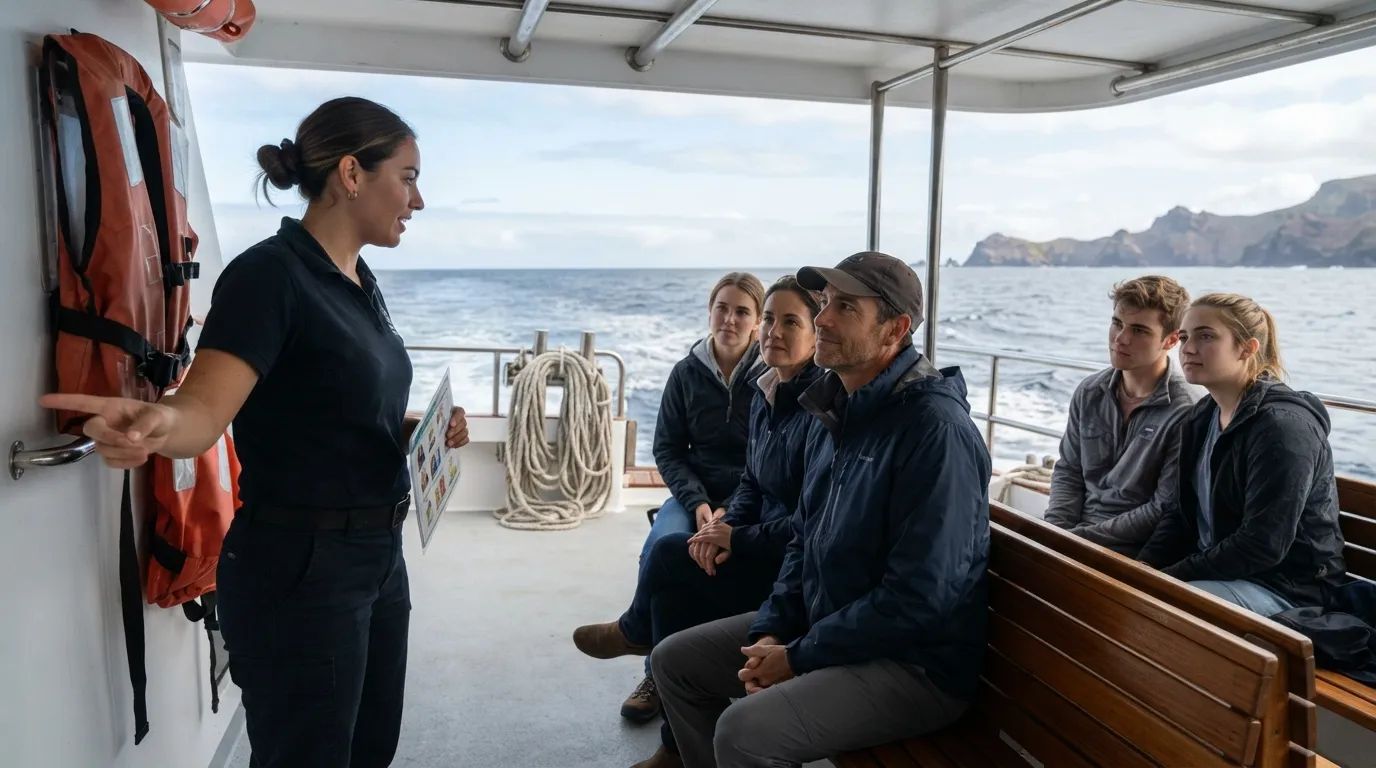
At the start of the trip, crew brief guests on safety protocols, and paying attention matters more than most people realize. A returning guest listens with the focused nod of someone cross-referencing what they already know.
They ask one or two precise questions, and they never ask where the bathroom is during a muster drill. First-timers either glaze over within 30 seconds or pepper the crew with anxious what-if questions.
Quick Compare
- First-timer: tunes out fast, or asks nervous what-if questions
- Returning guest: listens closely, asks one sharp clarifying question
- First-timer: asks logistics questions mid-drill
- Returning guest: already knows where the life jackets and exits are
Neither response helps. The returning guest’s calm version gives crew confidence they won’t need babysitting on the water toys.
That instinct shows up even more clearly in the very next sign.
#11 – Their Comfort Around the Tenders and Toys

Deckhands run every outside job on board, including the tenders and toys, so this is where they spend the most one-on-one time with guests. A returning guest boards a tender without a production – they sit, hold on, and let the deckhand work.
They also know not to lean over the side of a RIB at speed. The water toys are the biggest tell of all.
First-timers treat a jet ski handover like it needs a ten-minute lesson, every single time. Returning guests put on the life jacket, hear the one-sentence reminder, and go.
Deckhands recalibrate their whole workload based on this alone. The next sign is quieter, but crew rank it even higher.
#10 – They Read Crew Body Language

Experienced guests glance at the horizon, notice the wind shift, and quietly adjust their own plans instead of turning it into group drama. They’ve learned the captain already knows about the 15-knot forecast, and asking twice won’t change it.
A deckhand stowing extra lines at anchor? A returning guest clocks it and quietly moves their things inside – nobody has to say a word.
This silent situational awareness is the single biggest dividing line between a guest who makes a charter easier and one who makes it harder. It can’t be faked on a first visit – it’s earned over time, and crew clock it within hours.
What follows is a behavior that happens at the dinner table, not on deck.
#9 – How They Communicate Preferences
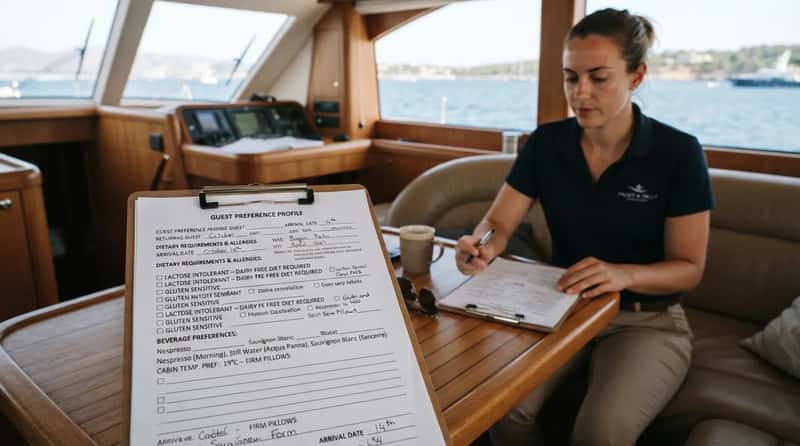
Filling out the preference form in advance goes a long way toward a better trip – the service, the food, the entire onboard rhythm depends on it. Returning guests submit detailed preference sheets before they even board, because they know it isn’t a formality.
First-timers fill in the form with two words – “not fussy” – then spend the first lunch explaining they’re actually lactose intolerant. Returning guests list it in writing, in advance, and never mention it again.
Worth Knowing
- Preference sheets typically cover allergies, drink orders, wake times, and cabin temperature
- Submitting early lets the chef provision correctly before the boat even leaves the dock
- Verbal corrections mid-trip force last-minute galley scrambles
- Detailed sheets are one of the clearest signs a guest has chartered before
It’s a small discipline that saves hours of kitchen confusion. The next habit is the one most guests think doesn’t matter at all.
#8 – They Give the Crew Space to Work

Giving crew a chance to make up beds, do laundry, and service systems while guests explore ashore is one of the most practical courtesies on a charter. Returning guests find reasons to be off the boat during turnaround windows.
They understand a cabin doesn’t clean itself with three people still in it, and hovering while crew scrub teak is uncomfortable for everyone. The most experienced repeat guests quietly disappear for exactly the right amount of time and come back to a spotless boat.
It’s not accidental – it’s learned consideration, and deckhands remember exactly who does it. That memory shapes how much extra care goes into the next setup.
The following sign plays out at the end of every single day.
#7 – How They Handle Unplanned Shore Excursions

Coming back with a dozen extra guests and expecting the chef to whip up a three-course meal at midnight puts crew in an impossible spot. Clearing extra guests with the captain first means no embarrassing shortage of food or drink.
A returning guest texts ahead. They don’t show up at midnight with eight people from the beach bar expecting lobster and clean towels – even a 30-minute heads-up changes everything in the galley.
Deckhands remember exactly which guests do this, because it determines how brutal the night watch becomes. The next tell involves something as simple as a thank you.
#6 – Genuine vs. Performative Gratitude

A charter is made wonderful by the hard work of the crew, from captain to deckhand, and a sincere thank-you goes further than people realize. Returning guests say it like they mean it – real eye contact, a specific detail, not a distracted “thanks” tossed at the air.
“The swim platform setup was perfect today” lands completely differently than a mumbled nod. First-timers often say nothing all week, then over-compensate with theatrical praise at disembarkation.
Deckhands can tell the difference instantly. Crew are working 16-hour days on moving water – real appreciation registers in real time, not just at tip time.
What happens at tip time, though, is its own tell entirely.
#5 – The Tip Envelope, Handled Correctly

It’s customary to tip between 5–15 percent of the charter’s value, but the how matters as much as the how much. On the last morning, the principal sits down privately with the captain and passes along the crew tip – never to individual crew members, since that can cause real tension.
A returning guest never makes the tip a public moment. No fanfare, no envelope passed hand-to-hand in front of the whole crew – it stays between the guest and the captain, exactly where it belongs.
At a Glance
- Typical charter tip range: 5-15% of the total charter cost
- Tip is handed to the captain in one lump sum, not split guest-to-crew
- Captain divides the tip among crew based on role and hours worked
- Discretion during the handoff signals the guest understands the chain of command
Deckhands notice discretion immediately. It tells them the guest actually understands the hierarchy on board.
The next sign is the one that surprises people most.
#4 – They Know the Captain’s Word Is Final

On navigation and safety, the captain’s word is final, full stop – and returning guests accept this without debate. A first-timer will argue about anchorage choices or demand a course change because of something they read on a travel blog.
A returning guest understands the captain carries professional certification, local knowledge, and full legal responsibility for every soul aboard. The most experienced repeat guests don’t just accept the captain’s decisions – they back them publicly in front of other guests, which smooths out the whole dynamic.
Deckhands notice who respects the chain of command. It tells them whether the week runs like clockwork or like a negotiation.
The next two behaviors are the ones that seal a guest’s reputation for good.
#3 – They Report Breakages Immediately

Crew should hear about any spillage or breakage the second it happens – it sounds obvious, but it’s actually rare. Most guests hide a broken wine glass, burying it under a towel or slipping it overboard rather than telling anyone.
A returning guest walks straight to the nearest crew member and says what happened, matter-of-factly, no drama. That honesty is worth more than the glass.
It means the deckhand can clean it safely before someone walks through it barefoot at 2 a.m., and it means the crew trusts that guest for the rest of the trip. Nothing erodes crew confidence faster than discovering damage was hidden.
The final two signs define a truly memorable returning guest.
#2 – They Leave On Time and Leave the Boat Right

On the last day, having light, soft bags ready by departure time matters more than guests think – lingering gets heavily frowned upon. Crew need to overhaul the entire boat: sheets, provisioning, refueling, sometimes a full repositioning to another port.
A returning guest respects the turnaround. They’re packed and off the boat within the window, no “just five more minutes” on the stern with a coffee.
They also leave the cabin in reasonable shape. Not spotless – that’s the crew’s job – but towels stacked, garbage binned, personal items actually gone.
And then there’s the one signal deckhands say, above everything else, separates the truly returning guest from the rest.
#1 – They Remember the Crew’s Names

This is the one. No technique, no charter experience, no amount of yachting knowledge substitutes for this single act.
A returning guest knows the deckhand’s name – not just the captain’s, not just the stewardess who poured their cocktails. The deckhand who washed down the tender at midnight and set up the paddleboards at 7 a.m. – that person.
Using it correctly, without glancing at a name tag, is the one thing no first-timer can fake. Deckhands work invisibly by design – polished, quiet, always a step ahead.
When a guest actually sees them and says their name, it changes the entire dynamic of the trip. Every experienced crew member ever asked about returning guests puts this at the top of the list, every single time.
Deckhands are trained observers who’ve processed hundreds of embarkations, and they read a returning guest within minutes – sometimes seconds. None of these signs are about luxury or wealth; they’re about respect, self-awareness, and situational intelligence.
Soft bags, barefoot instinct, silent gratitude, remembered names – none of it costs a cent. The guests who score highest on this invisible checklist tend to get the best charters, not because crew play favorites, but because trust flows naturally once it’s earned on both sides.
Bonus: The Insider Move That Guarantees Your Best Charter Yet

Here’s what almost nobody does, even after a great trip: put the praise in writing, to the right person, within 48 hours of stepping off the boat.
A quick email to the charter broker or yacht management company that names specific crew members and specific moments does more for your next trip than any amount of extra tipping.
- Email the broker (not just the captain) within two days, while details are fresh
- Name each crew member individually and describe one specific thing they did well
- Explicitly request that same captain and crew for your next booking dates
- Ask the broker to flag your file as a repeat client when you rebook
Written compliments get forwarded to the management company and often become part of a crew member’s file, which matters for their next contract and referrals.
Naming the same crew when you rebook isn’t just sentimental – brokers regularly try to accommodate specific crew requests from returning clients, and a guest with a documented good history tends to get first pick of dates, quiet upgrades in provisioning, and a crew that already knows exactly how you like your coffee before you’ve even boarded.