Most of these 25 mistakes look harmless in your bedroom and fall apart at the checkpoint, the gate, or the cargo hold. Some cost you a bottle of shampoo, and a few have no allowed place on the plane at all.
One mistake near the top can happen to a bag you packed perfectly, and it involves a battery. But the trouble starts with something as ordinary as a bottle of shampoo.
#25 – A Full-Size Shampoo Bottle in Your Carry-On
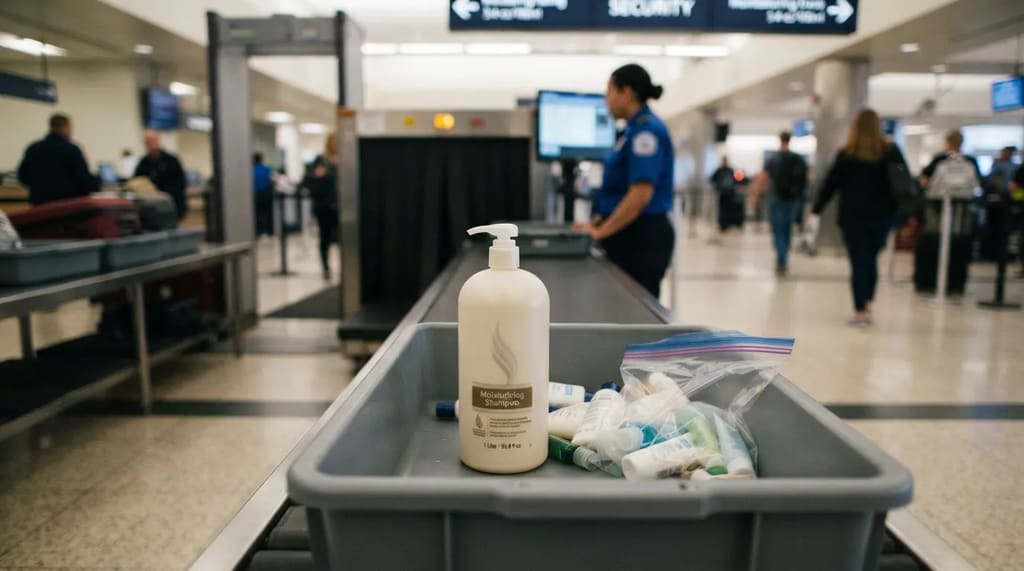
The TSA lets each passenger carry liquids, aerosols, gels, creams and pastes through in a quart-size bag, about 7 by 8 inches. Each item has to be 3.4 ounces (100 milliliters) or less.
A full-size bottle fails that test at the belt. Larger liquids belong in checked baggage.
When a bottle is over the limit, you can surrender it, walk it back to a checked bag if you still have time, or leave the line to mail or store it where the airport offers that service. None of those options is fun once boarding has started.
And the size rule covers more than bathroom products, because some foods count as liquids too.
#24 – Honey, Salsa and Peanut Butter at Security
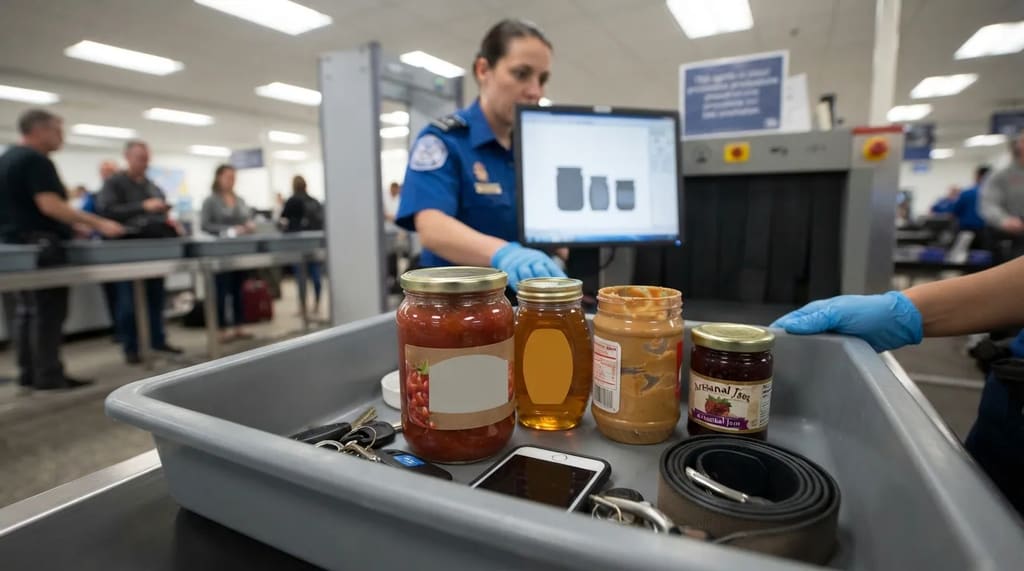
Here’s the twist: the liquids rule reaches well past shampoo. NerdWallet’s guide lists salsa, honey and peanut butter among the consumable goods it covers.
A jar from a farm stand faces the same limit as a tube of toothpaste. Because the checkpoint goes by container size, a half-eaten jar is still a large jar.
If the jar matters to you, it belongs in the checked suitcase, wrapped well in clothing.
Fast Facts
- Every container in your carry-on must be 3.4 ounces (100 milliliters) or less.
- All of them share one clear quart-size bag per traveler.
- Salsa, honey and peanut butter are treated like any other liquid or paste.
- Anything bigger rides in checked baggage.
Even if everything passes the size test, it still has to fit in a single bag.
#23 – A Second Quart Bag for the Overflow
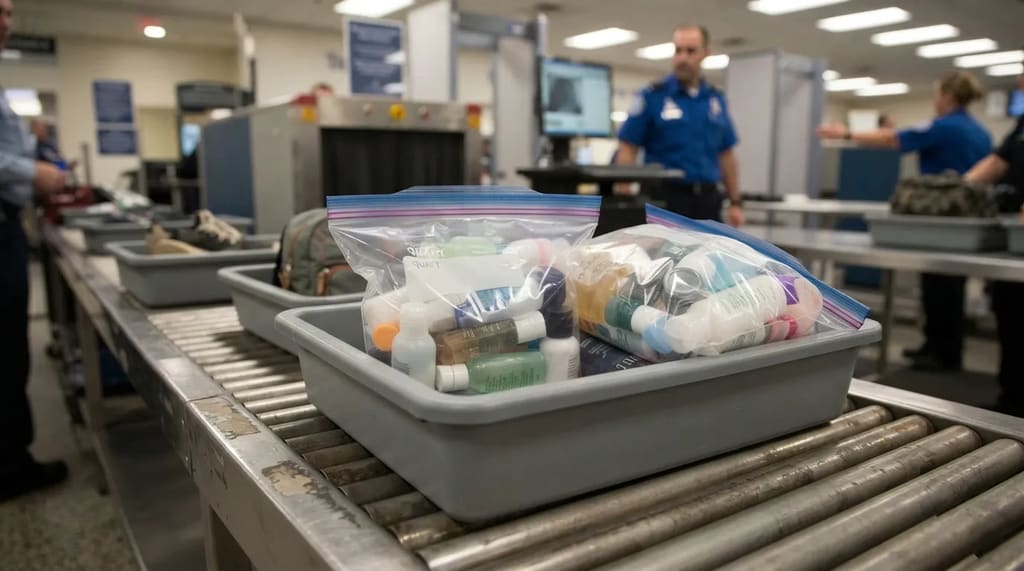
Each traveler gets one clear quart-size bag, children included. A second bag does not stretch the allowance.
Anything that won’t fit in the first one runs into the same surrender, return or mail choices as the oversized shampoo.
There is no cap on the number of containers, as long as each is small enough and they all fit in the bag. Space is the real limit, so choose which small bottles earn a place.
#22 – Counting on PreCheck to Relax the Limit
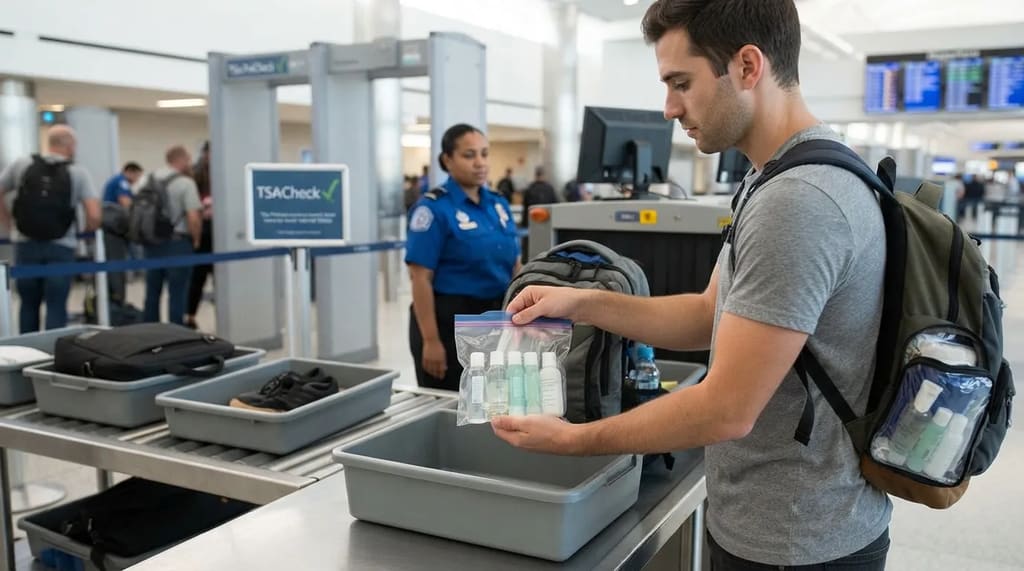
PreCheck usually lets you leave the quart bag in your carry-on, but every container still has to be 3.4 ounces or less. The newer CT scanner lanes work the same way: the bag can stay packed, and the size limit stays put.
Packing for the lane you hope to get is a poor bet. The limit is the same in every lane, and PreCheck only changes whether the bag comes out.
That’s not worth risking a bottle over.
Medicine is the main exception to the size limit, though it comes with a condition.
#21 – Squeezing Your Medicine Into Travel Bottles
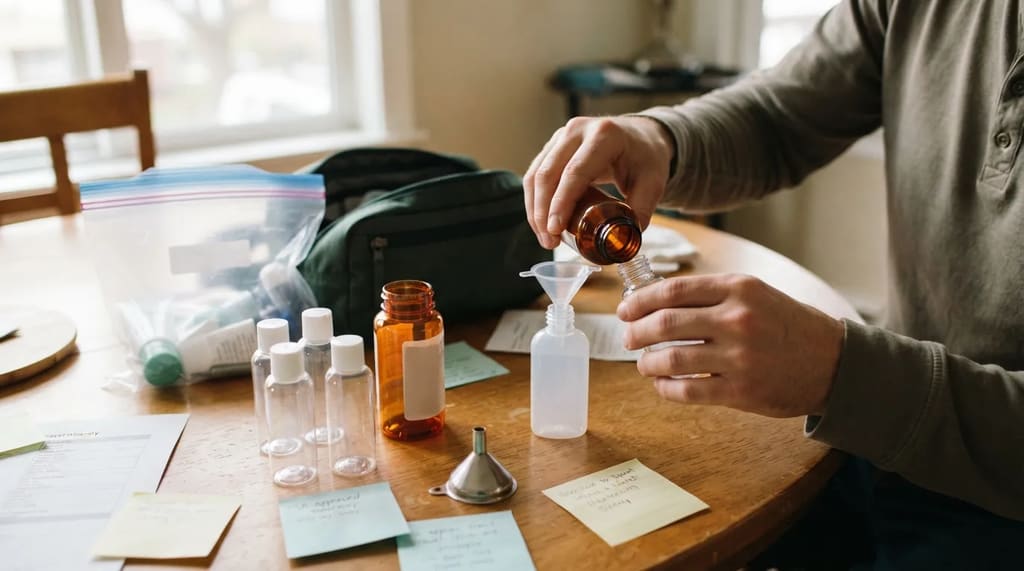
Medically necessary liquids, including prescription and over-the-counter medicine, may exceed 3.4 ounces and do not need to fit in the quart bag. You must declare them, though.1
Pouring liquid medicine into tiny bottles solves a problem the rule does not create.
Formula, breast milk and juice for infants and toddlers are also allowed in quantities over 3.4 ounces. Keep all of it in an outer pocket so you can set it apart at the start of screening.
#20 – Checked Bags Loaded With Full-Size Bottles
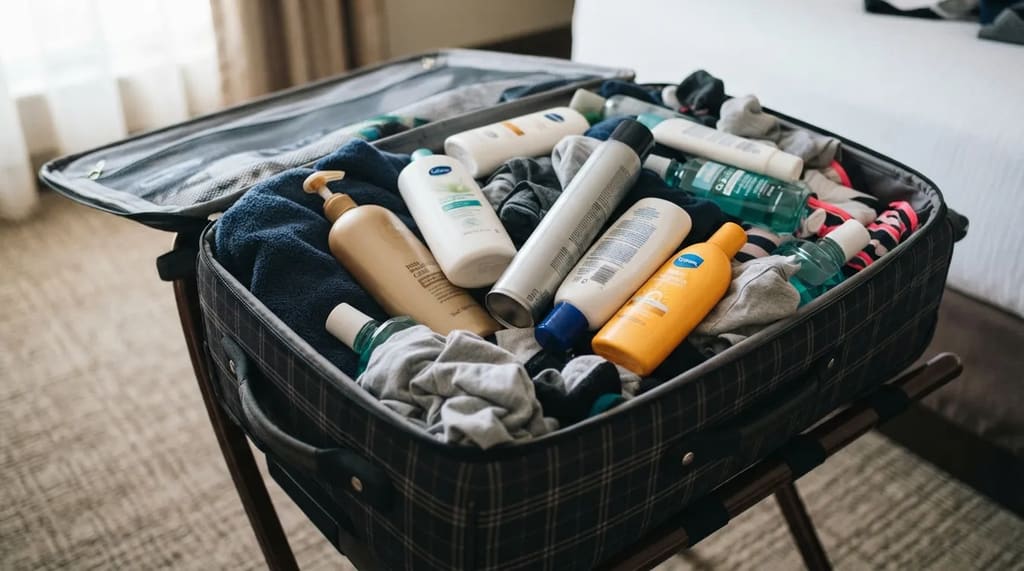
A checked bag escapes the 3.4-ounce rule, but not every limit. Toiletry-type liquids are capped at about 2 liters (68 ounces) in total per passenger.2
Hauling a week’s worth of full-size bottles is rarely worth the weight, and the shampoo that failed at the checkpoint earlier is a good example. Small refillable containers hold what you’ll use, and a drugstore near your destination covers the rest.
Aerosols carry their own conditions in either bag, starting with the nozzle.
#19 – Hairspray With the Nozzle Left Uncapped
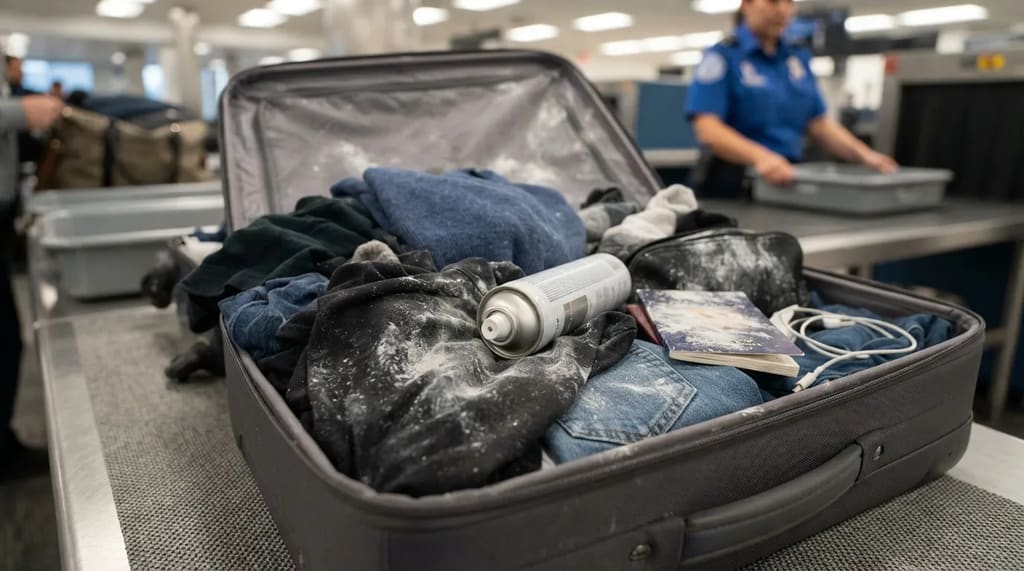
Hair spray, perfume, shaving cream and inhalers are allowed in checked and carry-on bags with quantity limits. They must be protected by caps or other suitable means to prevent accidental release.
The FAA’s list adds deodorant and sunscreen to the toiletry aerosols that are allowed.
A loose cap matters because a button pressed by a book or a shoe can empty the can into your clothes. In the carry-on, the same cans also have to meet the 3.4-ounce limit.
#18 – Cooking Spray and WD-40 in the Suitcase
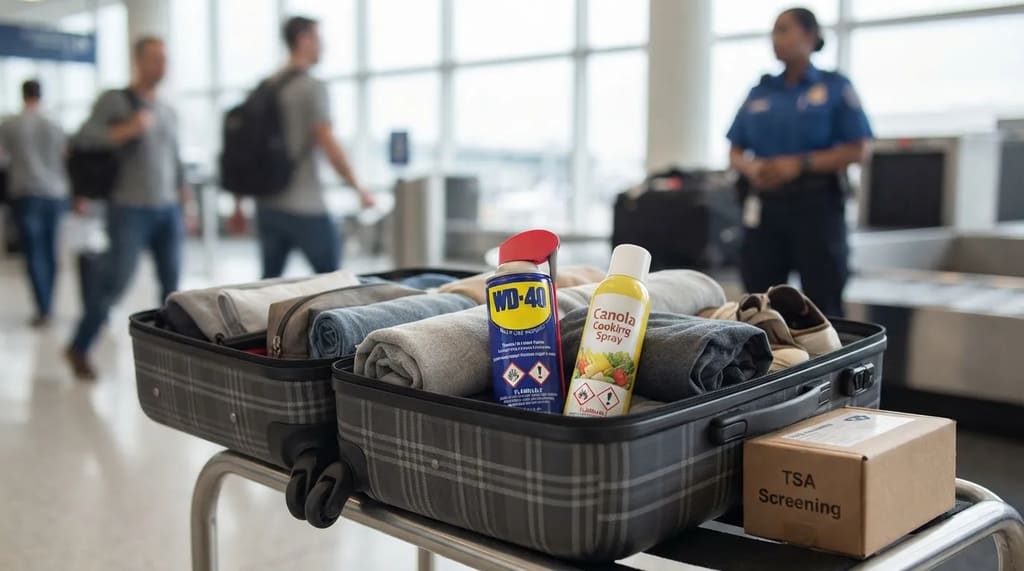
Hairspray is allowed, but cooking spray is not. Flammable aerosols that do not qualify as a medicinal or toiletry article are forbidden in carry-on and checked baggage.2
That covers WD-40, spray paint, spray starch and cooking spray. It looks inconsistent until you see that the rule sorts cans by category.
If you’re heading to a rental house or a cabin, buying these at your destination is simpler than arguing the category at the counter.
Paint itself is on a similar list, along with several household cleaners.
#17 – Paint, Drain Cleaner and Strong Glue
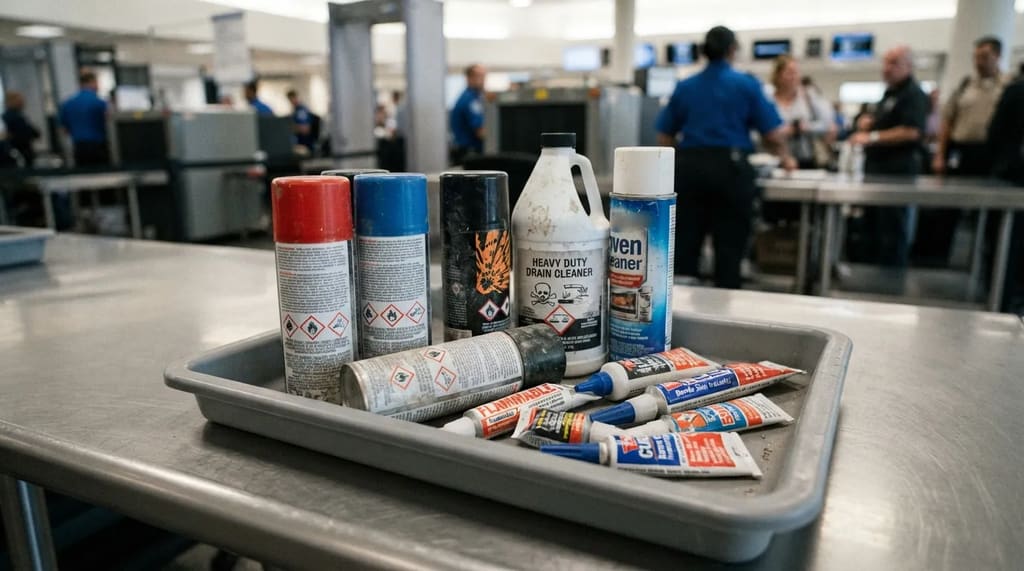
Many paints and paint-related solvents are flammable liquids and are not allowed in carry-on or checked baggage. The FAA also names certain drain cleaners and oven cleaners among cleaning products not allowed in either bag.
Glue is easy to overlook. Some super glues and other adhesives are flammable and not allowed in carry-on or checked baggage.
For a repair trip, buy supplies after you arrive, and read the label if you’re unsure.
#16 – Canned Air for Cleaning Your Electronics
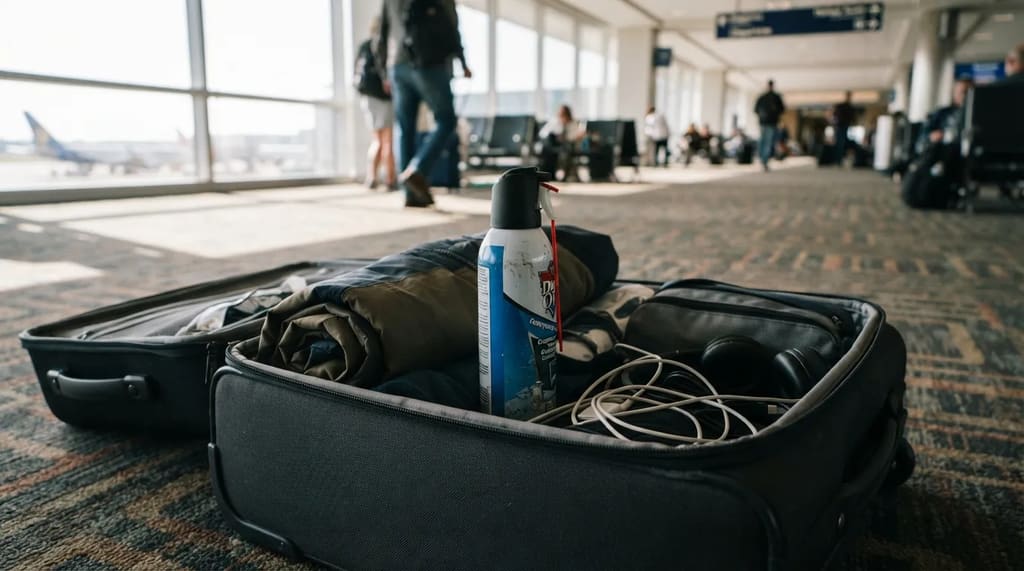
The FAA draws a line between aerosols and plain compressed gas. Canisters in which the compressed gas is the product, such as canned oxygen, refrigerant gases or compressed air for cleaning electronics, do not qualify as aerosols and cannot use the exception.
Electronic cleaner sold as a spray is a different case. Nonflammable, non-toiletry items like electronic cleaners and whipped cream are allowed in both carry-on and checked bags.
The label tells you which kind of can you are holding.
Sprays sold for protection need their own look, particularly the ones sold at outdoor stores.
#15 – Bear Spray Tucked Beside the Hiking Boots
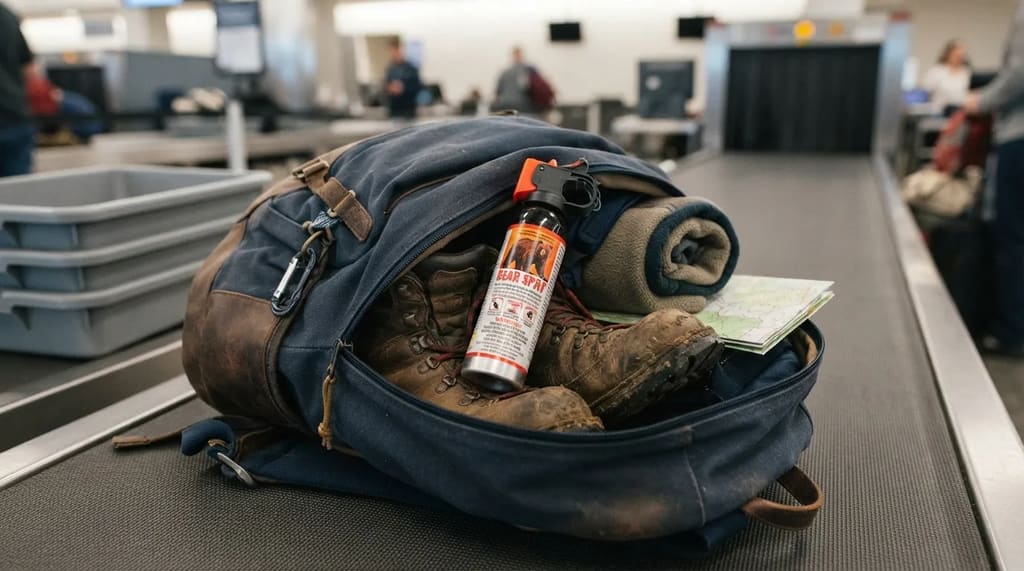
Bear spray and animal repellent are not allowed in carry-on or checked bags. If a hiking trip is on the calendar, plan to buy it after you land.
Pepper spray is handled differently. The FAA allows one small self-defense spray of 4 ounces in checked baggage only, and not outside the United States.
Sprays are not the only products sold at outfitters and gift shops that are banned from the plane.
#14 – Souvenir Sparklers and Spare Ammunition
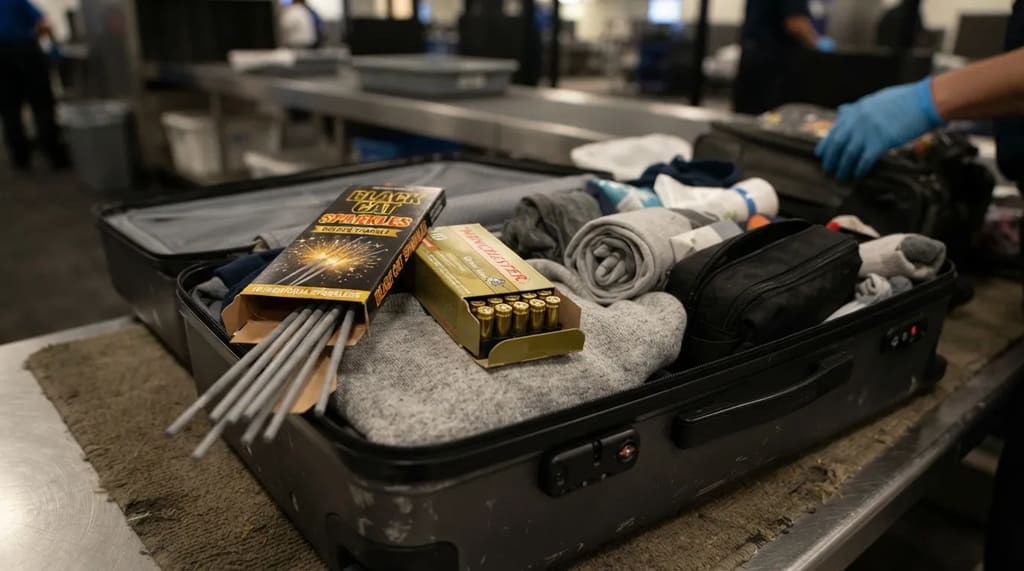
Explosives, fireworks and ammunition are on the FAA’s list of items to leave out. That includes firecrackers, poppers, sparklers, bottle rockets and flares.3
A box of sparklers from a roadside stand has no place in either bag.
Ammunition is more complicated. It is not allowed in carry-on bags and has limitations in checked bags, so ask the airline and TSA before packing any.
#13 – Strike-Anywhere Matches by the Boxful
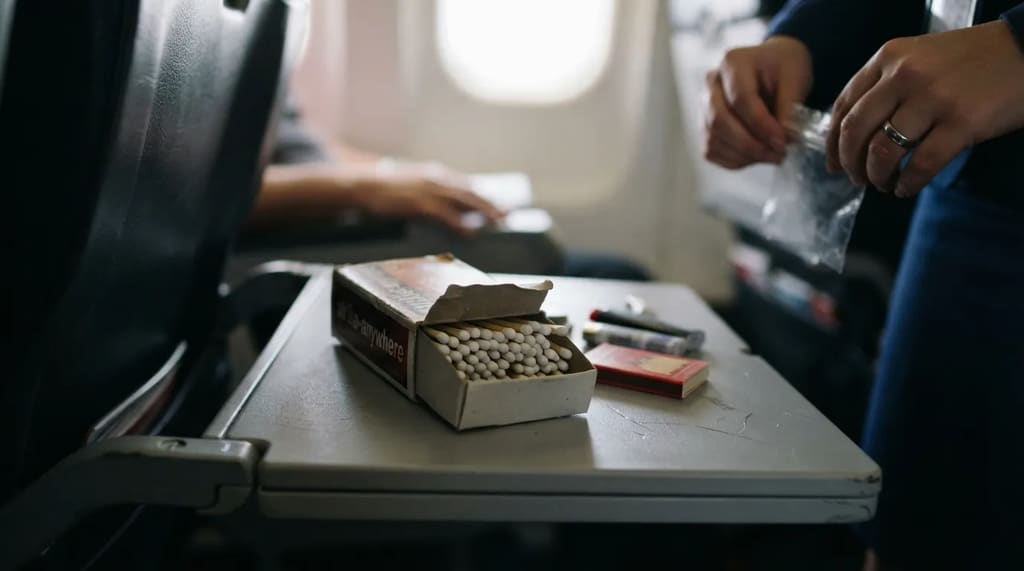
Strike-anywhere matches are not allowed in carry-on or checked baggage. Safety matches are limited to one book, in your carry-on only.4
A camper stocking up for a trip has to leave the box at home, since it fails on both counts. Matches are also one of the things you must pull out and keep with you if your carry-on is checked at the gate.
Lighters add a harder case, since one style is banned from the cabin altogether.
#12 – A Torch Lighter and Spare Fuel
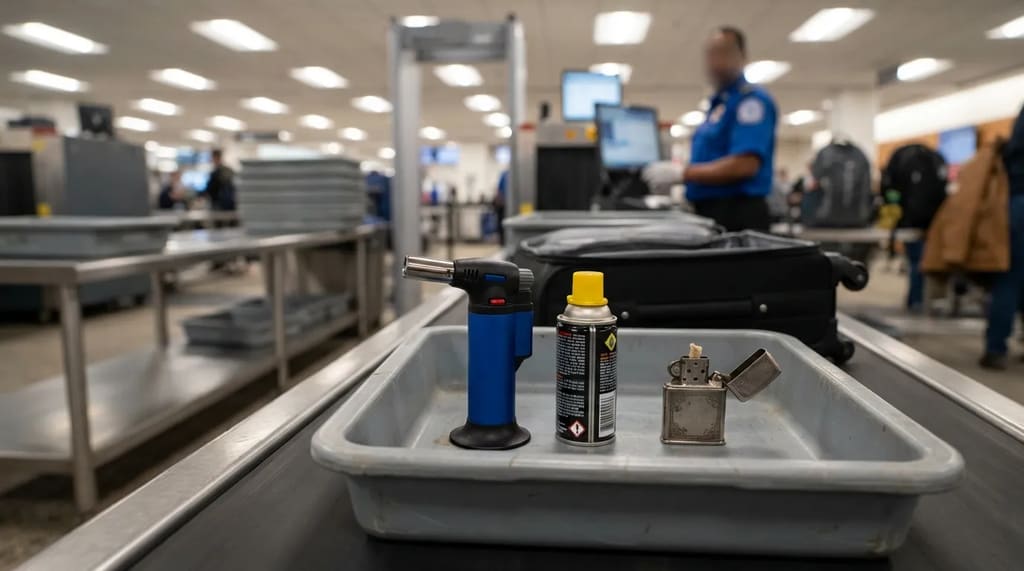
Torch lighters, also called butane, blue flame or jet flame lighters, are not allowed in the cabin or in checked baggage. Unlike a book of matches, there is no bag where they are accepted.4
Spare lighter fluid and butane are forbidden too. A grill or cigar enthusiast has to buy replacements at the destination.
Even the standard lighter that is allowed in the cabin has a limit on where it can ride.
#11 – Lighters Dropped Into the Checked Bag
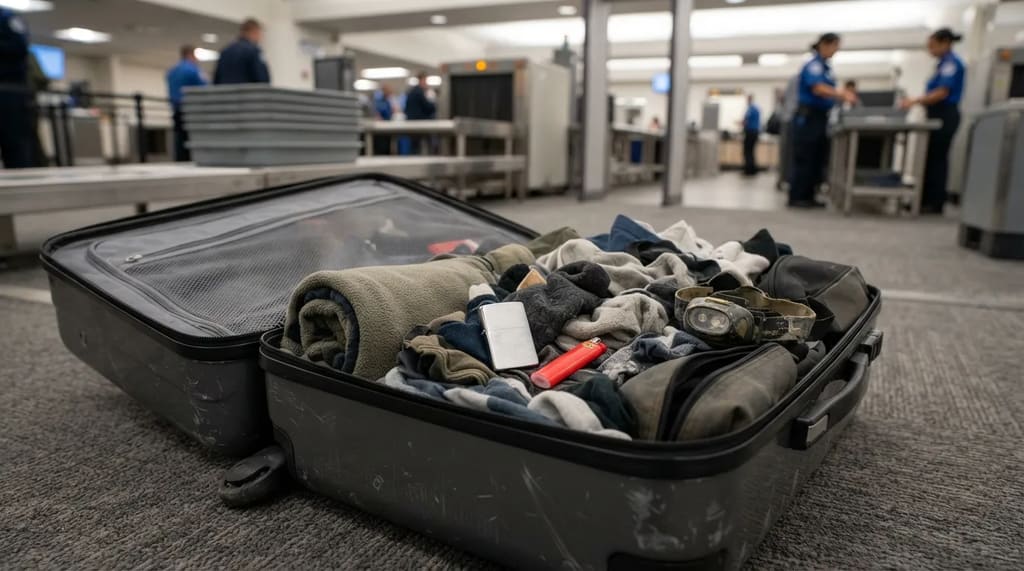
Absorbed-liquid and butane lighters, such as Zippo-type and disposable ones, are limited to one per passenger. They must be in your carry-on or on your person, and they are not allowed in checked bags.
A spare lighter in the suitcase is easy to forget, particularly after a camping trip. The rule is cabin-only for the same reason as the matches: a lighter that ignites in the hold cannot be reached.
Arc lighters are carry-on only as well.
Worth Knowing
- Zippo-type and disposable butane lighters: one per passenger, on your person or in your carry-on.
- Arc lighters: carry-on only.
- Safety matches: one book, carry-on only.
- Strike-anywhere matches and torch lighters: no bag at all.
#10 – An E-Cigarette Packed in the Suitcase
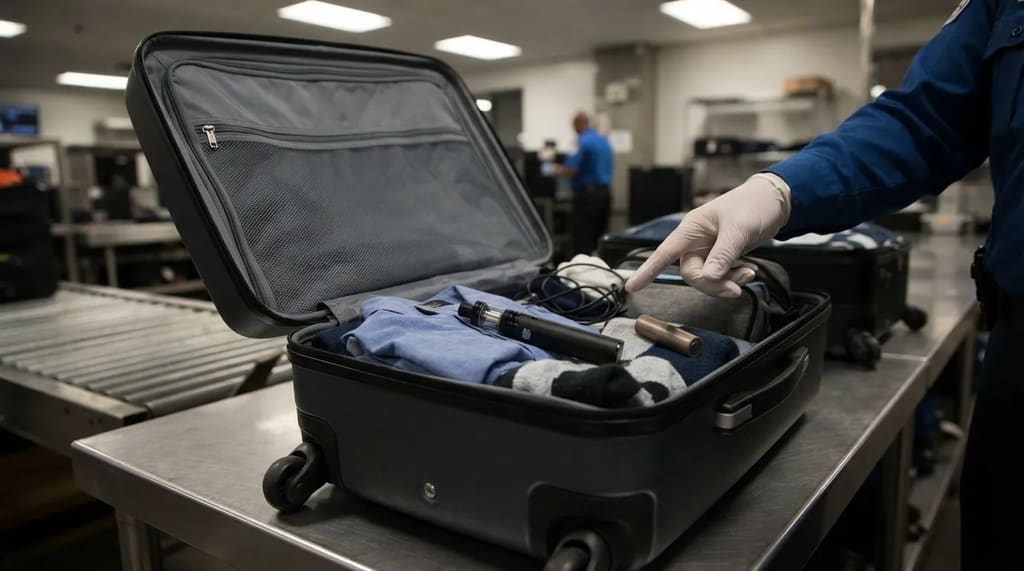
The FAA’s passenger guide says spare lithium batteries and electronic cigarettes are allowed in the aircraft cabin but forbidden in checked baggage. That includes bags checked at the gate or planeside.
A vape in a suitcase breaks the rule even though it is allowed in the cabin. The reason is the same one behind the lighter rule: a fire in the hold cannot be fought.
The battery inside a rolling suitcase raises the same question.
#9 – Smart Luggage Checked With Its Battery In
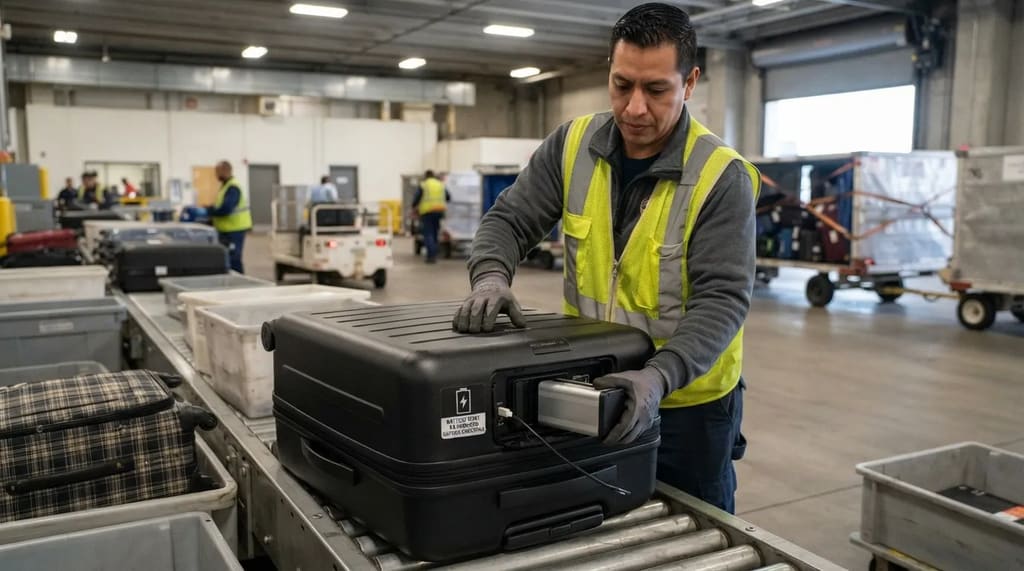
The FAA’s passenger chart lists baggage equipped with lithium batteries as its own category. Airlinetraveler’s pre-flight checklist says to remove the battery from smart luggage if the bag will be checked.
A smart bag is only worth buying if the battery comes out in seconds. If you can’t remove it, the bag becomes a carry-on-only purchase, and you lose the reason to own a large one.
Cordless tools carry batteries too, though the FAA treats them differently.
#8 – A Cordless Drill With the Battery Attached
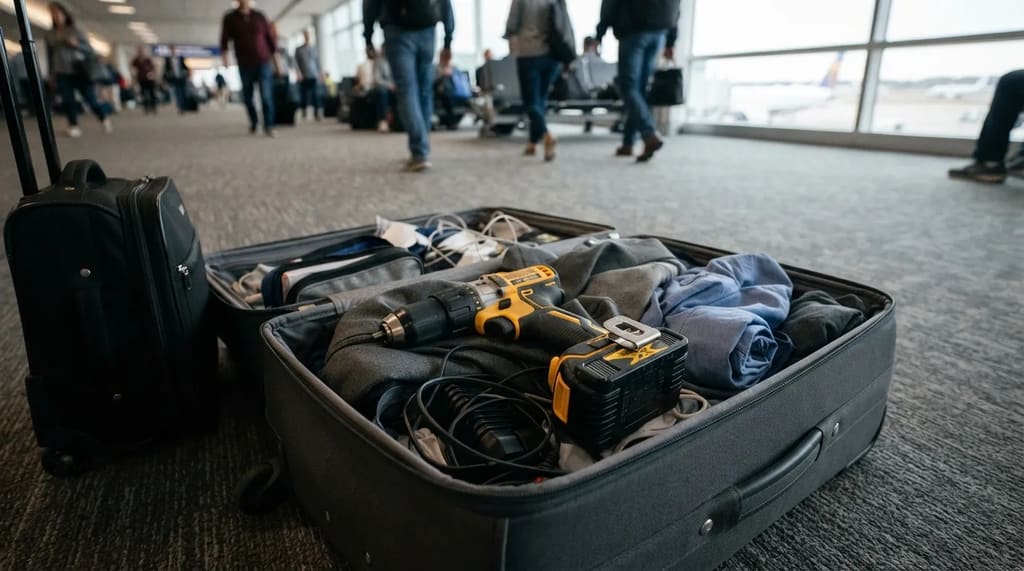
The safest and most recommended way to travel with a power tool is to remove the battery, pack it in your carry-on and check the tool. A tool can be checked only if it is completely powered off and protected from accidental activation, such as in the manufacturer’s hard case.5
Each spare battery must be protected from short circuits, whether in its original retail packaging, with taped terminals, or in a separate plastic bag or pouch.5 A loose battery rattling in a toolbox meets none of that.
#7 – A Portable Power Station for the Trip
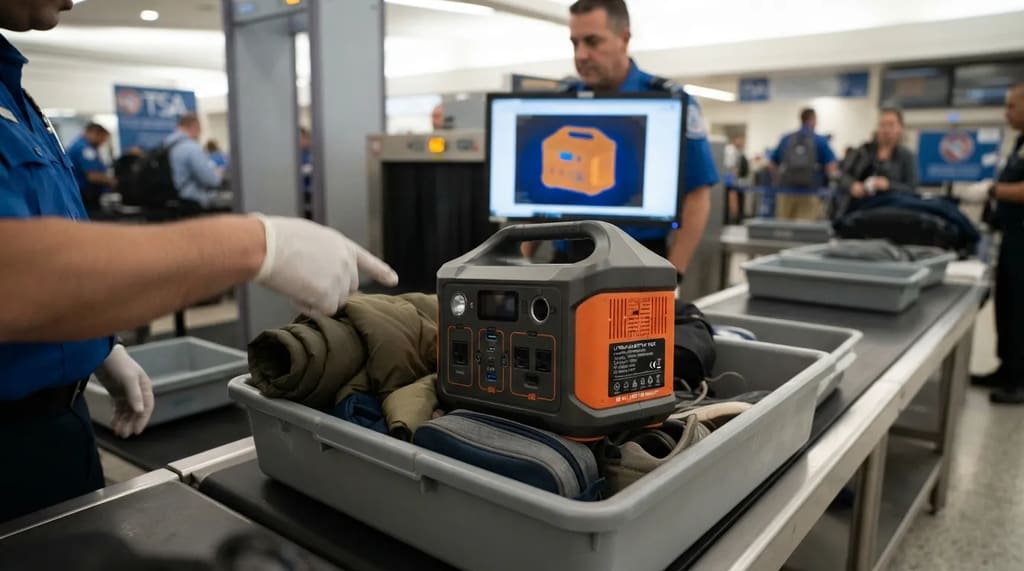
Stand-alone, backup and solar-system lithium generators exceed the 160 watt-hour limit and are forbidden on passenger aircraft. American Airlines also bars large portable power banks and battery-powered generators from carry-on and checked bags.
A power station bought for camping or an outage will have to travel by other means. That includes the ones sold as oversized power banks, so check the watt-hour number on the label before you pack.
The gap between allowed and forbidden is narrower than the labels suggest.
#6 – The 30,000 mAh Power Bank
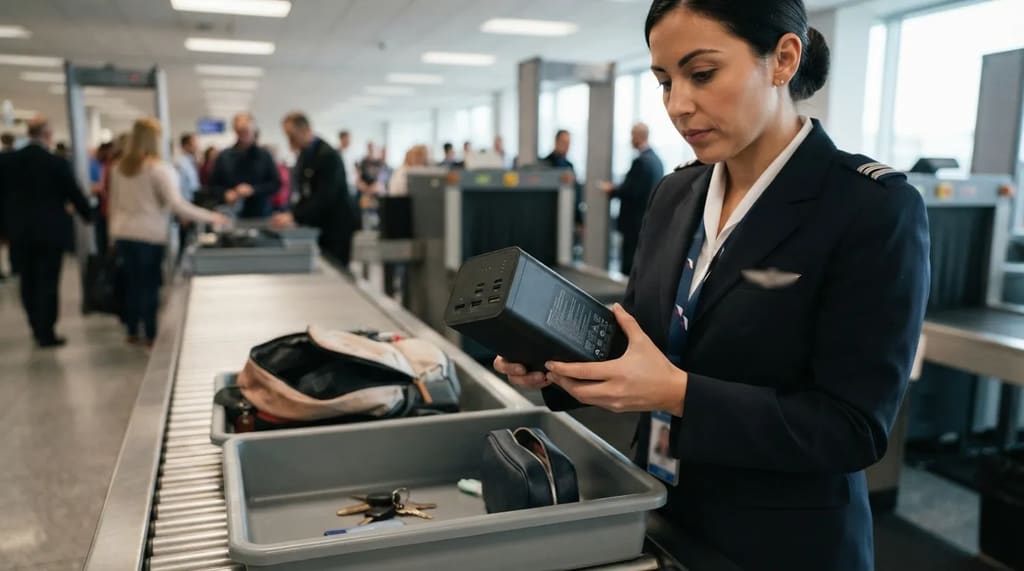
Lithium-ion power banks are limited to 100 watt-hours per battery. Here is how common sizes stack up.
At a Glance
| Power bank size | Approx. watt-hours |
|---|---|
| 10,000 mAh | 37 Wh |
| 20,000 mAh | 74 Wh |
| 26,800 mAh | 99.2 Wh |
| 30,000 mAh | 111 Wh (needs airline approval) |
For a vacation, a 20,000 mAh bank is the better purchase, since it clears the limit with room to spare and skips the approval hassle.
Related Stories From Travelbinger
#5 – A Pouch of Loose Spare Batteries
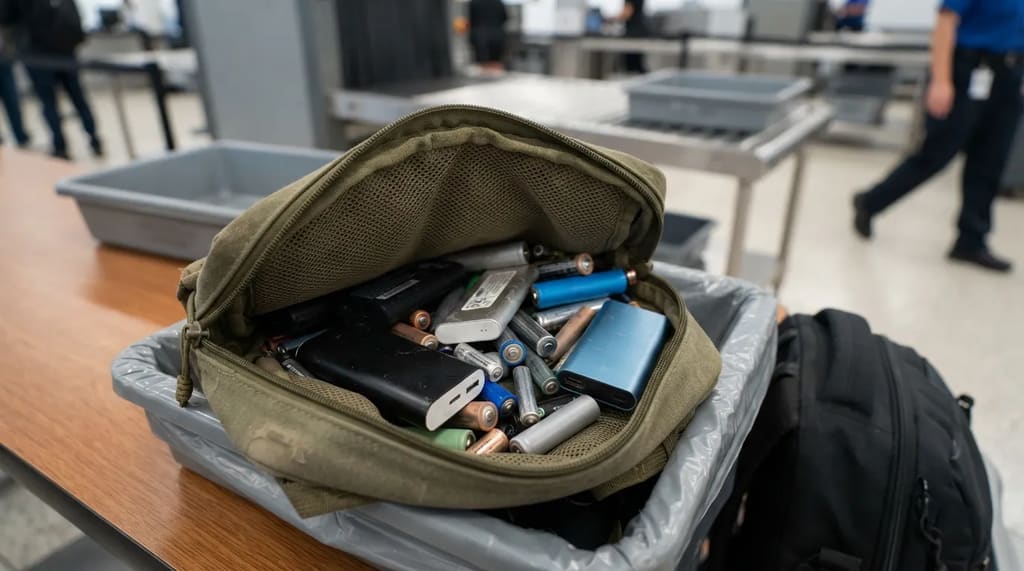
An ICAO addendum with an applicability date of March 27, 2026 limits passengers to two power banks and prohibits recharging them during flight. American Airlines has limited each passenger to two power banks under 100 Wh since May 1, 2026.
A zippered pouch of three or four banks and loose cells is a problem before it ever reaches the checkpoint. Each spare also needs its terminals protected, as with the drill battery in the earlier section.
The same ICAO rule has another half, which concerns charging.
#4 – Topping Up the Power Bank at Your Seat
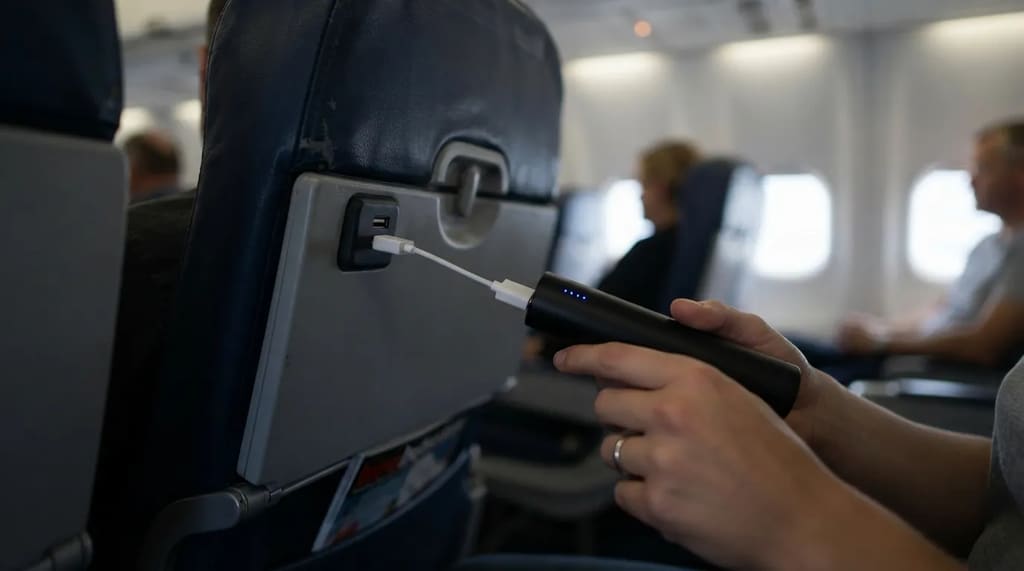
Never recharge your power bank on board, including from the seat’s USB port. The rule closes off the habit of plugging a bank into a seatback port to top it up mid-flight.
Charge the bank fully at home or at the gate and leave the seat port alone. It’s the one in-flight habit on this list with a rule that applies on every carrier, and following it costs nothing.
Airlines then diverge on whether you may draw power out of the bank.
#3 – The Power Bank Stowed in the Overhead Bin
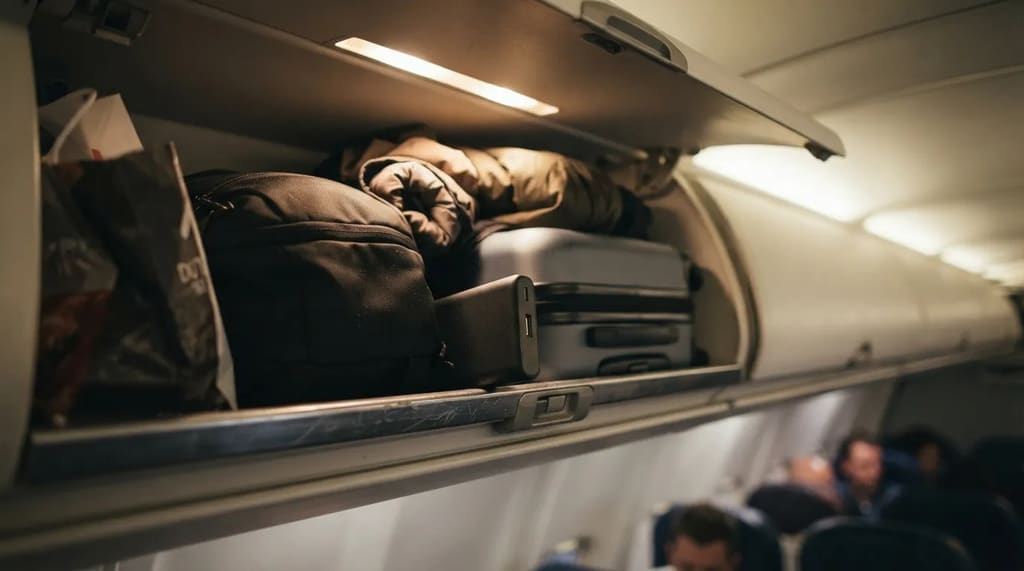
The airlines do not agree on where a power bank may sit or whether you can use one. In a September 2026 table of 38 carriers, 18 ban in-flight use outright.
Quick Compare
- Delta: bans use during taxi, takeoff and landing, and says power banks must be carry-on only, not in overhead bins.
- Ryanair: bans use during taxi, takeoff and landing.
- American and Southwest: allow use if the bank stays visible.
- Lufthansa Group: bans use and charging on board since January 15, 2026, and no overhead bin.
Same bank, four different sets of expectations.
All of these rules assume the battery is in the cabin with you, and the cargo hold is where that assumption fails.
#2 – Spare Batteries in the Checked Suitcase
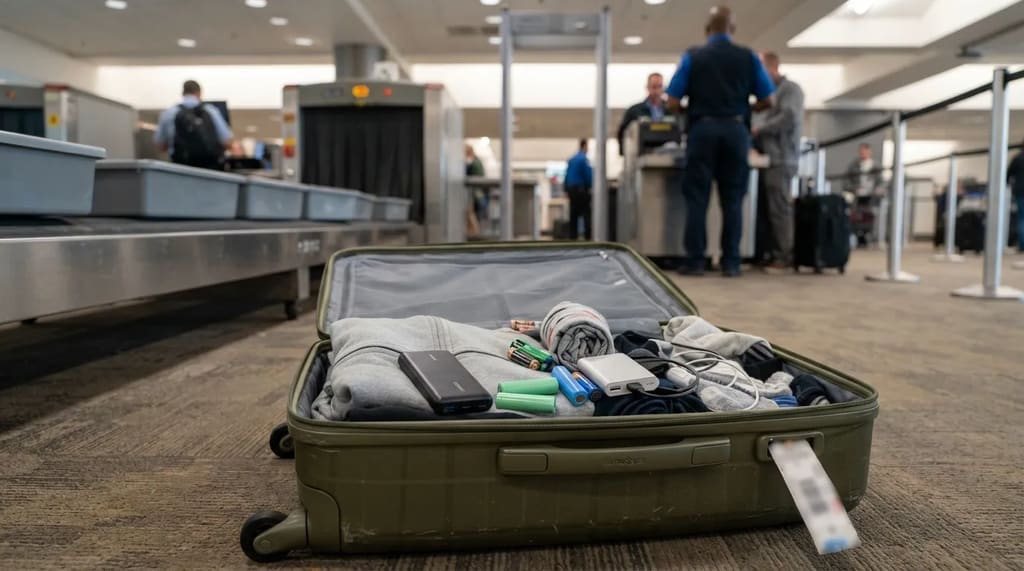
The FAA states that spare lithium batteries, including power banks and portable chargers, must be carried on and cannot be checked.6 In the cabin, crew can reach a smoking battery within seconds, while in the cargo hold a fire can burn undetected.
That is the point behind the e-cigarette, the smart bag and the drill in the earlier sections. A battery installed in a device can sometimes be checked, but a spare cannot go in the hold under any circumstances.
And now the twist promised at the top: a carry-on packed correctly at home can still end up in the hold.
#1 – The Carry-On the Gate Agent Tags
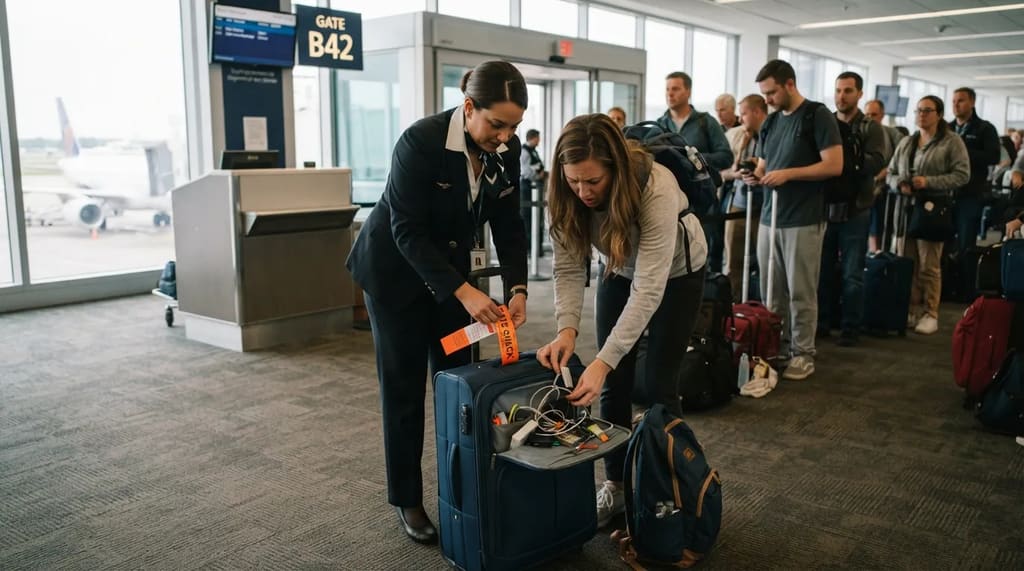
On a full flight, the overhead bins can run out, and the gate agent may tag your carry-on for the hold. When that happens, all spare lithium batteries and power banks must be removed and kept with you in the cabin.7
The bag you packed correctly is suddenly a checked bag, with everything that applies to one. Any lighter must also come out and stay with you.4
An expandable carry-on that gets gate-checked is one more reason to empty the power bank pocket before you hand it over.
Nearly every rule here comes down to location: a spare battery or lighter is fine in the cabin and forbidden in the hold. The habit worth building is asking where each item will ride, not just whether it is allowed.
A few items, like the torch lighter and the bear spray, have no allowed place at all, so they stay home. Everything else has a home in the bag that stays with you, the bag that goes under the plane, or the store at your destination.
Which item will you move to your personal bag first the next time you hear the overhead bins are filling up?
Bonus: The Insider Trick Nobody Tells You
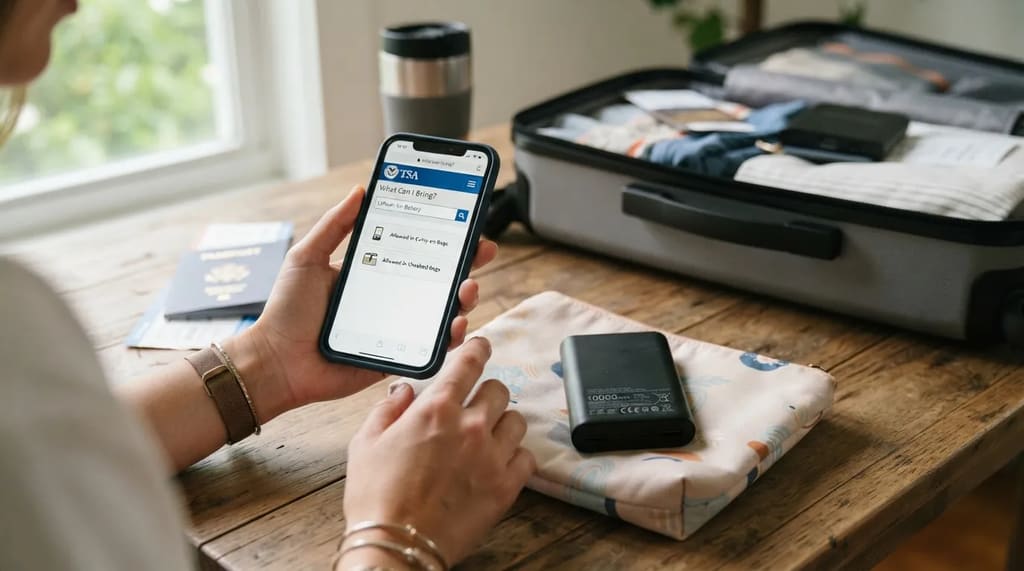
When you’re unsure about an item, don’t guess and don’t rely on a forum post. Get an answer from TSA itself before you leave home, and keep proof of it.
- Step 1: Type the item into the “What Can I Bring?” search tool on tsa.gov or in the myTSA app. It tells you whether the item is allowed in carry-on, checked bags, or both.
- Step 2: If the answer is unclear, send the item’s name or a photo to AskTSA. You can reach it by text at 275-872 or through its social media message channels.
- Step 3: For batteries, also photograph the label showing the watt-hour or mAh rating. Then check your airline’s own battery page, since airlines can set stricter rules than TSA.
Save the screenshots in your phone’s favorites album. The officer at the checkpoint has the final say, but a clear photo of the rating and the official answer settles most disputes fast.
- 3-1-1 Liquid Rule Explained: https://www.travelsentry.org/tsa-lock/what-is-the-3-1-1-liquids-rule/
- FAA PackSafe Printable Chart: https://www.faa.gov/hazmat/packsafe/printable-chart
- FAA PackSafe for Passengers: https://www.faa.gov/sites/faa.gov/files/hazmat/packsafe/resources/PackSafe_for_Passengers_English.pdf
- FAA Hazards in Plane Sight: https://medium.com/faa/hazards-in-plane-sight-these-items-might-be-lurking-in-your-bag-1f71e6d01eb2
- FAA PackSafe Power Tools: https://www.faa.gov/hazmat/packsafe/power-tools
- FAA Airline Passengers and Batteries: https://www.faa.gov/hazmat/packsafe/airline-passengers-and-batteries
- FAA PackSafe Portable Electronics: https://www.faa.gov/hazmat/packsafe/portable-electronic-devices-with-batteries