Most people picture a ship’s departure as one clean, cinematic moment – a horn blast, ropes falling into the water, open sea ahead.
What’s actually happening in the sixty minutes before that horn sounds looks nothing like that picture at all.
It’s a tightly wound, high-stakes countdown running across a dozen departments at once, where a single missed radio check or mistimed tide can strand a 900-foot ship at the dock – or send it into open water with a problem nobody caught in time.
Maritime professionals and official departure checklists reveal a process far more layered, far more legally binding, and far more nerve-wracking than anything visible from the pier.
Here’s what’s really happening on board in that final hour – starting with a clock that never stops ticking.
The Port Authority Clock Starts Running
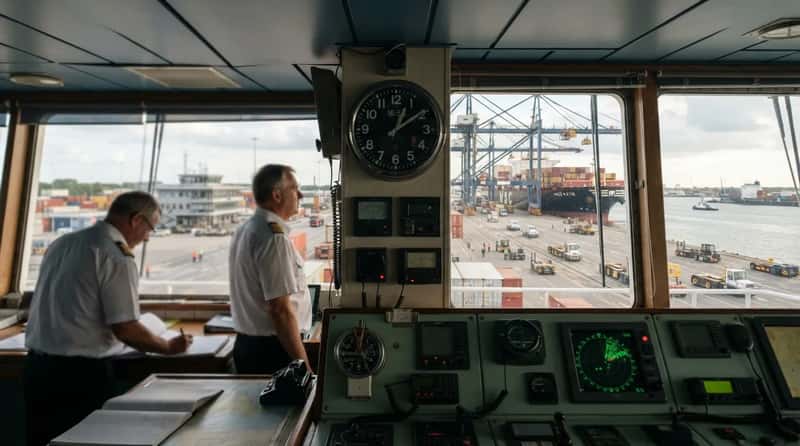
An hour before departure, the ship’s schedule stops being a plan and becomes a legal obligation.
Port berths run on tight rotations, and a late departure doesn’t just annoy passengers – it ripples through every vessel queued behind it, sometimes for hours.
Weather, tides, and berth availability can force a change of plan. But when none of those apply, the port authority holds the ship to its filed notice of departure, full stop.
The clock in the wheelhouse is synced to the harbor master’s office ashore, and every department head aboard knows exactly what time it is – because they’re not allowed to lose track of it.
From the dock, it can look like a lazy afternoon at the pier. Inside the ship, it’s a countdown machine running in minutes, not hours.
The clock is already running – and the people who need to beat it are scattered across every deck of the ship.
The Bridge Team Assembles
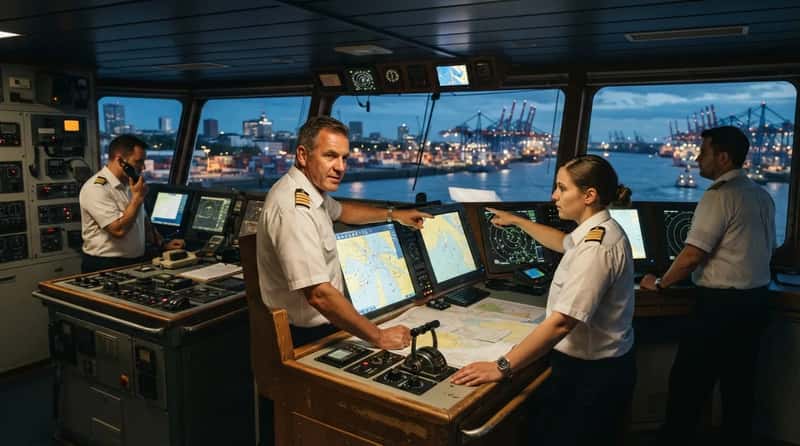
The bridge – the nerve center of any vessel – doesn’t wait for the final minutes to come alive.
The Master reviews pilot arrangements, decides whether a qualified pilot is required, and weighs the extent of pilotage needed, especially at an unfamiliar port.
For familiar ports the review moves faster, but it’s never skipped, and the officer on watch is already confirming every navigation system is powered, calibrated, and talking to the others correctly.
The Duty Officer becomes the primary radar and ECDIS observer, tracking every vessel movement near the ship and reporting it to the pilot before the first line is even slipped.
The bridge doesn’t wait to react to the harbor – it’s already reading it.
Meanwhile, the Third Officer is drawing up the departure checklist, logging entries in the Bell Book and Pilot Card, and cross-checking the tide and current tables, because leaving on the wrong side of a tidal window can turn a routine undocking into a fight with the current.
None of this happens one step at a time. The bridge team is already a functioning unit long before the gangway comes up – and one deck below, the engine room is running its own countdown.
Engine Department Goes to Standby
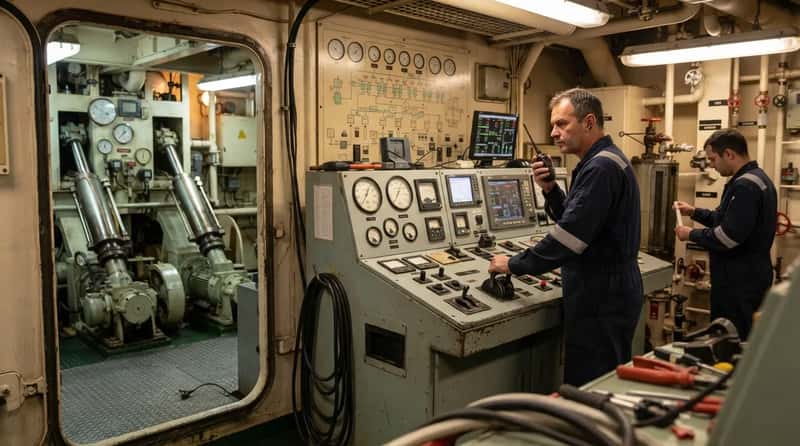
Down in the machinery spaces, the countdown has its own vocabulary: “standby engines.”
Oil levels get sounded in the bunker tanks, and temperatures are brought up carefully by opening steam to the heavy fuel lines.
Heavy fuel oil doesn’t behave at low temperatures – if it’s kept cold, its viscosity spikes and the pump can be damaged trying to force it through.
That’s why engine preparation starts long before the deck crew ever touches a mooring line.
SOLAS regulations require the steering gear to be tested before departure – not as a formality, but as international law.
A vessel that can’t confirm its steering has no business casting off, no matter how ready everything else looks.
The chief engineer’s team runs through fuel systems, cooling water, lubrication circuits, auxiliary generators, and bilge alarms in sequence.
When the bridge calls down for “engines ready,” the answer has to be unambiguous – there’s no “almost ready” at sea.
Once the engine room gives its word, the next stranger arrives on board: someone the crew has never met, who is about to take control of the ship anyway.
The Pilot Is Called
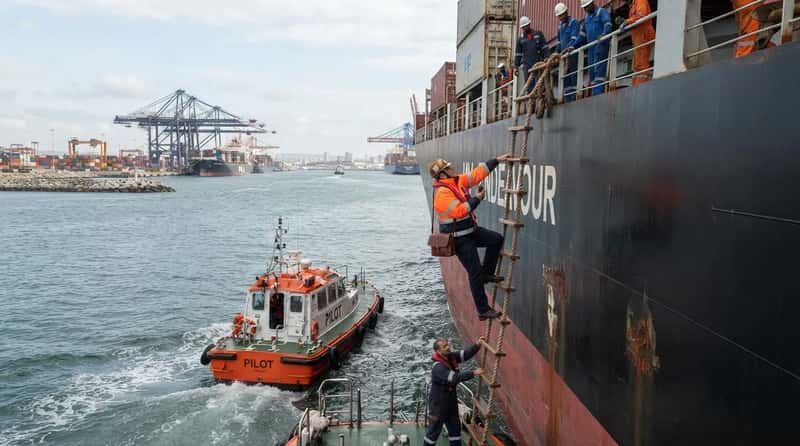
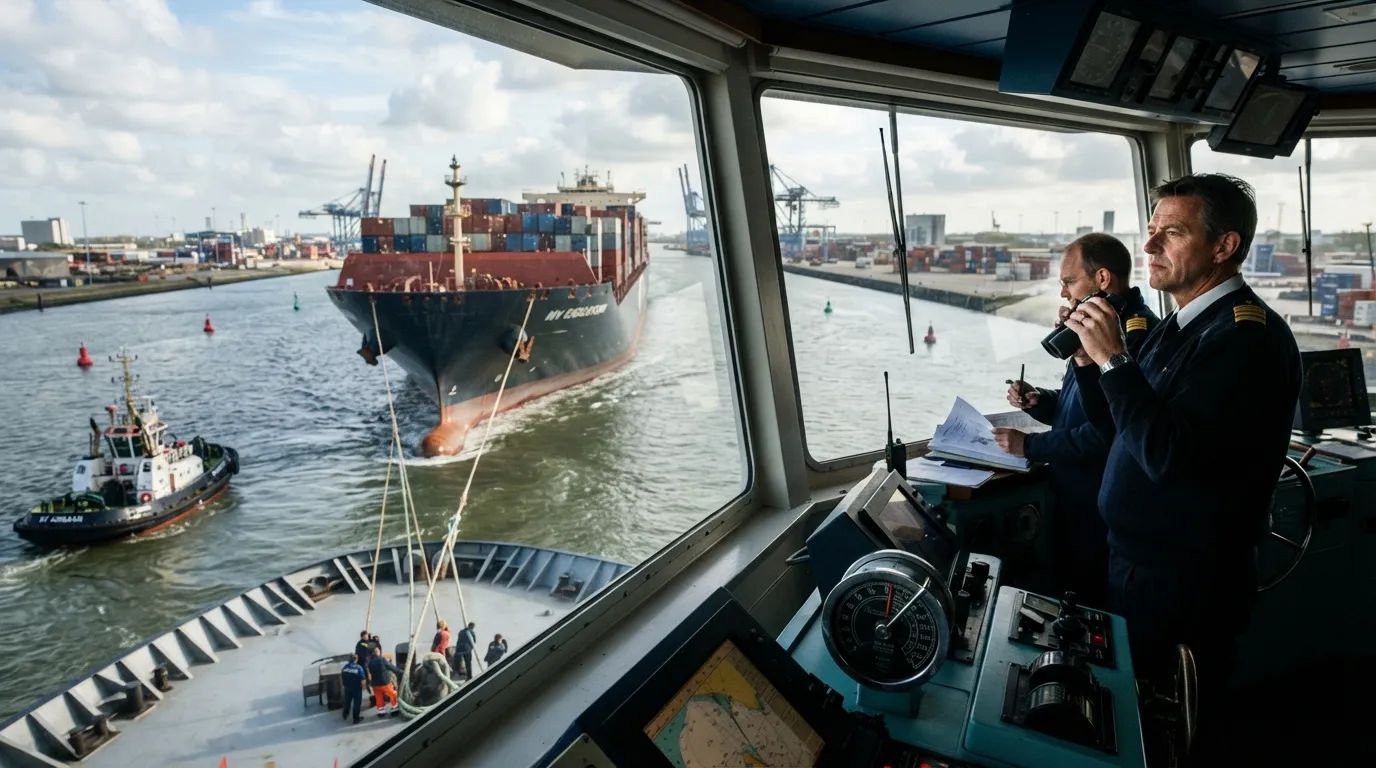
A harbor pilot typically boards the vessel by climbing a rope ladder from a small pilot boat, often while both vessels are still moving.
In most commercial ports, a licensed harbor pilot is legally required to direct the ship through port waters, no matter how experienced the ship’s own master is.
The pilot coordinates with vessel traffic services, organizes the tugs, and directs the ship’s course and speed through the harbor.
The moment the pilot steps aboard, command becomes layered: the master keeps ultimate authority, but the pilot takes the con – hands-on direction of helm and engine – for the transit out.
The pilot writes the placement and name of each tug onto a reference card kept on the bridge wing for quick recall.
That card isn’t a comfort measure – it’s the pilot’s operational map for an undocking that may need three tugs working in a confined basin at once.
The pilot’s arrival resets the energy on the bridge. The departure maneuver has officially begun – and outside, the tugs are already taking their positions.
Tugboats Take Their Stations
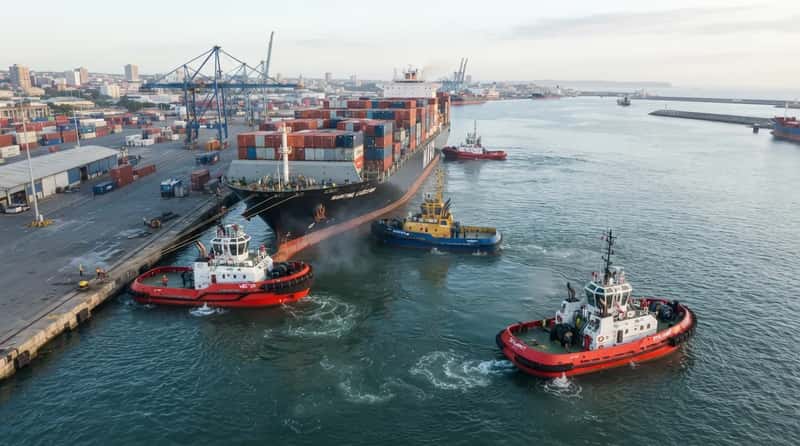
Few things in harbor operations are choreographed as precisely as tug positioning before a large ship undocks.
Unberthing is never “let everything go” – lines are released in a controlled sequence, coordinated by the pilot and the tugs, so the vessel peels away from the berth progressively and safely.
Each tug has an assigned position – bow, stern, or amidships – and a specific job: holding the ship off the dock, pushing it toward the channel, or checking its swing.
Quick Compare
- Bow tug: holds the bow off the dock or pushes it toward open water
- Stern tug: checks the ship’s swing and keeps it from fishtailing
- Amidships tug: added on larger vessels to control sideways drift
- All tugs: stay on constant radio contact with the pilot from start to finish
From the bridge wing, the pilot directs tugs to push against specific sides of the hull while the master orders the mooring lines let go, forward and aft.
The sequence matters more than it looks. Release lines out of order, or misapply tug force, and a 300-meter ship can swing into the dock with enough force to crush steel.
Berthing and unberthing a large vessel can take anywhere from 30 minutes to several hours, depending on size, weather, current, and port layout.
The tugs aren’t just muscle – they’re precision instruments, and their skippers stay in constant radio contact with the pilot the entire time.
Ashore, the dock crew is watching every line, waiting for an order they’ve heard hundreds of times and still take seriously every single one.
Mooring Lines Are Staged for Slipping
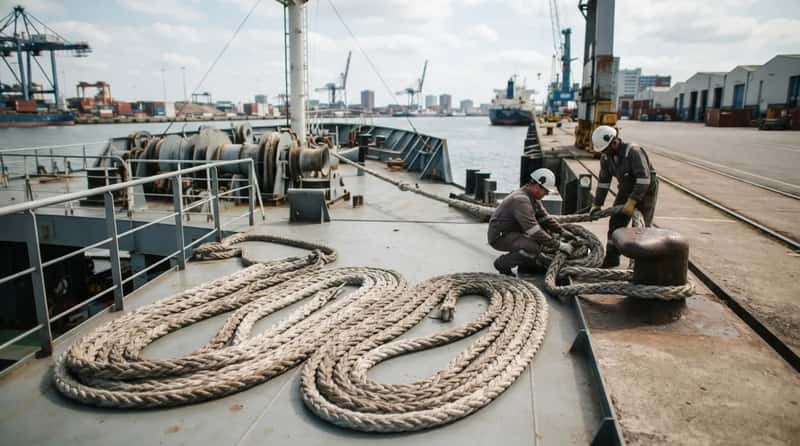
Long before anyone gives the order to let go, the deck crew is already repositioning mooring lines for a fast release.
Lines are re-tied or set up ahead of time so they can be released quickly and pulled straight back on board.
A crew member unties the line on the pontoon, arranges it in a long loop, and feeds both ends back onto the ship, because a line that tangles during release can snap with lethal force or foul a propeller.
Mooring lines are referred to by number and by name, and each one is released strictly in the order the pilot dictates – never casually, never out of sequence.
The first lines to go are always the ones carrying no load.
There’s often real debate before departure about the best moment to leave the berth – which way the tide is running, whether it’s rising or falling, whether wind is pushing the hull toward the pontoon or away from it.
All of that decides the order the lines come off in.
Every line has a purpose, and every line has its moment – and the deck crew knows both by heart.
Gangway Closure and Headcount
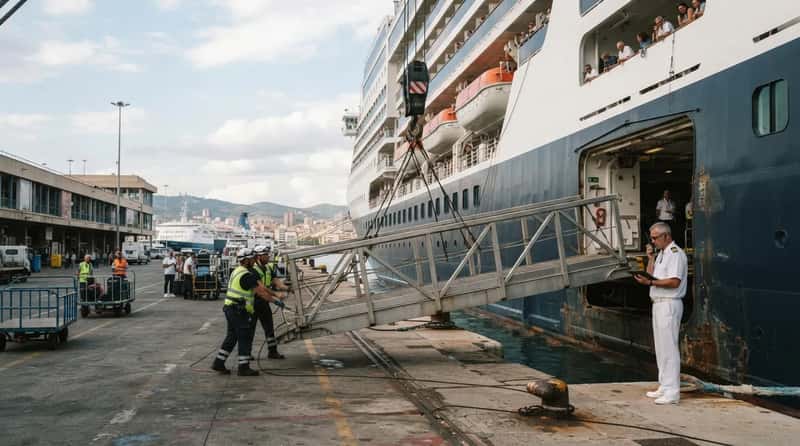
Passengers assume the gangway comes up once everyone’s aboard. In reality, it comes up at a fixed cut-off time no matter who’s still ashore.
The “all-aboard” time is often 30 minutes or more before sailing, and port procedures can push that window even tighter.
The gangway is technically dock equipment – once the ship starts separating, it has to come away cleanly or it becomes a structural hazard.
Before releasing the lines, the captain needs a final head count, confirmed through the purser’s office – a legal requirement, not a courtesy.
If the numbers don’t match, the ship waits, full stop.
Departure checklists exist specifically to confirm that everyone aboard is who’s supposed to be aboard – stowaways remain a real and persistent maritime concern.
The final muster isn’t paranoia. It’s procedure, mandated by international maritime law.
The gangway coming up is one of the most visible signals from the pier – it means the ship has already decided it’s leaving.
Weather and Route Confirmation
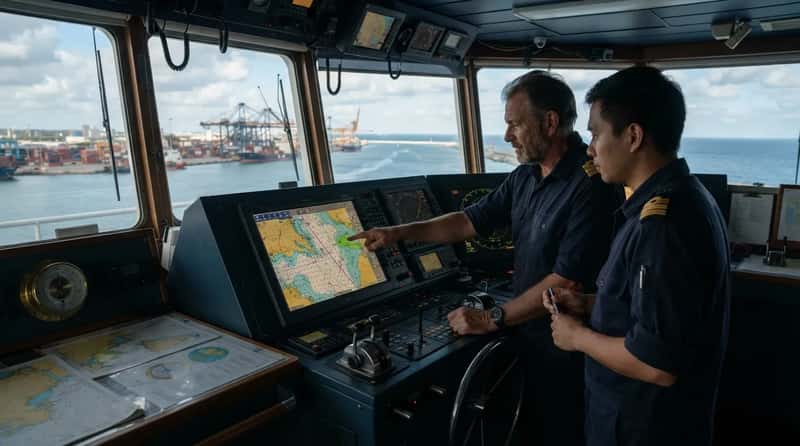
The captain doesn’t assume the forecast checked at 6 a.m. is still good by departure time.
Conditions get monitored continuously, because forecasts change, and a responsible captain stays aware of exactly how the picture is shifting.
In the final hour, the officer of the watch pulls an updated marine weather product covering wind, sea state, visibility, and anything significant along the planned route.
Official forecasts from agencies like NOAA are the standard source, cross-checked against the ship’s own barometric readings and any port authority broadcasts on VHF.
If the updated forecast disagrees with what was filed in the voyage plan, the master has to decide: amend the route, or delay departure.
If a gale is forecast, delaying is often the right call, and that decision belongs entirely to the master.
It’s one of the few moments in the final hour when the ship’s clock genuinely stops, when safety overrides schedule without negotiation.
Departure is never guaranteed until the ship is actually moving. The weather always gets a vote, and so does an invisible system most passengers have never heard of.
GMDSS Verification
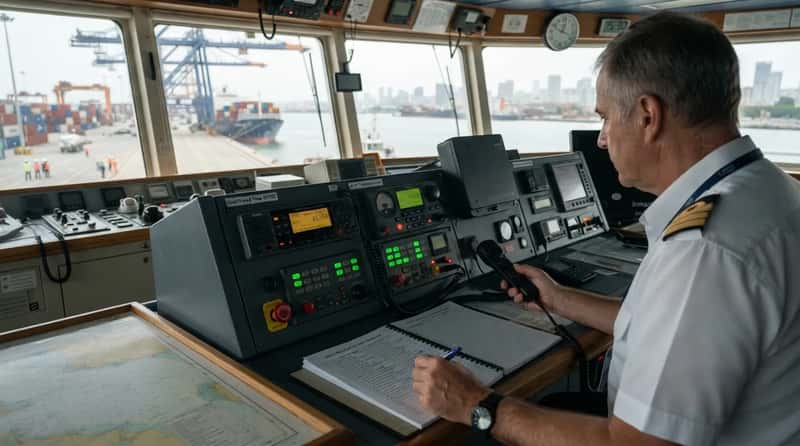
Few pre-departure checks are less visible – and more consequential – than verifying the Global Maritime Distress and Safety System.
Checklists require GMDSS to be tested and logged as fully functional, with crew certificates verified current and the master’s signature attached.
GMDSS is the international framework a vessel uses to call for help in a real emergency, covering VHF, MF/HF radio, satellite links, and emergency beacons.
Fast Facts
- GMDSS ties together VHF, MF/HF radio, satellite links, and emergency beacons into one distress network
- VHF Channel 16 must be monitored continuously at sea under SOLAS rules
- EPIRB batteries are typically rated for around five years before they need replacing
- A dead or expired EPIRB is treated as a safety failure, not a paperwork oversight
VHF Channel 16, the international distress and calling frequency, gets tested for volume and squelch – it must be monitored continuously at sea under SOLAS regulations.
Testing it isn’t optional. It’s a legal obligation, enforceable by port state control inspectors.
Emergency Position Indicating Radio Beacons – EPIRBs – and Personal Locator Beacons for offshore voyages need their registration and battery expiry checked.
An EPIRB with a dead battery or invalid registration is, in a survival situation, just a plastic box.
The check takes two minutes. Skipping it can cost lives, which is exactly why the radio room stays this quiet and this methodical.
Cargo and Stability Sign-Off
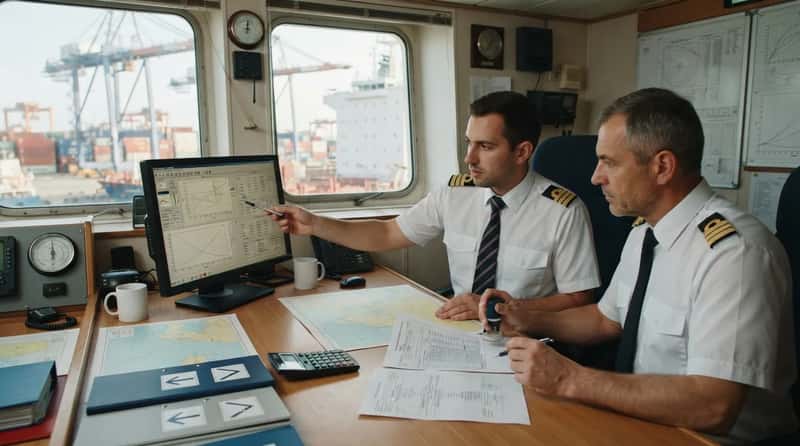
On a cargo vessel, the final hour adds a layer of accountability that cruise passengers never see: load confirmation and stability calculation.
A ship’s stability – its ability to right itself after rolling – isn’t fixed. It shifts with every ton of cargo loaded, every tank ballasted, every bit of fuel burned.
Before departure, the chief officer confirms the final cargo plan matches what’s actually aboard, that the stability computer reflects real figures, and that the calculated metacentric height (GM) sits within safe limits for the voyage.
All port-call documentation needs the ship’s official stamp and the master’s signature – the bill of lading, cargo manifest, dangerous goods declaration, and stowage plan.
Those documents travel with the ship and get presented at the next port. A missing signature or wrong tonnage figure can hold the ship at its destination before it’s even arrived.
Stability isn’t just physics. It’s paperwork, and the paperwork has to match the physics exactly.
The Muster Drill Signal
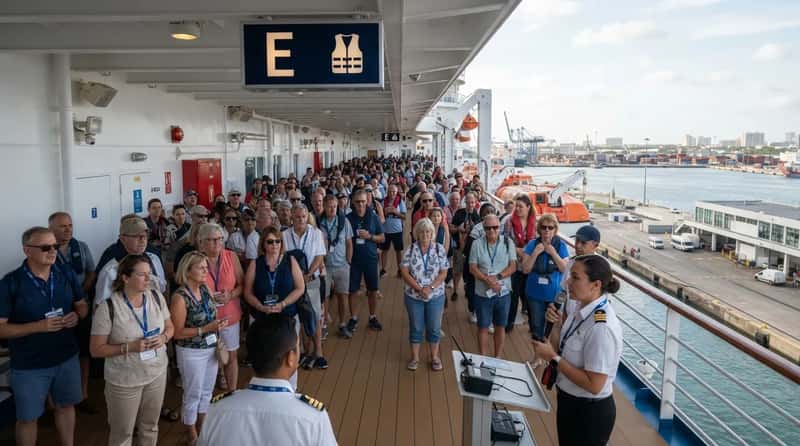
On passenger vessels, the final hour includes something cargo ships don’t need: a mandatory safety briefing for every person aboard.
IMO regulations require passengers to receive a safety briefing – covering muster stations, life jacket use, and emergency procedures – before or immediately after departure.
On many modern cruise lines this happens digitally, with passengers checking in at their assembly station through a cruise card or ship app before sailing.
The muster process gets verified by the ship’s safety officer, whose report goes straight to the bridge.
Until every passenger is accounted for, departure can be held – no exceptions.
That safety culture runs through every department on a passenger ship: the safety officer, the purser, the deck officers, and the hotel manager are all cross-checking the same question – is every person who’s supposed to be safe, confirmed safe?
The muster check closes one of the last open loops before the gangway comes up, but the radio traffic is only getting louder.
VHF Channels and Harbor Traffic
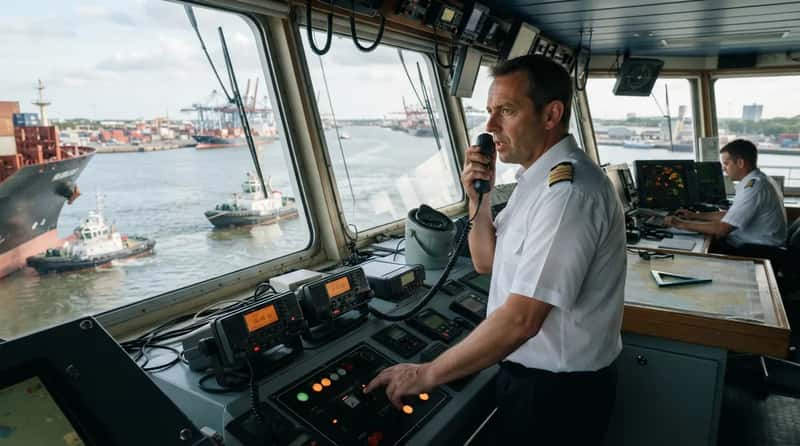
In the final thirty minutes, radio traffic on the bridge spikes sharply.
The duty officer confirms VHF communication tied to the ship’s departure and coordinates directly with vessel traffic services (VTS) ashore.
VTS is essentially air traffic control for the harbor, issuing movement instructions, granting clearances, and flagging other traffic in the approach channels.
Without a departure clearance from VTS, the ship stays at the berth, no matter how many other checks are complete.
The bridge team monitors several channels at once – the VTS channel, the pilot channel, the tug frequency – while keeping a continuous watch on Channel 16.
That’s a heavy cognitive load, managed only through strict role assignments on the bridge.
The harbor is never empty – container ships, ferries, fishing boats, and pilot craft are all moving through the same water at the same time.
Clearance to depart is never assumed. It’s requested, confirmed, and logged, and even that isn’t the last piece of paperwork standing between the ship and the sea.
Documentation, Customs, and Port Clearance
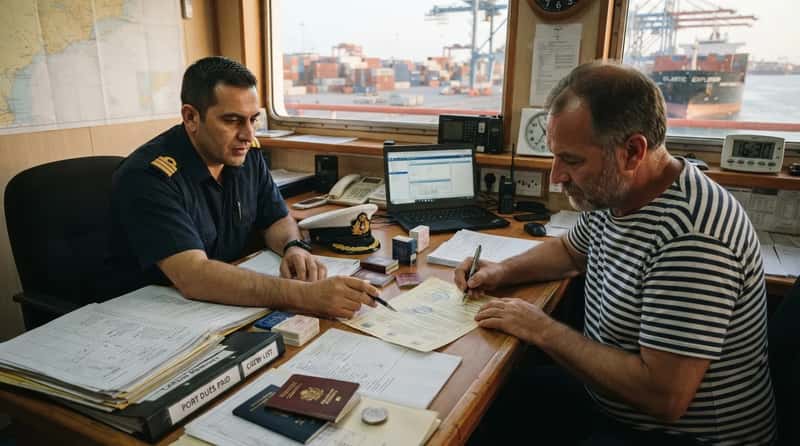
The ship legally cannot leave without one formal document: the port clearance, sometimes called the zarpe or departure certificate.
Customs or the port authority issues it only after confirming port dues are paid, crew and passenger manifests are filed, cargo paperwork is in order, and no outstanding holds exist against the vessel.
Worth Knowing
- Port dues must be paid in full before clearance is ever issued
- Crew and passenger manifests have to be filed and accurate down to the name
- Cargo paperwork, including any dangerous goods declarations, must be complete
- No outstanding legal, customs, or safety holds can exist against the vessel
Without it, pilots are typically instructed not to board, and tugs won’t be deployed – the whole operation simply stops.
Those regulations extend into customs law, immigration law, and the International Ship and Port Facility Security (ISPS) Code, which requires a security log of everyone who’s been aboard since the last port.
The security officer has to sign off that the log is complete and accurate before departure.
Under SOLAS Chapter V and federal regulation 33 CFR 164.25, navigation system checks must happen within 12 hours of leaving port, and that fact must be recorded in the deck logbook.
That logbook entry is the legal record. In any later investigation – an incident, an insurance claim, a regulatory audit – it becomes the primary document.
The port authority’s stamp on the clearance certificate is the final bureaucratic key. After that, the ship belongs to the sea – almost.
The Pilot Exchange and Last Checks
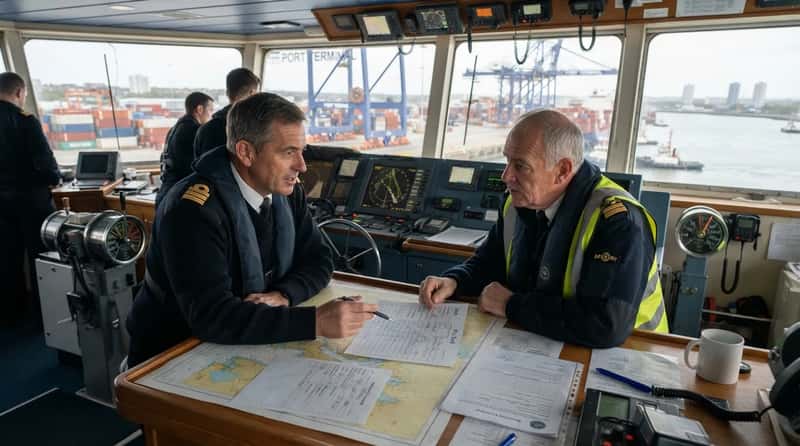
The master-pilot information exchange is a formal, structured conversation, never a casual chat.
It covers the ship’s maneuvering characteristics: minimum speed for steerage, stopping distances, engine response times, bow thruster power, and any known defects or limitations.
The master is required to disclose every defect – a thruster that’s offline, a radar showing anomalies, an anchor that won’t drop.
If unberthing is expected to be difficult, or the ship’s maneuvering ability is limited in some way, that has to be reported in writing before the pilot takes the con.
This protects both the pilot and the port – a pilot who moves a ship without knowing its real capabilities is operating blind.
The Pilot Card, handed over the moment the pilot boards, is a standardized summary of exactly what kind of ship they’re now responsible for.
After the exchange, both master and pilot know precisely what they’re working with. Now they can move it, as soon as the tide agrees.
Tidal Window and the Point of No Return
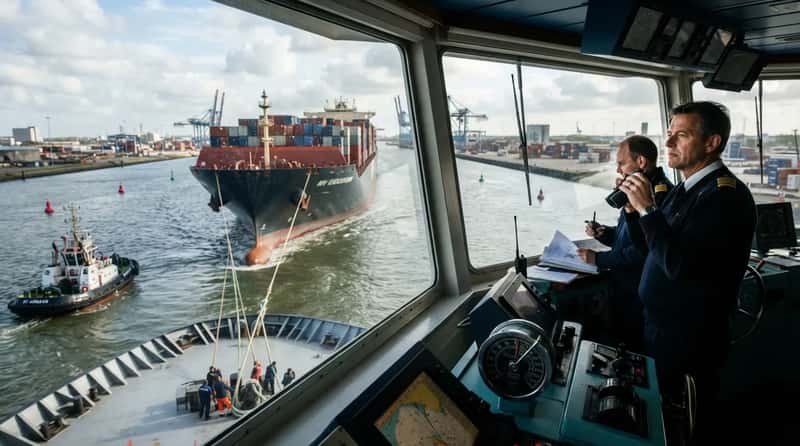
There’s a moment in the departure sequence that most people watching from the pier never identify: the point where the decision to sail becomes effectively irreversible.
Before departure, there’s often real debate about the best moment to leave the berth, weighing the tide – rising or falling – which can be critical for a safe exit from the harbor.
Many ports have tidal restrictions. A vessel drawing 14 meters of water can’t safely cross a bar that offers 15 meters at high tide and only 12 at low.
At a Glance
- Tidal windows can be just a few hours wide at some ports
- Missing one can mean a wait of six to twelve hours for the next
- Once lines are singled up, reversing course becomes costly and complicated
- The pilot and master time undocking against the tide tables, not the clock alone
Miss the window and the ship waits for the next one – sometimes six hours, sometimes twelve.
The pilot and master agree on departure timing against the tide tables, because starting the undocking sequence late on a fast-ebbing tide means arriving at the bar at the wrong height of water.
The schedule was never arbitrary. It was tidal mathematics all along.
Once lines are singled up – reduced to one line per position, ready to slip – turning back becomes expensive and complicated fast.
The crew is committed. The tugs are billing by the hour. The pilot is aboard. The harbor is watching.
Everything prepared in the last sixty minutes now has to perform, all at once.
The Lines Come Off
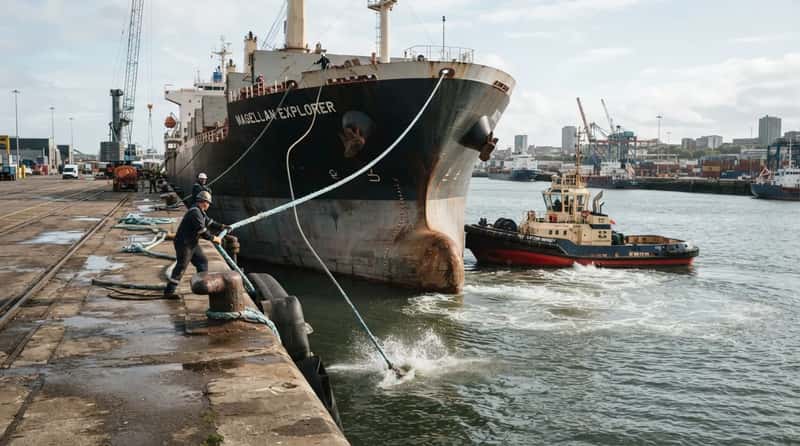
When it’s time to leave, the crew releases lines in the exact order the pilot calls.
Under normal conditions, spring lines go first during unberthing – the diagonal lines that keep the ship from sliding forward or backward along the dock.
They’re released last during berthing and first during unberthing for a simple reason rooted in physics: they’re doing the most work holding the ship in place.
As lines drop away one by one, the tugs compensate for each one’s lost tension, holding the ship steady against wind and current until enough lines are free for controlled movement into the channel.
Tugs reposition the vessel away from the quay, and the pilot guides it back through the harbor channel toward open water.
On the dock, the linesmen coil rope, stow gear, and watch a gap of dark water open between steel hull and stone pier.
On the bridge, the telegraph moves. The engine room answers. The ship is underway.
The average time it takes a ship to cast off and clear the berth is roughly 30 minutes, and every single thing that happened in the hour before exists to make those 30 minutes go this smoothly.
The Bottom Line
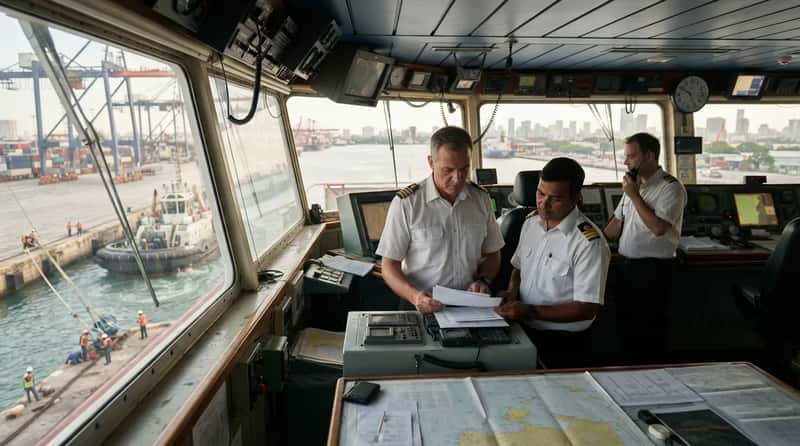
The hour before a ship departs port is one of the most compressed, multi-threaded operations in civilian transport.
It runs on maritime law, tidal physics, international safety codes, cargo mathematics, and radio protocol – all at once, executed by dozens of people who can’t afford to wait for someone else to finish first.
The pilot’s arrival, the tug deployment, the line-slipping sequence, and the VTS clearance aren’t formalities. They’re the structure holding the entire departure together.
Miss the tidal window and the schedule collapses. Miss a GMDSS check and a distress call becomes a tragedy. Miss the head count and someone gets left on the dock, or someone who shouldn’t be aboard sails away with everyone else.
Every single step in that sixty-minute countdown exists because, somewhere in maritime history, skipping it cost something real.
The next time you watch a ship slip away from a pier and vanish toward the horizon in what looks like one smooth, unhurried motion, remember what that hour actually held: a hundred small emergencies, quietly prevented, one right after the other.