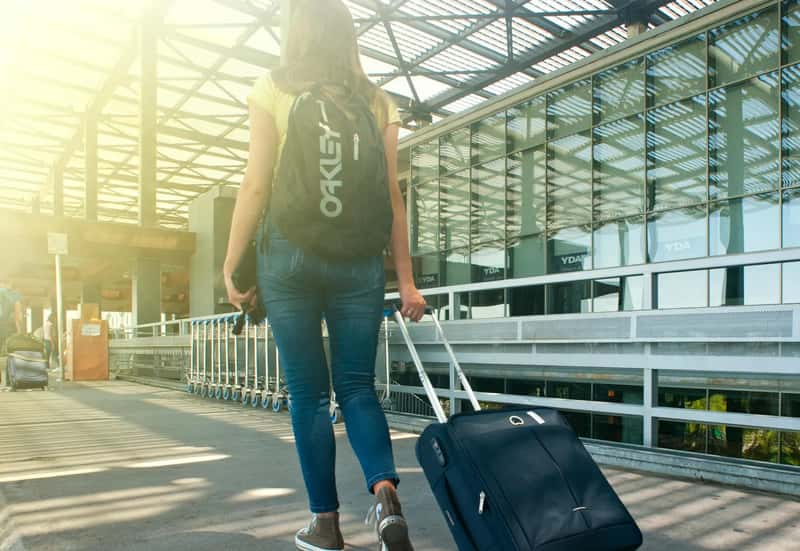
The airport is quiet at 3 AM.
You are not.
Your nervous system has been running its diagnostics since the taxi.
The customs officer shifts his weight. You notice. You’ve always noticed.
Most people learn to read a room in adulthood, slowly, clumsily, through social failure and recovery. You learned it in a kitchen. In a hallway. Before you could articulate what learning even was.
There is a yawning, fluorescent-lit gap between who you are at the gate and who you were at age seven, standing very still in a doorway, listening for tone before content. Between who you tell the hotel receptionist you are and who you become when the room door closes and the silence is safe. Modern travelers wear identities like lanyards: easy on, easy off. But for some of us, the costume isn’t fashion. It’s infrastructure. It’s the thing we built to survive a house that could detonate at breakfast.
1. The Original Training Ground
Growing up in an emotionally volatile household often feels like walking on eggshells. You never quite know what could trigger an emotional outburst, so you learn to tread carefully – always watching and listening.
This is not a metaphor. This is neuroscience in real time.
Every meal, every doorway, every car ride home became a sensory intake exercise. The angle of a jaw. The pace of footsteps on stairs. The quality of silence – because silence, in a volatile house, is never simply the absence of noise. It is data.
You learn survival skills no child should have to develop. You become hyper-aware of mood shifts, body language, the tone of a voice. You read the room better than any adult because, in some ways, your emotional survival depends on it.
The customs hall is just another room. You’ve been reading rooms your entire life. The fluorescent light doesn’t scare you. You were made in harsher light than this.
2. The Hypervigilance Transfer
When children grow up with emotionally reactive or critical parents, they often develop hypervigilance as a defense mechanism. This heightened state of alertness, intended to protect them from potential threats, can manifest in various ways.
But here is what the clinical literature doesn’t always say plainly: it transfers.
It moves with you like carry-on luggage. Onto the train platform. Into the visa interview room. Across every border, figurative and geographic, you’ve ever attempted to cross.
Hypervigilance is a constant state of heightened alertness in which the nervous system remains in survival mode, scanning for threats even in safe settings.
The customs officer isn’t a threat. But your amygdala doesn’t know the difference between an unpredictable parent and an unpredictable man with a stamp. Your body has one setting for ambiguity, and it was calibrated young. In transit, that calibration finally has a legitimate use. The vigilance finds its arena. The skill arrives, at last, to a place that deserves it.
3. The Impeccable Body Language Decoder
Children in these environments often become adept at reading facial expressions and body language. They understand the importance of non-verbal cues and can often anticipate emotional outbursts before they occur.
This isn’t intuition. It’s pattern recognition built on thousands of hours of involuntary observation.
A customs officer who is suspicious crosses his arms later – after the question, not before. One who is simply tired holds tension differently in the jaw. One who is about to wave you through has already broken eye contact in a specific direction. You know this. You don’t know how you know this.
Coping through hypervigilance develops the habit of reading every situation in minute detail – analyzing body language, tone of voice, and even facial expressions.
You became a forensic specialist of the human face before you were old enough to drive. The border is simply the latest examination room. You have never failed this test.
4. The Exit Strategy Architecture
The most tragic thing about your childhood is how much you have to edit yourself just to survive. As a child of a highly unstable parent, you quickly learn that everything is a potential trigger. You find yourself meticulously measuring every word, every action, censoring your genuine self in a desperate attempt to maintain a semblance of peace.
The traveler who is always scanning for the exit sign – in the restaurant, in the meeting room, in the relationship – learned that skill at the dinner table.
Travel becomes architecture for the self-editor. In a new city, every exit is visible. Every escape route is pre-planned without guilt, without social cost. The language barrier is not an obstacle – it is a pardon. You don’t have to explain yourself in a language you are still learning. The foreignness is the permission.
The road trip, the red-eye, the one-way ticket. These aren’t flights from responsibility. They are the first responsible decisions a person conditioned for disappearing ever made on their own terms.
5. The Empathy That Sees Through Walls
This heightened sense of awareness can develop into a deep sense of empathy. You become finely attuned to the emotions of those around you, often sensing their feelings before they even express them. This profound empathy isn’t just a survival mechanism – it’s a unique quality that sets you apart. It lets you connect with others on a deeper level.
I remember being eleven, at an airport for the first time, flying to see a relative alone. The gate agent was smiling but her eyes were doing something else entirely. I told my aunt about it later and she looked at me sideways. “How did you notice that?” she asked.
I didn’t have an answer then. I do now.
You notice because you were trained to notice by someone who made noticing a matter of emotional survival. Recent research suggests that individuals raised in certain volatile environments may develop hyperactive mirror neurons – the neurological structures responsible for empathy and the ability to understand the emotions of others. This could explain an intense, almost “hyper-empathic” connection felt even with near-strangers. You clock the tired diplomat. The nervous student. The grieving man pretending to read a magazine. Travel gives your empathy a landscape wide enough to finally breathe in.
6. The Resilience Paradox
Trauma has been scientifically linked to resilience and adaptability.
The word “resilience” gets used carefully in therapeutic circles. It is not a compliment for surviving something you shouldn’t have had to survive. But in transit, resilience is a currency. It spends well.
Spontaneity and adaptability are valuable qualities nurtured by navigating the unexpected. Embracing the unexpected and adjusting to changing circumstances fosters resilience and flexibility.
The missed connection doesn’t spiral you into crisis. The wrong bus becomes an adventure. The language barrier becomes a puzzle. Growing up with emotionally volatile parents is like being on a boat in a stormy sea – chaotic and unpredictable. But you learned to navigate chaos at a molecular level. A delayed flight is a gentle inconvenience by comparison. The traveler from a volatile house is almost embarrassingly calm in emergencies – because this? This isn’t an emergency. An emergency has a face. It comes home.
7. The Identity That Lives in a Suitcase
This constant emotional tightrope walk leaves deep scars that linger. Deprived of the freedom to explore, express, and simply be, many children struggle to develop a strong sense of self.
And so the traveler becomes a different self in each city. Not dishonestly. Necessarily.
Prague gets the version of you who is curious and cerebral. Oaxaca gets the version that laughs without flinching. Tokyo gets the version that finally respects silence. Each city is a soft test: who am I when no one knows my history? Who am I when I haven’t yet learned the social rules well enough to perform them?
Childhood trauma often affects adulthood psychology in ways people miss because it disguises itself as character traits you might even take pride in. Hypervigilance becomes “being responsible” or “detail-oriented.”
The fragmented identity – the one assembled from appeasing a volatile parent – finds something remarkable in a foreign city: the freedom to be authored rather than reactive. The suitcase doesn’t contain clothing. It contains possibility.
8. The Comfortable Discomfort of Nowhere
For those who grew up in chaotic or neglectful households, fear may have developed into hypervigilance – basically a chronic high-level of alertness and constant scanning for potential threats to wellbeing.
But something alchemical happens when that scanner has nothing to find.
The no-man’s-land between passport control and the arrivals hall. The 40,000 feet of pressurized air between two countries. The train that is neither here nor there. These in-between spaces become the rare zones where the scanner idles. Where the body neither performs domesticity nor braces for impact. The traveler from a volatile house craves these thresholds like clean water. They are the only places the nervous system has ever known a sustained truce.
Wanderlust often doubles as a form of escapism, offering a temporary refuge from daily stress or monotony. Traveling to new places provides a break from routine, allowing us to reset and recharge. But for the hypervigilant traveler, the reset isn’t from routine. It’s from readiness. It’s from always being braced for weather that never came.
9. The Fawn Response Dressed as Cultural Fluency
Fawning means prioritizing others’ needs and emotions to avoid conflict or rejection. Those who resonate with this pattern might have difficulty saying no, lose track of their own preferences, or constantly scan others’ moods to adjust their behavior. This response often develops in homes where appeasing a volatile caregiver was necessary for safety.
In a foreign country, this survival mechanism becomes indistinguishable from cultural sensitivity.
You adapt your register to the room. You mirror posture. You become fluent in the local frequency of deference. The waiter thinks you are remarkably considerate. The hotel concierge thinks you are unusually perceptive. The customs officer thinks you are calm and cooperative. They are not wrong. But the origin of this grace is not graciousness. It is a nervous system that learned, very early, that being liked was the cheapest form of safety.
You travel well. Wonderfully, sometimes. Just remember to ask what you actually want at the restaurant, instead of ordering what you think the table needs.
10. The Heaviest Bag You Never Check
Constant unpredictability can lead to constant hypervigilance in children, which can have physical and emotional ramifications.
All ten of these traits share a single postcard address: a house where love was ambient but safety was not guaranteed.
Your brain developed its core architecture during childhood, and traumatic experiences during that time literally shaped its structure. Research shows that chronic stress can permanently reshape brain structure and function, creating lasting changes in how you process threats, store memories, and regulate emotions.
You carry this with you. Across every time zone. Through every customs hall. Into every hotel room where you triple-check the lock out of old habit, not new threat. The skills are real. The empathy is real. The ability to decode a uniform, a micro-expression, a hesitation – all real, all earned, all worth something in a world that mistakes perception for magic.
But beneath the passport stamps, beneath the frequent flyer miles, beneath the collected ability to thrive in any language and any latitude – there is a child who learned to be extraordinary at reading people because being ordinary at it carried consequences. Hypervigilance is a complex and multifaceted response to a history of emotionally reactive or critical parenting. While it may have served as a protective mechanism during childhood, it can become detrimental to an individual’s emotional and physical well-being as they grow older.
The extraordinary traveler. The one who navigates border queues like a diplomat and strange cities like a local. The one who is never surprised by a delayed flight or a difficult official. That person’s origin story is not wanderlust. It is a kitchen. A doorway. A parent whose mood was the weather system, and who taught you – without meaning to – that the whole world is a climate to be read and survived.
The border is not the hardest crossing you have ever made. It isn’t even close.
The hardest crossing was leaving a house that never felt like home and deciding, somewhere in the accumulated miles between then and now, that you deserved to find one.
Maybe that’s what the travel was always about – not escape, not evasion, not the intoxicating blur of a new city. Maybe it was always about practicing, city by city and border by border, the radical act of arriving somewhere and allowing yourself, just briefly, to stay.