The room is dim and anonymous.
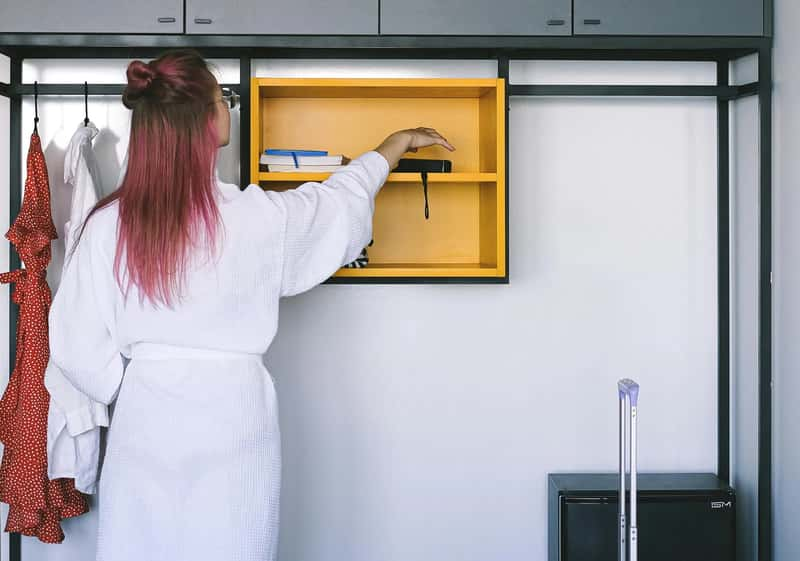
Your passport sits on the nightstand, not inside the safe bolted to the closet wall.
You glance at it every few minutes.
You tell yourself it’s habit. Practicality. Mild distrust of hotel engineering.
But something else is happening. Something older than this room, older than this trip, older than you’d like to admit. There is a wide, quiet chasm between the traveler you present to the world and the person who cannot sleep unless their wallet is visible, touchable, real. We curate ourselves for the departure lounge. We perform ease. We perform lightness. But strip away the itinerary and the carry-on and the carefully chosen airport outfit, and what remains is the psychology we packed first – before anything else.
1. The Safe Is Not the Problem
Let’s start here, quietly and without judgment.
The hotel safe is a small metal box. It has a keypad. It is, by every rational measure, more secure than a nightstand.
And yet. You don’t use it.
You tell yourself the codes are flimsy. That staff have master overrides. That you’d forget the combination at 6 AM in a foreign city. These are real concerns, technically. But they aren’t the real reason.
One common manifestation of scarcity trauma is a hyper-focus on saving, accumulating possessions, or even hoarding. For those affected, the fear of scarcity becomes a driving force, compelling them to hold onto material goods as a buffer against future uncertainty. The accumulation of possessions can provide a semblance of security, creating an illusion of safety and control in an unpredictable world.
The hotel safe asks you to surrender that illusion. Even briefly. Even safely.
And for some travelers, that surrender is psychologically impossible. Not irrational. Impossible.
There is a difference.
2. The Visible Proof
There is a particular kind of mind that needs to see something to believe it exists.
Not in a philosophical sense. In a visceral, nervous-system sense.
A scarcity mindset is characterized by hypervigilance. With money, you can feel frequently or constantly afraid something bad is going to happen. You can experience anxiety, an all-consuming focus on money, and fears about your financial future, so you might be constantly checking your bank account.
The hotel safe traveler does the same with physical objects. The passport. The phone. The emergency cash folded into the inner pocket of the jacket draped over the chair.
They need to see it. Touch it. Confirm its presence.
This is not paranoia dressed up as caution. This is proof-seeking behavior – a psychological ritual born from a history in which things disappeared without warning. Where security was temporary. Where what you had could vanish before morning.
The visible object on the nightstand is not just an object. It is evidence that you are still okay.
3. The Inheritance You Never Asked For
Nobody chooses their first education in scarcity.
It arrives in childhood, in the texture of ordinary moments. The dinner table where portions were rationed. The parent who counted coins at the checkout. The quiet, ambient understanding that there was never quite enough.
If your parents or caregivers had a scarcity mindset, such as due to financial struggles, they may have focused much of their attention on meeting financial needs and less on other things. They could have passed this approach on to you. If your parents were preoccupied with financial worries when you were growing up, you may have learned these traits from them and developed a scarcity mindset of your own.
You grew up. You became financially stable, perhaps. You booked a hotel room in a city that is not your city.
And somewhere in that room, the inheritance activated. Quietly. Without announcement. Just a refusal, automatic and bone-deep, to put the passport inside the box and close the door.
The past is not behind you when you travel. It is in the room with you.
It has been there the whole time.
4. When the Brain Treats “Now” Like “Then”
This is the cruelest feature of scarcity trauma: it is temporally confused.
Your nervous system learned its lessons during a specific period of real lack. But the brain does not timestamp its fears. Those past experiences fuel a belief system that predicts future instability in order to protect against a similar lack of resources.
So here you are. A functioning adult. In a hotel that costs more per night than your childhood family’s weekly grocery budget.
And your nervous system is still filing threat reports.
Trauma can impact cognitive and emotional processing, making it harder for individuals to challenge and reframe their scarcity mindset. The brain’s stress response systems become sensitized, leading to heightened anxiety and an increased focus on potential threats rather than opportunities.
The safe is a potential threat. Not because it is dangerous. But because closing it means trusting that what goes in will still be there when you return.
And trust, for the scarcity-traumatized traveler, is a currency they never had enough of.
5. The Anecdote Nobody Tells at the Airport Bar
I have been that traveler.
I have stood in a hotel room in a city that was not mine, opened the safe, placed my documents inside, and immediately taken them back out. I told myself I was being practical. That I wanted quick access in the morning.
But here is what was actually happening: the moment the door clicked shut, a low, cold panic rose from somewhere beneath my sternum. Nothing dramatic. Just a quiet wrongness. A disconnection from proof.
I needed to see my things. Seeing them meant having them. Having them meant being okay. And “okay” was not a state I had ever been able to take for granted.
Scarcity trauma is the trauma or the emotional or psychological harm that’s caused by long-term scarcity of some essential need. Mine was not always material. Sometimes it was safety. Sometimes it was certainty. But the body doesn’t differentiate. It just keeps the score.
The passport on the nightstand was me, keeping score.
6. Control as a Survival Language
Travelers who refuse the hotel safe are, in many cases, fluent in the language of control.
Not controlling personalities, necessarily. But people who learned early that control – of objects, of environments, of small visible things – was the only reliable protection against chaos.
Another indicator of operating in a scarcity mindset is when we vacillate between states of collapse and control. In the first, we may feel powerless, hopeless, or in despair, and we have a sense of being at the mercy of the universe and others’ whims. In the other, we are trying to manage and control everything.
The hotel safe removes control. Someone else’s technology. Someone else’s system. A door you close and then cannot watch.
The lack of control over your surroundings is anxiety-provoking. When you’re at home, you have control over your environment. In hotels, however, many factors are out of your control, which might unsettle you.
Keeping valuables visible is a reclamation of that control. It is a small sovereignty. A private jurisdiction within a room that belongs to someone else.
It is how you tell the chaos: not tonight.
7. The Bandwidth Problem
Here is something the research understands that the traveler rarely does: this hypervigilance has a cognitive cost.
Princeton University psychology and public affairs professor Eldar Shafir, PhD, talked about how people’s minds are less efficient when they are in the scarcity mindset – when they are feeling lacking something, whether it is money, time, a job, or a relationship. Shafir explains that everyone has only a certain amount of “mental bandwidth,” which is our brainpower and cognitive space. The scarcity mindset occupies the mental bandwidth with preoccupations and cognitive deficits, leaving very limited mental bandwidth to make important decisions and changes in life.
Every glance at the nightstand. Every subtle inventory-check. Every peripheral awareness of where the valuables are – these are not free behaviors. They are withdrawals from a finite cognitive account.
The traveler who cannot put their passport in the safe is spending the entire trip monitoring the passport instead of living it.
The city outside the window. The meal going cold. The conversation happening at the table.
All of it slightly dimmed by the vigilance they cannot turn off.
8. The Temporary Identity
A hotel room is, by design, a rehearsal space for a temporary self.
You are not quite who you are at home. Your routines are suspended. Your objects are re-arranged. Your identity is loosely tethered to a keycard that expires at checkout.
Frequent travel isn’t just physically demanding – it’s psychologically disruptive. Even when everything goes smoothly, many travelers experience low-level tension: irritability in the airport, brain fog in meetings, restlessness in hotel rooms, or a subtle sense of disconnection.
For the scarcity-traumatized traveler, this identity dissolution is not abstract. It is acutely felt. And physical objects – passport, wallet, phone – become anchors. Proof of self. Evidence of continuity.
The scarcity mindset, when compounded by trauma, can further exacerbate its effects on an individual’s psychological well-being and perception of resources. Traumatic experiences can deeply impact a person’s sense of safety, trust, and self-worth, making it even more challenging to break free from the cycle of scarcity thinking.
To lock those anchors in a box, even temporarily, is to feel temporarily unmoored.
The visible passport is not about the passport. It is about continuity of self in a room that reminds you, every few hours, that you are a guest.
9. The Exit Strategy
There is one more dimension to this that rarely gets named.
Keeping valuables visible and accessible is also, at its quietest, an exit strategy.
Scarcity trauma does not only whisper “you might lose this.” It also whispers: “you might need to run.”
At its core, scarcity trauma arises from a chronic state of deprivation and insecurity. When individuals are consistently exposed to situations where their basic needs are unmet, the stress response system is activated continuously. This prolonged state of hyperarousal can lead to significant psychological repercussions, such as anxiety, depression, and chronic stress. The constant worry about where the next meal will come from or whether one will have a safe place to sleep sparks a sense of instability that can permeate all areas of life.
For people raised in environments of instability – economic, domestic, emotional – speed of departure was sometimes a survival requirement. You needed to be able to leave fast. You needed to know where your things were because there might not be time to look.
That training does not leave the body when the circumstances change. It just relocates. To a hotel room. To a nightstand. To a passport that must always be visible, always within reach, always ready.
Even when there is nowhere you need to run to.
10. The Heaviest Carry-on
The things we carry into a hotel room are never only the things in our bags.
We carry the home we grew up in. We carry the version of scarcity we learned before we had language for it. We carry the nervous system responses that were built, brick by careful brick, from every moment that proved the world could not be trusted to hold things safely.
Prolonged insufficiency of financial, emotional, or social resources has been linked to the development of negative psychological effects, including scarcity thinking. The consequences of scarcity trauma can be pervasive, impacting mental health, relationships, career prospects, and overall quality of life.
The hotel safe sits empty. The passport remains on the nightstand. And the traveler calls it a preference, a habit, a quirk – because naming the real thing is harder than navigating an airport in a language you don’t speak.
In order to develop an abundance mentality, you need to first see, acknowledge, and heal the experiences that led to your so-called scarcity mentality. Mindset and beliefs are psychological imprints, and sometimes trauma wounds, not choices. They are the traces left in our bodies, minds and spirits of the harms or intense stressors we have experienced.
The heaviest carry-on has no wheels. You can’t check it at the counter. You can’t stow it overhead. It goes everywhere with you, fitting perfectly into every room, requiring no space at all and all the space you have.
There is a particular kind of grace available to the traveler who finally sees it – who stands in a hotel room in some distant city and understands, without shame, that the nightstand arrangement is a message from an earlier self. A self who learned hard things in hard circumstances and did what all living things do: adapted. Survived. Kept watch.
Recognizing the behavior is not the same as curing it. And curing it is not the same as needing to. Some wounds become architecture. They shape the rooms we build around ourselves, the rituals we perform in borrowed spaces, the quiet negotiations we conduct each night between who we are and who we’ve had to be. The passport on the nightstand is not a failure of logic. It is a love letter to the person who made it here.
One day, perhaps, the safe door will close and something in the chest will stay quiet. That moment won’t be about the safe. It will be about finally trusting that what you have does not disappear the moment you stop watching it.