The earth is on fire beneath your feet.
You booked the flight anyway.
You stood at the crater’s edge and felt something crack open – not the ground.
You.
There is a particular kind of person who finds more peace in the sulphurous hiss of a geothermal vent than in the sanitized quiet of their own home. They book flights to Iceland in January. They press their palms into volcanic rock and stand at the lip of something that could swallow them whole. They are not reckless. They are reckoning. The “Identity Gap” is the vast, uncomfortable distance between the version of yourself you perform for the world and the version of yourself that has been simmering – under pressure, under silence, under years of keeping it together – waiting for something hot enough to draw it out.
1. The Volcano Is Not Out There. It Is in Here.
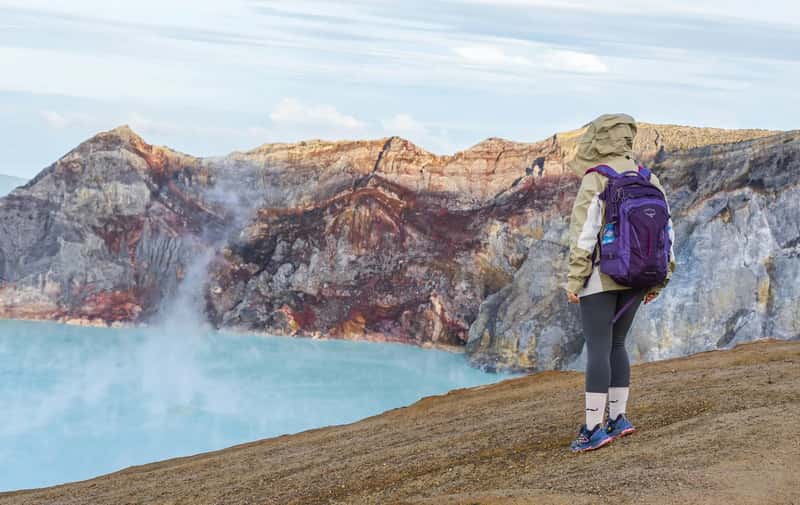
Therapists have long used the volcano as a foundational metaphor for emotional suppression. And for good reason.
Imagine a volcano. It doesn’t just erupt out of nowhere. Deep inside, pressure is building. That pressure comes from a mixture of heat and force that simmers below the surface until it explodes. In the same way, our anger is the eruption – but what’s inside the volcano, what fuels the explosion, are often other emotions we haven’t noticed, expressed, or processed.
Now consider why a person would voluntarily travel to stand beside one.
There is a quiet, barely-conscious logic at work. When the interior landscape has been sealed for years – grief un-grieved, rage un-voiced, desire un-named – the nervous system begins to search outside the body for something that mirrors what it cannot say.
The volcano does not need language.
It just burns.
And for a certain kind of traveler, that is exactly the permission they have been waiting for.
2. The Sensation Seeker With the Quiet Interior
Psychology has a name for the person who is perpetually drawn toward intensity. Sensation seeking is a personality trait defined by the search for experiences and feelings that are “varied, novel, rich and intense,” and by the readiness to take physical, social, legal, and financial risks for the sake of such experiences.
But here is what the clinical definition misses.
Not every sensation seeker is loud. Not every adrenaline-chaser is obviously reckless.
Sensation seekers are often trying to achieve a “flow state” – being fully immersed, holding an energized focus, full involvement, and enjoyment of the moment. In this state, a person is hyper-focused and connected to what they are doing. Their emotions are channeled, and the person feels joy in the moment.
For the emotionally suppressed traveler, standing beside active lava flows or soaking in a geothermal spring is not thrill-seeking. It is threshold-seeking. They are not running toward danger. They are running toward feeling – toward a body temperature that matches the heat they have been bottling inside for years.
3. The Body Knows What the Mind Refuses
The connection between emotional suppression and physical temperature is not metaphorical. It is neurological.
The physical symptoms of stress are real – sometimes, when you go through periods of stress, your body can become hot even if there are no infections present. It isn’t your imagination; there is a strong correlation between the mind and body. As you become more emotionally stressed, your body temperature may rise as your nervous system responds.
The body, in other words, is already running hot.
It is already volcanic.
Trauma, much like physical temperature, can range from a chilling numbness to a searing heat. The temperature of trauma is a metaphor that captures the intense, often fluctuating emotional states experienced by those who have endured deeply distressing events. Just as our bodies respond to external temperatures, our minds and emotions react to the “temperature” of our trauma, shaping our experiences and responses in profound ways.
The traveler standing in a geothermal field is not escaping their internal weather. They are finally walking into it.
4. The Permission of the Primal
There is something that civilization has systematically stolen from the modern psyche. A scholar studying the psychological dimensions of volcanoes noted that C.G. Jung once wrote that the “emotional energy it generated has sunk into the unconscious.” He was describing the severing of human beings from raw, wild nature – and by extension, from the raw, wild interior self.
Active volcanoes and geothermal springs are among the few remaining places on earth that have not been polished, explained away, or made comfortable.
They are pre-civilizational. Pre-performative.
Dreaming of an erupting volcano often points to a powerful surge of suppressed emotions, significant life upheaval, or the emergence of an uncontrollable force within one’s life. This vivid imagery highlights a critical moment of release and transformation, where immense internal pressures are no longer contained, signaling an unavoidable shift in the inner or outer world.
To physically stand at a volcano is to inhabit the dream. To stop metaphorizing and start feeling.
The earth does not apologize for erupting. Most of us have been apologizing for decades.
5. I Understood This in a Hot Spring in Iceland
I want to stop here. Right in the middle.
I remember lowering myself into a geothermal pool in southern Iceland at dusk, the sky the color of a bruise healing. The water was uncomfortably hot. Not dangerous. Just honest. There was a moment – only a moment – where I felt my chest loosen in a way that no amount of breathing exercises had ever managed. It was not relaxation. It was recognition. The heat was doing something the mind had been refusing to do for months: it was acknowledging that something had been burning in there all along.
I had traveled four thousand miles to feel something I had been avoiding in my own kitchen.
This, I later understood, is the architecture of what we call “identity travel.” Not tourism. Not escape. Something older, more animal, and more necessary.
Hot springs offer a tranquil environment for relaxation and meditation. The natural setting and warm water can significantly reduce stress, promote mental clarity, and aid in emotional well-being. But that clinical sentence does not quite capture the feeling of your suppressed interior finally finding its temperature match in the earth beneath you.
6. Heat Therapy and the Surprising Science of Emotional Thaw
Science is beginning to catch up with what the body already knew.
A recently emerging somatic antidepressant intervention is whole-body hyperthermia, in which subjects are temporarily exposed to heat and then allowed to cool down. Recent studies employing hyperthermia-based strategies appear to show mood improvements both immediately and several weeks after the conclusion of treatment.
This is not a spa trend. This is neuroscience affirming what the ancient Romans, the Japanese, and the Finnish have practiced for centuries.
Whole-body hyperthermia is a treatment method that includes heating the body using an infrared sauna, and during this treatment, people sweat in an effort to cool down. Researchers hypothesize that after receiving this treatment, a person’s body temperature continues to decrease, which may be a good thing, as people with depression tend to have higher body temperatures.
The emotionally suppressed body is already running a fever.
The geothermal spring does not add heat. It meets it – and in meeting it, begins the long, mineral-soaked process of release.
7. The Dopamine Architecture of the Crater’s Edge
Why does standing at the edge of something dangerous make certain people feel, paradoxically, more themselves?
During novel experiences, the brain releases more dopamine and less norepinephrine in high sensation-seekers than in low sensation seekers. The high thrill and minimal stress may drive sensation-seekers to repeatedly seek out new, exciting experiences.
But there is a deeper current underneath the dopamine.
When you shut down your feelings for too long, your psychological system simply cannot handle that level of repression. Suppressing feelings for so long can make a person numb.
The volcano rim is not a place of danger for the suppressed traveler. It is a place of contrast. A before-and-after. A way of measuring, through sheer sensory intensity, the distance between the numbed self and the alive self.
They are not seeking the eruption. They are seeking proof that they can still feel the heat.
8. The Geothermal Spring as Confession
There is a reason cultures across every continent have treated hot springs as sacred.
Hot springs have a long history dating back to ancient civilizations. From the Romans at the Bath Baths in England to Japanese onsens and hot springs in Iceland, many cultures have recognized and taken advantage of the benefits of hot springs over the centuries. In ancient Rome, for example, baths were popular places for meeting and relaxing, considered an essential part of their healthy lifestyle.
The sacred is, by definition, a place where the performance stops.
You cannot wear armor in 104-degree mineral water. You cannot maintain the professional facade. You cannot sustain the careful distance from your own interior when the earth itself is conducting heat through your spine.
After reviewing available studies, researchers concluded that depression, sleep problems and stress were all seen to improve. A number of studies also noted that anxiety decreased.
The geothermal spring is not just a wellness destination. For the emotionally sealed traveler, it is the closest thing to a confessional that does not require language.
You enter one person. You emerge – slightly, incrementally, dangerously – more yourself.
9. The Identity Gap Widens in the Cold Life
The suppressed person does not always live dramatically. Often, they live very quietly. Very correctly.
When emotions stay bottled up, they create emotional pressure. Eventually, the body and brain reach a tipping point, and that’s when anger erupts – often fast, loud, and overwhelming.
But before the eruption, there is something more insidious: the freeze.
The daily life that feels ten degrees too cold. The conversations that feel scripted. The Sunday evenings that feel like a sentence. The Identity Gap yawns widest not in moments of crisis but in moments of grinding, beige normalcy.
The way our bodies respond to heat and cold can have a direct impact on our nervous system, making temperature regulation a simple yet effective tool for emotional regulation.
The traveler who books a flight toward fire is, on some level, attempting a primitive form of nervous system recalibration. They are choosing heat as a corrective. They are using geography as therapy.
And more often than they would admit to their colleagues on Monday morning, it works.
10. The Return: What You Bring Back From the Fire
The most psychologically significant moment of volcanic or geothermal travel is not the arrival. It is the return.
You come back from the crater’s edge. You emerge from the spring. You sit in the airport, steam still metaphorically rising from your skin, and you are confronted with the hardest question the journey was always asking.
Now what?
Healing from trauma involves finding a balance, a way to regulate these extreme emotional temperatures. This is where trauma-informed therapy can play a crucial role. Through techniques such as grounding, mindfulness, and cognitive-behavioral therapy, individuals can learn to modulate their emotional responses, bringing the temperature of their trauma into a more manageable range.
The volcano gave you permission. The spring gave you softness. But neither can do the longer work of integration – the slow, grinding, unglamorous process of bringing the heat back into ordinary life and letting it thaw the places that have been frozen for years.
New adventures provide an opportunity to grow and expand one’s sense of self. But only if you bring the self back. Only if you do not leave your revelation at the crater’s rim like a forgotten scarf.
The experience of hot springs bathing is deeply enhanced by immersion in natural surroundings. The sights, sounds, and feelings of the environment encourage mindfulness, presence, and stillness. This connection with nature reduces stress, improves mental wellbeing, and provides a restorative break from the demands of daily life, leaving both body and mind renewed.
The traveler who seeks geothermal fire is, in the end, not looking for an adventure to post. They are looking for a mirror hot enough to show them who they actually are. The earth, in its indifferent, magnificent heat, obliges. It does not care about your calendar or your carefully curated persona. It simply burns – ancient, honest, and without apology.
The suppressed self recognizes the volcano not because it is foreign, but because it is familiar. Because somewhere beneath the politeness and the productivity and the years of keeping the lid on tight, there is the same pressure, the same slow accumulation, the same heat that has nowhere to go.
The question the geothermal spring leaves you with – the one that hums in your chest long after you have returned to your quiet life and your quiet rooms – is not “why did I go?” It is simpler than that, and harder: what are you still not letting yourself feel?