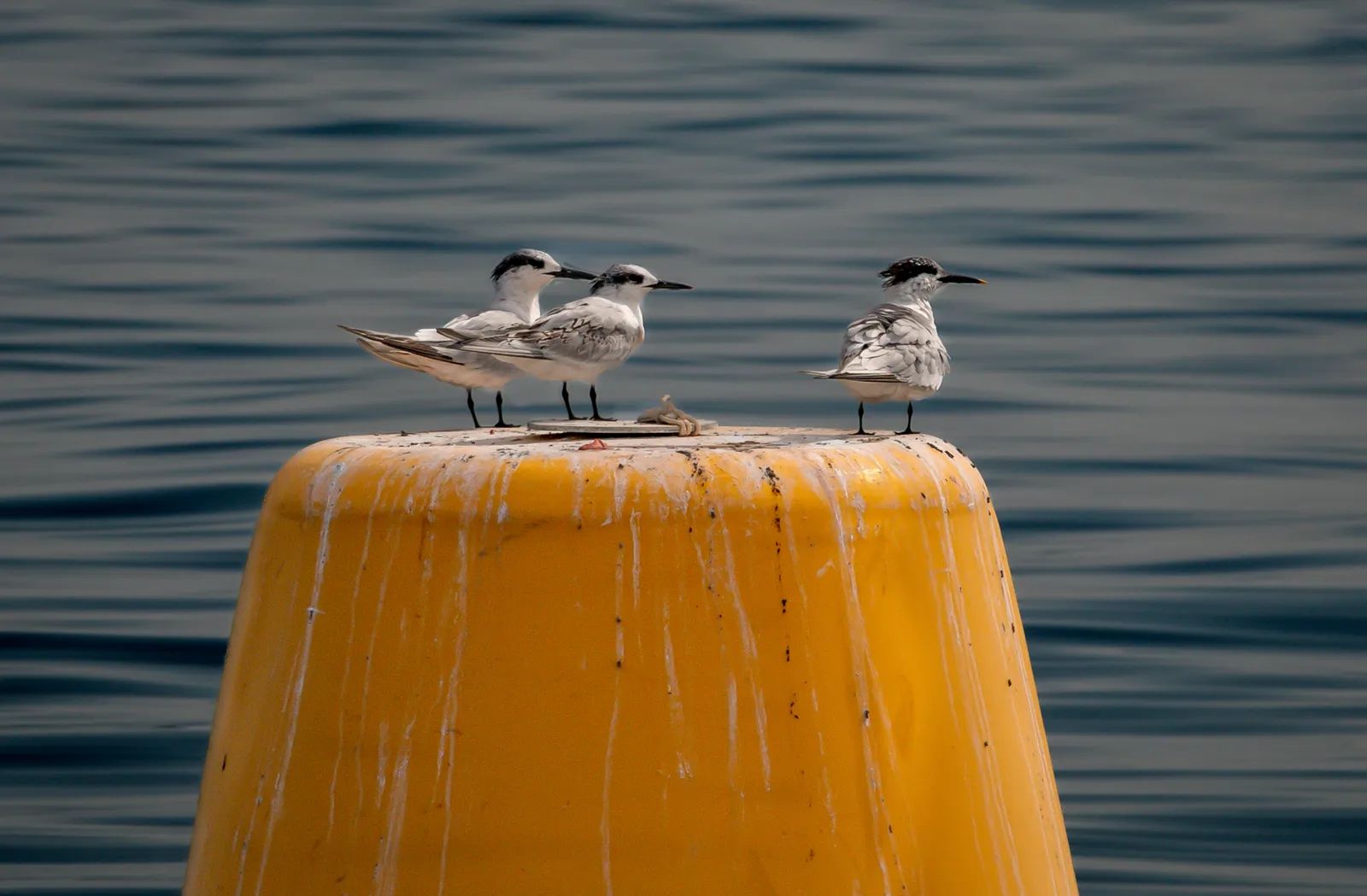
Cornwall, England – A buoy rises from the water with a tall pole topped by oversized eyes that rotate steadily in the wind. The motion creates what researchers describe as an animated eye effect, intended to startle diving seabirds before they plunge into the mesh below. Nearby, another net carries a kite shaped like a bird of prey that lifts and dips on its tether. Both simple devices were tested in a recent study published in Conservation Letters, and early results suggest they can meaningfully lower the risk of seabird bycatch in gillnets. ([1])
The Persistent Threat Beneath the Surface
Gillnets hang vertically in the water column and are prized by fishers for their efficiency. For diving seabirds such as auks, however, the same nets become invisible hazards once the birds submerge in search of food. In the Baltic Sea and Northeast Atlantic alone, more than 95,000 seabirds are estimated to die in gillnets each year. European fisheries as a whole account for roughly 31,000 common guillemots lost annually to the same cause. Finding practical ways to reduce these numbers has proved difficult, with many earlier attempts showing limited or inconsistent success.
Testing Two Low-Tech Deterrents
Researchers led by Tom Horton of the University of Exeter placed the experimental devices on commercial gillnets operating off the Cornish coast. One setup featured a buoy-mounted pole carrying large, painted eyes that spun to produce the animated effect. The second used a kite resembling a raptor, flown from a similar pole to mimic a predator overhead. The trial focused on auks, the family that includes guillemots and razorbills, because these species frequently forage at depths where gillnets are set. Both deterrents were compared against unmodified nets to measure any change in capture rates.
Clear Reductions in Capture Odds
Nets equipped with the kites showed 71 percent lower odds of catching an auk. Those fitted with the spinning-eye buoys recorded a 59 percent reduction. The differences were statistically notable and occurred under real fishing conditions rather than in controlled tanks. Earlier work with similar eye buoys in Iceland’s lumpfish fishery had not produced comparable results, underscoring that effectiveness can vary with location, species behavior, and net type. The Cornish findings therefore add a promising data point rather than a universal solution.
Practical Limits and Next Steps
The devices are inexpensive and require little maintenance, which could encourage wider adoption if further trials confirm the pattern. Still, questions remain about long-term durability in rough seas, potential habituation by birds, and performance across different fisheries. Lead author Tom Horton noted that most people never see the moment a diving bird meets fishing gear, highlighting how hidden the problem remains. Continued testing will be needed to determine whether these visual deterrents can be refined or combined with other measures to protect vulnerable seabird populations more broadly.