Most people walk away from a buffet thinking: someone will eat the rest. Turns out, almost no one does.
The truth about what happens to that untouched shrimp, cooling pasta, and stacked desserts has stayed off-menu for decades – and the real numbers are genuinely shocking.
From landfills to pig farms to discount apps, this is a story about waste, money, and a system quietly breaking under its own buffet line. Here’s what the data actually says – starting with the number that should make you put your plate down.
#8 – Nearly Half of It Was Never Going to Be Eaten
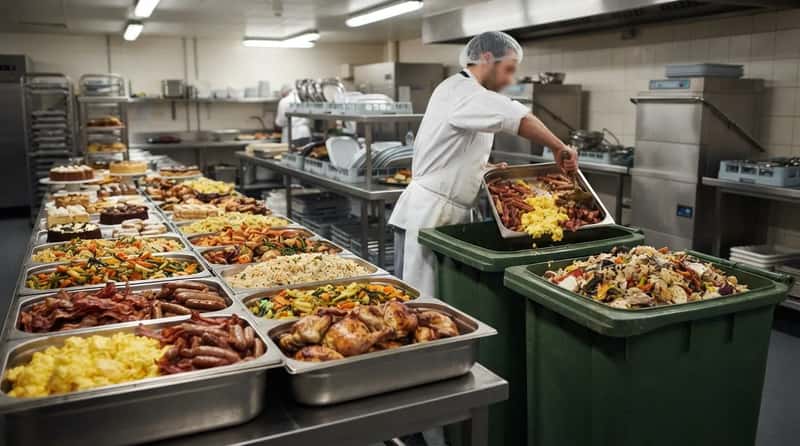
To avoid disappointing customers, buffets routinely prepare far more food than necessary. It’s a double-edged sword – it guarantees variety, but it also guarantees an enormous volume of waste.
The classic buffet model demands many different dishes in large quantities, constantly refreshed so every tray stays appetizing. Research from the University of California, Berkeley, concluded this makes buffets exceedingly less sustainable than other restaurant formats.
Most buffet providers waste almost half of what they offer customers, with the majority ending up in landfills. That statistic alone should stop you mid-plate.
Studies in university canteens and hotel buffets found that customers eat around only half the food they put on their own plates – meaning waste happens at two levels simultaneously: in the kitchen and on your tray.
But that’s nothing compared to what happens once service ends. That’s #7…
#7 – Health Codes Decide Its Fate Before You Leave the Room
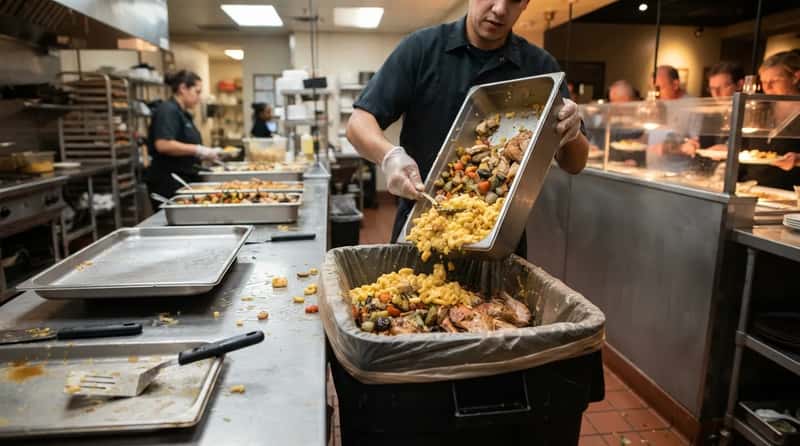
Buffet restaurants must remove food from the line the moment it no longer meets food safety guidelines. This happens on a rolling clock – not just at closing time.
Food pulled from the buffet is treated the same as food already served to customers. It’s considered contaminated and unsafe, so it goes straight into a trash bin or compost bin.
In some jurisdictions, food that has been put on display must be discarded once service ends – regardless of whether it was ever touched. Untouched. Discarded. Gone.
Fast Facts
- Food pulled from the line is legally treated the same as food already served.
- It’s classified as contaminated, so it goes to the trash or compost – no exceptions.
- Some jurisdictions require disposal after service ends, touched or not.
- The rules exist for temperature control, cross-contamination risk, and liability.
The rules aren’t arbitrary – temperature control, cross-contamination risk, and public health liability all play a role. But the result is that mountains of food that looks, smells, and is perfectly fine gets thrown away by legal requirement.
That leads to the next question – can restaurants at least give it to someone who needs it? The answer is more complicated than you’d think, and it brings us to #6…
#6 – Donation Is Legal, But Most Restaurants Skip It Anyway
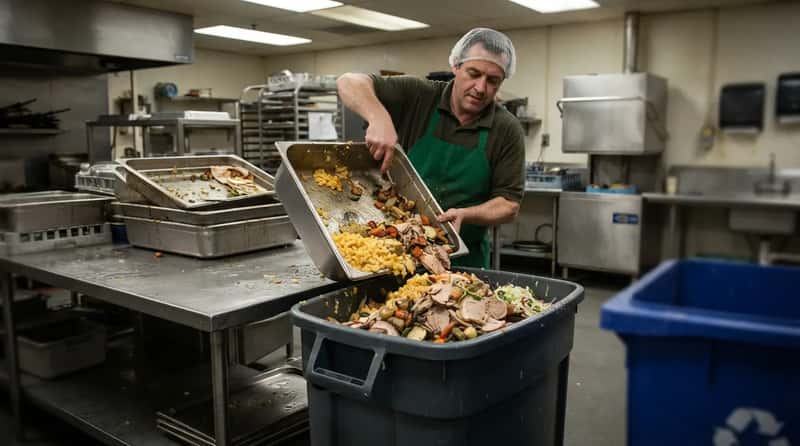
Here’s where it gets frustrating: donating leftover buffet food is actually legally protected in the United States. The 1996 Good Samaritan law gives liability protection to anyone who makes a good-faith donation to a nonprofit that feeds the hungry.
All 50 states have food donation statutes that limit donors’ liability, though coverage varies widely. So there’s a legal path – but most buffets simply don’t take it.
Only 32% of hotels have a donation program to manage excess food. That means roughly two out of three hotels are throwing it out instead.
Restaurants can donate surplus food to shelters, provided it was safely held and hadn’t yet hit the self-serve station. Once it’s touched the buffet line, the rules get much stricter – and most operators simply choose the bin over the paperwork.
The gap between what’s possible and what actually happens is staggering. But what about the food that never even reaches the buffet tables? That’s #5…
#5 – Staff Meals and Surplus Apps Are Quietly Gaining Ground
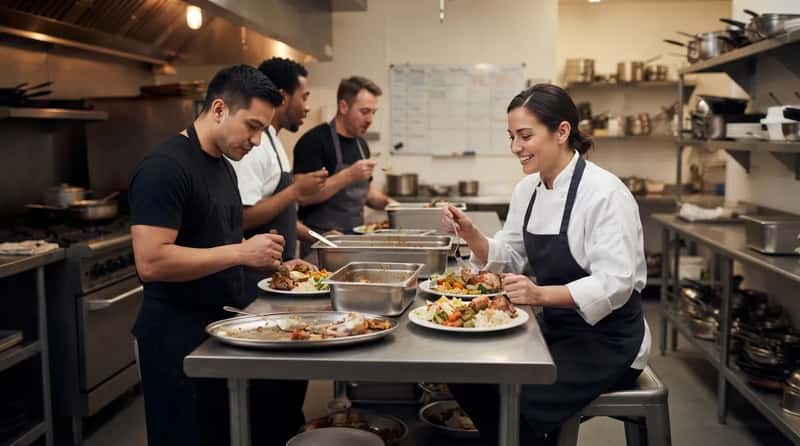
Not every scrap goes straight to landfill. A growing number of restaurants are finding smarter exits for food that would otherwise be wasted.
Some leftover buffet food is sold at a discount through surplus food apps, giving restaurants a way to reach new customers and make money on what would have become waste. These apps have expanded rapidly in recent years, letting consumers grab end-of-day meals at steep discounts.
Staff meals are another quiet outlet. Food that hasn’t been on the public-facing buffet line but is surplus from the kitchen can legally be offered to employees, and in many restaurants this is just a routine part of how kitchen staff eat on shift.
When a tray of food meant for the buffet display has been kept at a safe temperature but isn’t needed, it can sometimes be repurposed the next day. Temperature logs and chain-of-custody records are everything here.
These aren’t large-scale solutions yet – but they’re real, and they’re growing. Now for one of the strangest destinations for buffet leftovers, at #4…
#4 – Some of It Literally Ends Up Feeding Pigs
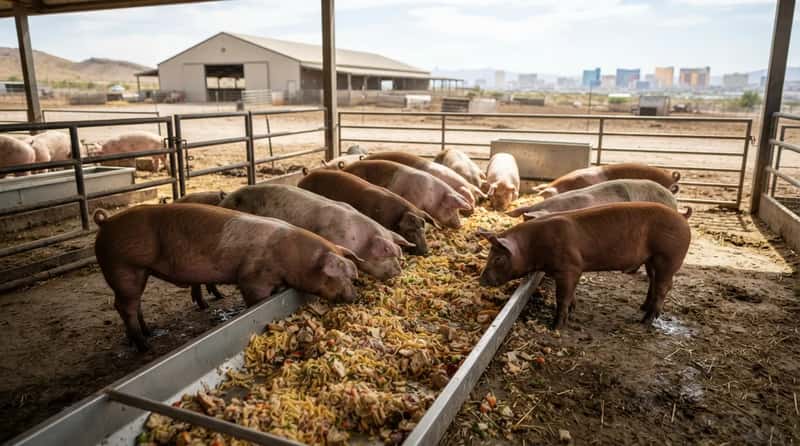
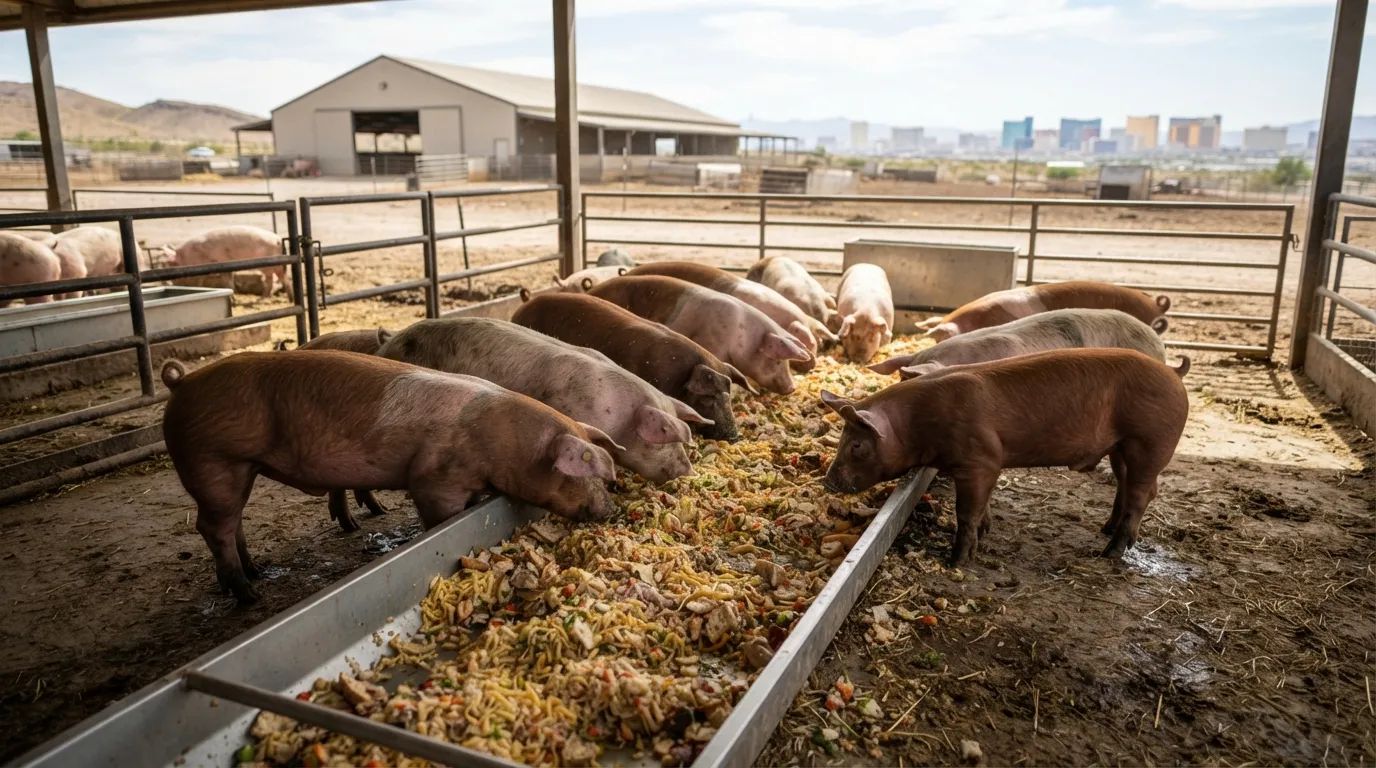
This one surprises almost everyone: large pig farms can accept food scraps from buffets to feed their livestock, as long as the scraps are cleaned and pasteurized first. This has been common practice in Las Vegas – so common that the decline of casino buffets is now hurting at least one local farm.
It’s a legitimate, circular food system: kitchen scraps become animal feed, and the animals go to market.
The buffet, in a roundabout way, feeds more people than it appeared to.
Worth Knowing
- Farms only accept scraps once they’re cleaned and pasteurized – raw handoffs aren’t allowed.
- The practice is deeply tied to Las Vegas casino buffet culture.
- Pasteurization requirements vary by state, so not every farm or region can take part.
- When it works, it closes the loop: scraps become feed, and feed becomes food again.
Buffet restaurants that use this route donate food pulled from the buffet line to local pig farmers, avoiding the landfill entirely and shrinking their overall waste footprint.
This practice is more regulated than it sounds – pasteurization requirements vary by state, and not every farm or region supports it. But in cities with dense buffet culture, it’s a genuinely active pipeline.
The environmental stakes of getting this wrong are at #3, and they’re bigger than most people realize…
#3 – The Environmental Cost Is Hidden in Plain Sight
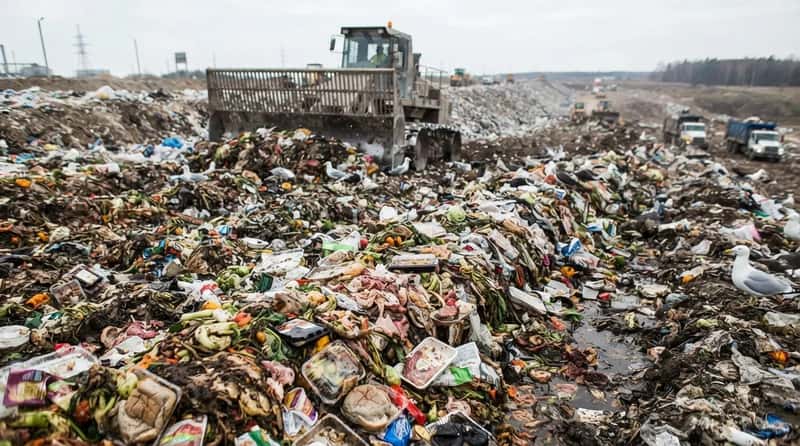
The scale of buffet food waste isn’t just a restaurant industry problem. It’s a carbon problem.
Research approximates that one kilogram of food waste produces almost two kilograms of carbon dioxide equivalent emissions and results in the exhaustion of 2.9 tons of natural resources, including contribution to species extinction and loss of biodiversity.
Food waste that ends up in landfills creates methane – a greenhouse gas 25 times more harmful than CO₂ – and food is the single largest component of landfills, making up 24% of all waste.
At a Glance
- 1 kg of food waste produces almost 2 kg of CO2-equivalent emissions.
- Each kilogram also drains roughly 2.9 tons of natural resources.
- Landfill methane is about 25 times more potent than CO2.
- Food makes up 24% of everything sitting in landfills.
- In Germany, buffets alone account for 45% of hospitality-sector food waste.
In Germany, buffet waste alone accounts for 45% of all food wasted in the entire hospitality sector – more than plate waste, preparation waste, and storage losses combined. That’s not a rounding error; that’s a structural failure.
UNEP’s 2024 index showed that 1.05 billion tonnes of food were wasted in 2022 – representing 19% of all food available to consumers across retail, food service, and households. Buffets are a significant driver of that number.
The dollar figures behind this waste are where things truly become jaw-dropping. That’s what #2 is about…
#2 – The Dollar Value Being Thrown Away Is Staggering
Here’s the number that should make every buffet owner lose sleep. Nearly half of the food at buffets is wasted, contributing to 108 billion pounds of food wasted in the United States every year – equivalent to 130 billion meals and worth more than $408 billion in lost value annually.
The hotel industry alone generates 289,000 tons of solid waste annually – 79,000 tons of which is food. U.S. hotels spend over $35 billion each year on banquets and catering, generating enormous volumes of uneaten leftovers.
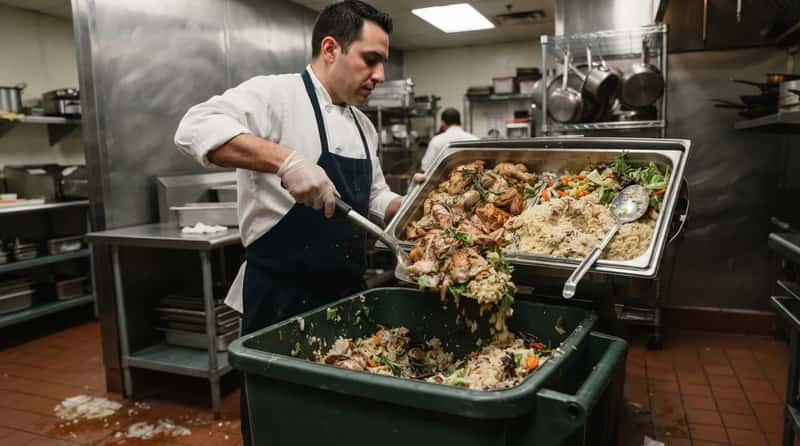
Every tray of untouched roast chicken or cooling risotto at a hotel buffet represents real money simply being shovelled into a bin. And that’s exactly what some hotel staff have been witnessed doing – literally wheeling in large bins and shovelling untouched food directly off platters.
A case study of a hotel lunch buffet found that 46% of food produced was never consumed. A separate audit of an 800-person event found the kitchen produced about 2 pounds of food per person, when the average person only eats about one pound.
The industry knows this. Some are finally starting to fight back with technology – and the results at #1 might be the most important part of this entire story…
#1 – Smarter Technology Is Starting to Fix the Whole System
Here’s the real reason to pay attention to this issue right now: the fix exists, and it works.
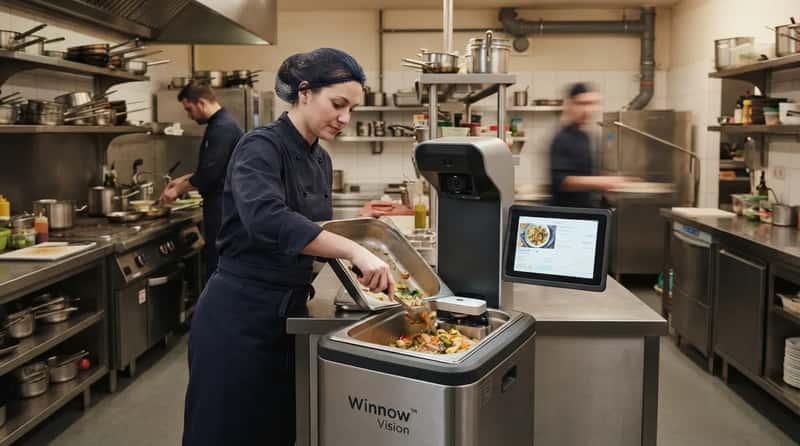
Software solutions like Winnow apply machine learning to data from smart bins and electronic scales to track food waste over time. One group of German hotels using this technology reduced their food waste by 42.7%-84.3%, potentially saving 9,000 EUR per year per kitchen.
That’s not a marginal improvement – that’s a near-elimination of waste in some cases. And it comes purely from better data, not from changing the menu or the concept.
Why It Stands Out
- Smart-bin systems have cut kitchen food waste by up to 84% in real hotel trials.
- Some kitchens now save around 9,000 EUR a year once waste drops.
- Predictive inventory tools match prep volume to actual demand, not guesswork.
- Composting and food-sharing apps give surplus trays a second life instead of a landfill fate.
Buffets are increasingly using sophisticated inventory management systems that predict how much food to prepare based on historical data, time of year, and special events – cutting down significantly on excess food generated.
Smaller portions refilled more frequently, and staff training to guide diners at the buffet, are two additional measures the industry is actively exploring to curtail the problem at its source.
Closer coordination between catering providers, community groups, and charities could redistribute surplus food before it becomes unsafe – with food-sharing apps and community fridges playing a growing role. Many large hotels now also use on-site composters to turn food waste into nutrient-rich soil fertiliser.
The tools are here. The question is whether the industry will actually use them at scale – or keep shovelling perfectly good food into bins.
The Bottom Line
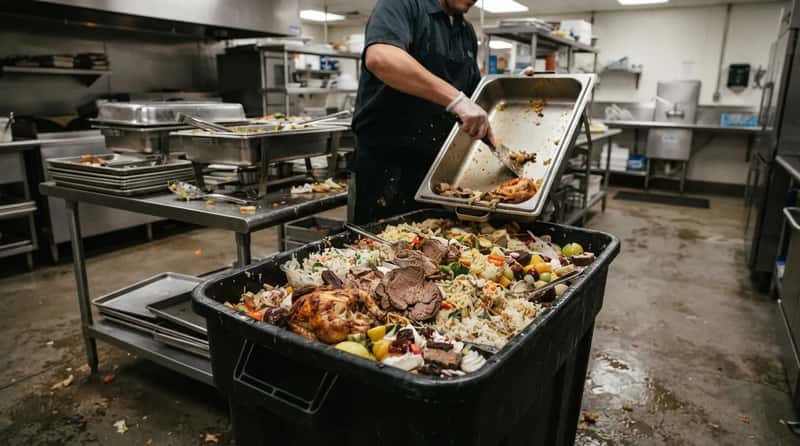
Most buffet food that guests don’t take ends up in landfills – and the scale is almost impossible to overstate. Research shows buffet providers waste almost half of everything they put out, and most of that goes straight into the trash.
Some finds its way to pig farms, discount apps, or staff meals. A small fraction gets donated – but only at hotels that have actually set up a donation program, which is fewer than one in three.
The environmental and financial cost is real and measurable, and technology is already proving it can be fixed. The will to do it industry-wide is still catching up.
Next time you walk past a buffet tray, you probably won’t look at it the same way again. Have you ever seen a restaurant handle this the right way – or the very wrong way?
Drop it in the comments.
Bonus – The One Trick That Gets You Fresher Food (and Cuts Waste)
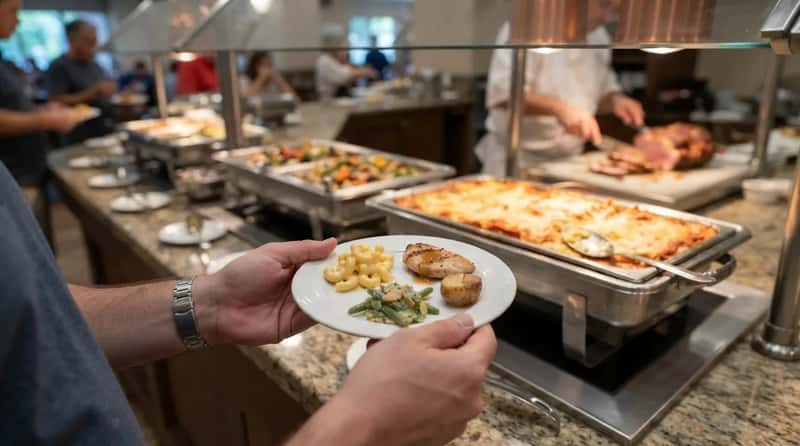
Most of the waste you just read about happens because of one thing: over-serving yourself on the first pass. Fix that, and you personally cut your share of the “half of what’s on your plate goes uneaten” problem almost overnight.
Here’s the actual insider move regular buffet-goers and even some staff use:
- Take a small “scout” plate first. Grab a few bites of 3-4 items instead of a full plate – this is how you find out what’s actually good before committing real portions.
- Go back only for what you finished. Refills should mirror what you actually cleaned off your plate, not what looked good under the heat lamp.
- Ask when trays get refreshed. Staff usually know their own restock rhythm; arriving right after a refresh means hotter, fresher food instead of stuff that’s been sitting under the lamp.
- If you want food to-go, ask before it hits the line. Once food is on the public buffet it legally can’t be packaged for you – but kitchen staff can sometimes box up a fresh-cooked portion straight from the back if you ask politely and early.
None of this requires the restaurant to change anything. It’s a habit shift that gets you better food and quietly shrinks the mountain this whole article is about.