Most travelers assume airport security starts and ends with a metal detector and a quick glance at a screen. That assumption is wrong, and it’s not even close.
By the time your carry-on reaches the belt, someone has likely already been reading you – not just your bag – for several minutes. What follows is a countdown through everything officers are trained to notice before they ever touch your zipper, and some of it will change how you pack tonight.
#10 – The X-Ray Color Code Nobody Explains to You
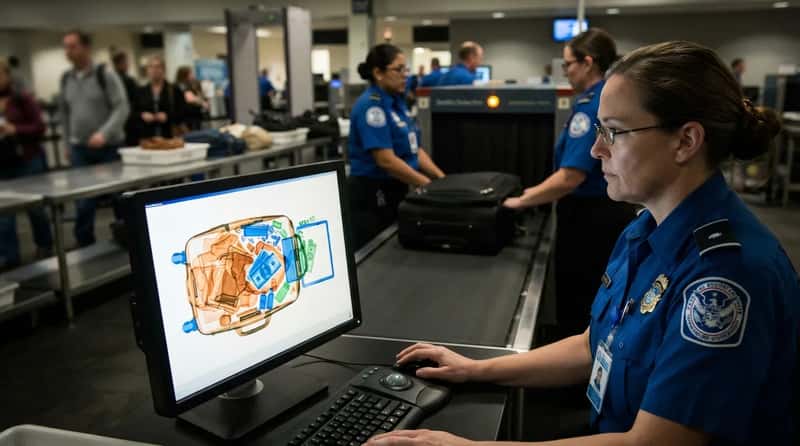
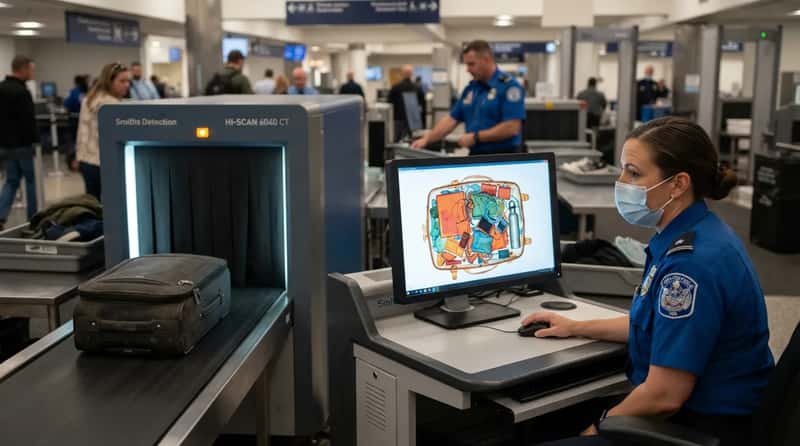
Security officers read your bag’s X-ray image like a color-coded map. Every material passes through the scanner differently, and that difference is exactly what gives you away.
Metals, liquids, and organic material each render in their own distinct color on the monitor. Officers are trained to flag anything that doesn’t match its expected color signature.
Dense objects show up darker, while food, drugs, and certain fabrics glow differently than metal or plastic. A trained eye can tell within seconds if something doesn’t belong.
That’s why hiding cash or pills inside an electronic device almost never works. The color gives it away every time.
But the color-coding is just the opening act of what officers actually see on that screen.
#9 – The 3D Rotation Trick That Changes Everything
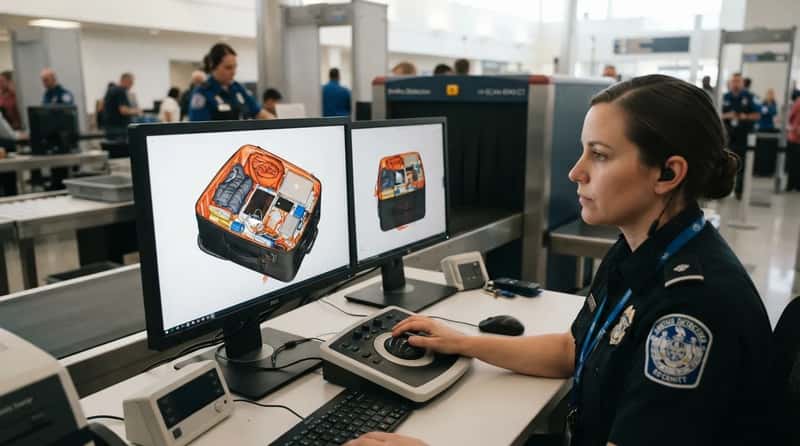
Older scanners only show a flat, top-down image. The newer generation does something far more powerful.
CT scanners build a full 3D image that officers can rotate 360 degrees on screen. A suspicious shape can no longer hide behind another object.
The bag doesn’t even need to be opened for an officer to look inside a rolled-up jacket or under a false bottom. They already have the three-dimensional picture in front of them.
Burying something at the bottom of a bag used to work. At any airport running CT scanners, that trick is dead.
And what actually counts as a “threat” on that rotating image isn’t always what you’d guess.
#8 – Clutter Is Its Own Red Flag
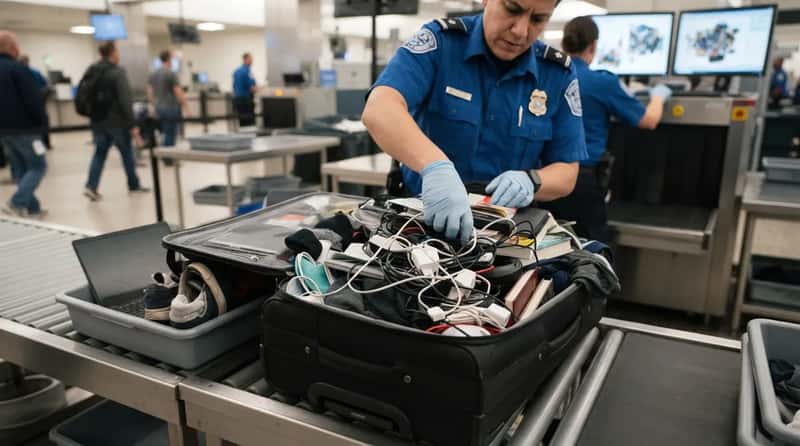
A messy bag isn’t just annoying to pack. It actively invites a closer look.
Overstuffed bags read as a dense blur instead of a clear image, and a blur means one thing to an officer: manual search. Ambiguity is the enemy of getting waved through.
The single most common reason a bag gets pulled isn’t a weapon – it’s disorganized packing that obscures the image.
Stuffing shoes with socks or chargers, or mixing unrelated items together, can distort shapes enough to trigger a second look. It’s rarely about what you packed – it’s about how unreadable it made the picture.
That’s mildly annoying. What comes next is genuinely surprising.
#7 – Your Peanut Butter and Cheese Are Legitimate Suspects
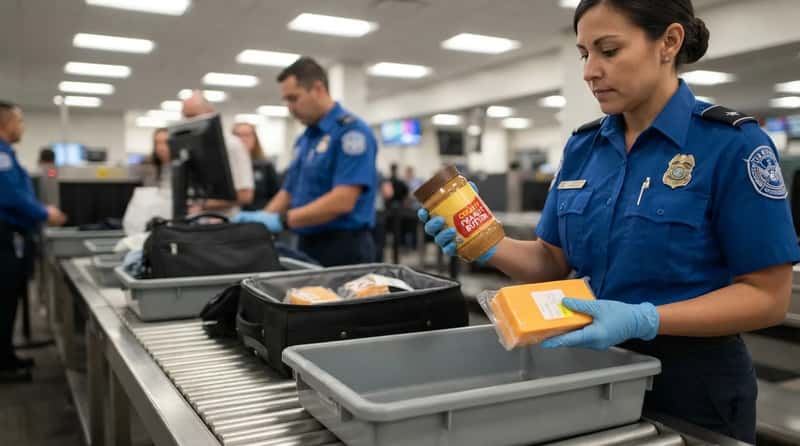
Food causes more bag searches than most passengers ever expect.
Dense, opaque foods like cheese, peanut butter, and wrapped candies can block the scanner’s view completely. On an X-ray, a thick jar of peanut butter and a block of plastic explosive can share an unsettlingly similar density signature.
A four-dollar jar of almond butter has caused more missed flights than most travelers would ever believe.
Solid foods are usually fine, but spreads follow the same rules as liquids and gels. Stack enough dense organic matter together – even a pile of paperback books – and you create the same problem for the scanner.
Fast Facts
- A standard PB&J sandwich screens fine, but a full jar of peanut butter can technically violate the same rule as a full-sized bottle of shampoo.
- Water bottles are by far the most commonly surrendered item at TSA checkpoints, according to a former TSA officer.
- Everyday organic foods such as coffee grounds and chocolate can look similar to explosives on the X-ray screen.
Food is one thing. What your electronics do to that image is another problem entirely.
#6 – Electronics Hidden Inside Your Bag Create a “Blind Spot”
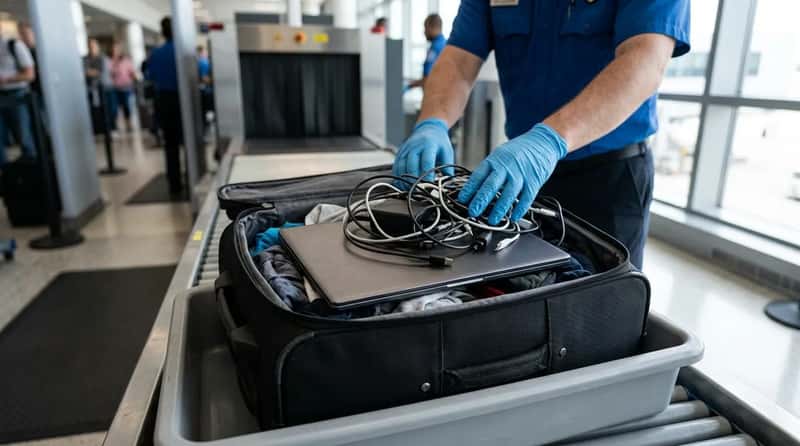
TSA doesn’t ask you to pull out your laptop for bureaucratic theater. It’s pure physics.
A laptop left inside a packed bag creates a dense electronic shadow on the scan. Anything hidden behind that shadow – intentional or not – becomes effectively invisible to the machine.
That’s exactly why a bag with a laptop left inside is almost always pulled for secondary screening. Officers know the blind spot exists, and they don’t take chances with it.
Tangled charging cables cause a smaller version of the same problem. A spaghetti-knot of cords looks chaotic on an X-ray even when it’s completely innocent.
And there’s an entirely separate system watching you before your bag even reaches the belt.
#5 – Behavior Detection Officers Are Already Watching You in Line
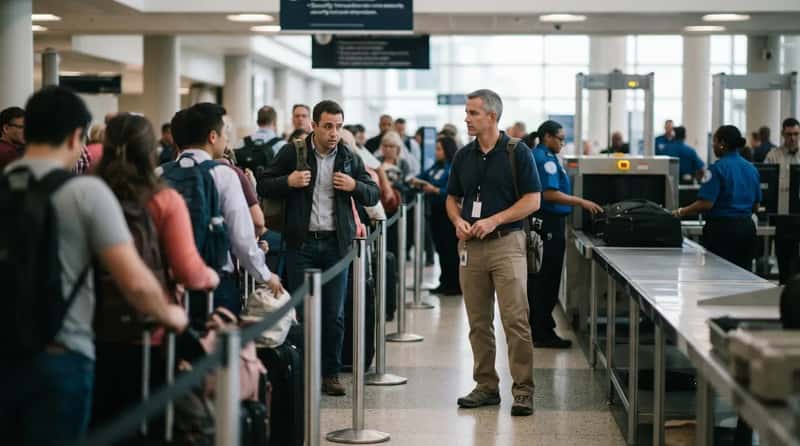
Most passengers have no idea that some officers are scanning the crowd, not the bags.
Plainclothes behavior-detection officers strike up casual conversations while watching for facial expressions, body language, or anything else that reads as a stress signal. They look like fellow travelers, and they’ve likely been watching you since before you reached the checkpoint.
This is part of TSA’s SPOT program – Screening of Passengers by Observation Techniques. The program has cost taxpayers more than $900 million since it launched in 2007.
The theory behind it is simple: people trying to hide something display involuntary stress signals they can’t fully control. Officers are trained to catch exactly those tells.
At a Glance
- By fiscal year 2012, about 3,000 behavior detection officers had been deployed to 176 of the more than 450 TSA-regulated airports in the country.
- The program has been running nationwide since 2007, with roughly $900 million spent on it since deployment.
- A government review later found the program’s results were “no better than chance” at spotting deception.
But the science behind all that watching is far shakier than TSA would like you to believe.
#4 – The Secret 92-Point Checklist That Flags Yawning
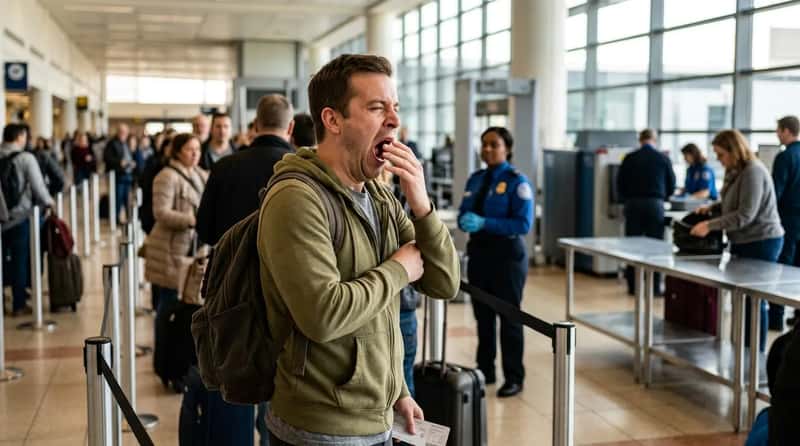
TSA has an actual scoring system for passenger behavior, and some of what it flags will genuinely surprise you.
A leaked 92-point checklist shows officers scoring travelers on mundane physical reflexes believed to signal deception. Each behavior carries its own point value, quietly building toward a threshold that can trigger questioning.
Yawning too dramatically, whistling in line, or having sweaty palms can technically add points to your suspicion score. Most of these behaviors describe an ordinary nervous flier, not a criminal.
Documents released under the Freedom of Information Act include studies undermining the entire premise. Attempts to spot deception through physical tells are, by the government’s own research, highly subjective and unreliable.
The next trigger, though, has nothing to do with psychology – and it’s nearly impossible to fool.
#3 – Explosive Trace Detection: The Swab That Knows Everything
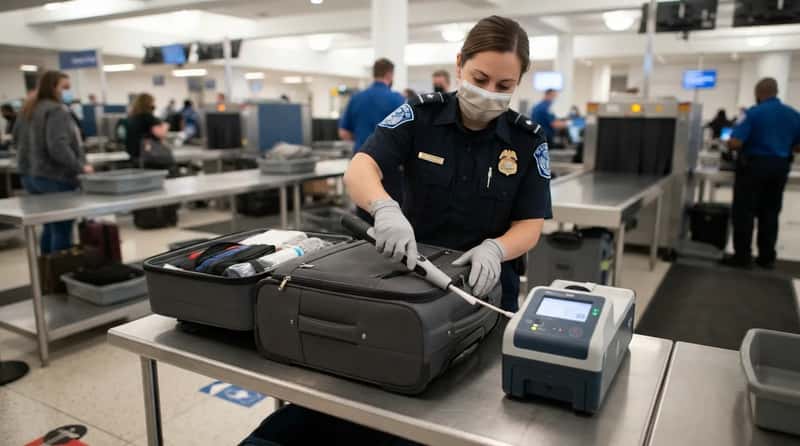
If your bag survives the scanner and officers still aren’t satisfied, there’s one more tool that terrifies smugglers.
Explosive Trace Detection machines screen luggage and hands for microscopic residue. Officers swab a bag or a passenger’s palms, then feed that swab into a detection unit built to catch amounts invisible to the eye.
A single microscopic particle of explosive residue is enough to trigger a full secondary screening. This matters more to ordinary travelers than they realize.
Certain fertilizers, some medications, and even a few hand lotions can trigger a positive reading. It isn’t only bombers who sweat this particular test.
Combined with the scanner, this swab creates a near-complete chemical fingerprint of your bag – before a single zipper gets touched.
#2 – Metal Shielding: The Smuggler’s Trick That Backfires
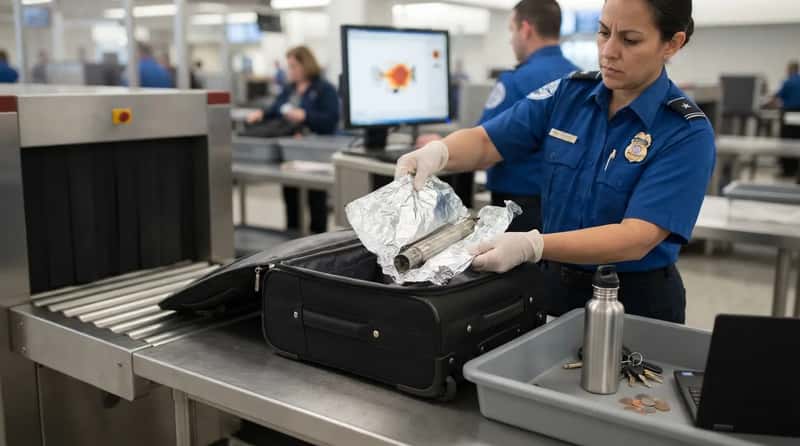
Some travelers try wrapping objects in foil or hiding them inside metal containers. Officers are specifically trained to catch exactly this move.
Metal can block scanning equipment from seeing through an object entirely. TSA doesn’t ban foil outright, but that shielding effect is precisely why foil-wrapped items so often trigger a hand search.
The rule of thumb among officers is simple: if they can’t explain it, they open it. Trying to shield something from view makes it look far more suspicious, not less.
This applies to ordinary travelers too. Stacking coins, keys, a metal water bottle, and a laptop together in one layer creates a metallic blur that reads like a threat, even when it’s nothing but loose change.
But the single most revealing thing officers notice happens before your bag ever touches the belt.
#1 – How You Packed the Bag Tells Officers Almost Everything
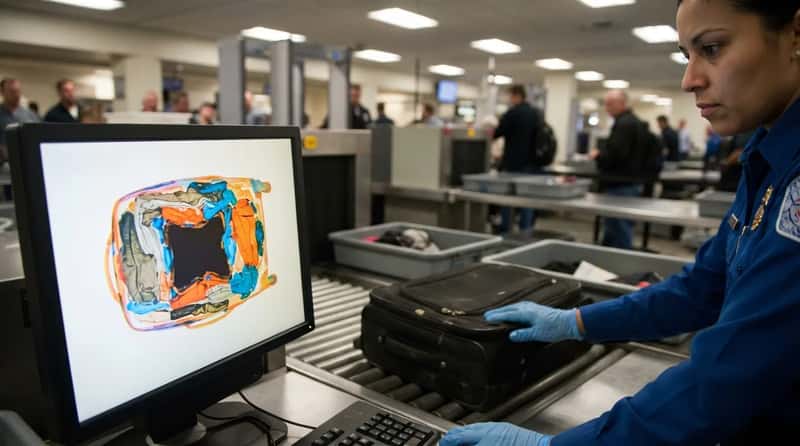
The story of your carry-on starts long before the X-ray image ever appears on screen.
Officers who’ve screened millions of bags develop an almost unconscious sense of what “normal” looks like. A bag packed suspiciously neat around an empty central void is a known red flag – and so is a bag that’s obviously been repacked in a hurry.
TSA screens roughly 3.3 million carry-on bags for explosives every single day. At that volume, officers build a pattern-recognition instinct most passengers never think about – and anything that breaks the pattern gets a second look.
Sometimes the most innocent items spark a search, from lip balm to a jar of peanut butter. When an X-ray flags something unclear, an officer has to open the bag by hand to find out what it actually is.
Worth Knowing
- In 2021, TSA discovered 5,972 firearms at checkpoints nationwide, and about 86 percent of them were loaded.
- TSA also screens roughly 1.3 million checked bags every day, on top of the millions of carry-ons.
- The number of weapons found at checkpoints has climbed almost every year since TSA began tracking the data.
What officers are really reading isn’t just what’s inside your bag. It’s the intent behind how you arranged it – and after millions of bags, they’ve learned to read that story fast.
The Bottom Line
Security officers read far more than a list of banned items. They read density signatures, color codes, packing behavior, and even body language, all at once.
The biggest triggers were never really about weapons – they’re overstuffed bags, dense foods, tangled cables, and metal that shields the scanner’s view. CT scanners now rotate a full 360 degrees, so depth and concealment no longer buy anyone protection.
Even your posture in line is quietly being scored before your bag reaches the belt. Pack it clean, pull the electronics, skip the foil-wrapped snacks, and try not to whistle nervously at the checkpoint.
Did any of this surprise you, or has your bag ever been pulled for something completely unexpected? Tell us what happened.
Bonus: The One Packing Order Officers Use on Their Own Bags
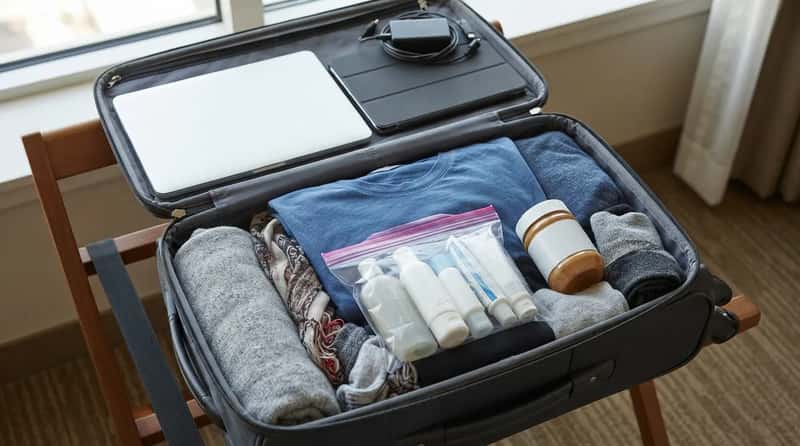
Here’s the trick that ties everything above together: officers don’t pack by category, they pack by density separation – and you can copy it in under two minutes.
- Isolate every dense item. Laptop, tablet, phone charger brick, jars, and cosmetics each get their own “lane,” separated by at least a few inches of soft clothing so their shapes never touch or overlap on the scan.
- Lay electronics flat, in a single layer, near the top. Never stack a laptop under shoes or a jacket – that’s exactly the blind spot officers described in the electronics section above.
- Keep dense food separate from electronics. A jar of peanut butter sitting next to a laptop reads as one giant blob; move it to an outer pocket by itself instead.
- If you have TSA PreCheck or Clear access, use it whenever it’s offered. Those lanes almost always run the newer CT scanners, which rotate the image in 3D – meaning a well-separated bag is far less likely to get flagged for a hand search in the first place.
None of this requires new gear or extra time at home. It just means packing in “lanes” instead of piles – the exact habit that makes an officer’s screen look boring, which is precisely what you want it to look like.