
Colonial Williamsburg’s famous Christmas look, with fruit on the doors and a single candle in the windows, didn’t come from the 1700s. It took shape in the early 20th century. That sounds like a letdown until you stand on the street at dusk, when fire, music and fireworks take over and the real story turns out to be stranger than the postcard.
Here are 11 traditions worth planning your trip around, and several are free to watch from the street. The biggest events fall on three weekends, December 5, 12 and 19 in 2026, and pick the wrong night and you can miss the best of it. This countdown climbs from a tree lighting to a night whose name has nothing to do with Christmas, and the last entry explains why.
#11 – A 40-Foot Spruce With 7,500 Lights
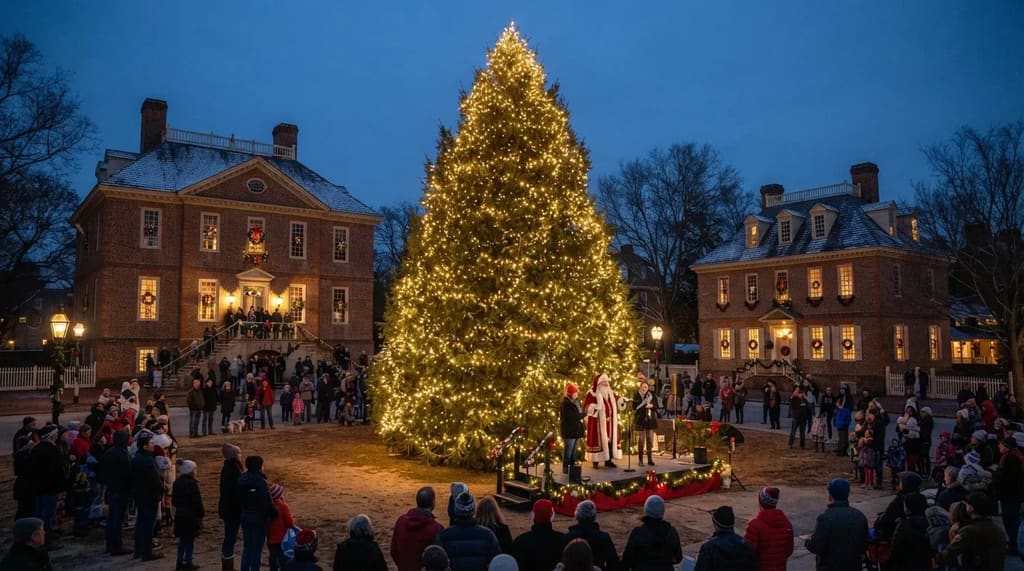
Start with the warm-up, because it’s short and easy to fit in. The Community Christmas Tree Lighting takes place on Thursday, December 3, and no event ticket is required. Father Christmas helps light a live, 40-foot spruce with over 7,500 lights on Market Square.1
Plan to be on the Courthouse steps by 5:00 p.m. on Thursday, December 3, because the program runs only half an hour. Expect a reading of The Night Before Christmas, the story of the first Christmas tree in Virginia, and classic carols. The Kiwanis Club of Williamsburg co-sponsors it, so it feels like a small-town gathering more than a museum program.1 That makes it a gentle first evening while you’re still finding your way around.
A tree is one decoration. A garden club and two historic hotels show what whole buildings look like when they’re dressed for the season.
#10 – Garden Club Homes and Gingerbread Hotels
Some of the prettiest decorating happens indoors. The 65th Annual Christmas Homes Tour is listed for December 5 and covers Colonial Williamsburg properties decorated by the Green Spring Garden Club. That’s the same day as the first fireworks, so check the listing for tour times before you build the rest of the day around it. The Homes Tour is Saturday, December 5.
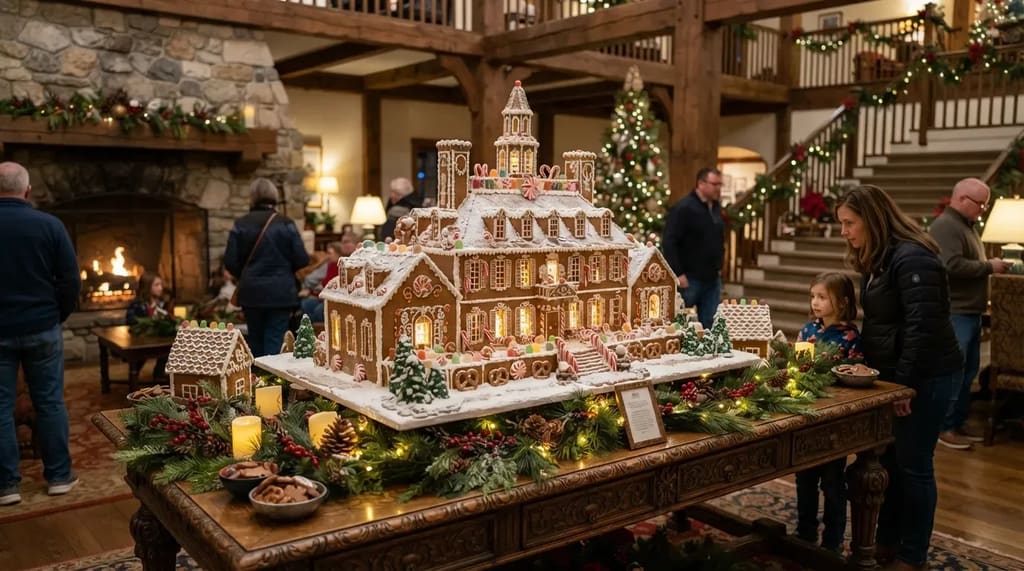
The hotels join in too. Historic hotels and inns around Colonial Williamsburg sparkle with traditional lights, the Williamsburg Inn holds an annual lighting ceremony, and the Williamsburg Lodge hosts a Gingerbread Open House. If you only have one afternoon, spend it on the streets. The hotel stops are better saved for a rainy day, when you’ll want somewhere warm to duck into.
At a Glance
- The event: 65th Annual Christmas Homes Tour
- The date: Saturday, December 5
- The decorators: the Green Spring Garden Club
- The overlap: it falls on the first fireworks night
- The hotel extras: a Williamsburg Inn lighting ceremony and a Williamsburg Lodge Gingerbread Open House
Back outdoors, the decorations that fill phone cameras hang on ordinary doors, and every one of them is built from food.
#9 – Doors Covered in Apples, Pineapples and Oyster Shells
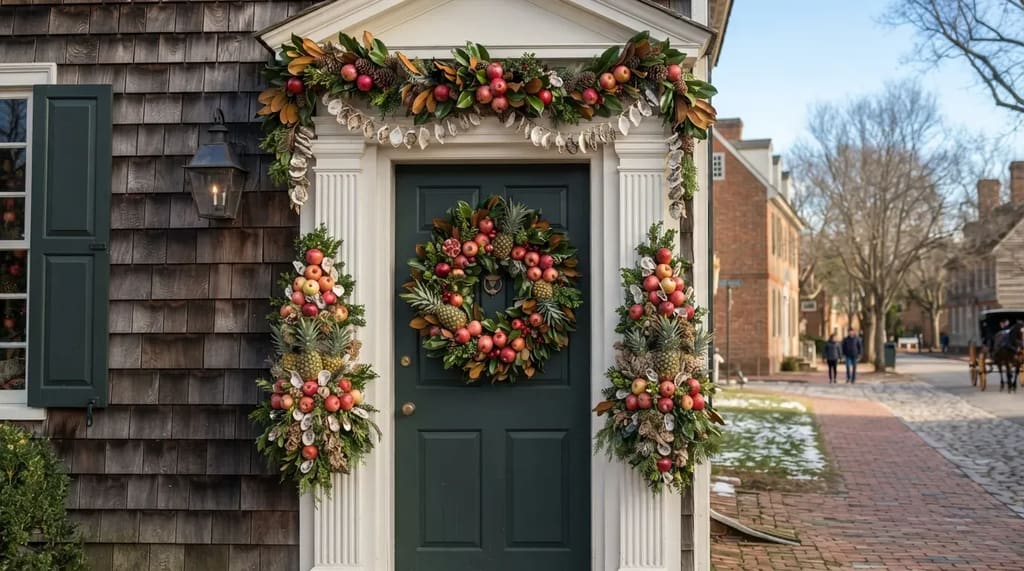
The Foundation’s own journal says millions of people have visited the Historic Area at Christmas just to admire the door decorations. The look runs to fresh apples and pomegranates, magnolia leaves and oyster shells. Pineapple-studded wreaths, oyster-shell-trimmed swags and apple fans are among the highlights. A slow walk down the street turns into a friendly competition between buildings.
You don’t need a ticket for this part. You can walk the streets of the Historic Area without one; a ticket is only required for the historic buildings and the Art Museums.2 The doors read best in daylight, when you can see the color and texture of the fruit, so save dusk for the fire and music. The doors are free to view from the street.
That much fruit hanging outside would have shocked a family in the 1700s, when fruit in winter counted as precious.
#8 – Fruit Too Costly to Hang Outside
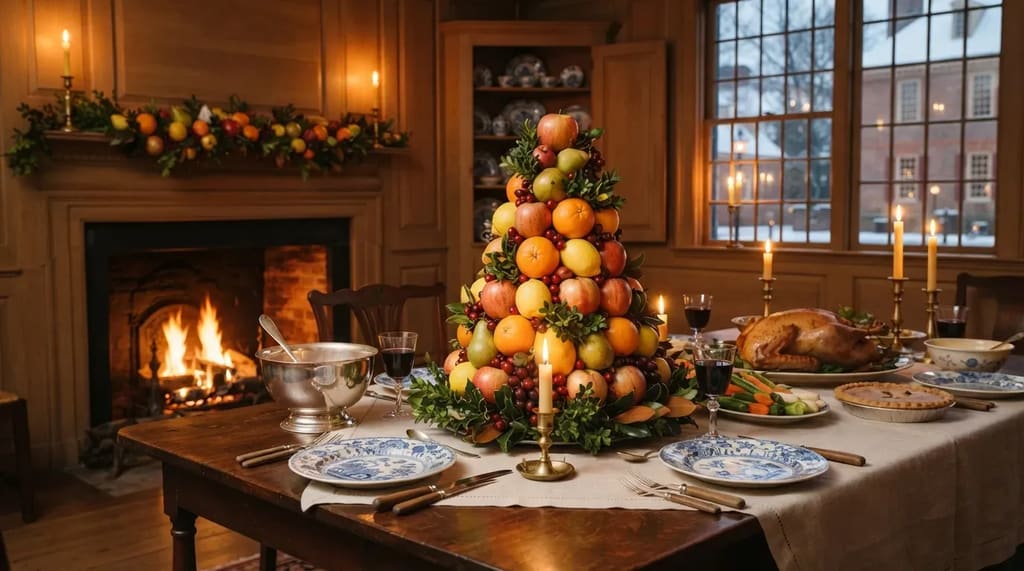
In 18th-century Virginia, a winter apple was worth more on the table than on the door. Colonial Williamsburg’s history pages note that candles and fruit were precious commodities in the eighteenth-century winter, and today’s display is a bit extravagant by 18th-century standards. A household that owned fresh fruit in December would have eaten it or served it at a special meal.
The table is where the real colonial look lives. Fruit pyramids appear in European prints as early as the 17th century and on Virginia dinner tables from the colonial period through the Civil War. The pineapple’s rise to wreath star is less clear, and no one knows for certain how it became an essential element of the decorations. The fruit pyramid is the decoration with real colonial roots.
Fruit is for looking at. The next tradition is for listening, and it starts while there’s still daylight.
#7 – Wassailing and Scottish Songs Down the Street
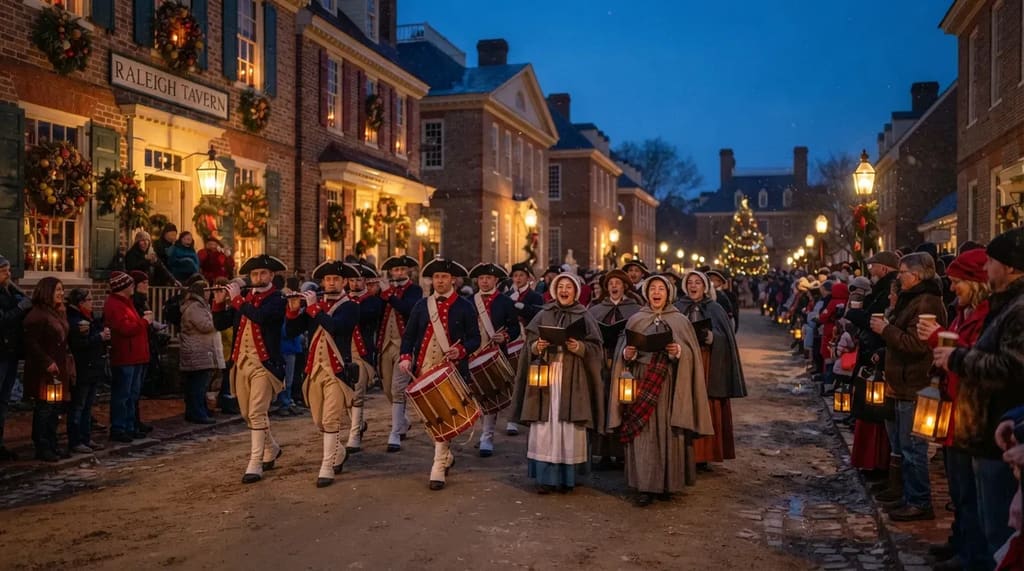
Music runs on several stages at once. Grand Illumination brings musical performances to multiple stages throughout the streets. Visit Williamsburg lists the Fifes and Drums, “Wassailing in Williamsburg,” Scottish songs and traditional carols.2 A procession led by the Colonial Williamsburg Fifes & Drums is part of each evening.3
Local groups fill the schedule too. Last year’s announced lineup included the Colonial Singers of Williamsburg, the Jubilee Performers and the Tarpley Ringers. One tour operator’s itinerary for the weekend of December 11 puts the Fifes & Drums processions and the Ringing of the Bells at 5:00 p.m. Showing up at 6:45 just for fireworks means missing the part with room to wander. Arrive near 5 p.m., two hours before the fireworks.
Fast Facts
- The Fifes & Drums procession is part of each Grand Illumination evening.
- Other listed sounds: wassailing, Scottish songs and traditional carols.
- Last year’s local groups: Colonial Singers of Williamsburg, Jubilee Performers and Tarpley Ringers.
- One weekend itinerary puts the processions and the Ringing of the Bells at 5:00 p.m.
#6 – Father Christmas Telling Stories on Palace Green
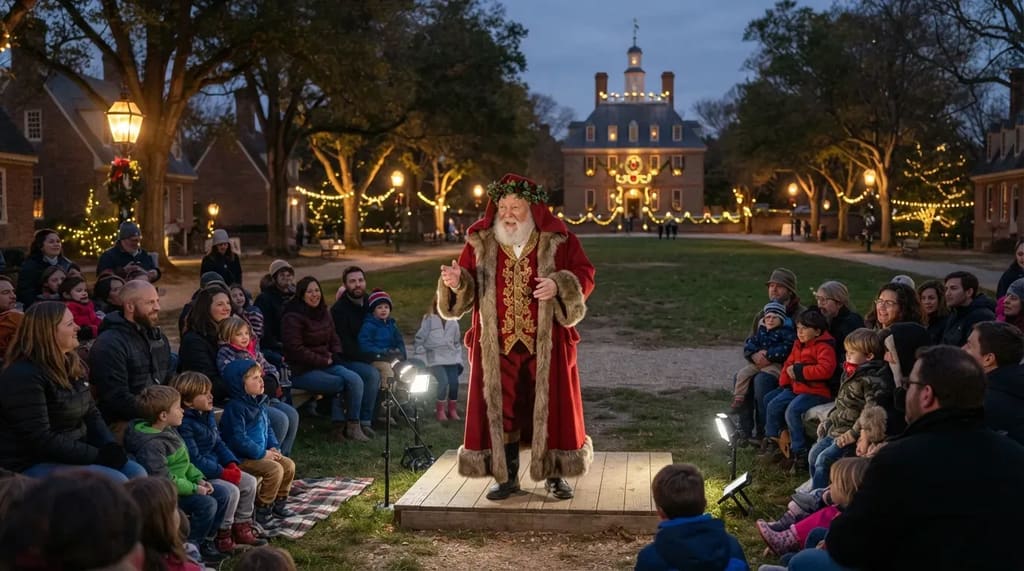
Saturday evenings include storytelling on Palace Green and a special appearance by Father Christmas. The same character shows up at the tree lighting from #11, where he helps illuminate the spruce. If you’re traveling with grandchildren, this is the stop that gives them something to remember.
Father Christmas is the older English figure, and he suits the setting. Colonial Williamsburg’s history pages treat Santa Claus as a later arrival to early America. Palace Green is also a place to watch the Palace fireworks from, so you can claim your spot while the stories run. Palace Green on Saturday evening does double duty.
#5 – Cressets Burning Where Streetlights Would Be
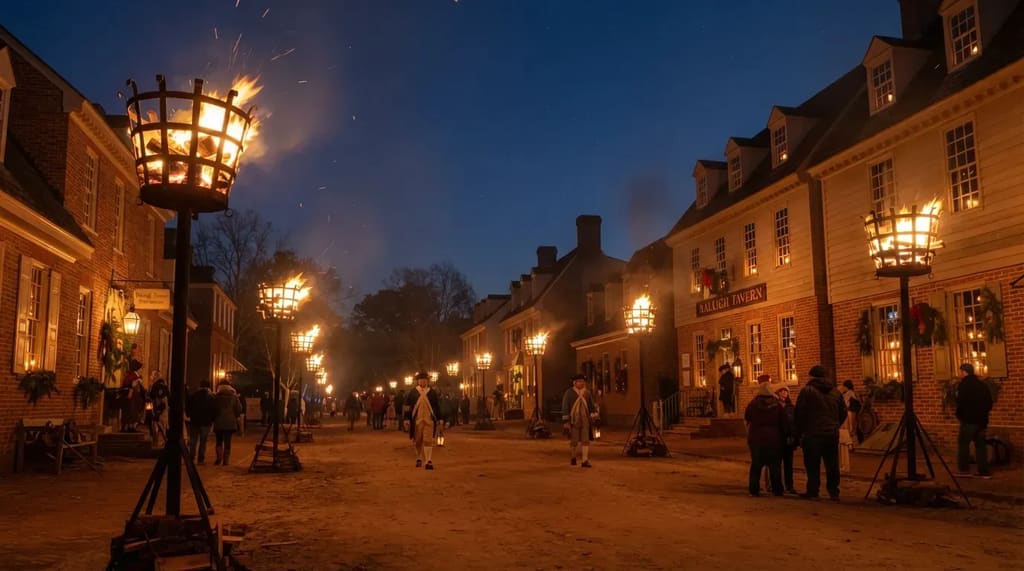
Along Duke of Gloucester Street, the light at Grand Illumination comes from fire. Each evening includes the lighting of the cressets, which are iron baskets of burning wood set up along the way. Between the cressets and the flaming torches, the street goes from daytime museum to something that feels a lot older.
Candles are the older idea behind the whole night. Grand Illumination is based loosely on the colonial and English custom of placing lighted candles in the windows of homes and public buildings to celebrate a special event. So the glow in the windows isn’t just decoration. It’s a way of marking an occasion. Be on the street by 5 p.m. to catch the lighting.
Fire is also behind the tradition that comes the night before, and it involves a log, a wagon and a wish.
#4 – A Yule Log Hauled In by Wagon
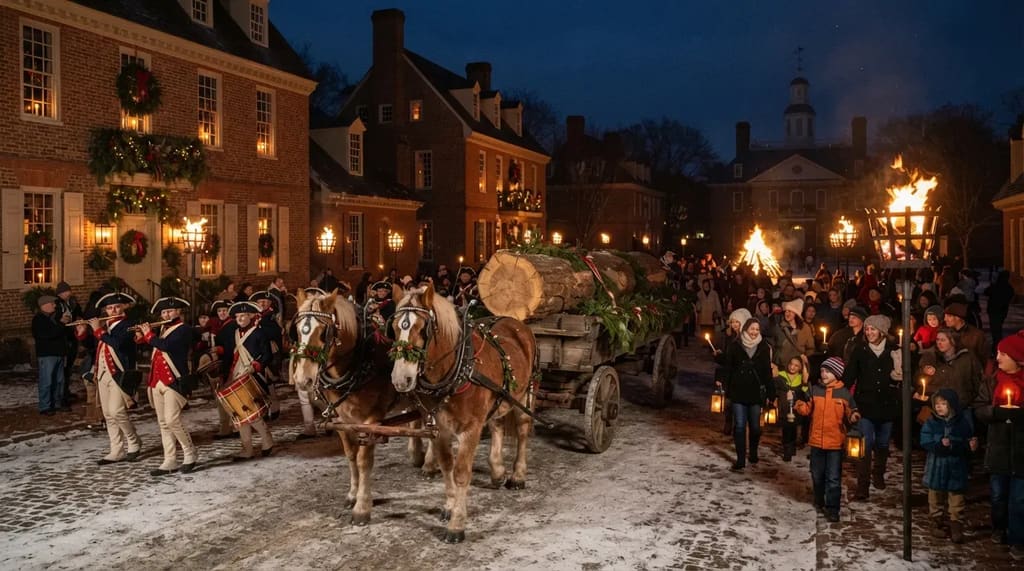
Friday night is when the Yule log arrives. In 2026 the program runs on Fridays, December 4, 11 and 18, with the lighting of the cressets and a procession beginning at the Capitol.3 It’s a non-ticketed event, and you follow the log, hauled by wagon, with music and festivity along the way. The cressets from #5 are lit that night too, so you get the glow without the fireworks crowd.
Then comes the one thing on this list you do instead of watch. Guests make a wish and toss a sprig of greenery into the bonfire.4 If you want to take part, not only look on, Friday is the better night. Friday is the night for the wish and the bonfire.
The wreaths, candles and fruit you’ve just read about share a birth date, and it’s later than you’d guess.
#3 – The Moment Guides Reveal It Isn’t Colonial
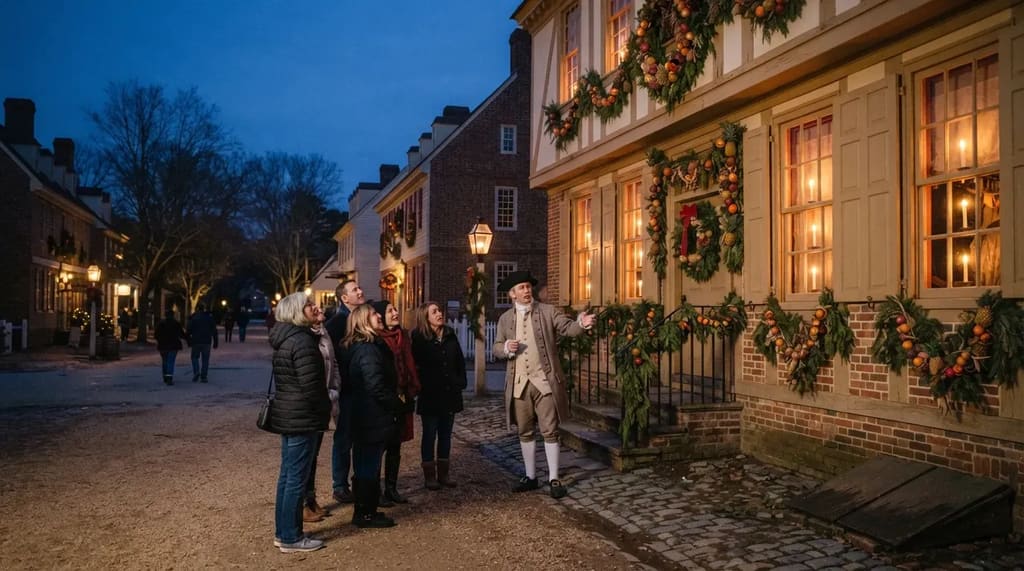
Visitors sometimes gasp at this part. The Washington Post reported that when guides explain that none of the decorations, nor the single candles in the windows at dusk, would have been there in the 1700s, visitors react with surprise.5
The Foundation’s own journal tells the story. When the Historic Area opened to the public in 19346, there were no decorations at all on the exhibition buildings at Christmas. Guests came in great numbers and asked why. Plain evergreen wreaths followed, and then the fruit-bedecked versions that have epitomized the Williamsburg Christmas since.
By 1939 the “della Robbia” wreaths were attracting considerable comment and the “Williamsburg Christmas look” was launched.6 Fruited wreaths seem to have started in America’s wealthier homes in the early 20th century, so Williamsburg adopted a fashion rather than inventing one. Don’t let that spoil it. It’s a deliberate design from the 1930s, and the Williamsburg Christmas look dates to the late 1930s. The Foundation says so itself.
The tradition that closes each Saturday has no such asterisk, though you’ll want to know there are two shows, not one.
Related Stories From Travelbinger
#2 – Two Fireworks Shows Going Off at Once
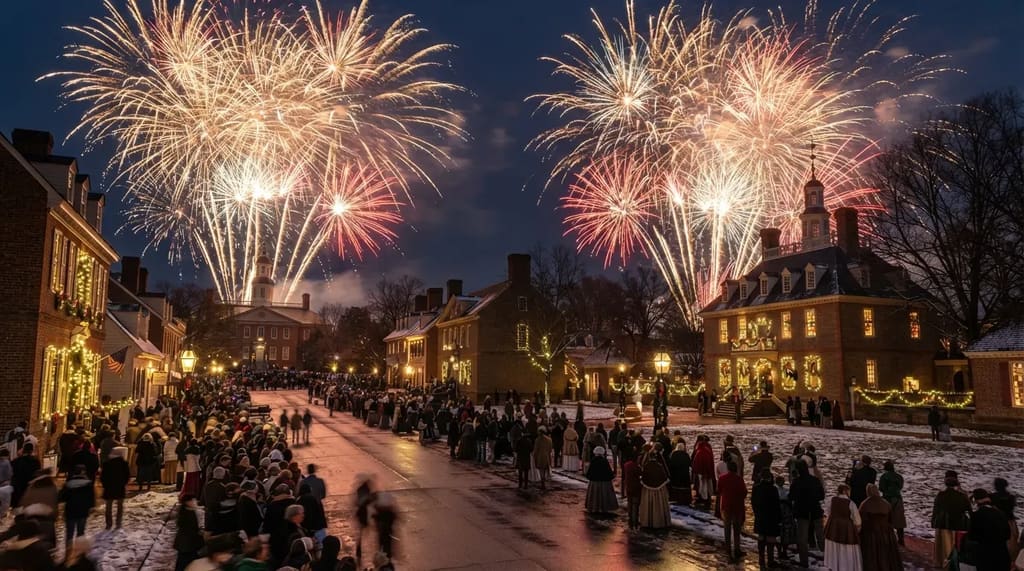
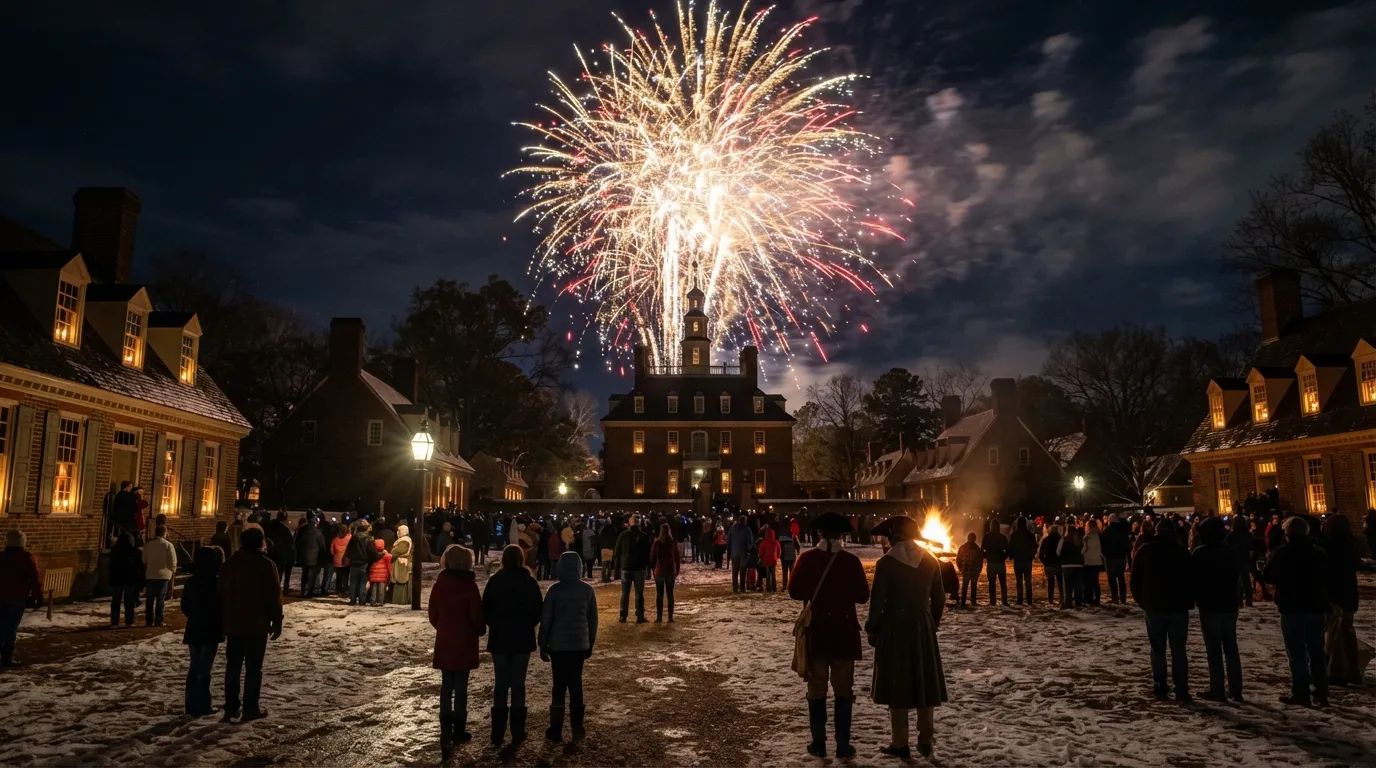
At around 7 p.m. each Saturday, two simultaneous 18th-century-style fireworks displays go up, one at the Capitol and one at the Governor’s Palace.3 7 The City of Williamsburg sponsors them. They’re at opposite ends of the Historic Area, so don’t plan to watch both well from a single spot. Pick one display and stay put.
Visit Williamsburg names Palace Green and Duke of Gloucester Street among the most popular viewing spots, and its advice is to find your spot early. Watching costs nothing, since a ticket is only required to enter the historic buildings and the Art Museums.2 Choose one show and claim your spot early. If you took the Palace Green tip from #6, you’ve already done it.
Everything on this list sits under one name, and in the 1700s that word meant something that had little to do with Christmas.
#1 – Why It’s Called an Illumination at All
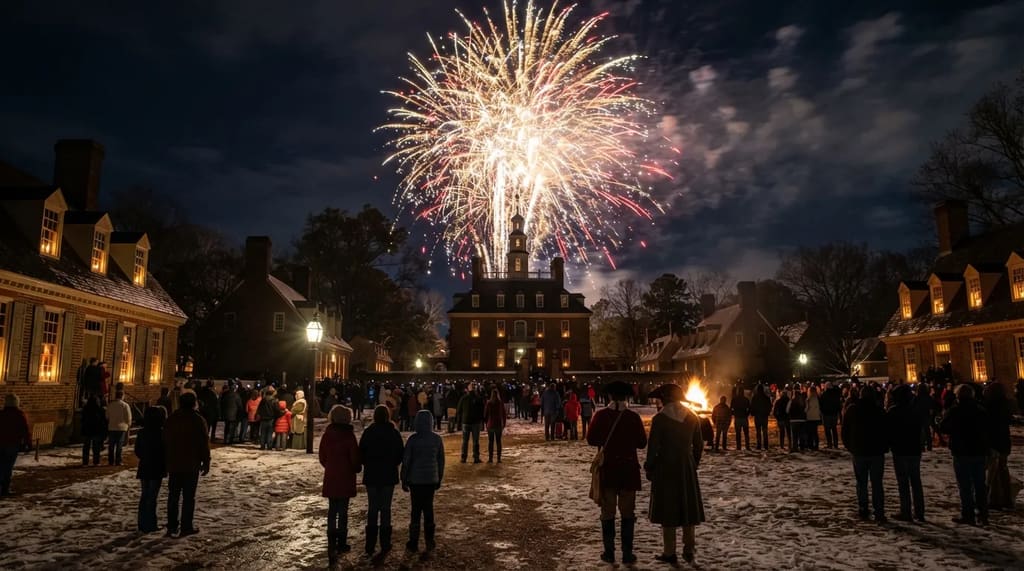
In the 18th century, illuminations meant the firing of guns and lighting of fireworks to celebrate major events, such as the birthday of a reigning sovereign, military victories or the arrival of a new colonial governor.8 That’s the older meaning behind the name of Colonial Williamsburg’s signature December night. It also explains why the evening ends with fireworks over the Capitol and the Palace, and why the candles in the windows from #5 were a way to mark an occasion.
A Williamsburg illumination was a public announcement that something big had happened. So the Grand Illumination isn’t a Christmas custom with fireworks bolted on. It’s a way of marking an event, aimed at the season.
Quick Compare
- Friday (Dec. 4, 11, 18): the non-ticketed Yule log procession from the Capitol, lit cressets, and the wish-and-sprig toss at the bonfire.
- Saturday (Dec. 5, 12, 19): storytelling and Father Christmas on Palace Green, then two fireworks displays around 7 p.m.
- Daylight in between: the fruit-covered doors, free to view from the street.
Colonial Williamsburg’s Holiday Planner lists three Grand Illumination weekends, December 5, 12 and 19 in 2026, with the Yule log on the Friday before each. If you can manage a full weekend, take the Friday for the wish and bonfire and the Saturday for fireworks, and see the doors in daylight in between. Plan Friday for the Yule log and Saturday for the fireworks. Times have shifted from year to year, so confirm them in the Holiday Planner before you go.
The Christmas look you’ll photograph in Williamsburg is a 1930s design, and the habits under it are far older: fire in the street, music on the corner, greenery on the door, a shared bonfire. Judge the visit by what’s lit, sung and tossed in the flames rather than by a date stamp. A tradition can be young and still be good.
What’s one small ritual in your own family’s December, a log, a lit window or a bowl of fruit, that you later found out was younger than you’d always assumed?
- CW Community Tree Lighting: https://www.colonialwilliamsburg.org/events/special-event-community-christmas-tree-lighting/
- Visit Williamsburg Grand Illumination Guide: https://www.visitwilliamsburg.com/blog/post/a-guide-to-grand-illumination/
- Williamsburg Families Grand Illumination: https://www.williamsburgfamilies.com/grand-illumination/
- Williamsburg Families Event Dates: https://www.williamsburgfamilies.com/2026-special-event-dates-in-colonial-williamsburg/
- Washington Post Decorations History: https://iol.co.za/travel/2017-12-21-the-history-of-williamsburgs-beloved-holiday-decorations/
- Williamsburg Wreath Origins: https://dmarlin.com/pastprologue/photos/travel/williamsburg-virginia-wreaths/
- CW Grand Illumination: https://www.colonialwilliamsburg.org/events/special-event-grand-illumination/
- Go Williamsburg Grand Illumination: https://gowilliamsburg.com/events/grand-illumination/