Here is the twist about airport help for travelers over 70: almost none of it switches on because of your age. These services are free and real, and nearly all of them depend on someone asking.
TSA Cares (1-855-787-2227) answers screening questions for passengers with disabilities and medical issues, and like airline wheelchair help, it costs nothing. Skip both and you may spend the trip on long walks, in long lines, lifting your own bags.
The age break at the security checkpoint begins at 75, not 70. And the most valuable service on this list turns on a detail of your ticket that you may never have looked at.
First comes the simplest one, the ride from curb to gate.
#12 – A Free Ride From Curb to Gate
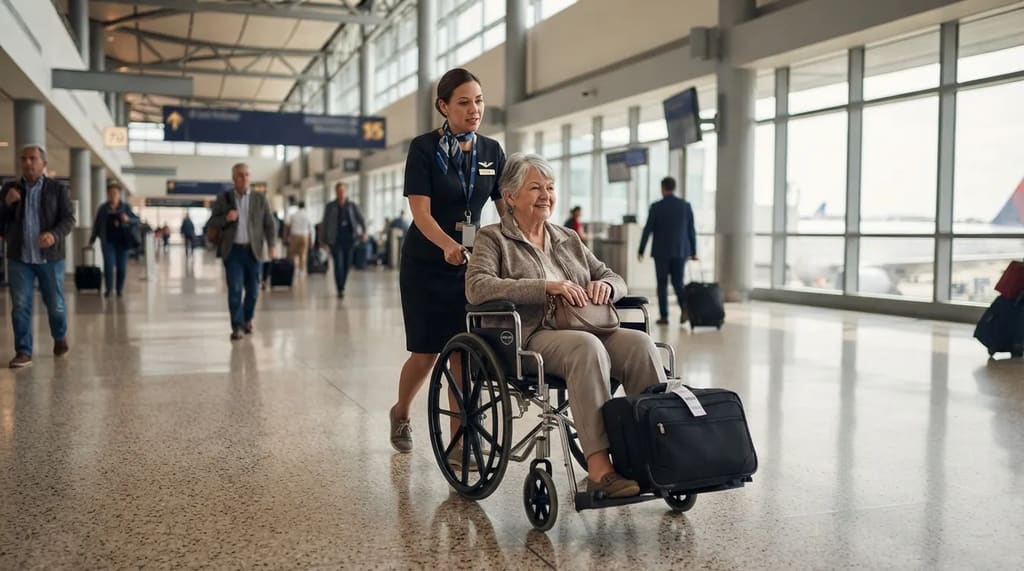
Under the Air Carrier Access Act, U.S. airlines, and foreign airlines flying to or from the United States, must promptly provide wheelchair or other guided assistance to passengers with disabilities who ask for it. The service is free.
No federal rule sets 70 as the age for this help, so it rests on need rather than on a birthday. American Airlines, for one, tells senior travelers to request wheelchair assistance for help with long distances at the airport.1
You may request assistance even if you do not travel with a personal wheelchair. That suits a traveler who walks well at home but not across a long terminal with a connection to catch.
Picture a sprawling terminal with your gate at the far end and the clock running. A chair turns that dash into a ride.
Day-of requests are honored but may involve longer waits, which is why the booking screen deserves your attention before the airport does.
#11 – The Request You Place When You Book
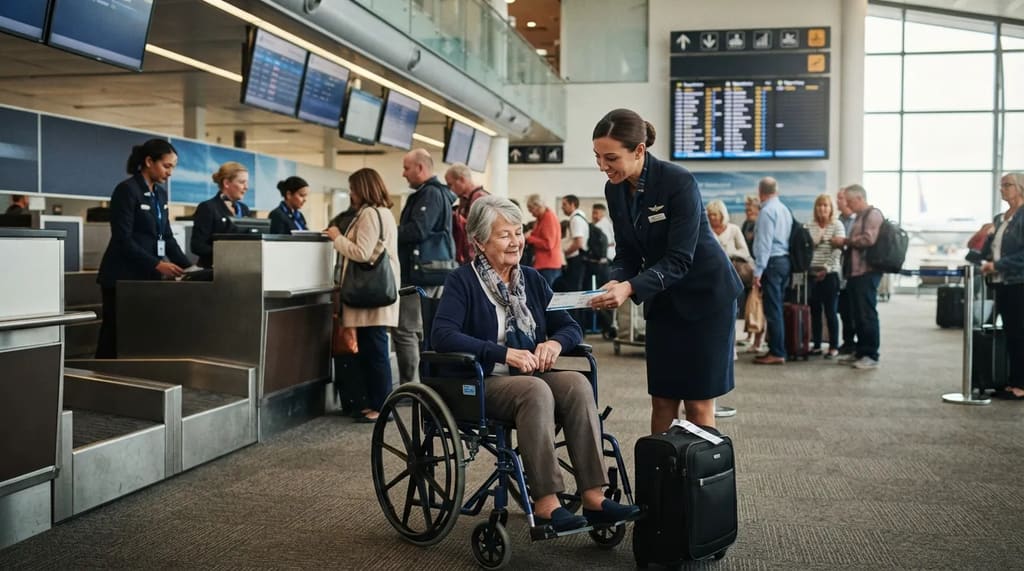
American Airlines recommends requesting wheelchair assistance in advance, by adding special assistance when you book or manage your trip on its website or app.1 If you have already booked, you can usually add it through the manage-trip page or by calling the airline.
Airlines may not require advance notice that a person with a disability is traveling. The Department of Transportation still recommends contacting the airline ahead of time to arrange wheelchair or guided assistance, seating accommodations or handling of an assistive device.
The law protects your right to be helped, not your place in line. That makes the no-notice-required rule a poor reason to wait.
Some services do carry a lead time, and that is where early asking pays off most.
- Airlines may require up to 48 hours’ notice for accommodations that need preparation, such as a respirator hook-up.2
- Airlines can require 24 hours’ notice for bulkhead seating or a seat with a movable aisle armrest.
If you travel with a power wheelchair, call the airline’s accessibility desk as soon as your ticket is confirmed, especially if a small plane is involved.
#10 – A Second Confirmation 48 Hours Before the Flight

A booking-day request is a good start, but reconfirming about 48 hours before departure and again at the gate is a routine worth keeping. It costs a short phone call or a check of the app.
A request made weeks ago can still go missing between a booking screen and a gate. A quick check catches that while there is still time to fix it.
Assistance is a queue like any other, so the staff member who comes for you is also serving other passengers. That is the reason for arriving earlier than the airline’s general advice suggests.
The Department of Transportation says a passenger must self-identify to airline staff at the airport as the person needing the requested assistance.3 4 Keep your reservation details handy and go to the airline’s designated check-in or assistance point.
Everything so far is the airline’s job, and the security checkpoint belongs to a different agency with its own phone number.
#9 – The TSA Cares Call Made 72 Hours Ahead
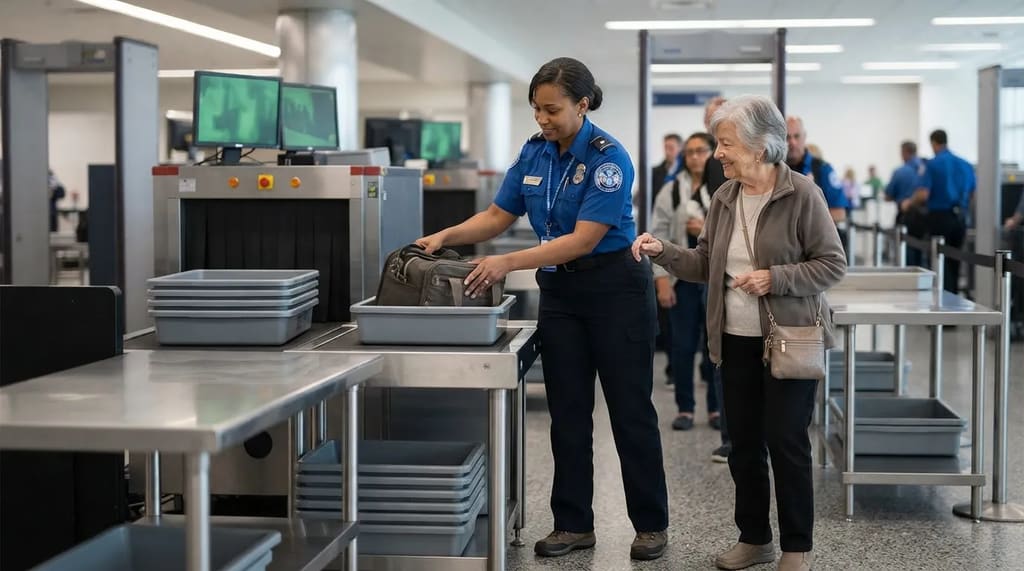
TSA Cares helps travelers with disabilities and medical conditions through screening. You can call 855-787-2227 or submit the online request form at least 72 hours before your flight.5 6
Passenger Support Specialists are trained TSA staff who guide travelers with medical conditions through screening. They handle the checkpoint itself, so you are not working it out alone at the bins.
Fast Facts
- Phone: 855-787-2227, or use the online request form.
- Lead time: at least 72 hours before your flight.
- Who can use it: travelers with disabilities or medical conditions.
- Cost: nothing.
Think of it as a guide through the one part of the airport the airline cannot touch.
The limit is built into the program. TSA Cares assistance is only available through the screening checkpoint, so it does not stand in for the airline requests at the gate.5
TSA Cares is open to anyone with a disability or medical condition, while the one age-based rule beside it starts later than many travelers expect.
#8 – The Screening Break That Starts at 75
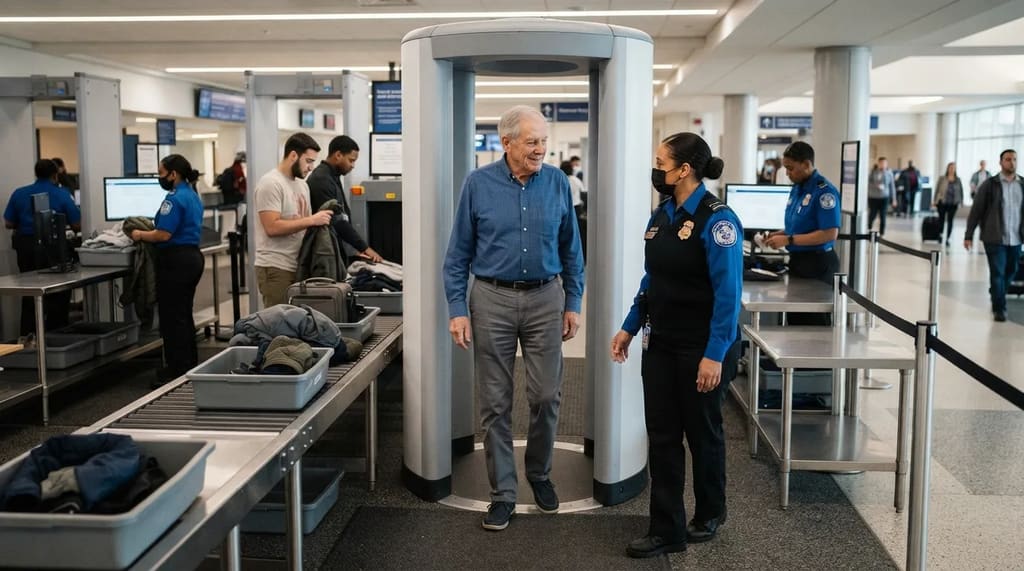
TSA says passengers 75 and older can receive expedited screening through its risk-based security measures.7 The break starts at 75, so a 70-year-old walks up to the same screening as other travelers.
Say your age at the checkpoint rather than waiting for an officer to guess it. If you are helping a parent who is 75 or older, state their age and ask for the modified screening on their behalf.
Shoes used to be the headline perk. TSA ended its shoe-removal mandate on July 8, 2025, so travelers of every age now keep them on, though an alarm can still mean removing them for further screening or a pat-down.
- Light jackets still come off for Advanced Imaging Technology screening, whatever your age.
- At 75 and older, a passenger who cannot stand for screening is screened through other security methods.7
If you are between 70 and 74, treat this as a rule that is coming rather than one to plan around today.
The same TSA page covers a more ordinary difficulty than a birthday, which is standing through a pat-down.
#7 – Asking to Sit Down at the Checkpoint
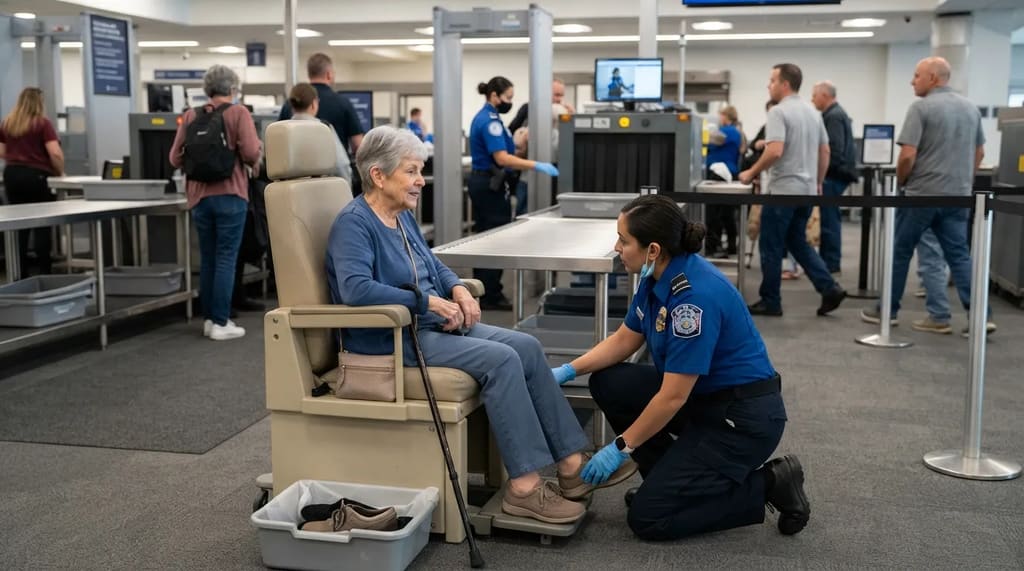
If the alarm goes off during screening, you may be required to remove your shoes for further screening or undergo a pat-down. You can request to be seated during this portion of the screening.7
The request is not reserved for a particular age. For any traveler whose medical condition prevents standing or walking, shoes need not come off, though they are inspected manually.
That matters if standing is the hard part of security for you, whatever your birthday says. A calm request to sit is easier to grant when the officer hears it before the alarm and the bins have you flustered.
Quick Compare
- Age 75 and older: eligible for expedited screening, and screened by other methods if unable to stand.
- Age 70 to 74: the same screening as other travelers, unless a medical need applies.
- Any age, with a condition that prevents standing: you may ask to sit, and your shoes stay on but are inspected manually.
If you carry a medical device or implant, say so early. As noted above, other screening procedures may apply, and a note in your pocket saves explaining it twice.
Once you clear the checkpoint, the airline takes over, and its first test is the boarding line.
#6 – Preboarding, Requested in Person at the Gate
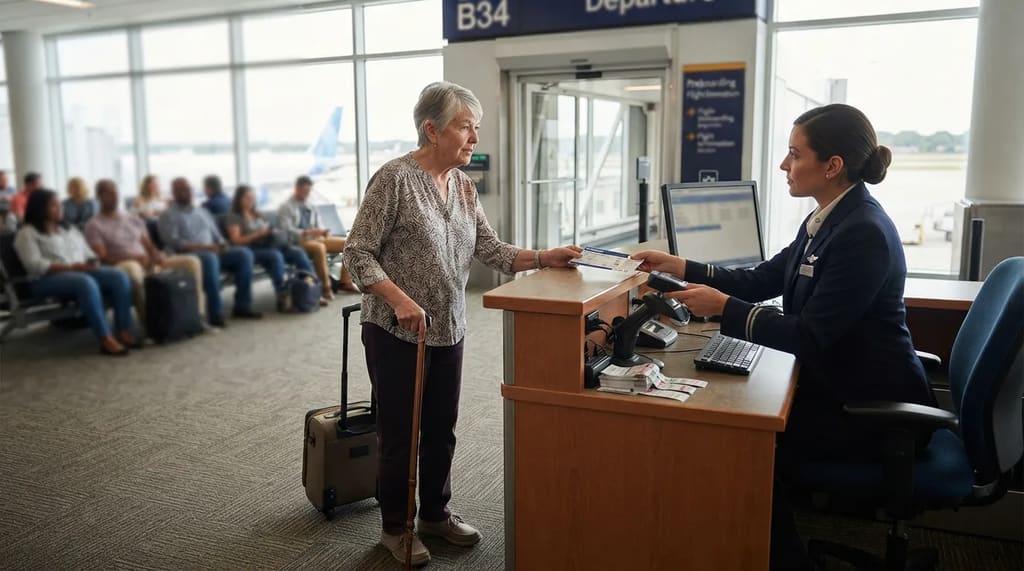
Federal rules say airlines must let a passenger with a disability board before all other passengers if that passenger self-identifies at the gate as needing additional time or assistance to board, stow accessibility equipment, or be seated. The request is made at the gate.3
You do not need a wheelchair to qualify, because the test is needing additional time or assistance to board. A cane, a stiff hip or a slow walk down a jet bridge can all be reasons.
A short, plain sentence at the desk is enough to start: you would like to preboard because you need a little extra time.
At American, preboarding for special assistance has to be requested, and no one calls your name for it automatically. Once your zone is called, the preboarding window has closed.
Getting on early can settle where you sit only in some cases, and the seat itself is a separate request.
#5 – An Aisle, Bulkhead or Movable-Armrest Seat
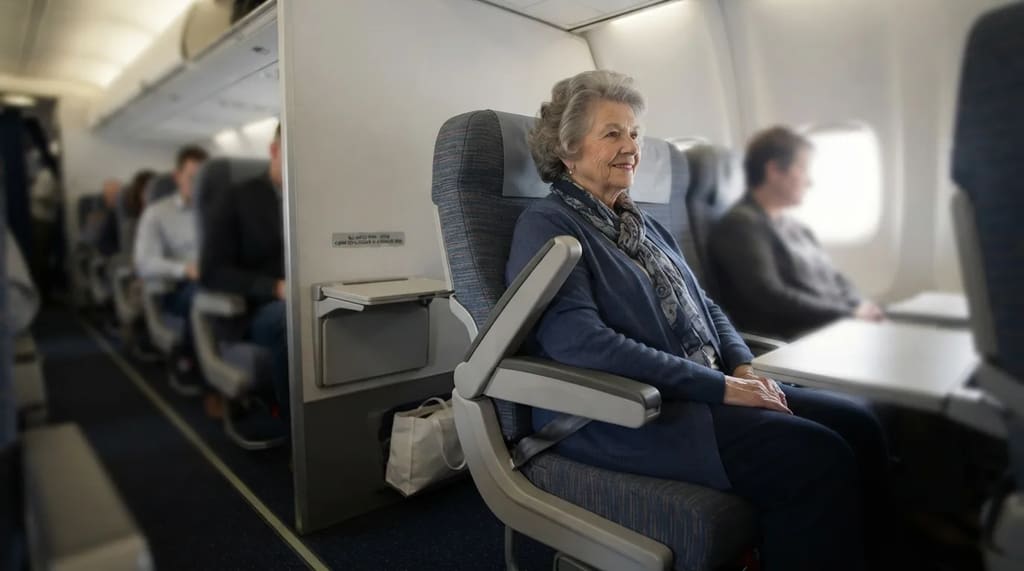
Airlines must offer seating accommodations to certain passengers with disabilities. That includes anyone who self-identifies as having a disability outside the four listed categories and needs a seat assignment to use air travel services, with an aisle or bulkhead seat among the Department of Transportation’s examples.
The airline must offer a seat with greater legroom, including an aisle or bulkhead seat, and a row with a movable aisle armrest. A movable armrest matters if you transfer from a chair or cannot climb over a seatmate.
- Bulkhead seats and movable-armrest seats can require 24 hours’ notice.
- If you travel with a companion, ask for the adjoining seat by name, since it is not always blocked automatically.
If your airline does not assign seats in advance, passengers who identify themselves as needing a seating accommodation may pre-board and select the seat that best meets their needs. That is a second reason to speak up at the gate.
A good seat does little for the carry-on bag that still has to get into the bin above it.
#4 – Help Lifting Your Carry-On Into the Bin
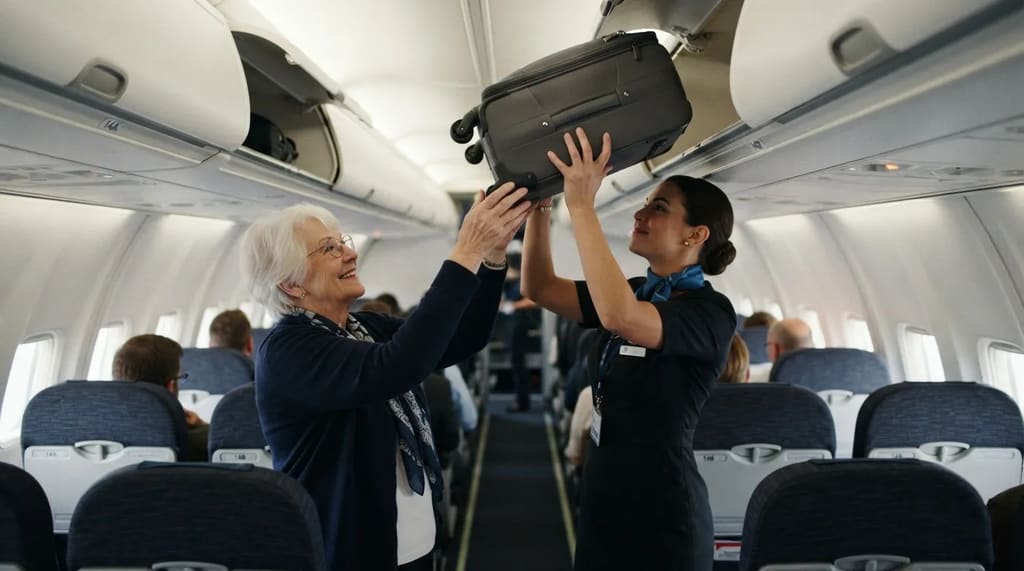
Once you are on board, airlines must provide help if you ask, including stowing and retrieving carry-on items and assistive devices. Tell the flight attendants what you need, since that is where the request goes during the flight.
The help starts before the aircraft door. Airlines must assist passengers in carrying their gate-checked or carry-on luggage when passengers are unable to carry it because of a disability.
If you use a folding chair or walker, assistive devices do not count against your carry-on limit. Skipping early boarding can cost you cabin space for a folding chair.
For many travelers the bag, not the chair, is the best reason to preboard. A bin with room beside your seat is worth the short request at the gate.
Handling a bag is one task, and getting yourself down a narrow aisle is another.
#3 – The Aisle Chair and Help Reaching Your Seat
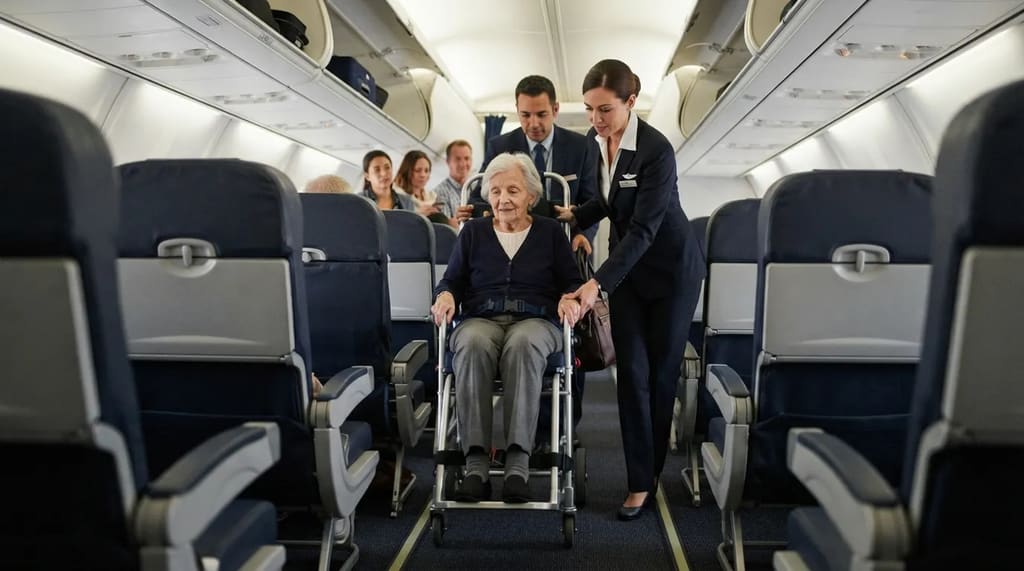
Passengers with disabilities must get prompt and timely boarding and deplaning assistance, upon request, from properly trained airline personnel. That includes assistance with moving to and from seats.
If you cannot walk the aisle, you will be transported to your aircraft seat in an aisle chair. It is a narrow wheelchair built to fit between the rows.
Staff park the aisle chair alongside your own wheelchair so the transfer is side to side. On the day of travel, remind the gate agent that you need preboarding assistance and the aisle chair.
The Department of Transportation says assistance must be performed in a safe and dignified manner. It adds that assistance within the cabin is required, but not extensive personal services.2
Worth Knowing
- Covered: boarding and deplaning help, aisle-chair transport and moving to and from your seat.
- Not required: personal care such as help eating or help inside the lavatory.
- If you need that kind of care, plan to travel with a companion.
That boundary is worth knowing before you fly, because help with a seat transfer is covered while help with personal care is not.
Related Stories From Travelbinger
 17 Things TSA Supervisors Quietly Tell Experienced Travelers Over 60 That Agents Never Say Out Loud
 Most travelers assume airport staff keep a secret menu of perks for anyone over 60. The official rules tell a different story: the one well-documented age-based perk starts at 75, not 60.
 15 Services at American Airports That Over 65s Can Reserve in Advance for Nothing
#2 – Assistance From Your Seat to the Curb
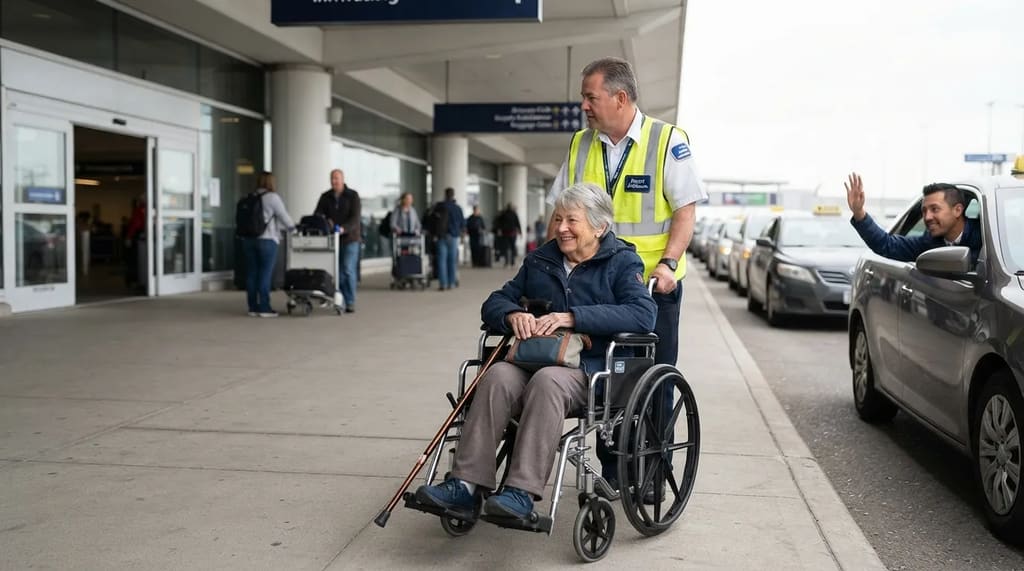
Landing does not end the help. The rules cover assistance with moving from the arriving flight to the curb for pick-up.3
That includes the stops along the way. Airlines must also assist in key function areas of the airport, such as ticket counters and baggage claim.
You do not have to have arranged any of it before takeoff. If you realize during the flight that you will need assistance at your destination, tell the flight crew when the flight lands.
Waiting is part of the routine too. Stay seated until the aisle clears, then ask for your cane and bag.
Airline wheelchair assistance ends at the curb or at a pickup point. Tell whoever is collecting you where to meet.
All of this assumes one flight, and a connection changes who is responsible for getting you to the second gate.
#1 – A Ride Between Gates When You Change Planes
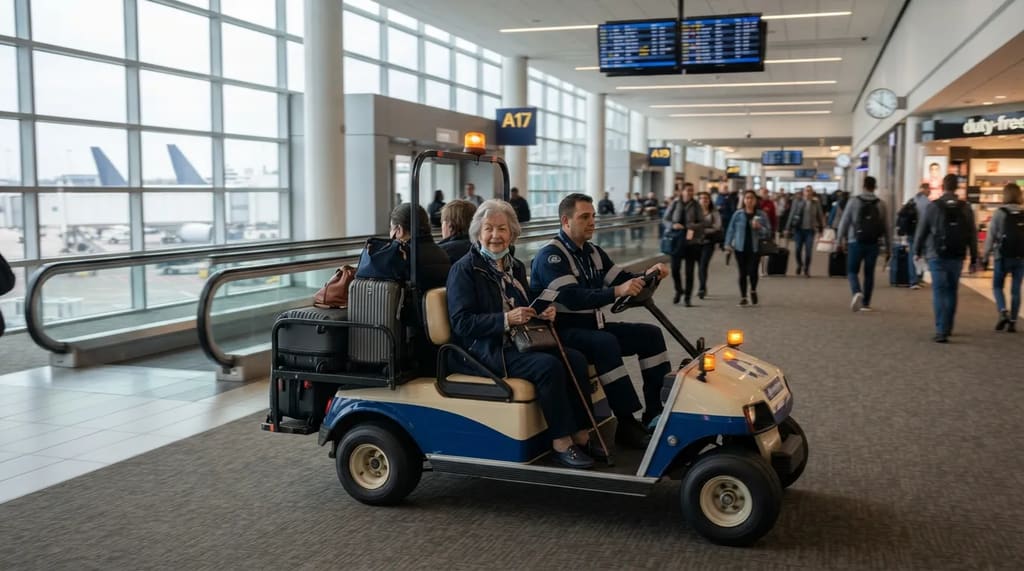
Picture a late arrival, a far-off gate and a clock running down. This is the moment the whole list has been building toward.
The Department of Transportation says airlines must help from your aircraft seat on an arriving flight through the airport to the gate of your connecting flight, and from that gate to your seat on the aircraft. The ride covers the whole stretch between planes, not just the exit.
The detail on your ticket matters here. Federal rules say that when two flights are operated by different carriers, the carrier that operated the arriving flight is responsible for providing or ensuring the assistance, even if the passenger holds a separate ticket for the departing flight.
So your arriving airline owes you the ride, even when you booked the second flight on your own. On codeshare flights, the airline that operates the flight is the one that counts, so put the request in with that carrier as well.
Staff are expected to offer a choice about how you travel. A Department of Transportation training document tells them to ask the person with the mobility disability whether the person would prefer to be pushed or not.
For a traveler over 70 with a tight connection and a long concourse, this is the service that can decide whether you make the second flight. It is also the one that depends most on a request made early.
What to Settle Before You Zip the Suitcase

Treat these requests as part of the booking, like picking a seat, rather than as an admission of anything. The help is tied to need and to asking, and it is easier to arrange before the day than at the counter.
A good order is to add the request when you book, reconfirm 48 hours out, and say it again at the gate. Add the TSA Cares call if the checkpoint is where you struggle.
On your last trip with a connection, how far apart were your two gates, and would you have used a ride between them had you known to ask?
- American Airlines Special Assistance: https://www.aa.com/web/i18n/travel-info/special-assistance/special-assistance.html
- DOT Passengers with Disabilities: https://www.transportation.gov/airconsumer/passengers-disabilities
- DOT Disability Bill of Rights: https://www.transportation.gov/airconsumer/disabilitybillofrights
- DOT Bill of Rights PDF: https://www.transportation.gov/sites/dot.gov/files/2022-07/508_Airline_Passengers_with_Disabilities_Bill_of_Rights_07132022_ADA.pdf
- TSA Cares Request Form: https://www.tsa.gov/contact-center/form/cares
- TSA Media Room PSS: https://www.tsa.gov/news/press
- TSA Screening Passengers 75+: https://www.tsa.gov/travel/tsa-cares/screening-passengers-75-and-older