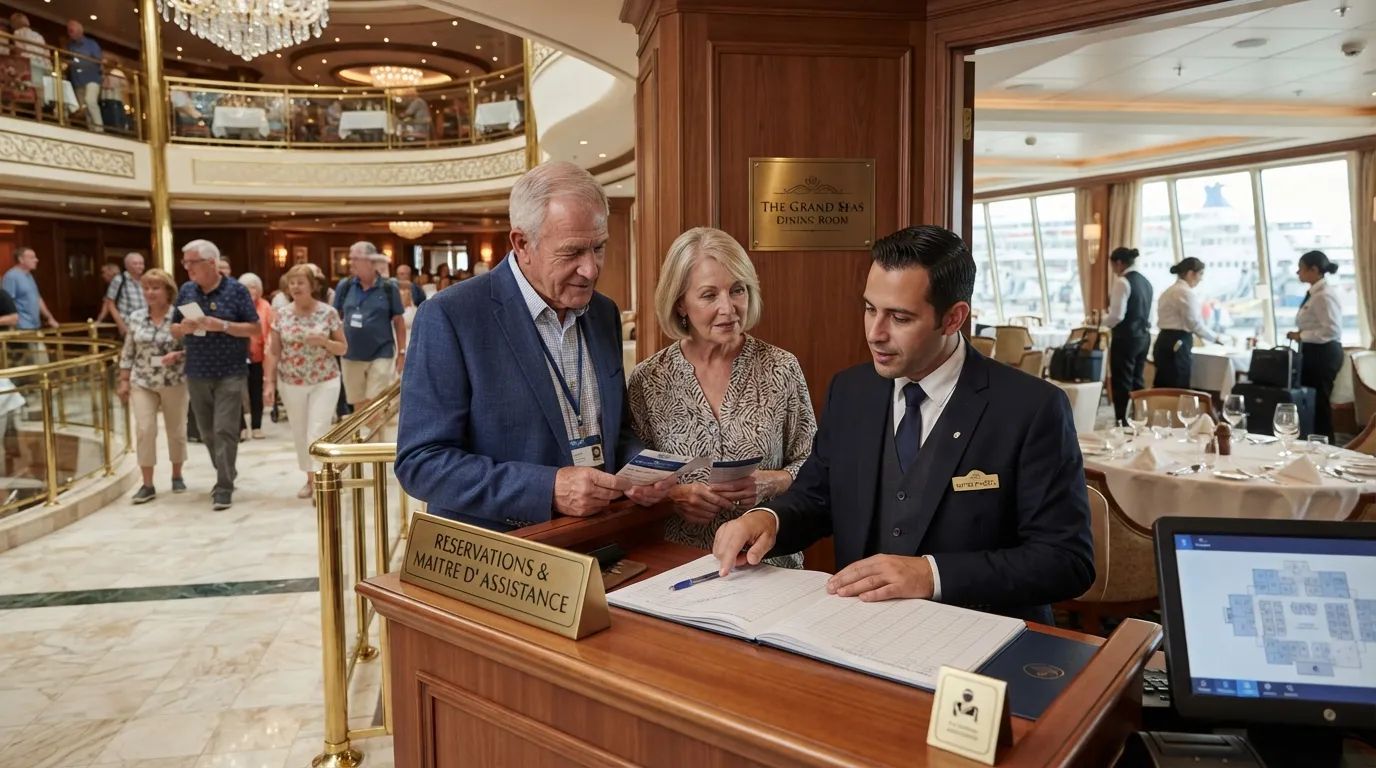
Picture night one. The ship is sliding out of port, and a host leads you to a table right beside the swinging kitchen doors. On Holland America with traditional dining, that’s your table for the whole week, every single night.
The 14 requests below cost nothing, and the staff can work with every one of them. None is a guarantee, but they work best when they land early. One of them can’t be fixed at the dining-room door once the ship sails, and it’s saved for last. First, the view.
#14 – A Window Table Requested Before the First Dinner
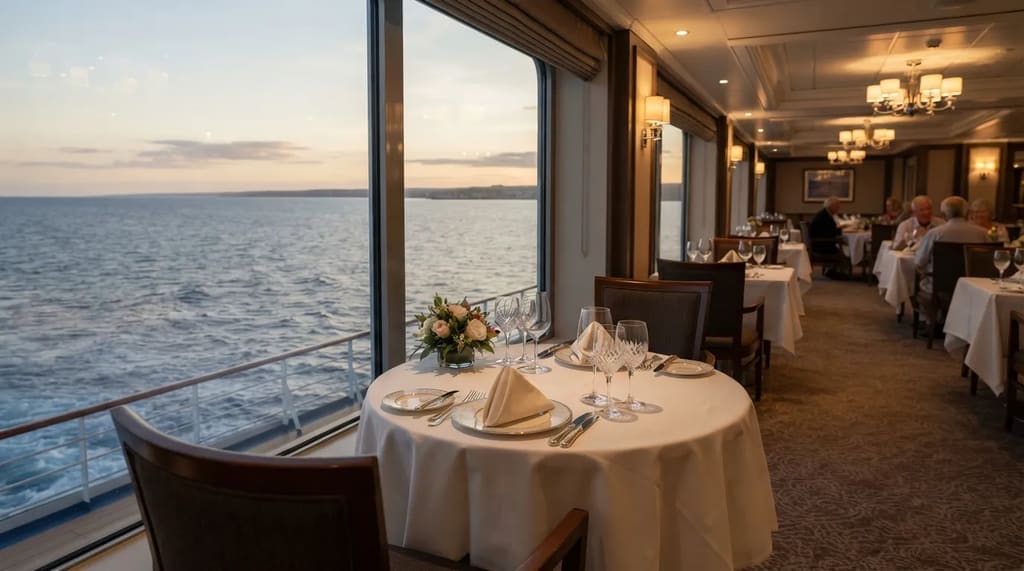
Choose traditional dining and the table you get on night one is the table you’ll see all week. A poor spot isn’t a one-time annoyance. It repeats at every dinner.
That’s why timing matters more than charm. Requests made before the very first dinner service tend to get priority over ones asked midweek, when the good tables are already assigned. Ask before the first dinner service, not after.
Name the window, then offer a fallback, such as a corner with a view of the room. Holland America notes that the maitre d’ assigns the table on board, so treat a window as a request rather than a promise.1
At a Glance
- When to ask: before the first dinner service
- Who decides: the maitre d’, on board
- Your fallback: a corner with a view of the room
- If it’s refused: let it go and save your energy for the items ahead
Of everything on this list, the window is the one to drop if it’s refused. Scenery is pleasant, but the items ahead protect your hearing, your mobility and your health.
And a gorgeous view can still come with a bad neighbor, like a speaker or a swinging kitchen door. That calls for a separate request.
#13 – A Quiet Table Away From the Noise
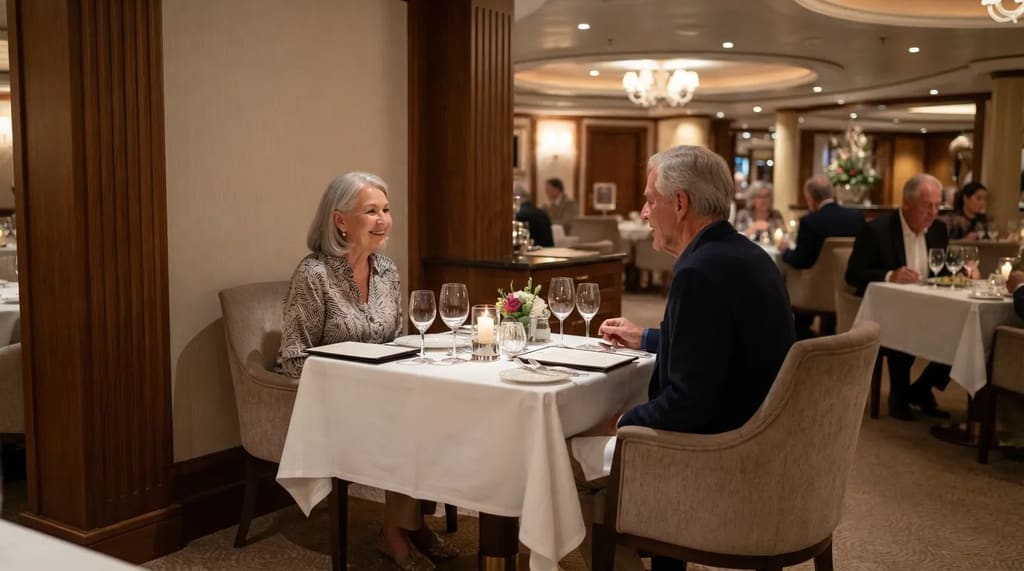
Conversation is the point of a long dinner, and a table beside the service station makes it a shouting match. The maitre d’ controls table assignments in the main dining room, so a seat away from the clatter is a matter of asking.
Name what you want to avoid: the kitchen doors, the service station, the band. A specific list gives the maitre d’ a rule to apply across the whole chart, which is easier to meet than a vague wish for quiet.
If you wear hearing aids, say so. Background noise is the hardest thing for them to sort out, and a corner or wall seat leaves fewer directions for sound to arrive from.
Seating time plays a part as well. An earlier seating often means a calmer dining room, which helps if noise is your main complaint.
Quiet is one kind of comfort. Whether you can reach the table at all is another, and the wrong layout makes that harder than any noise.
#12 – A Table With Room and No Step Up
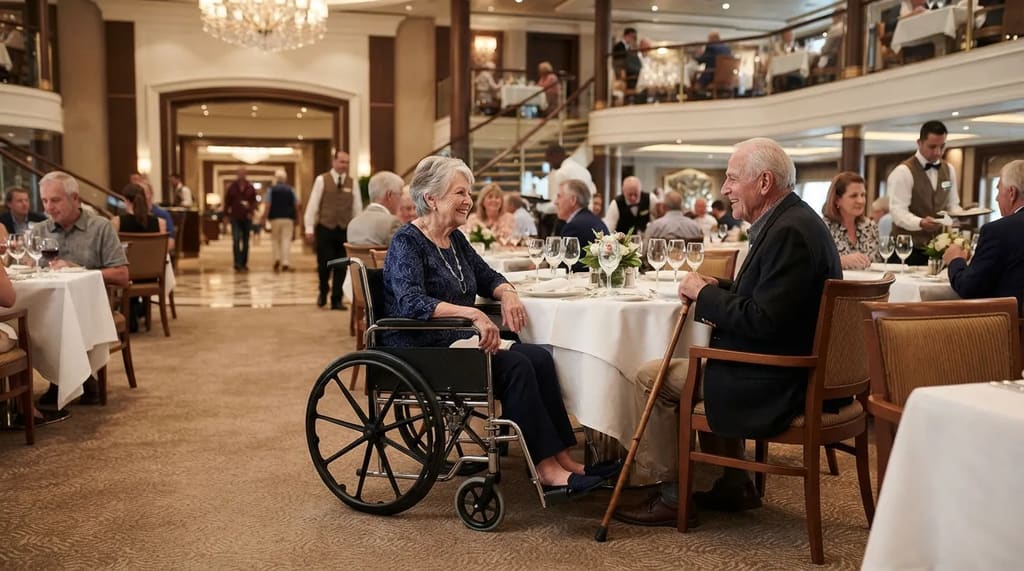
Where a dining room is built on more than one level, a table on the raised section can mean a step with a cane or a walker. You won’t see that on the deck plan.
Ask for a table with no step up. You can also ask for a chair to be removed at the table, which lets a wheelchair or scooter pull up without a transfer. A table near the entrance helps if long walks tire you.
Say this on embarkation day, because staff can’t plan around a need they haven’t heard about. For needs that reach beyond the dining room, the cruise line’s accessibility department is the channel to use before sailing.
This ranks above the window and the quiet corner because it decides whether you reach the table comfortably at all.
Those requests suit the evening meal. Breakfast and lunch run on different rules, and the table you were given at night doesn’t carry over.
#11 – Breakfast and Lunch Tables Without Strangers
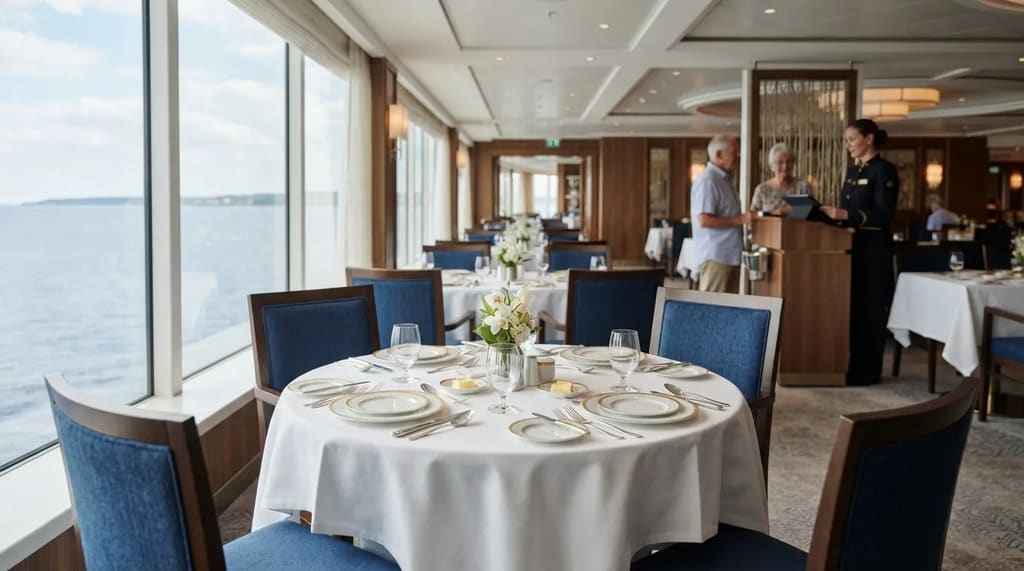
Assigned seating applies to dinner only. Breakfast and lunch are open seating.2
Cruise Critic reports that at those meals a waiter shows you to a table, often with other diners, but you can make requests.3 So the host stand is where you speak up, and the earlier in the morning you do it, the less crowded the room.
Keep it short. Tell the host your party size and that you’d like a table to yourselves. Add anything else you need in the same breath:
- How many are in your party
- Whether you’d rather not share
- Any step, noise or mobility need from the last two items
A plain meal is easy to arrange. A milestone dinner takes one extra sentence, and it can help every other request you’ve made.
#10 – Telling the Dining Room About an Anniversary
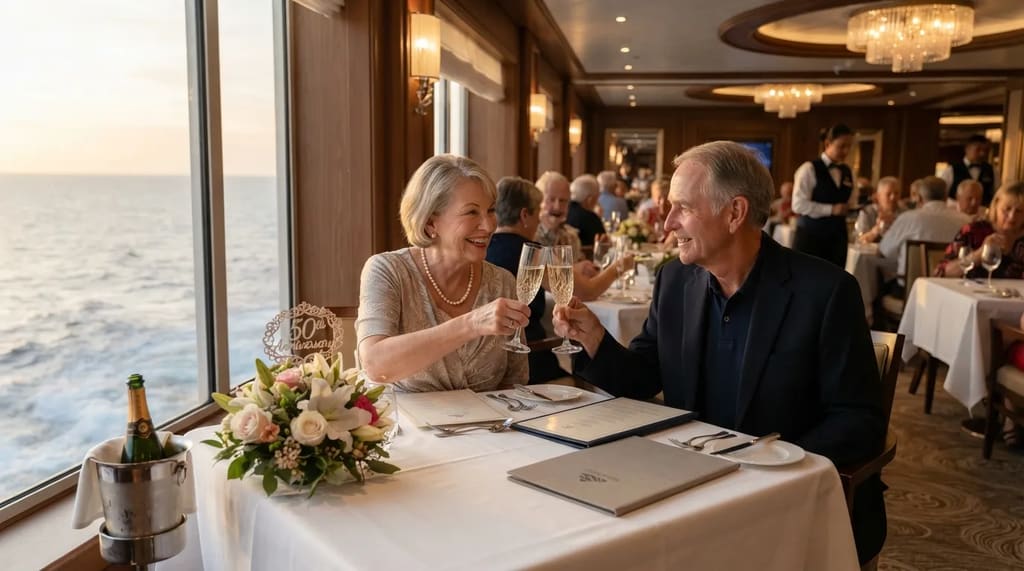
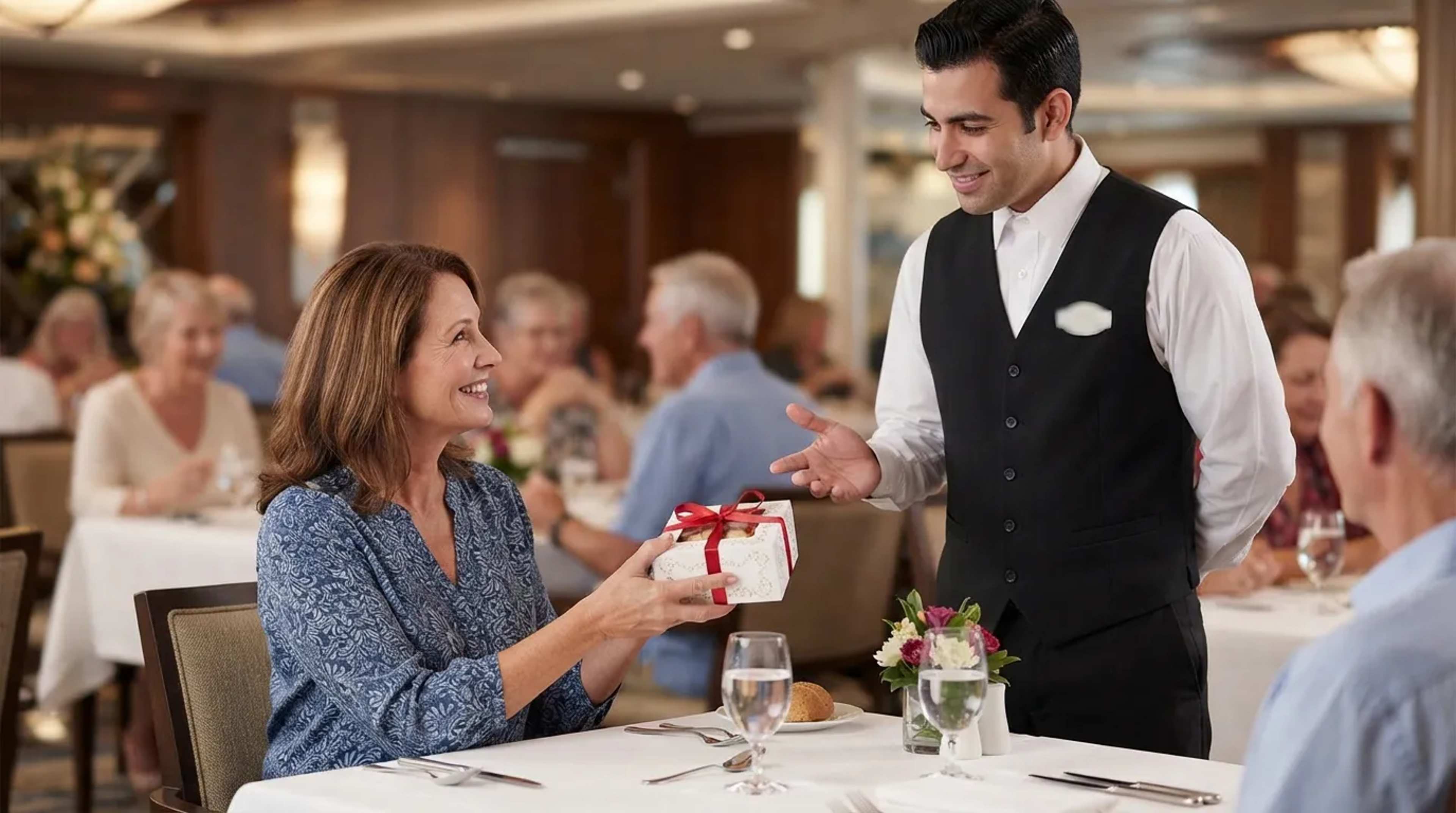
A table for two is a favor. A table for two on your fiftieth anniversary is a reason.
The maitre d’ handles table assignments, dietary coordination, special-occasion planning and off-menu accommodations all at once. So give the occasion and the exact date on embarkation day, in the same conversation as your table request.
The date matters because the staff can plan around the right night, while a remark to a waiter midweek is easy to lose. What a ship does for a celebration varies by line, so ask what’s available and whether anything carries a charge.
Celebrations are planned for one night. The question that comes up every night is whether you’ll be standing at the host stand, waiting.
#9 – A Reservation Before the Flexible-Dining Rush
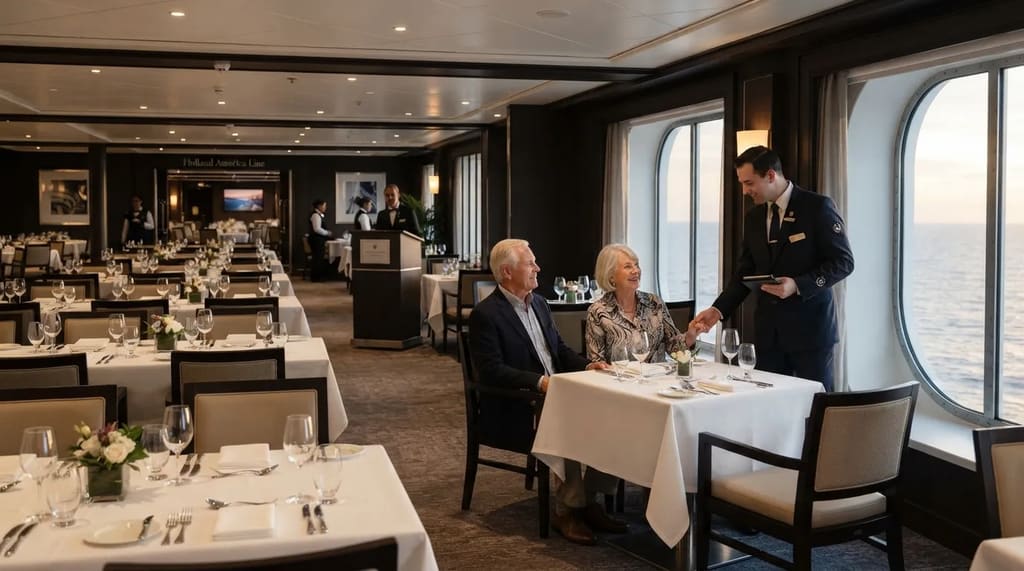
On Holland America’s flexible open dining, the hours run from 5:15 p.m. to 9:00 p.m., and you can reserve by phone or simply arrive.4 Arriving works on a quiet evening and fails on a busy one.
Cruise Critic notes that flexible diners can face waits at peak times unless they reserve ahead.3 With a slow-moving party or a tired spouse, a wait at the door costs more than it sounds like.
Royal Caribbean’s blog adds that you can book a dinner in the Cruise Planner or app and request a table for two when you do. Reserve the flexible dinner and state your table size in the same step.
Reservations suit a couple or a foursome. Bring a bigger group, and flexible dining can work against you.
#8 – A Large Table for Your Group or for Company
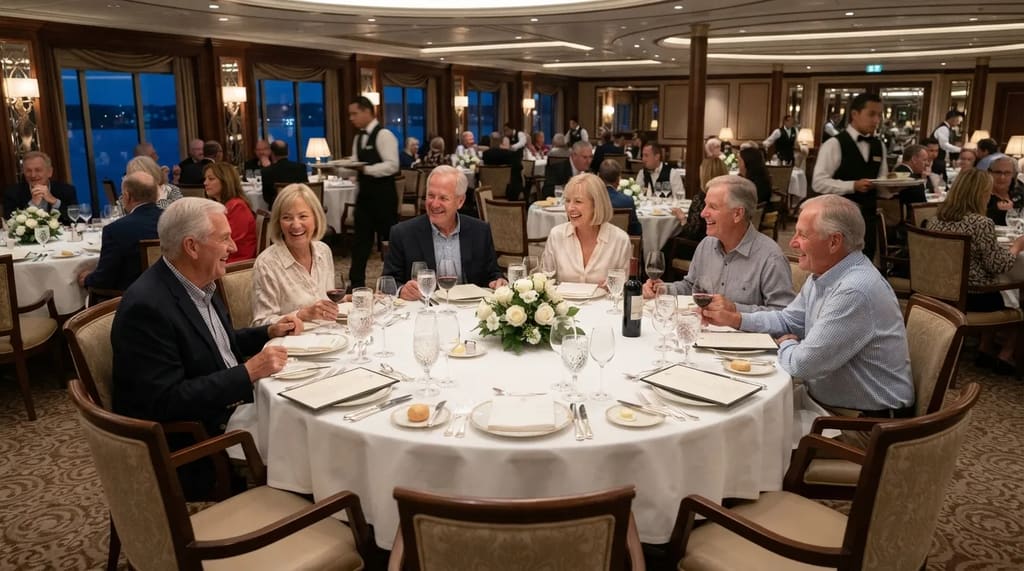
Flexible dining is built for small parties. If you’re traveling with more than four, traditional dining is probably the better choice, because it lets you plan seating together.
Royal Caribbean’s blog says that with traditional dining you can request a table allocation 50 days before sailing if you want a larger group seated together.5 6 Mark the 50-day date on your calendar when you book, since tables are assigned around early requests.
Quick Compare
- Traditional dining: same table and tablemates all week, with group seating you can plan ahead
- Flexible dining: built for small parties, with a different server most evenings
- A larger table size: you’re seated with those same people for the whole cruise
You may want company instead. Say so and ask for a table of six or eight, which is a perfectly normal request. Just understand the commitment before you pick the size.
That’s a gamble worth taking if you like new faces. If you don’t, ask early for a table of your own, because the same table follows you to every dinner.
Plenty of couples read that and decide they’d rather not gamble on tablemates at all. They have a request too, and it has its own timing.
#7 – A Table for Two Instead of a Shared Ten
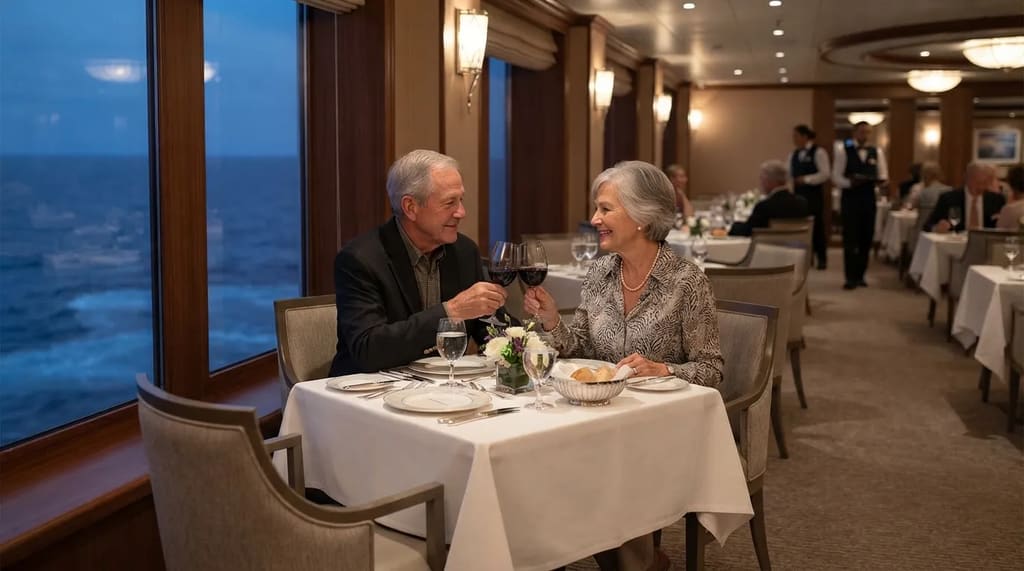
For a couple who wants a quiet dinner, a shared table is overrated. You can’t escape a conversation that lasts seven nights, and the dining team may seat a small party alone or at a large table with cruisers you don’t know.
Make the request before you sail. Holland America lets you ask for a seating time, a table size and who you’d like to dine with through your travel advisor.1 The maitre d’ still makes the final assignment, so a yes isn’t guaranteed.
Ask for the two-top again once aboard if the contract doesn’t show it. Go to the main dining room and ask to speak to a head waiter. Some ships have only a few small tables, so the answer can be no, and then you can ask for a smaller table of four.
Ask for a table for two in writing before you sail. Once the table is settled, the clock is the open question.
#6 – Swapping Your Dining Time on Day One
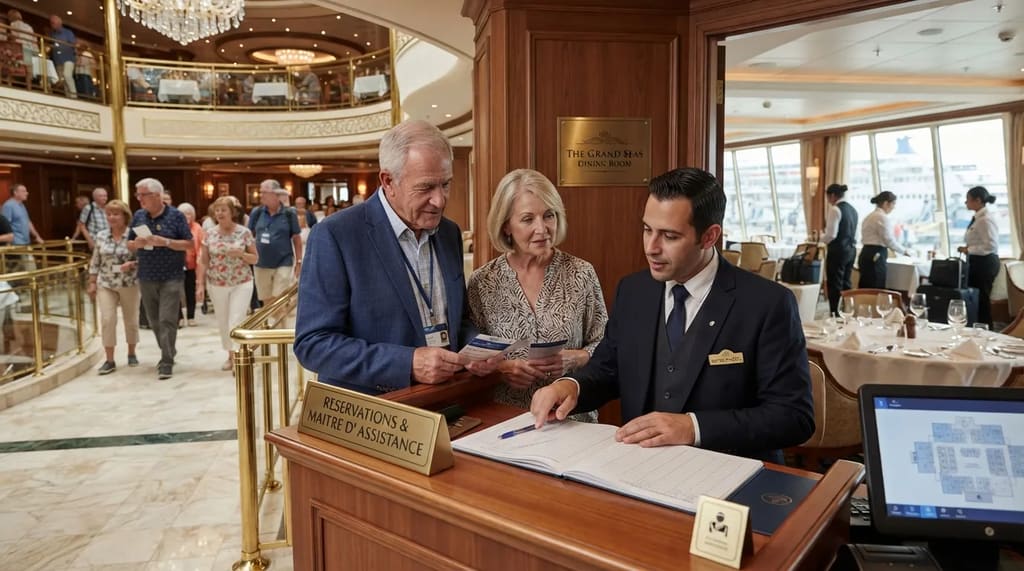
Traditional dinner hours differ by line, so check yours before you assume. Ships can also shift dining times by up to 30 minutes.
Fast Facts
A time that looked fine in the booking app may feel very different after a long day in port.
Ask to change your dining time on embarkation day. Cruise Critic calls embarkation day the time to request a dining time change, and the maitre d’ has more openings then than after the room settles.
Early seating is the better pick if you tire after a port day. You finish dinner while you still have energy, instead of sitting down at 8:30 with your feet aching.
Time and table are things you set once. What lands on the plate is something you can adjust every night, if the waiter knows how.
#5 – A Waiter Who Learns Your Preferences
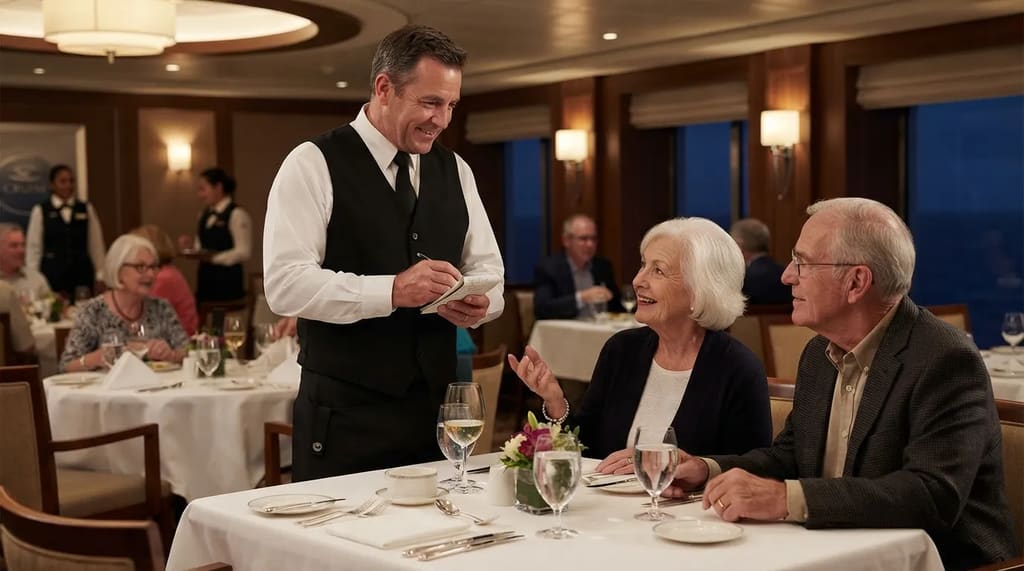
Traditional seating gives you the same waiters every night, and that’s worth more than it sounds. Your waiters learn your preferences quickly, and the experience starts to feel personal.
Flexible diners lose a little of that. Your server changes each evening unless you make a specific request for the same person, and there might be a wait. If you value being known, that’s a real trade-off.
Whichever you choose, tell the waiter on night one what you like. Spice levels, cooking temperatures, portion sizes and texture preferences can all be passed along to the galley, so you don’t repeat yourself.
Ask the waiter to pass your preferences to the galley. Those travel from dining room to kitchen on one sentence. Dietary needs have to travel further, into restaurants you pay extra to eat in.
#4 – Dietary Notes at Every Specialty Restaurant
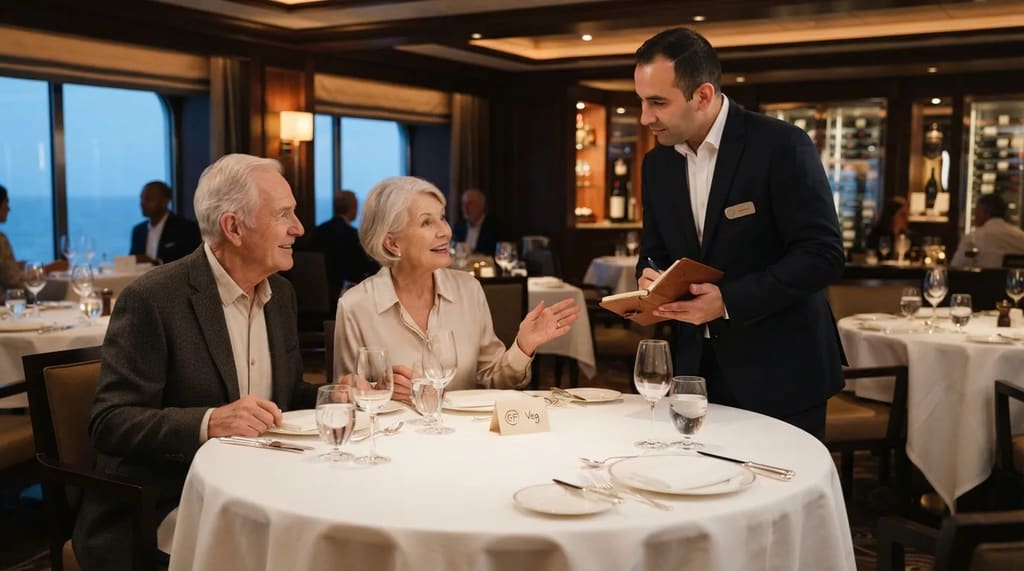
A diet arranged for the main dining room doesn’t automatically follow you through the door of the steakhouse. Each venue takes its own reservation, and each has its own kitchen.
Celebrity is one example of a line where the specialty restaurants accommodate special dietary requests. The catch is that someone there has to know about yours.
Mention your dietary needs when you book each specialty reservation.
Worth Knowing
- Each specialty venue takes its own reservation and runs its own kitchen
- Booking early in your cruise helps lock in preferred times
- Raise your needs in the same conversation as the booking
- On many lines you can also add dietary notes in the cruise app
A reservation is only as good as the person who knows you made it. And the most useful conversation on the ship is with the person who runs the seating chart.
#3 – A Sit-Down With the Maitre d’ Before Dinner
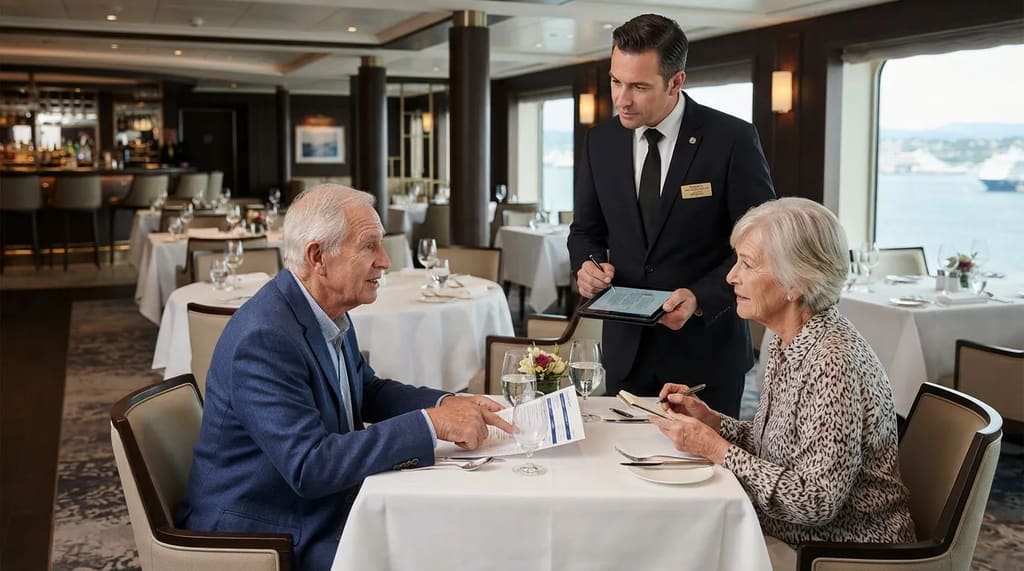
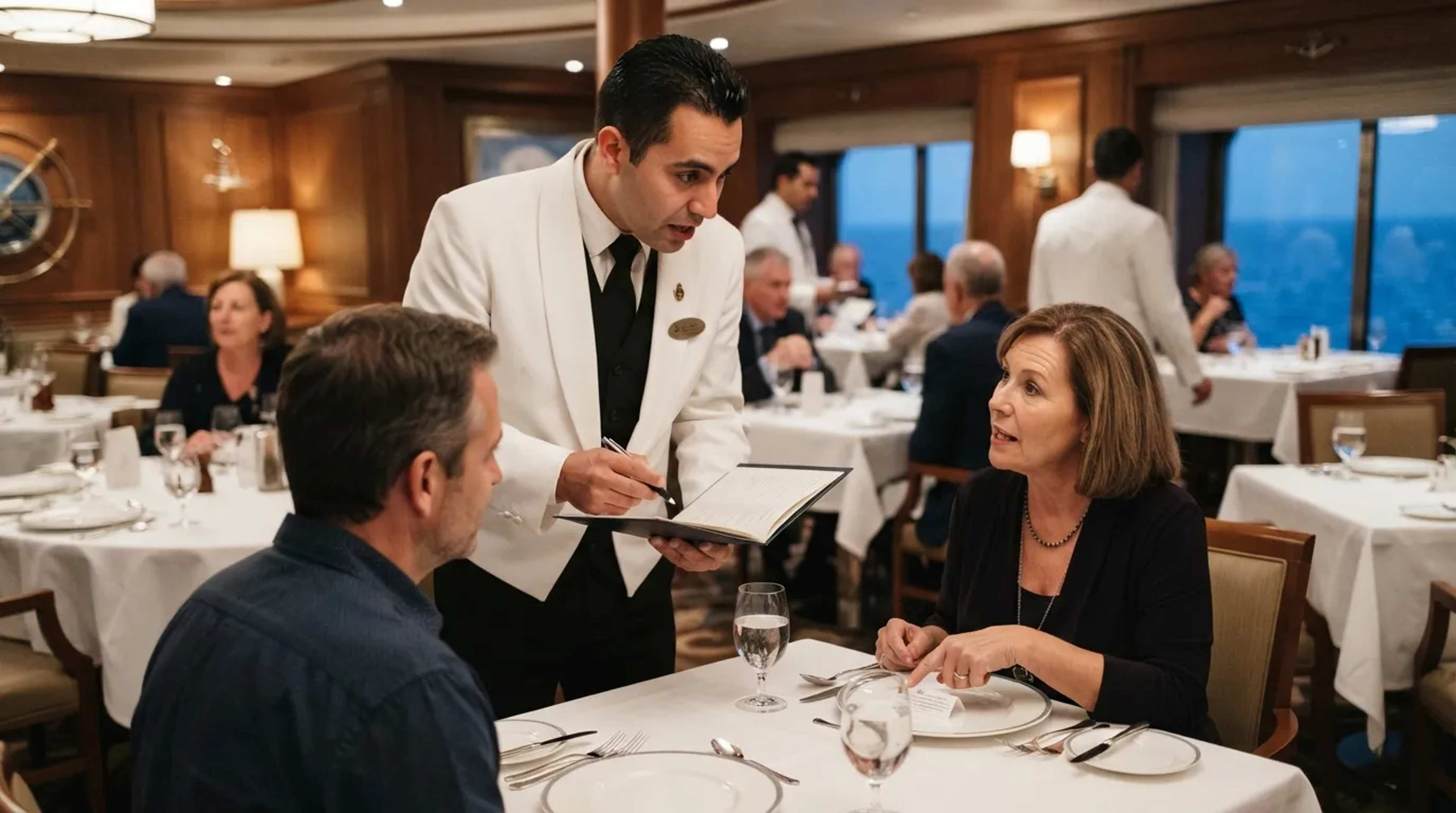
One short conversation can settle your table, your time, your occasion and your diet. The maitre d’ controls table assignments, dietary coordination, special-occasion planning and off-menu accommodations, all at once.
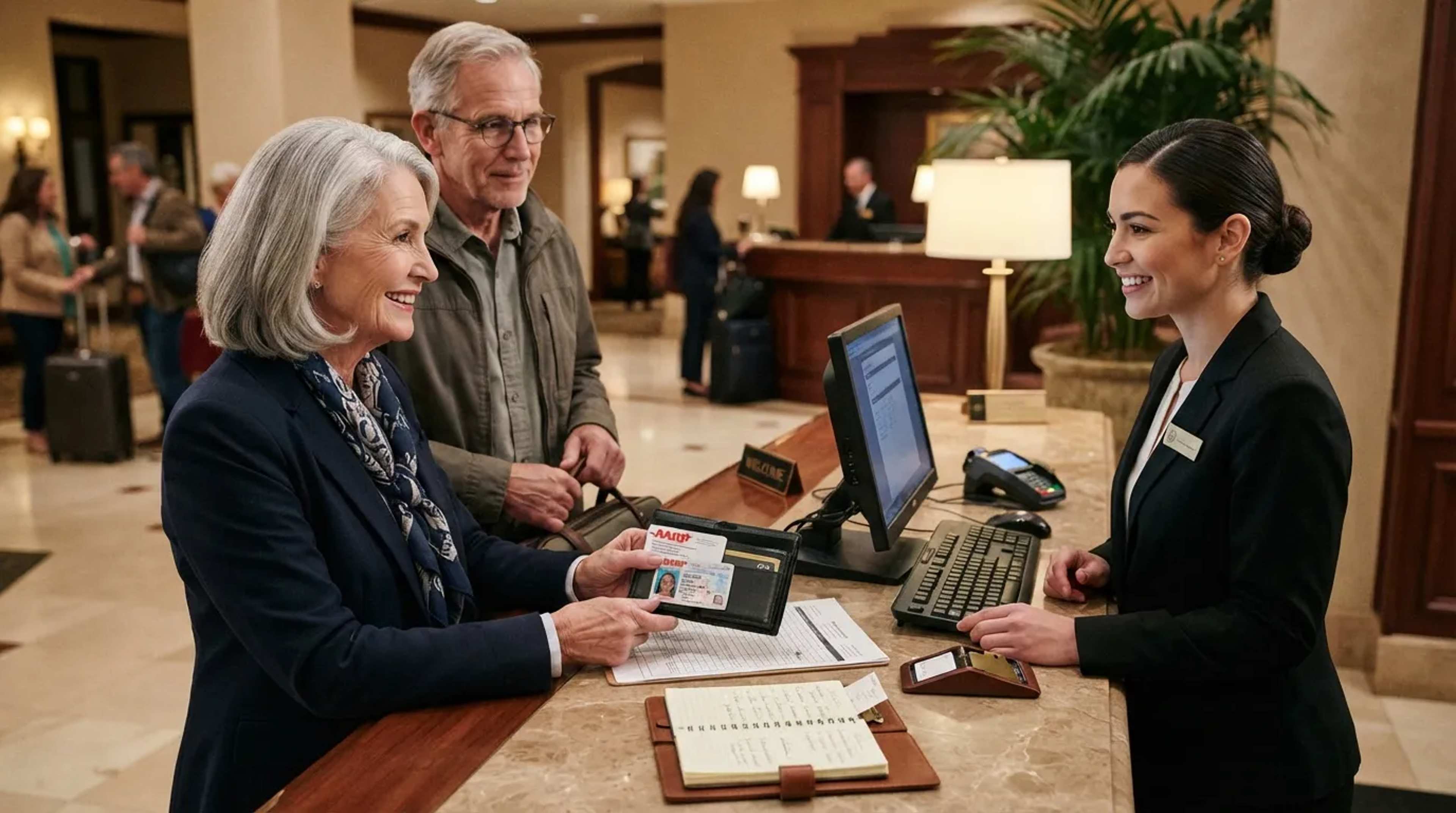
Before you ask for anything, check what you already have. Holland America says the status of your seating request appears on your Cruise Contract, and your assignment is noted on your guest card at boarding.4 If those already show a two-top at your time, you may only need to confirm.
Request a sit-down with the maitre d’ before the first dinner service. A real sit-down on embarkation day beats a passing mention at dinner. Bring your list:
- Table size and any step or noise needs
- Your preferred seating time
- An occasion and its date
- Your diet, in one clear sentence
You can leave that office with every detail agreed, and the first waiter you meet may know none of it. Spoken at the table, a diet note does something paper can’t.
#2 – Saying Your Diet Out Loud at First Dinner
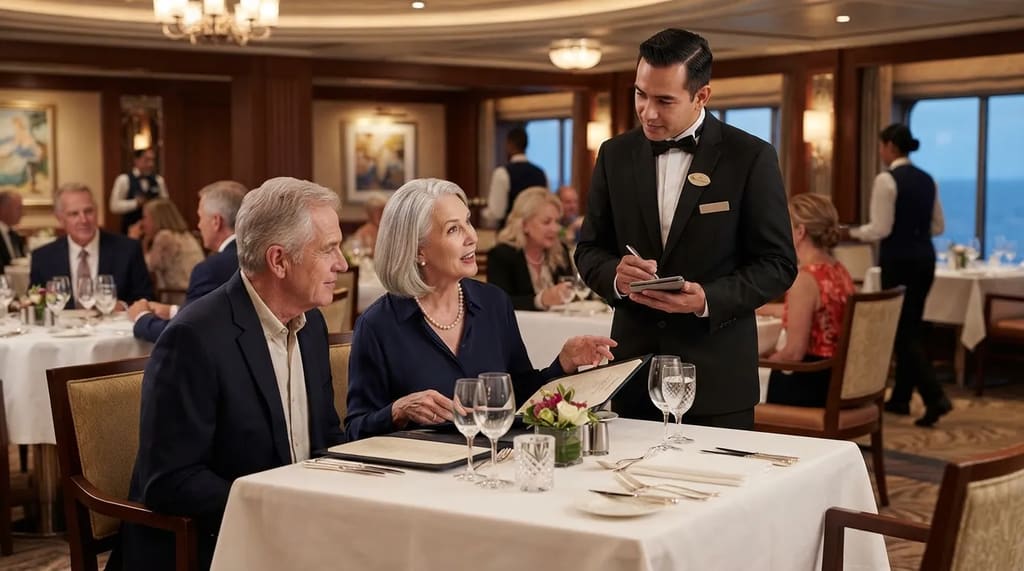
A form can get lost, but a face and a name stick. That’s the reason to repeat a dietary need at the table even when it’s already on file.
Cruise Critic’s advice is the same: alert the line’s Special Needs department in advance and then meet the maitre d’ onboard to discuss your needs. Holland America likewise asks you to reconfirm special requests with the maitre d’ after you board.
Ask one more question while you’re at it. Holland America may substitute products when a specified brand isn’t available, and an additional charge may apply.4 Ask what the ship will substitute and whether it costs extra.
You can also plan ahead at the table. Most lines can accommodate any special diet, even if that means pre-ordering certain foods or choosing your menu in advance. Ask your waiter each evening what you can pre-order for tomorrow.
Everything so far can be repaired on board, at least in part. The most important item on this list can’t, because the kitchen needs a head start that no maitre d’ can give back.
#1 – Dietary Needs Reported Before You Sail
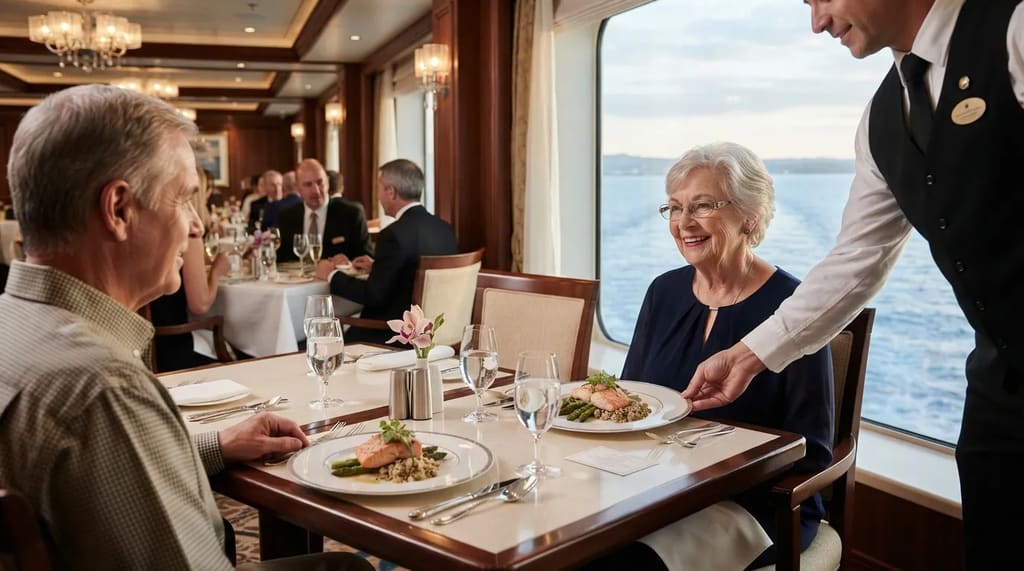
Some meals can’t be made on the ship at all. Holland America says certain special diets can be accommodated only with advance notification, including kosher, salt-free, fat-free, diabetic and baby food.1 4
That changes how every earlier item looks. A window table, a two-top or a better time can be negotiated at the host stand, but a diet depends on what the ship has stocked and prepared before you arrive.
Tell the cruise line’s special needs team before you sail. Mark the dietary field when you complete online check-in, and tell the Special Needs department in advance. Then ask the line for its cutoff date, since deadlines differ.
Don’t stop at a checked box. Email the team to confirm your requirement has been noted, and keep the reply. Then bring that confirmation to the sit-down in #3 and say your diet aloud at the first dinner, as in #2.
For a serious allergy or a medical diet, confirm the line’s requirements with your doctor and the cruise line before you book.
A cruise dining room feels fixed because the seating chart is built before you ever walk in. In reality it’s a set of requests weighed in order, and the early ones, made to the right person, usually carry the most weight.
So treat the weeks before sailing and the first hour aboard as your window, and let smaller wishes like the view wait. A few minutes with the cruise line and a few more with the maitre d’ cover most of this list.
If you’ve sailed with traditional dining, which table size would you request next time, and what made you decide?
- Holland America Know Before You Go: https://www.hollandamerica.com/en/us/plan-a-cruise/get-ready-for-your-cruise/faq/know-before-you-go
- Cruise Critic Flexible vs Traditional: https://www.cruisecritic.com/articles/flexible-versus-traditional-cruise-dining
- Cruise Critic Main Dining Room: https://www.cruisecritic.com/articles/what-to-expect-on-a-cruise-the-main-dining-room
- Holland America Dining Venues: https://www.hollandamerica.com/en/us/faq/onboard-cruise-experience/dining/dining-venues
- Royal Caribbean Table for Two: https://www.royalcaribbeanblog.com/2024/03/13/how-do-i-get-table-two-the-main-dining-room
- Royal Caribbean Group Dining: https://www.royalcaribbean.com/faq/questions/group-reservation-dining-accommodations