Skip a specialty dinner on Royal Caribbean without canceling, and an empty chair can cost $25 per person, or $50 at some venues.1 That’s a bigger bill than any fork mistake on this list.
These 14 mistakes come from cruise-line policies and the dining-room etiquette guides cruisers read before they sail. Some cost a little goodwill, some cost real money, and one affects your health.
The last one has a deadline that falls weeks before you ever sit down, so it’s worth reading to the end. First, a mistake that happens before you even reach the table: what you wear.
#14 – Swimwear and Bare Feet at Dinner

Swimwear and bare feet are typically banned in the dining room at all times, and Cruise Critic notes that a cover-up doesn’t change that. The same publication calls it rude to flagrantly ignore a stated dress code.
That doesn’t mean a tuxedo every night. It means checking the dress suggestion for the evening before you leave the cabin, because formal nights are only one end of the range.
Many lines print the evening’s dress suggestion in the daily schedule or app, so the answer is rarely a mystery. Dinner is also the busiest stretch of a long working day for dining crew, which makes the dress code one of the few courtesies that costs you nothing but a change of clothes.
Being on vacation doesn’t suspend the rule, and arriving in trunks puts a staff member in the awkward spot of turning you away at the door. If you’d rather stay casual, pick a casual venue instead of testing the host stand.
A plate from the buffet can follow you through the dining room doors too, and it saves you nothing.
#13 – A Buffet Plate Carried Into the Dining Room
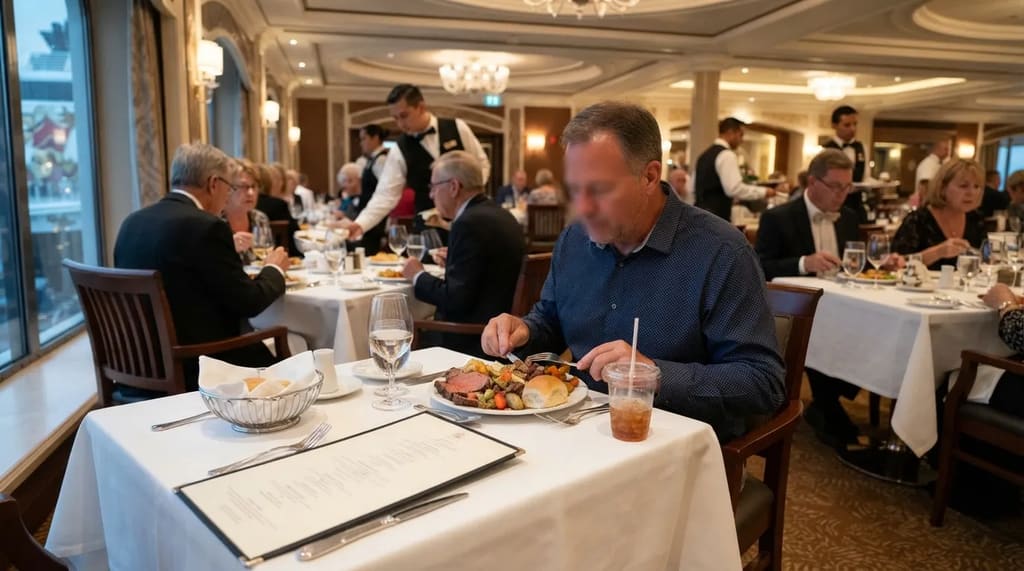
Walking into the formal dining room with a buffet plate or a soda in hand looks like a harmless shortcut. It stops looking that way once you consider what it replaces.
Dinner in the main dining room is already included in the fare on lines such as Holland America. So the plate in your hands saves no money and no time, and it sits oddly beside a menu you’ve already paid for.
The main dining room is where the ship does table service, with courses arriving one at a time. Walking in with your own plate turns a served meal into a self-serve one.
Quick Compare
- Buffet: self-serve, so you fill and carry your own plate.
- Main dining room: table service, with courses arriving one at a time.
- Cost: on lines such as Holland America, main dining room dinner is already in your fare.
The better habit is simple: finish what you take from the buffet before you walk to the dining room. Then arrive at your table with an appetite for the meal that’s waiting.
The waiter’s job is to serve you the courses on that menu, in order, and outside food complicates a rhythm that is already tight. Leave the buffet at the buffet.
The thing in your pocket can disturb more tables than any plate, and it rings.
#12 – The Phone Call the Whole Room Hears

Your phone doesn’t know it’s in a shared room. The dining room is one of the few places on a ship where people really do talk to each other, so a speakerphone call turns every neighboring table into part of your conversation.
Tables sit close together, and voices carry. A call that feels private to you is a public performance to everyone within earshot.
One passenger complained directly to a cruise line about loud calls filling the dining room during dinner service. That tells you the habit gets noticed, and it gets reported.
Silence the phone before you sit down, and take any call outside the dining room. If it rings anyway, let the rest go to voicemail and finish dinner first.
There’s also a plain practical reason: a call mid-course delays your own order, your own plates and everyone’s sense of how the evening is going. A message can wait forty minutes, and your table’s patience can’t.
Even a kind gesture from your chair can go wrong, and it involves nothing more than your dirty dishes.
#11 – Stacking Plates to Help the Waiter
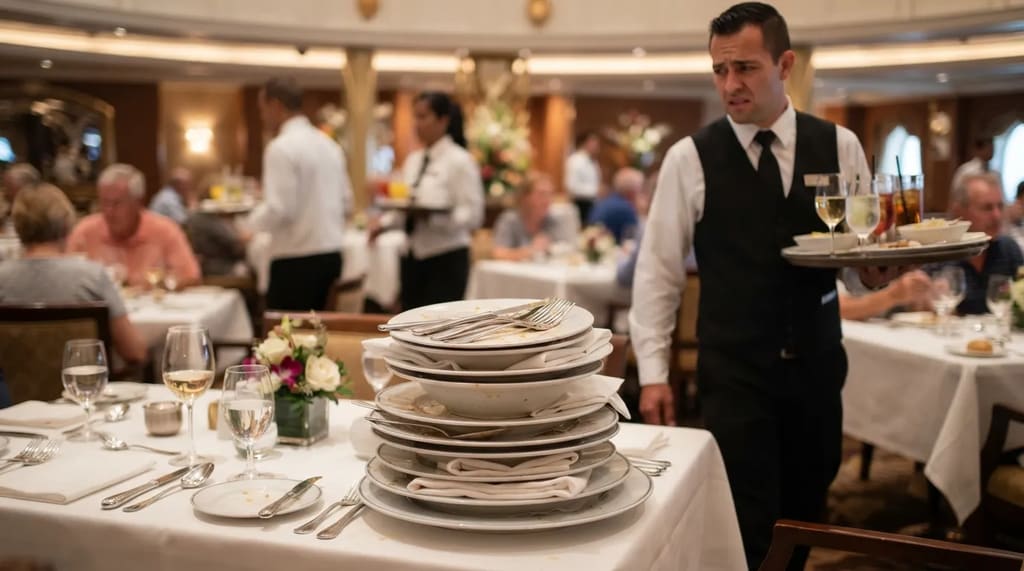
Tidying your own table feels like a favor. Crew members have shared that if they’re already on their way to serve someone, they feel they have to stop and rush over to clear your table.
So the help you meant to give pulls a waiter away from another guest. Leave the dishes where they are.
The people waiting on you aren’t just carrying plates. They’re juggling courses, drink orders and the needs of every table around yours.
Clearing is part of a sequence. Waiters have to clean up your table in time for the late seating, or for breakfast the next morning, and they do it in an order they’ve planned around the whole section.2
If something is in your way, a small request does more good than a stack of plates. Ask for it to be taken, and let the waiter choose the moment.
Plates are the easy part. The words that fly across the table can do far more damage.
#10 – Accent Jokes and Politics at a Shared Table

Cruise dining rooms are staffed by crew from dozens of countries, which makes imitating someone’s accent a bad idea from the first syllable. Passengers who mimic a waiter’s accent cross a line fast.
Tablemates are the other half of the room. Politics and religion are the classic sparks for arguments at cruise dining tables, and food-shaming a fellow guest is another thing to avoid.
Cruise Critic also lists bragging among the things not to do in the main dining room. The advice is consistent: keep the conversation light, curious and about the trip itself.
When a table isn’t working, leaving mid-meal solves nothing. If you have a problem with your table assignment, seek out the maître d’ and ask for a change.2
Once the conversation is under control, the menu is where plenty of guests leave value on the plate.
#9 – Ordering the Same Three Dishes All Week
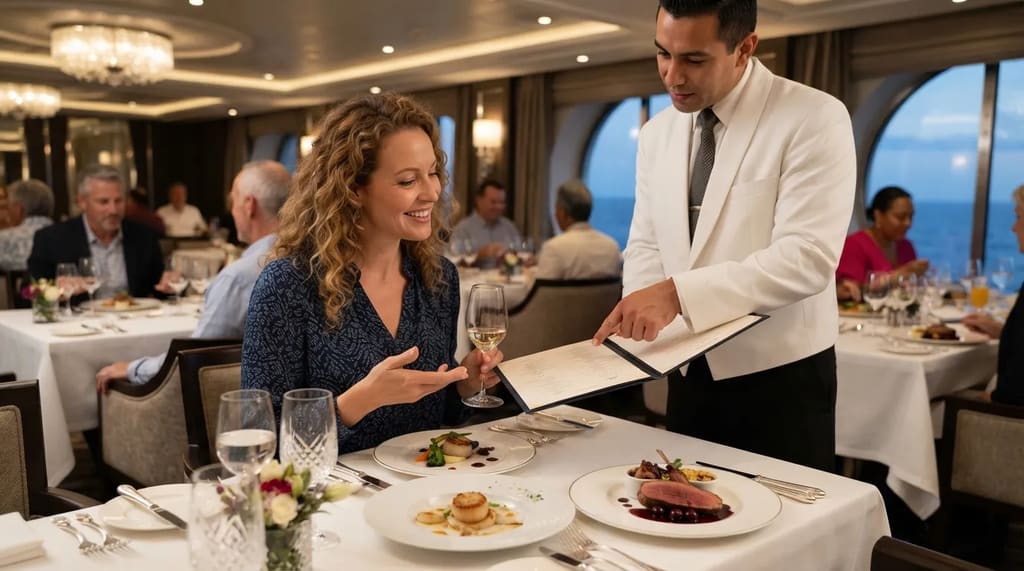
The menu changes daily and costs nothing extra. Waiters want guests to explore it, but plenty stick to the same three safe dishes all cruise.
The included dining room gives you room to experiment. Main dining rooms let guests order multiple entrées at no extra charge. That makes it the cheapest place on the ship to find out whether you like duck, lamb or something you can’t pronounce.
Here’s my verdict: ordering a second entrée to taste something new isn’t greedy. Cruise Critic does list ordering more than you can eat among the things not to do, so sample rather than stockpile.
Many cruise menus also keep a short list of always-available classics, so a safe fallback is waiting if the experiment flops. If you like the adventurous dish, you’ve got a new favorite; if you don’t, it cost you nothing.
Even guests who explore the menu miss a request that isn’t printed on it, and it starts with a cheese plate.
#8 – Never Asking for What Isn’t on the Menu
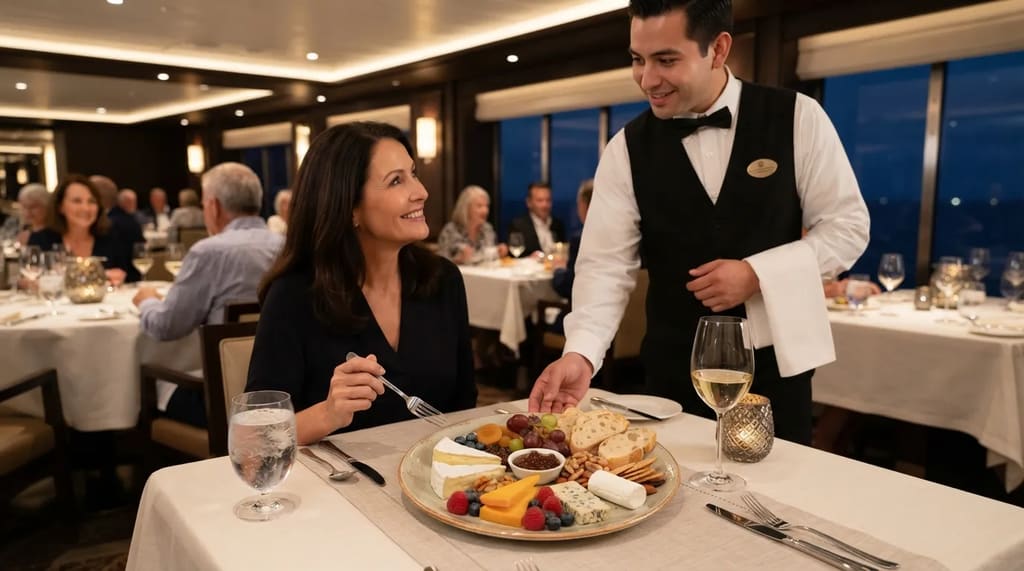
A cheese plate often shows up later as a dessert option, but if you ask for it as an appetizer, your waiter can usually arrange it. Fruit plates, sorbet and a scoop of ice cream are also easy requests.
Waiters can only offer what they know you want. Think of the printed menu as a starting point rather than a boundary, because a polite question costs nothing and the worst answer is a no.
Pace is another request. You can even ask for your appetizer, main course and dessert order to be taken all at once. That helps if you have a show to catch or a long evening ahead.
Phrase it as a question, not a demand. It’s more gracious to say “May I please have the…” than “Give me the…”
Asking the crew for things is welcome, but handing them something is where a kind impulse meets a rule.
#7 – Baking Treats for Your Waiter
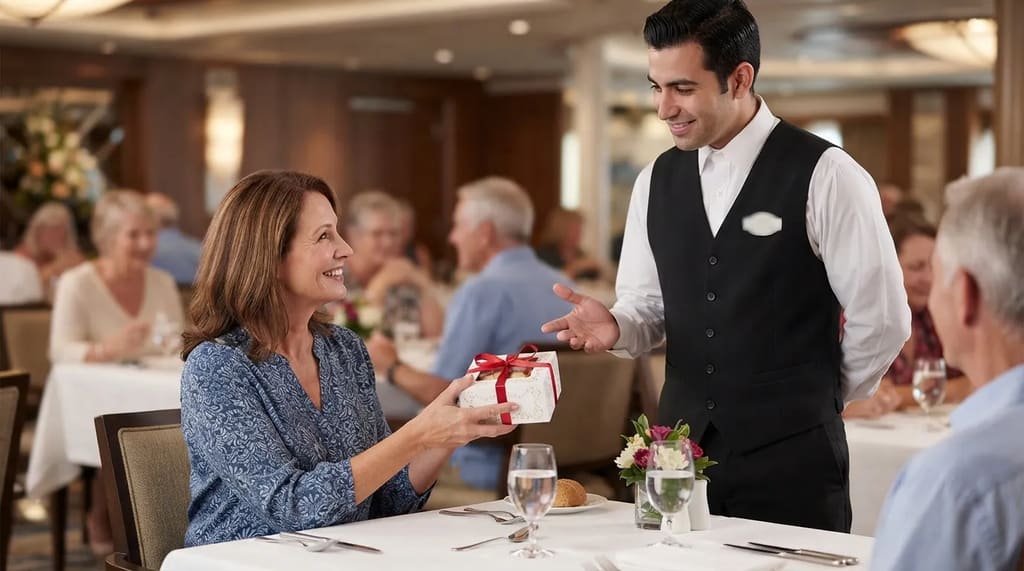
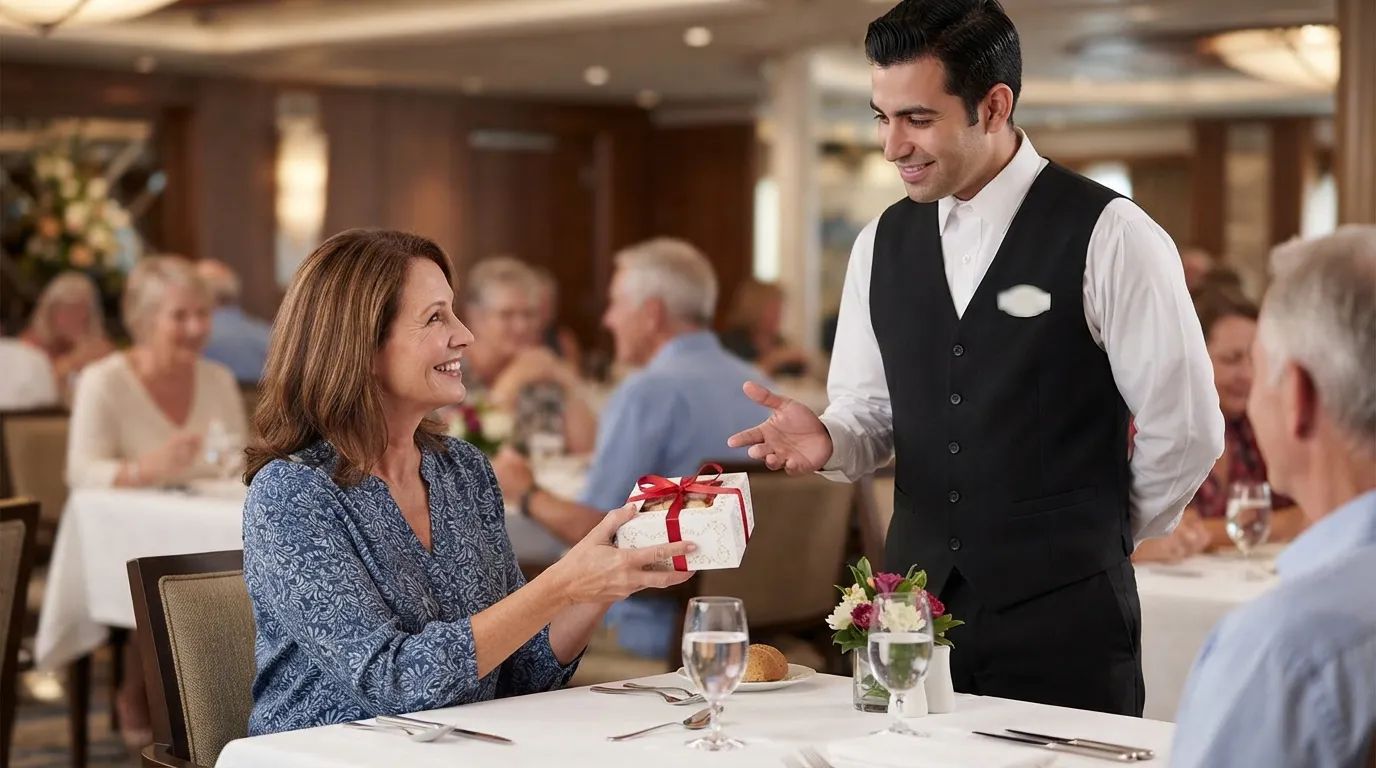
Baking something for your cabin steward or waiter comes from a lovely place. On all the cruise lines one etiquette guide knows about, crew members aren’t allowed to accept homemade food from guests.
The rule exists for a sensible reason: food prepared in a private kitchen is outside the controls a ship applies to everything else it serves. A crew member who accepts your cookies is the one who takes the risk.
There are better ways to say thank you, and they cost nothing.
Quick Compare
- Homemade treats: not accepted, and risky for the crew member.
- Using their name: learn it, pronounce it correctly and use it every night.
- A written comment: praise on the guest comment card reaches supervisors.
If service was excellent, tell the head waiter too. A kind word that reaches a supervisor helps a crew member more than a plate of brownies ever could.
A rough first night is its own kind of trap, and it catches guests before the cruise has really begun.
#6 – Writing Off the Dining Room After Night One
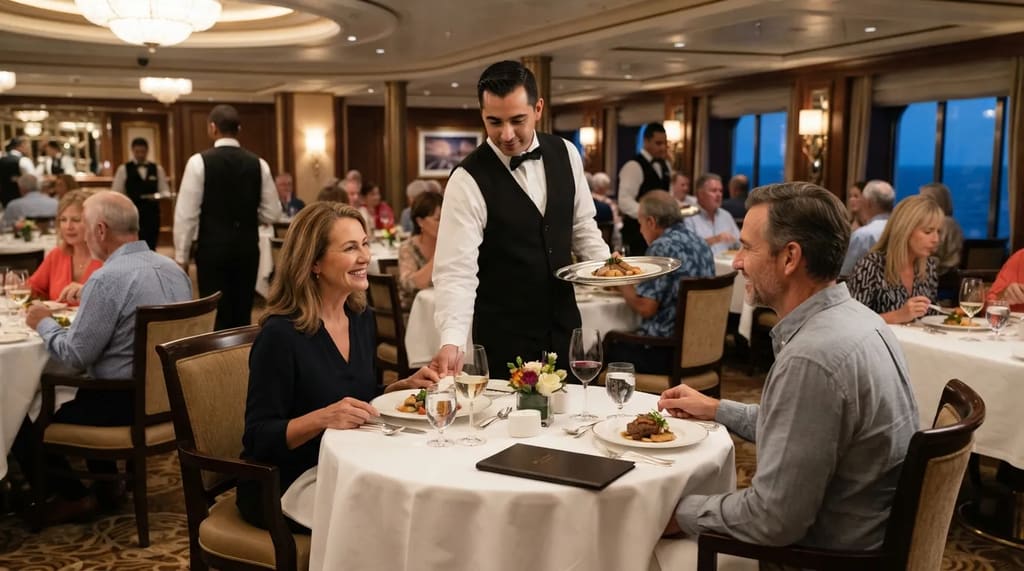
One chaotic first dinner shouldn’t decide the rest of the cruise. Yet someone has a disorganized experience on embarkation night, then writes off the dining room for good.3
That’s a judgment made on the least typical night of the sailing. A full ship has just boarded, and everyone is learning the room at once.
On traditional dining you typically see the same waiter team all week, so night two is a real chance to start fresh. Mistakes happen on any night, whether it’s a forgotten drink, a missed ingredient or the wrong dish.
If something does go wrong, patience works better than a scene. You’re far more likely to get an issue resolved by being polite than by being rude.
Judging the room by night one is a mistake about timing, and a second timing mistake is the one that holds up your whole table.
#5 – Arriving Late to a Fixed Seating
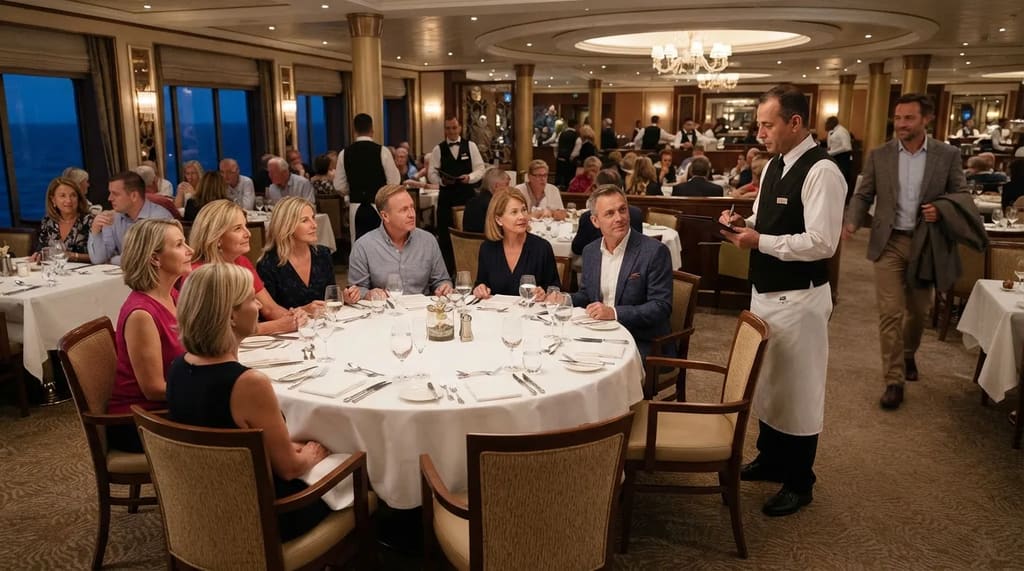
Waiters usually don’t take dinner orders until everyone is in their seats. So one late arrival at a shared table slows the order for everyone sitting there.
Cruise Critic points out that lateness delays ordering for others. It can also force waiters to rush you through your meal to get you out in the allotted time, so you’re the one who loses the leisurely pace you came for.
Flexible dining has its own version of the problem. If you booked My Time Dining on Royal Caribbean, showing up at the wrong time from your reservation may mean you don’t have a seat.
If you’re on traditional dining but have plans elsewhere, a quick call to the dining room is a thoughtful thing to do.3 It frees the seat and spares your tablemates a long wait.
Lateness in the main dining room costs some patience, but at a specialty restaurant the same habit is billed per person.
#4 – Skipping a Specialty Reservation Without Canceling
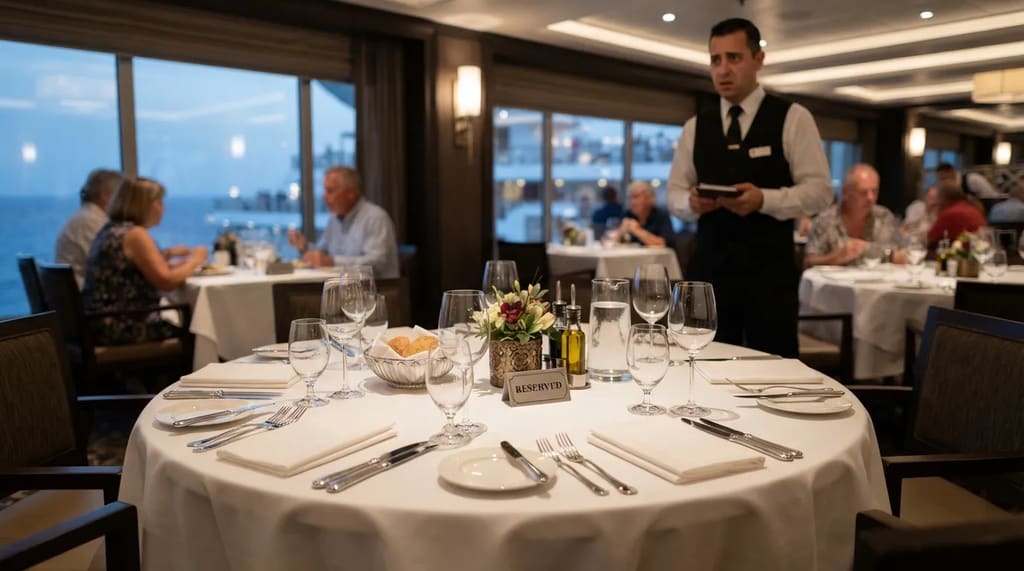
The fees are real, and they differ by line. Royal Caribbean doesn’t allow changes within 24 hours of a specialty reservation, and a $25 per person fee applies if you cancel inside that window or don’t show up.1
- Royal Caribbean charges $50 per person at Chef’s Table, Izumi Hibachi and several other venues.1
- Norwegian charges $10 per person if you don’t cancel or change a reservation at least two hours before dinner.4
- Celebrity notified passengers of a $20 per person fee at its Fine Cut Steakhouse.5
Compare that with #5: on Norwegian, a guest more than 15 minutes late has the reservation released and the $10 fee charged.4 A habit that merely slows a table in the main dining room costs real money here.
A held table can’t be sold to anyone else, which is why lines treat a no-show like a bill. Cancel as soon as your plans change, not after the day is half gone.
Policies shift, so read the terms shown when you book, including whether a dining package exempts you.
Another charge on your account runs every day whether or not you sit down for a meal, and plenty of guests only skim it.
#3 – Pulling the Daily Gratuity Off Your Bill
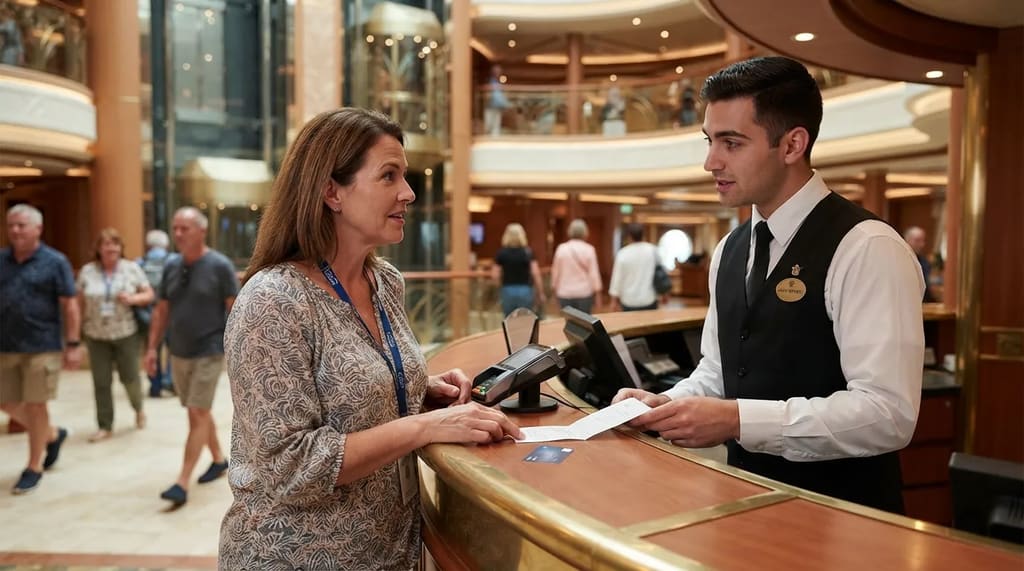
The daily gratuity is the line item some guests go hunting for at guest services. On most mainstream lines, it runs $16 to $21 per person, per day.
That includes Royal Caribbean at $18.50, Carnival at $17 and Norwegian at about $20.6 Rates change, so check your own booking.
Related Stories From Travelbinger


This charge is meant to reach the people who serve you at dinner. It typically goes to the main dining room server and assistant server, and it’s pooled and shared among the dining, housekeeping and behind-the-scenes staff.
Some guests remove it at guest services to protest a bad meal. That takes money from the staff rather than the cruise line, and crew members are paid base wages that assume gratuities will be paid.
My verdict: use the head-waiter route from #6 to fix a problem, and leave the gratuity alone. The charge applies whether you stick to the buffet or never set foot in the main dining room, and some Norwegian fares build it into the ticket, so check yours.
The dining room that’s already in your fare is also where the most serious request gets handled, and the buffet isn’t the safe alternative.
#2 – Trusting the Buffet With Your Allergy
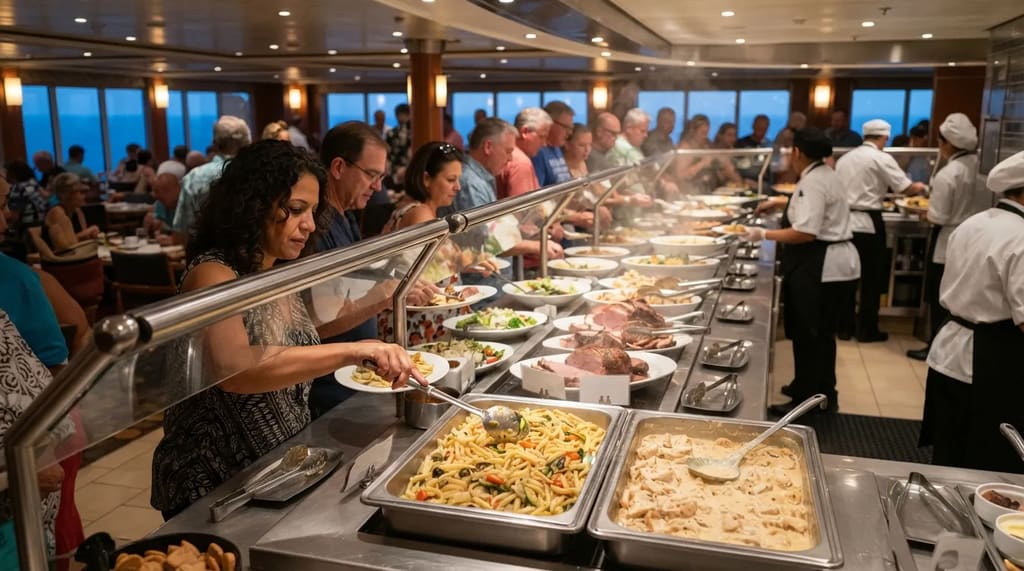
The buffet looks like the flexible option, but for guests with allergies it’s the riskier one. For severe allergies, the main dining room is usually the safest option because the buffet has more cross-contact risk.
The reason is how the room works. In the main dining room, your meals are made fresh, and a waiter, a head waiter and a maître d’ all know what you can’t eat.
Carnival’s guidance is blunt on this point: allergies can best be accommodated in the main dining room.7 That’s one more reason to keep dinners in the included dining room, as in #13.
Buffets share serving spoons, counters and crowds, so a trace of one dish can end up in the next. If you do use one, speak with the senior dining staff, or ask to speak with a chef.
All of that depends on a step that happens before you sail, with a deadline weeks away, and it is the biggest mistake on the list.
#1 – Boarding Without Telling the Cruise Line
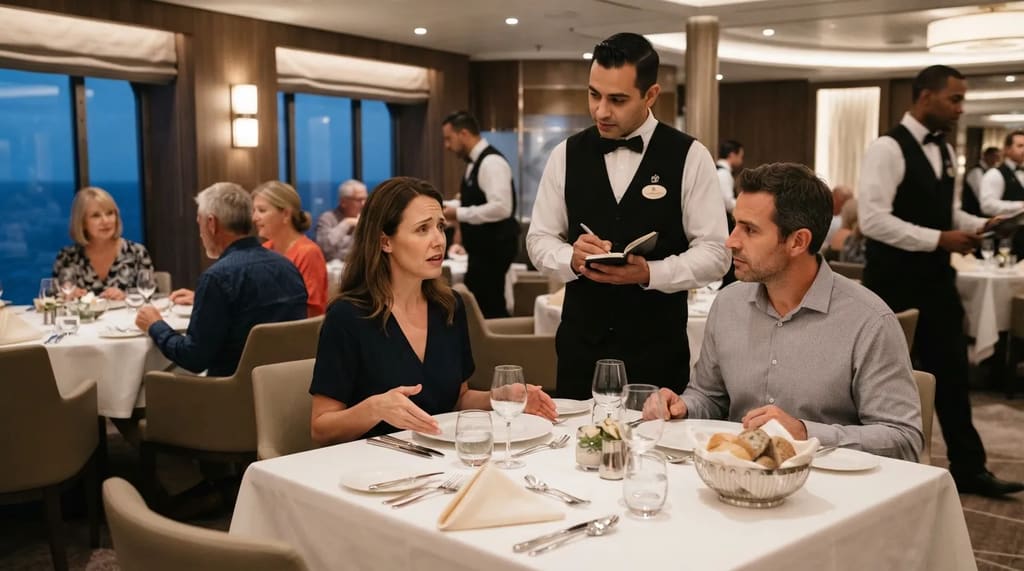
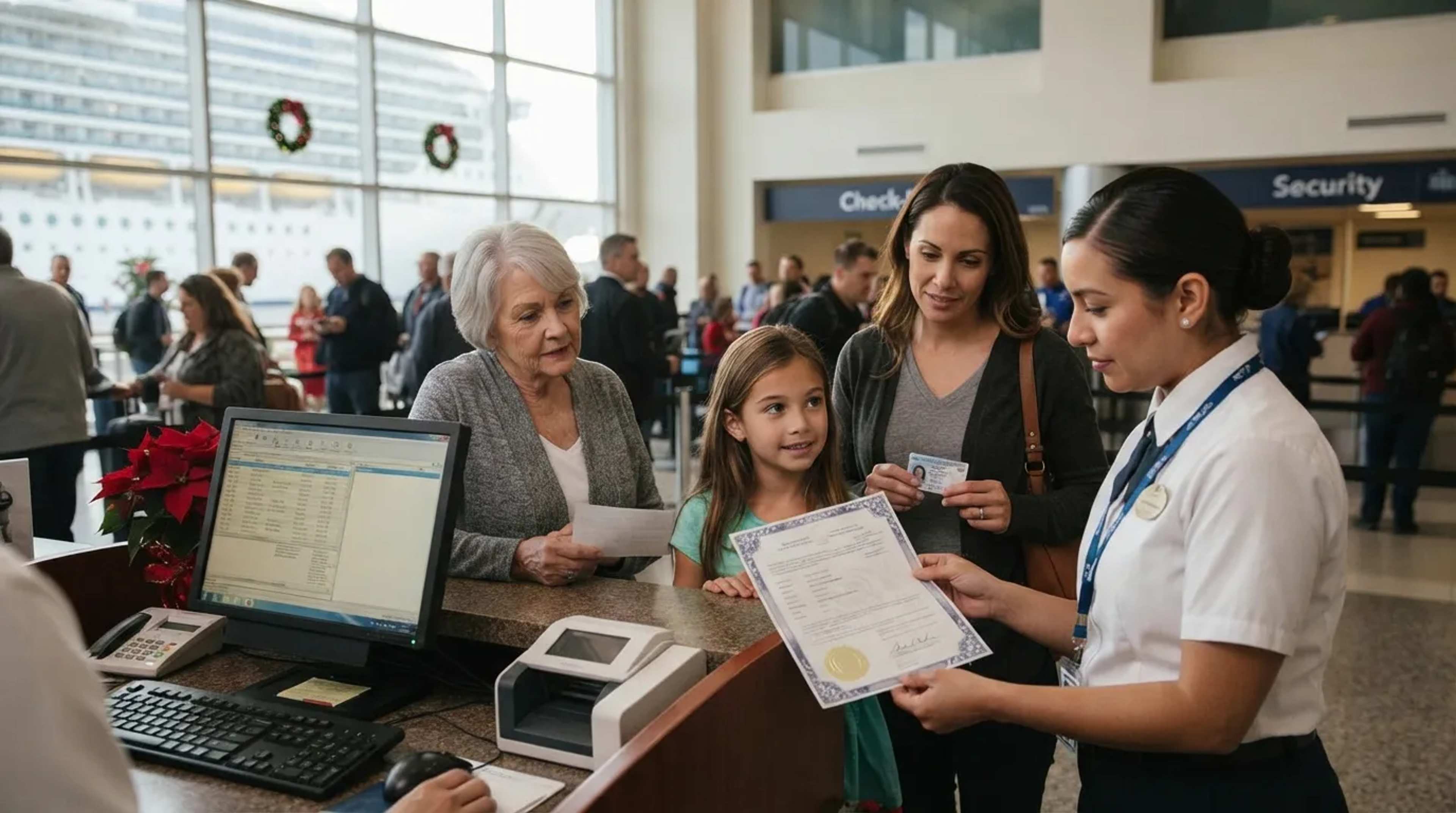
Cruise lines can accommodate almost every dietary restriction, but they must know about them to help you. Waiting until the first dinner leaves the ship little time to plan for you.
The lines set their own deadlines, and the gap between them is wider than most guests expect.
At a Glance
- P&O: at least 28 days’ notice.
- MSC: no later than 30 days.
- Norwegian: at least 45 days in advance.
- Royal Caribbean: at least 45 days.
Telling the line is only half the job. Carnival has a pre-cruise Allergies Form and then asks you to tell the maître d’ and your dining team on the first evening, because the form reaches the provisioning side while the conversation reaches the people cooking.8
Tell the cruise line before you travel, then tell the dining team again before you eat. Then remind your server each night, because Princess asks guests to remind their server at every meal.
Check the details with your doctor and the line’s special-needs team, since each line’s process and deadline differs.
Every Table Runs on What You Tell the Crew
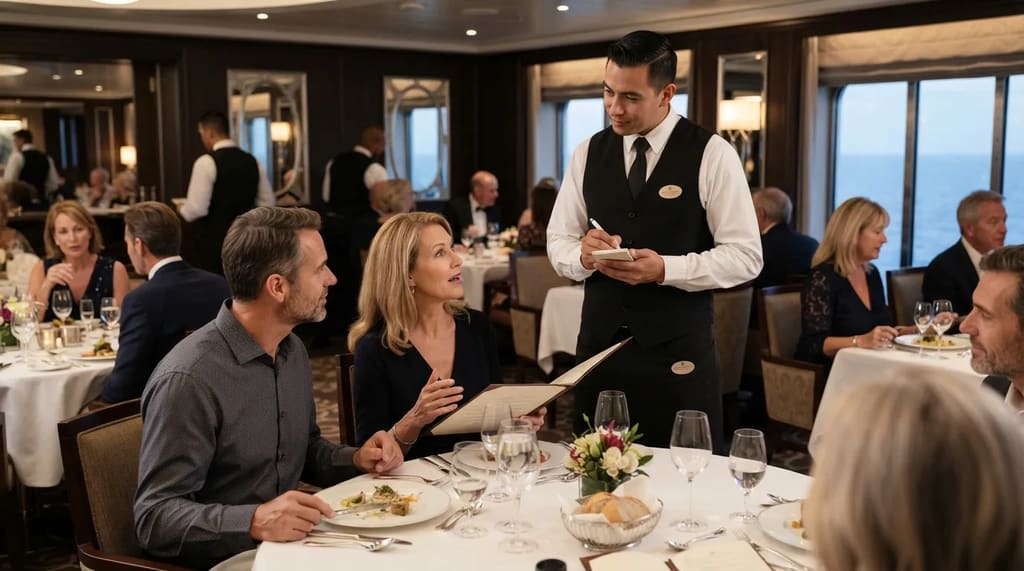
Look back through the list and a pattern shows up. The small mistakes cost goodwill, the middle ones cost money, and the last one can cost you the chance to be protected.
Each depends on what the dining team knows and when they know it. That’s the shift worth making on your next sailing: treat the dining room as a service you brief, not a place you simply show up.
Worth Knowing
- Goodwill: phone calls, plate stacking and accent jokes (#12, #11, #10) cost you the crew’s and tablemates’ patience.
- Money: specialty no-shows and removed gratuities (#4, #3) show up on your bill or the crew’s paycheck.
- Protection: allergy mistakes (#2, #1) are the ones that matter most for your health.
Waiters can’t read minds, but they can fix a surprising amount once they hear about it. The allergy, the late arrival, the cancellation and the dish you’d like to try all start as one quiet sentence.
What’s one request you made at a cruise dinner table, whether a cheese plate, a second entrée or a change of seat, that you’d tell a first-time cruiser to try?
- Royal Caribbean Specialty Cancellation: https://www.royalcaribbean.com/faq/questions/specialty-dining-restaurant-cancellation-policy
- Cruise Critic Dining Don’ts: https://www.cruisecritic.com/articles/9-things-not-to-do-in-a-cruise-ship-main-dining-room
- Cruise Dining Mistakes Guide: https://lifewellcruised.com/cruise-main-dining-room-mistakes-to-avoid-in-2026/
- Cruise Critic NCL No-Show Fee: https://www.cruisecritic.com/news/ncl-introduces-no-show-fee-for-specialty-restaurants
- Celebrity Fine Cut Fee: https://www.yahoo.com/lifestyle/articles/does-royal-caribbean-dining-fee-202727647.html
- Cruise Gratuity Rates Guide: https://thepointsguy.com/cruise/cruise-ship-tipping
- Carnival Allergy Guidance: https://www.carnival.com/about-carnival/special-needs/pre-cruise-forms
- Carnival Guests with Allergies: https://www.carnival.com/about-carnival/special-needs/allergies