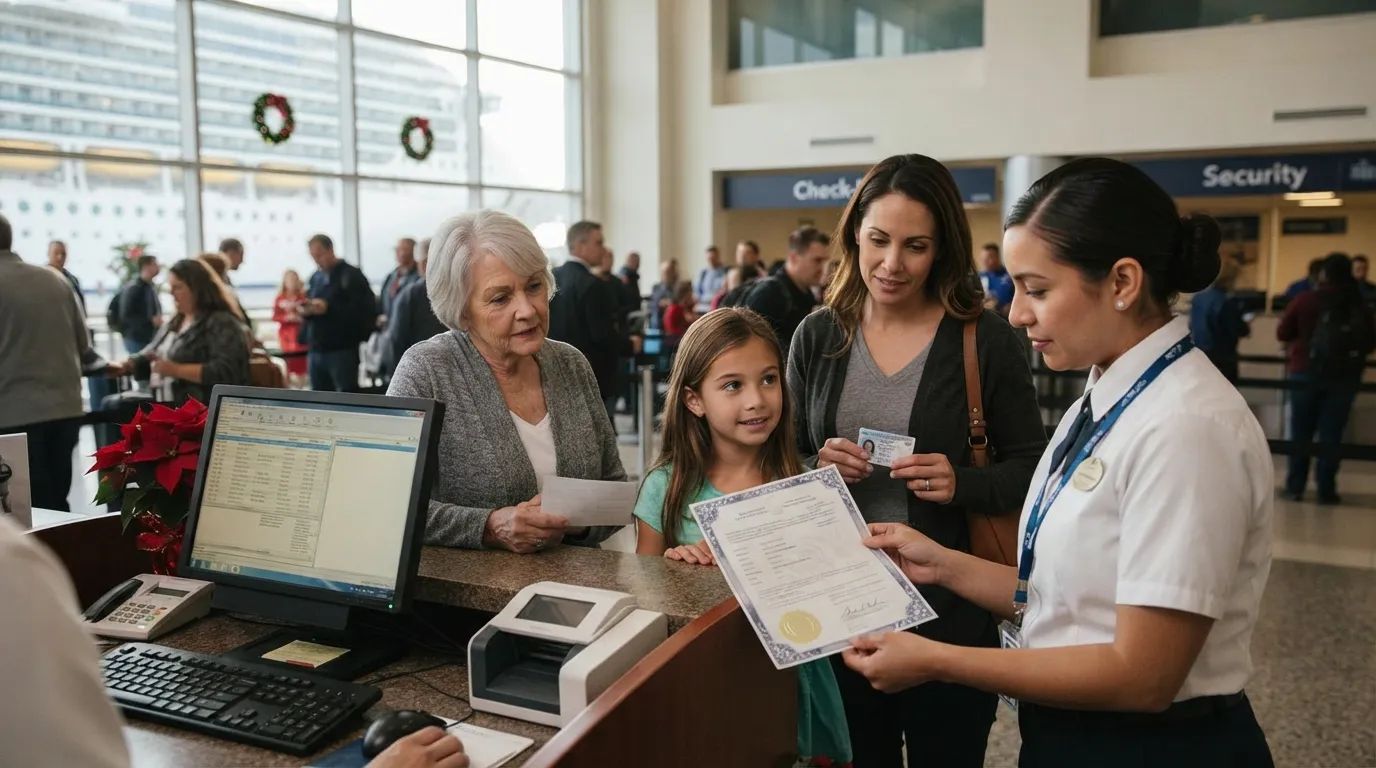
The brochure photo shows three generations around a tree on a sunny deck, and nobody in it is arguing about a cabin. Real Christmas cruise planning looks nothing like that picture. Christmas and New Year sailings are among the most popular of the year, so the rooms, tables and tours a multigenerational group needs are the first things to go.
Almost every mistake on this list gets made on booking day, months before anyone packs a sweater. The early ones cost you an evening or a port stop. The last one can cost a full cabin fare, and its clock starts ticking the day you pay your first deposit.
#10 – The Shore Tour and Dinner Table That Sell Out First
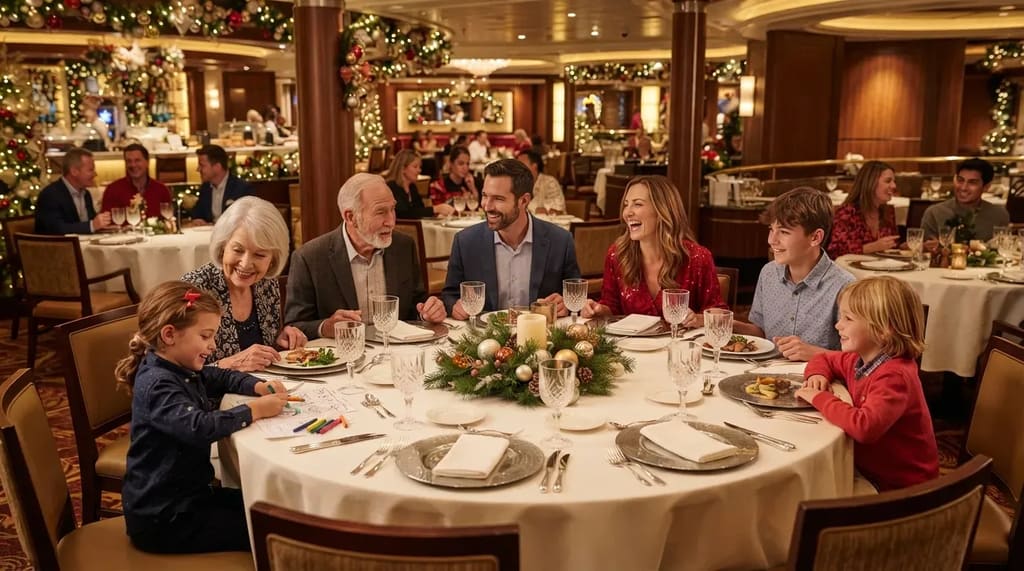
Christmas week fills a ship’s activity list the way it fills an airport. Royal Caribbean’s own guidance is to reserve specialty dining and popular shore excursions first, since both are in high demand on Christmas sailings.1 A couple can slip into a leftover spot. A family of nine needs nine open seats on the same tour and a table big enough for everyone.
That is why a late start costs you the plan you had in your head. Treat your booking confirmation as a starting gun. Booking windows vary by sailing and cruise line, so find the date your line opens reservations and put it on every household’s calendar.1
Fast Facts
- Christmas and New Year sailings are among the most popular of the year.
- Royal Caribbean advises booking specialty dining and popular excursions first.
- Two travelers can fill a leftover slot. Nine travelers rarely can.
- Reservation windows differ by line and by sailing, so check yours.
Reserve the tour and the specialty dinner before you shop for luggage. Pick one person to book both, because two relatives booking separately usually end up with two half-plans. Even a perfect reservation can hit a locked door, though, since some ports treat December 25 as a holiday too.
#9 – A Port Day That Lands on Christmas Itself

A port stop on December 25 isn’t the same as a port stop in July. Some attractions and businesses may have limited hours on Christmas Day or New Year’s Day. That can turn the shopping stroll Grandpa has been looking forward to into a walk past closed shutters.
If your group is counting on a particular museum, market or beach club, confirm it’s open before you build the day around it. Christmas markets are a related trap. Some ocean voyages visit cities with Christmas markets, though those are more commonly tied to European river cruises, so check the exact port schedule and market dates.
An itinerary that sounds festive in the ad may reach the market town on the wrong day. Ask for the port schedule and check opening hours for the days you’ll be ashore. The tour you booked in the last slide only helps if the stop it visits is open.
Hours are the easy problem. The harder one is whether three generations even want to spend the day in that port at the same time.
#8 – One Itinerary, Three Different Ideas of a Vacation
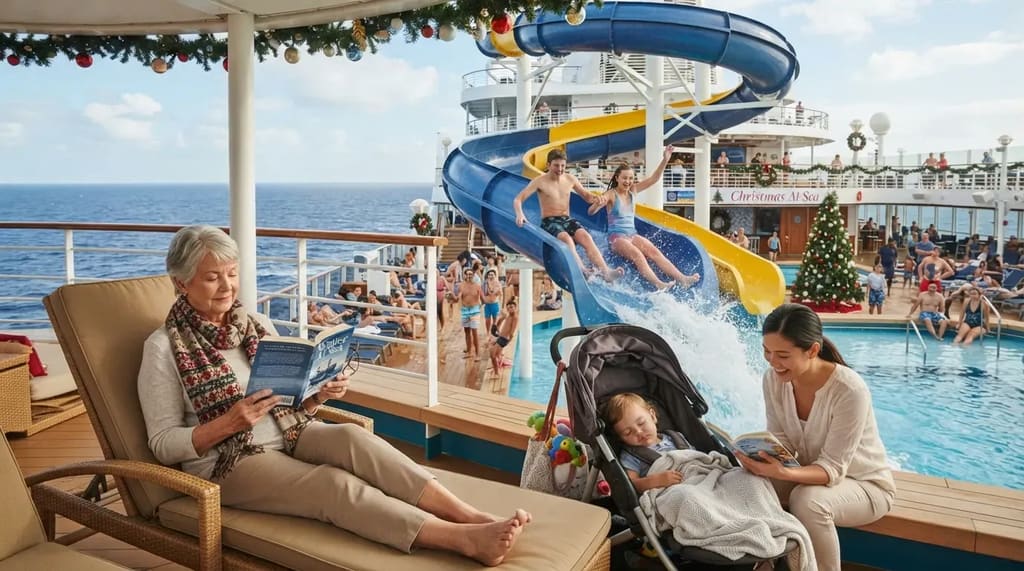
Grandma wants a deck chair and a book. The teenagers want the waterslide, and the toddler wants a nap at an hour nobody can predict. Cruises can work remarkably well for multigenerational families, but only when the group stops expecting everyone to take the same vacation.
Ships are built for this, since multigenerational groups can spend time together without needing to follow the same schedule. The mistake is the color-coded group itinerary, with every household expected at every tour and show. Before booking, ask each household what would make the trip enjoyable and what would make it frustrating, and let the answers shape the plan.
Quick Compare
- Everything-together plan: every tour and show is a group event, so one missed nap derails the whole day.
- Anchors-only plan: a couple of fixed meals, with everything else optional.
- The payoff: Grandma keeps her deck chair, the teens keep the waterslide, and nobody has to apologize.
My verdict: a shared schedule is overrated, and a short list of anchors works better. Pick two shared meals and leave everything else optional. Dinner is the one meeting worth fixing in advance, and that choice has a catch for the youngest and oldest at the table.
#7 – The Set Dinner Time That Collides With Nap Time

Dinner is the one place a big family can reliably end up together. Fixed dining times can help families reconnect each evening, but they can also clash with naps, excursions or different appetites. A table for nine at 8:15 sounds festive until a two-year-old melts down at the appetizer. Then Christmas Eve becomes a negotiation.
For a three-generation group, I’d still choose set seating over flexible dining, at least for the nights that matter most. A fixed table is the only way to guarantee everyone sits together. When you book, choose the seating time and ask the line to link every household’s reservation so you’re assigned one table.
If the youngest guest is a baby or toddler, pick the earlier seating. Set the seating time and link every reservation when you book.
Seating a toddler at the table is one thing. Finding out the ship has no program for that toddler is another.
#6 – The Kids’ Club That Doesn’t Exist on Your Ship
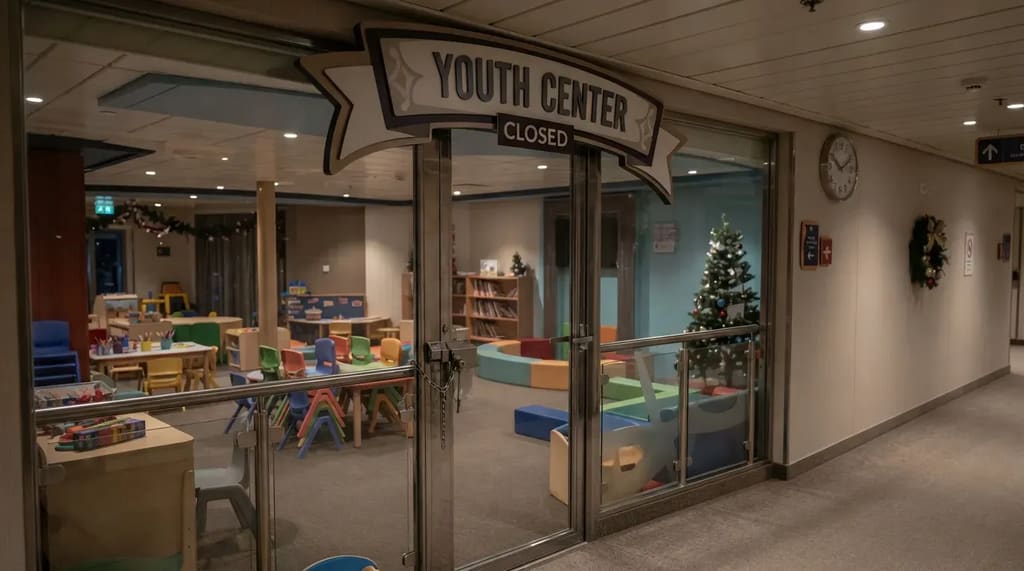
Parents often assume every cruise comes with children’s programming. It doesn’t, even on a famous brand. Not every luxury cruise line offers extensive children’s programming, and families with younger children should confirm minimum ages, youth facilities, connecting accommodations and childcare options before booking.
Discovering the gap on Christmas Eve, with the ship at sea, is a poor time to learn it. The mainstream lines are built differently. Celebrity, for one, offers children’s programming centered around kids’ specific ages, and Royal Caribbean runs a nursery for children aged six to 36 months. That nursery is a paid service that requires a separate booking.2
Worth Knowing
- Not every luxury line offers extensive children’s programming.
- Ask about minimum ages, youth facilities, connecting rooms and childcare before you book.
- Celebrity builds its kids’ programming around specific age groups.
- Royal Caribbean’s nursery covers ages six to 36 months, costs extra and needs its own reservation.
The free-roaming plan from earlier only works if the kids have somewhere to be. Get the age bands and hours for every child in writing before you pay a deposit. And where everyone sleeps is the next puzzle, because the tidy answer, one category for all, is usually the expensive one.
#5 – Booking the Same Cabin Category for Every Household
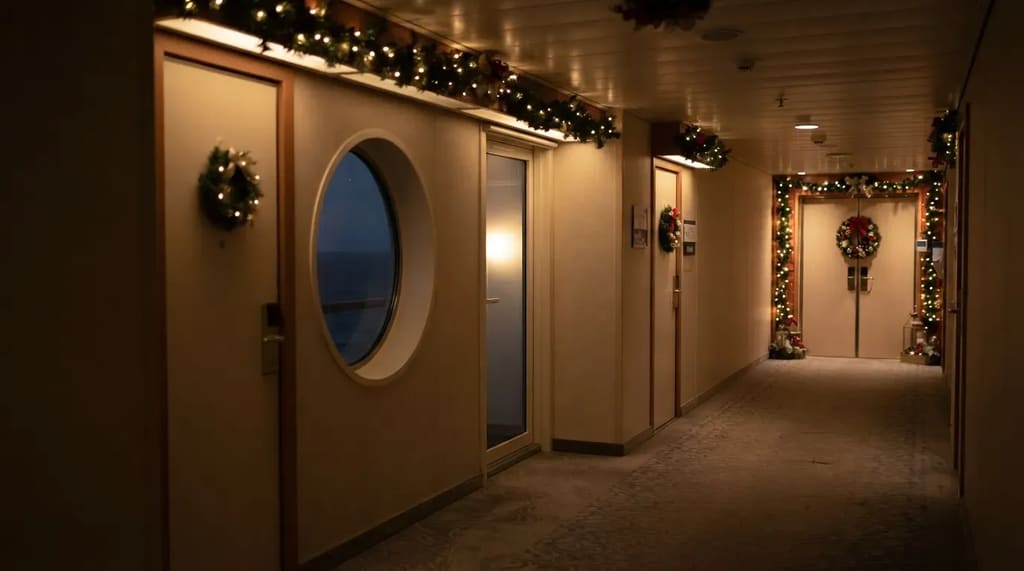
Families like symmetry, so they book four identical balcony cabins and are surprised by the total. Not every household needs the same room. A sensible mix might be a suite for the grandparents, an interior or ocean-view room for the adults, and bunk-style or triple cabins for the kids.
My verdict is that a balcony for every household is overrated. Put the balcony where someone will actually sit on it at sunrise, which is usually with the grandparents.
Also ask about group perks. Lines set their own thresholds, so a travel agent can tell you whether the number of cabins you’re booking qualifies for onboard credit or other incentives. Be careful with “kids sail free” offers. Royal Caribbean’s offer is limited-time, covers guests 12 or younger, and applies only on active dates, so confirm it covers your Christmas sailing. Match each cabin to how its occupants will use it.
Saving money on cabins only pays off if the rooms are near each other, and that’s where families learn which rooms the line sells first.
#4 – Hoping the Line Will Connect Your Rooms Later

Connecting staterooms are real, and they’re among the scarcest rooms aboard, so multigenerational groups should book earlier than anyone else. The mistake is booking a “guarantee” cabin, where the line picks the room, and planning to request a connection afterward. That approach rarely works. The only way to guarantee connecting cabins is to book the specific connecting cabin numbers.
A guarantee category is how you end up with one room on deck 3 and another on deck 9. Picture a parent doing the midnight walk with a sleepless baby, hunting for the grandparents’ door on another deck.
Placement matters for the oldest travelers too. For older guests, choose rooms on the same deck, near elevators, so the walk to dinner doesn’t become the day’s main event. The cabin mix from the last slide only works if the room numbers are real, not hoped-for. Pick the exact cabin numbers, and skip the guarantee category.
Cabins are about comfort, though. The next rule decides whether the youngest guest is allowed aboard at all.
#3 – The Baby Who Turns Six Months Old After Embarkation
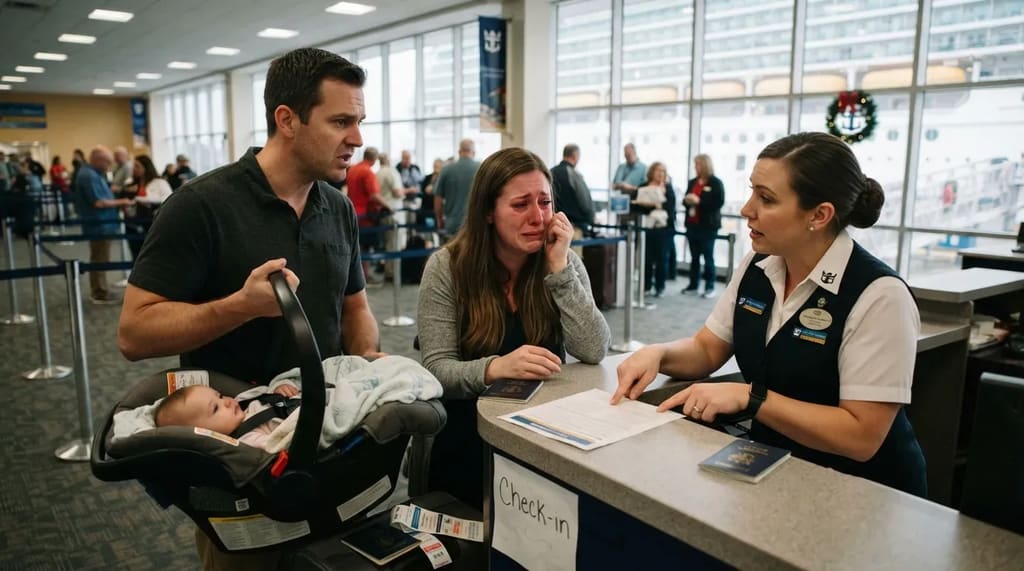
A baby’s birthday has to arrive before the ship sails. Royal Caribbean requires infants to be at least six months old on the first day of the cruise, and a birthday during the voyage doesn’t rescue the booking. The consequence is blunt. Guests traveling with a young infant who doesn’t meet the policy will be denied boarding, and no refunds are provided.3
The minimum also rises to 12 months on some voyages. At Royal Caribbean, that applies to transatlantic, transpacific, Hawaii and select South American cruises, and to any cruise with three or more consecutive days at sea.4 Rules vary by line, so don’t assume the policy from last year’s cruise carries over. Count the baby’s age on embarkation day, using your own line’s policy.
The baby’s age is one document. The rest of the family’s paperwork has its own traps, and one of them applies only when grandparents travel with grandchildren.
Related Stories From Travelbinger


#2 – The Birth Certificate That Won’t Pass at the Pier
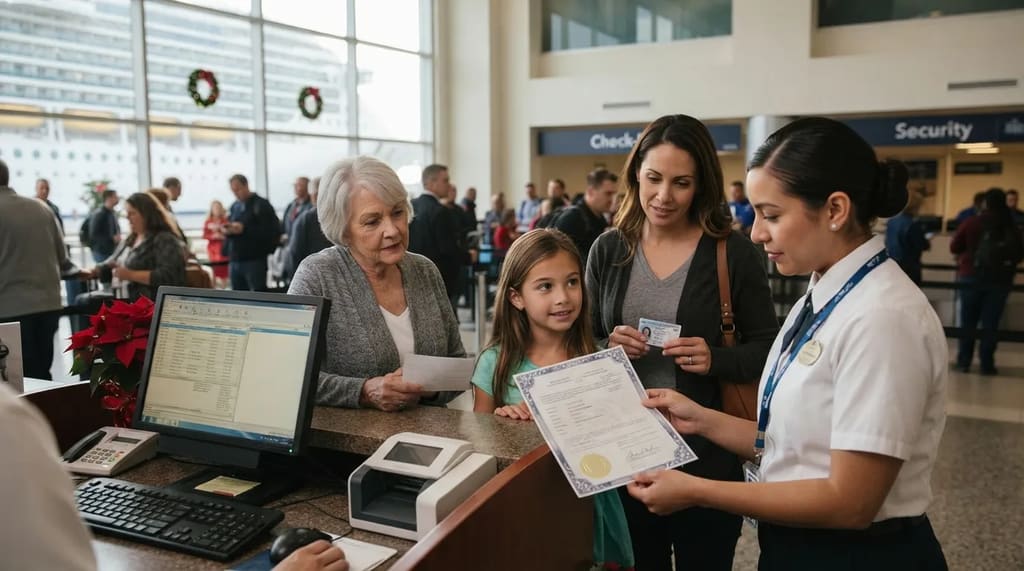
You can skip the passport on some Christmas cruises, but only if everything else is in order. On a closed-loop sailing, which starts and ends at the same U.S. port, U.S. Customs and Border Protection lets citizens use photo ID plus proof of citizenship such as a birth certificate. CBP recommends an original or certified copy.5 6
The birth certificate has to come from a state or local vital records office, because hospital-issued certificates are not accepted. For children under 16, the birth certificate typically is all that’s needed. A cute keepsake certificate with tiny footprints on it won’t do.
At a Glance
- Closed-loop cruise: starts and ends at the same U.S. port.
- Adults: photo ID plus proof of citizenship, such as a birth certificate.
- Copies: CBP recommends an original or certified copy.6
- Children under 16: a birth certificate typically is all that’s needed.
- Not accepted: hospital-issued certificates.
My verdict is to bring passports anyway. If someone misses the ship in a foreign port, they need a passport to fly home, and a birth certificate won’t get them on a commercial flight. For grandparents, there’s a second rule. A notarized letter of permission is often required, and at the least strongly recommended, when a minor travels abroad with anyone other than both parents, and that includes grandparents. Bring a notarized permission letter whenever a child sails without both parents.
#1 – The Insurance Deadline That Starts With Your First Deposit

The most expensive mistake on the list is made in the first two weeks, and it has nothing to do with the ship. Many travel insurance plans exclude pre-existing medical conditions unless you buy a waiver. According to CNBC’s cruise insurance roundup, you typically get it by buying within about 14 days of the first payment, and some insurers allow longer.7 Forbes Advisor adds that you must also be medically able to travel and insure 100 percent of the non-refundable trip cost.
Here’s why it’s the biggest. A three-generation group multiplies the health histories attached to one booking, and the clock runs from the first deposit, not from final payment or departure. One grandparent’s heart condition or a cousin’s surgery last spring can decide whether a claim gets paid. Cancel For Any Reason coverage typically must be added in the same 14 to 21 day window, and it usually reimburses only part of the trip cost, not all of it.8
If you’ve already paid the deposit on the cabins from the earlier slides, the window may be open right now. Some travelers buy a policy for what they’ve paid so far and update it as costs grow, so ask whether yours allows that. Buy within 14 days of your first deposit, which is the shortest window you’ll meet.
Every item above comes down to the same thing: a Christmas cruise is mostly decided long before December. The ship, the tree in the atrium and the carolers are the easy parts. What separates a calm trip from a stressful one is a handful of choices made at the booking screen, when it all still feels like a plan on paper.
So give booking day more attention than the packing list. A linked table, connecting cabins and a policy bought on time won’t appear in anyone’s holiday photos, but they are what make the photos possible. The best Christmas picture is the one where nobody in it is thinking about the logistics.
- Royal Caribbean Holiday Cruise Tips: https://www.royalcaribbean.com/guides/last-minute-family-vacation-ideas
- Royal Babies & Tots Nursery: https://www.royalcaribbeanblog.com/2025/10/06/royal-caribbean-changes-kids-club-prices-nursery-and-late-night-care
- Royal Caribbean Infant Policy: https://www.royalcaribbeanblog.com/2022/05/03/royal-caribbean-changes-its-minimum-age-infant-policy
- Royal Caribbean Age Limits: https://www.cruisehive.com/royal-caribbean-age-limits/104179
- CBP WHTI Overview: https://www.cbp.gov/travel/us-citizens/western-hemisphere-travel-initiative
- CBP WHTI FAQs: https://www.cbp.gov/travel/us-citizens/western-hemisphere-travel-initiative/faqs
- CNBC Cruise Insurance Roundup: https://www.cnbc.com/select/best-cruise-insurance/
- Cruise Insurance Guide: https://www.visitorscoverage.com/travel-insurance/cruise-insurance/