An Amtrak roomette measures about 3 feet 6 inches by 6 feet 6 inches, and everything you bring has to share that space with you and a second passenger.1 On a long-distance train with few stops, a forgotten charger or a missing pill bottle stays missing for hours.
The twelve items below come from Amtrak’s published rules and from rider guides, weighed for travelers who are 65 or older. Most are cheap and obvious once you hear them, but one involves something the crew generally cannot hold for you.
We will get to that one last. First, the floor of that tiny room.
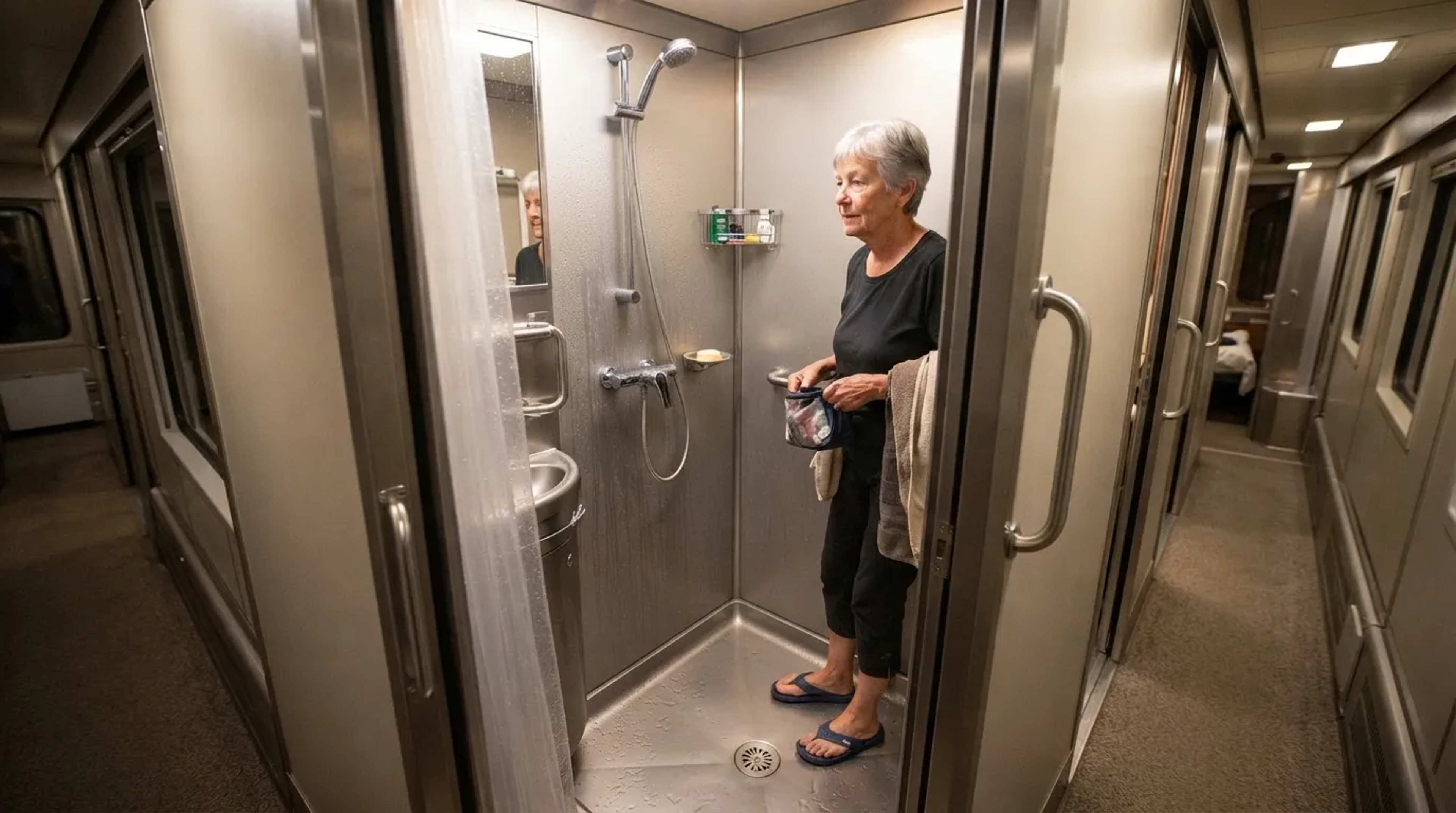
#12 – Slip-On Shoes and Shower Sandals
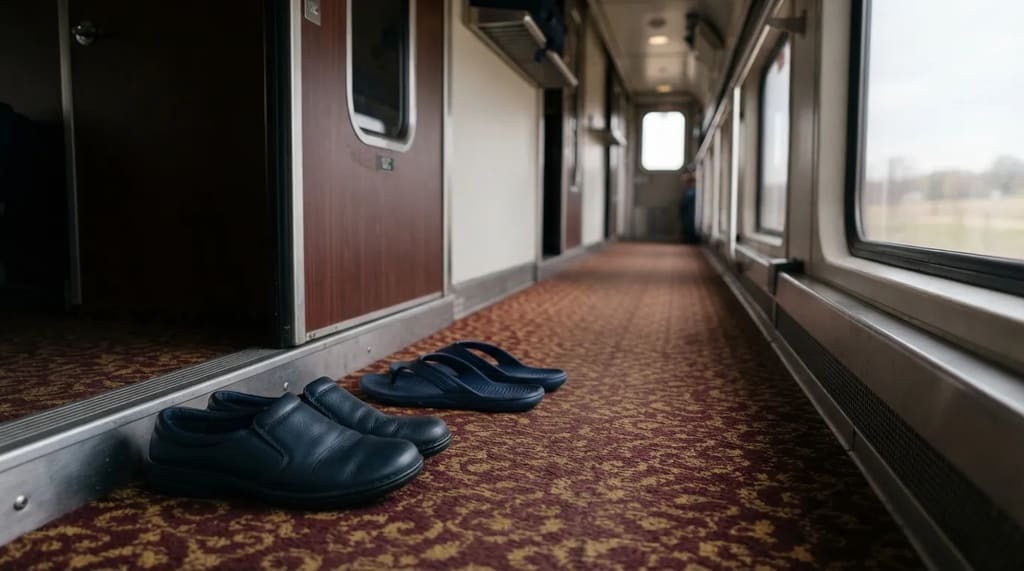
Bathroom arrangements depend on the room you book. On a Superliner roomette, passengers use shared restrooms and a shower room in the sleeping car, and Viewliner cars put a public shower room at one end of each sleeping car.
Bedrooms add a private in-room toilet and shower, so a bedroom ticket changes what you need to carry.1 Check the car type on your route before you decide.
For the walk down the corridor, slip-on shoes are easier to move around in than lace-ups. Shower sandals are worth packing for any sleeper car with shared shower facilities.
Skip the bathrobe, since the walk is short and a sweater over your sleepwear does the same job. The sweater doubles as a daytime layer.
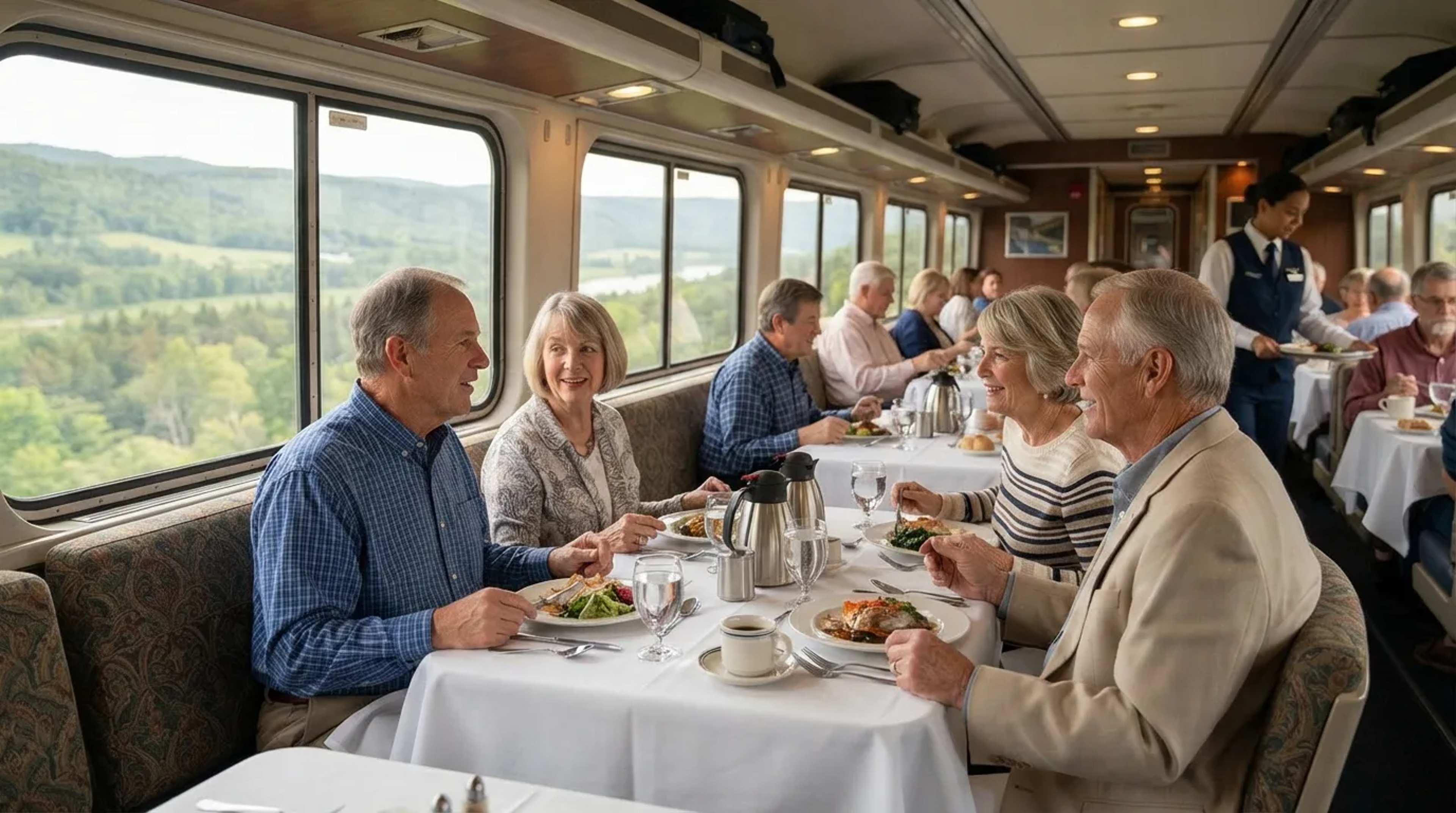
Shoes take care of the floor, but the air in the dining car and the sightseeing lounge is a separate matter.
#11 – One Warm Layer for the Dining Car
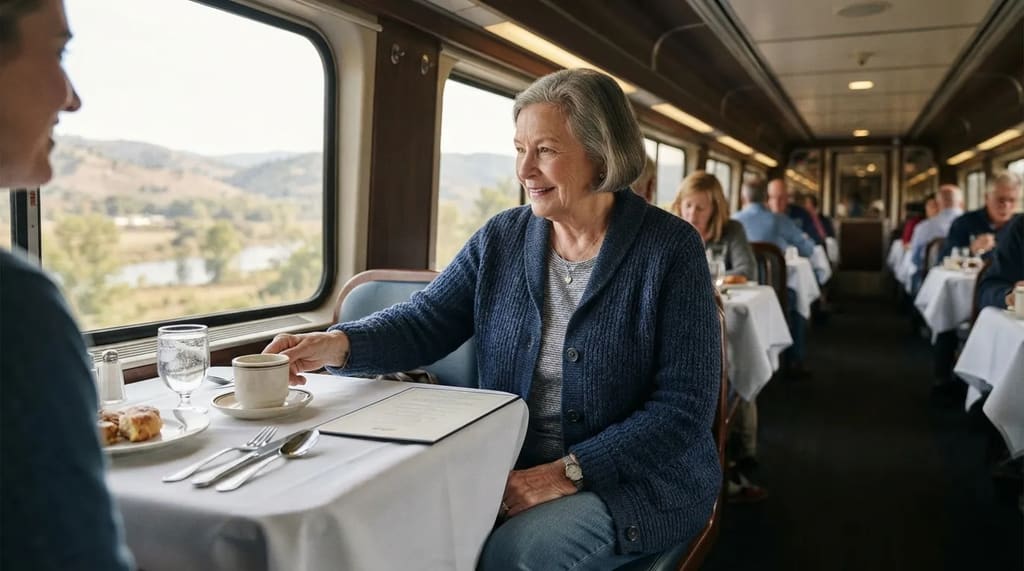
Your roomette has its own controls. Amtrak lists climate control among the room’s features, so you can adjust the temperature where you sleep.2
The shared spaces are another story. Trains can be cold, and the temperature can drop during the night, which matters when you walk to breakfast or wait on a platform at a long station stop.
At a Glance
- In your room: climate controls you can adjust yourself
- In the hallway and dining car: temperatures you cannot control
- At night: the chill can deepen, so keep a layer within reach
- On the platform: long station stops can feel colder than the train
A cardigan or fleece is enough. Throw it over your sleepwear for the walk to breakfast.
Sleeper tickets already include bedding. Amtrak lists fresh bed linens and a room attendant who handles the bedding, so leave your own comforter at home unless you are particular about your pillow.1
Warmth settles the day, though a good night’s sleep also depends on light and noise that the room does not fully block.
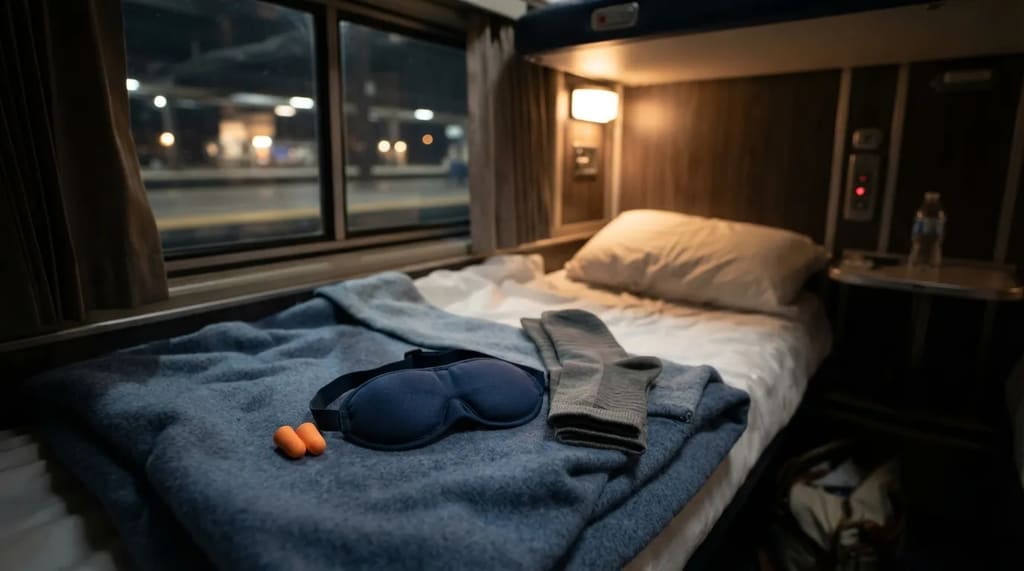
#10 – Earplugs, an Eye Mask and Support Socks
A roomette gives you privacy, but it is not soundproof. It has a privacy door or curtain, yet the sleeping car is still a shared environment.
A train that pauses at a station overnight brings platform lights and voices along with it. A good eye mask and a pair of foam earplugs handle both for very little money.
- Foam earplugs, which weigh almost nothing
- A soft, comfortable eye mask
- Compression socks, which guides recommend for long stretches of sitting
Compression socks are a question for your doctor first, since some circulation conditions make them a poor choice. If your doctor already recommends them for travel, a clean pair for each day takes little space.
Of everything in the sleeping kit, these items cost the least and weigh the least. They earn a place even if you sleep soundly at home.
Quiet and dark cover the night, but a dry throat at 2 a.m. does not wait for morning.
#9 – A Reusable Water Bottle, Filled Before Boarding
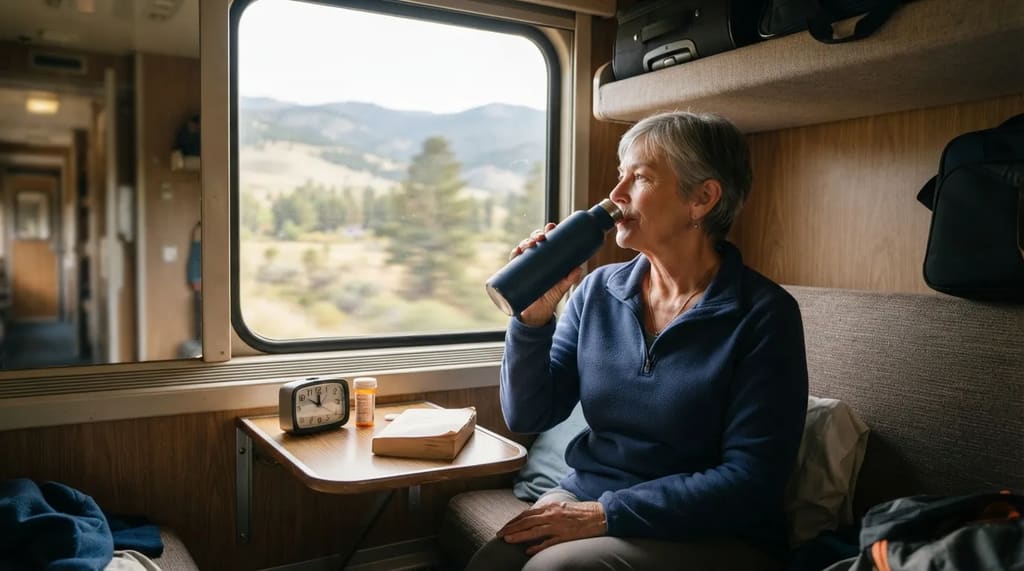
Water seems like the one thing you can leave off the list, because sleeper fares include bottled water. The catch is supply: stocks can run low toward the end of long-distance routes.
A reusable bottle filled at the station before you board gives you a backup. It also means a pill at 2 a.m. does not require a walk down the corridor.
Keep it to one bottle. Every extra pound rides with you through every station and eventually has to go overhead.
Water covers the morning, but the long afternoons between stations call for something to do.
#8 – Books and Shows Loaded Before You Leave
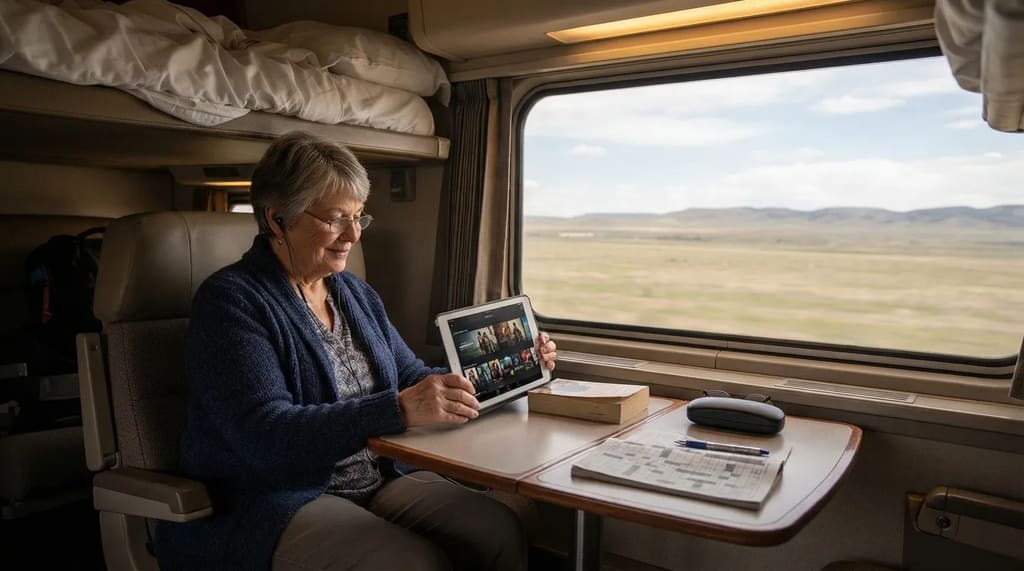
Do not count on the internet. Many long-distance Amtrak trains do not offer Wi-Fi, and where it exists it only works in areas with cellular coverage.
Cross-country routes pass through long stretches of open country where signal fades, so anything you want to watch or read has to be on the device before you board. Download a few shows, an audiobook or a set of puzzles at home on your own connection.
Tell your family you may be out of reach for hours at a time. That prevents a worried phone call when a text goes unanswered.
Worth Knowing
- Wi-Fi is missing on many long-distance trains
- Where it exists, it depends on cellular coverage
- Downloads should be finished at home, not at the station
- A paperback never needs a signal or a charge
The window is the best screen on the train. One paperback and a book of crosswords will do more for a two-day trip than a bag full of gadgets.
Anything electronic you do bring will need power, and that has a catch of its own.
#7 – A Longer Charging Cable and a Wall Adapter
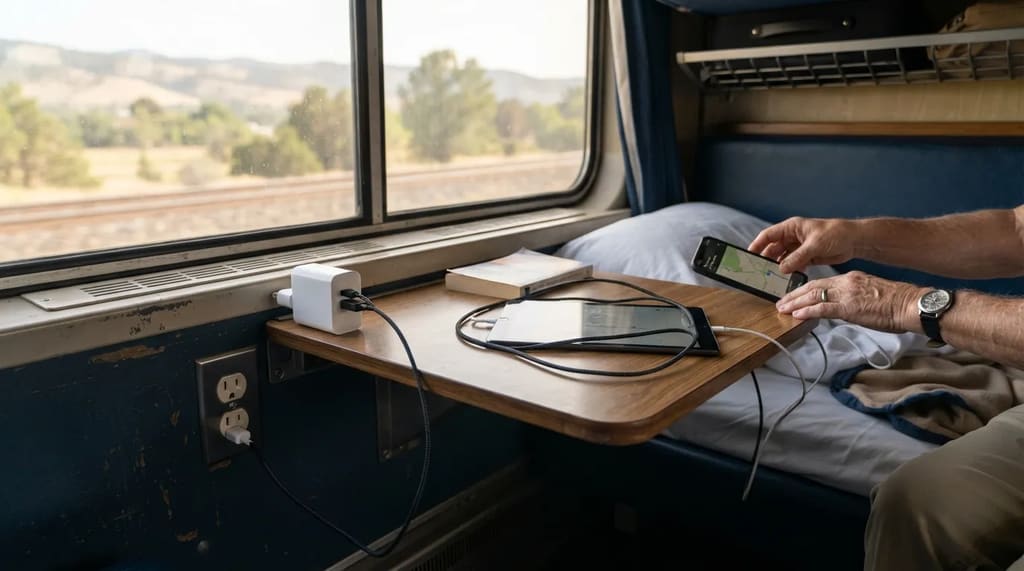
Your room is better equipped than a coach seat. A roomette has outlets and a fold-down table, and the power is standard 110-volt AC.1
What it lacks is modern ports. Sleeper cars are generally not equipped with USB chargers, so passengers should pack adapters for the electrical receptacles.3
Bring a small plug-in charger with USB ports and a cable long enough to let the phone rest by your pillow. If you carry two devices, a charger with two ports lets one outlet serve both.
A power bank is only worth the money if you plan to spend your days away from the room. It covers you on trains where charging points are missing, and in a sightseeing lounge it saves a walk back to your room.
Charged devices keep you busy, though they do nothing when the café car runs out of what you wanted for lunch.
#6 – Dry Snacks for the Gaps Between Meals
Meals are the best part of the sleeper fare. Sleeper Service passengers are entitled to all regular meals, so do not pack lunches.
The trouble comes between meals and when supplies thin out. The café car can run low, and the same goes for the dining car.
Terms also vary by route. The Points Guy reports that sleeper passengers have meals included, except on Silver Star trains between New York City and Miami, so confirm the meal terms for your own train at booking.
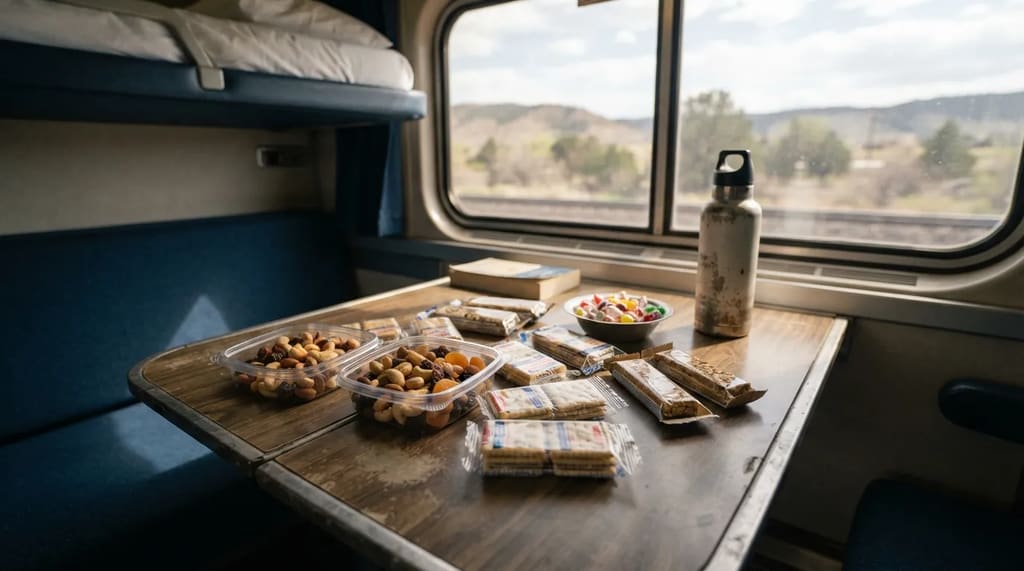
For snacks, pack items that need neither heating nor refrigeration:
- Packaged crackers or peanut butter sandwiches on sturdy bread
- Nuts, dried fruit or granola bars
- Hard candy for dry mouths and mid-afternoon dips
On a route where meals are included, one small bag is plenty. A cooler of sandwiches takes up room you do not have in a roomette.
#5 – Small Bills for the People Who Look After You
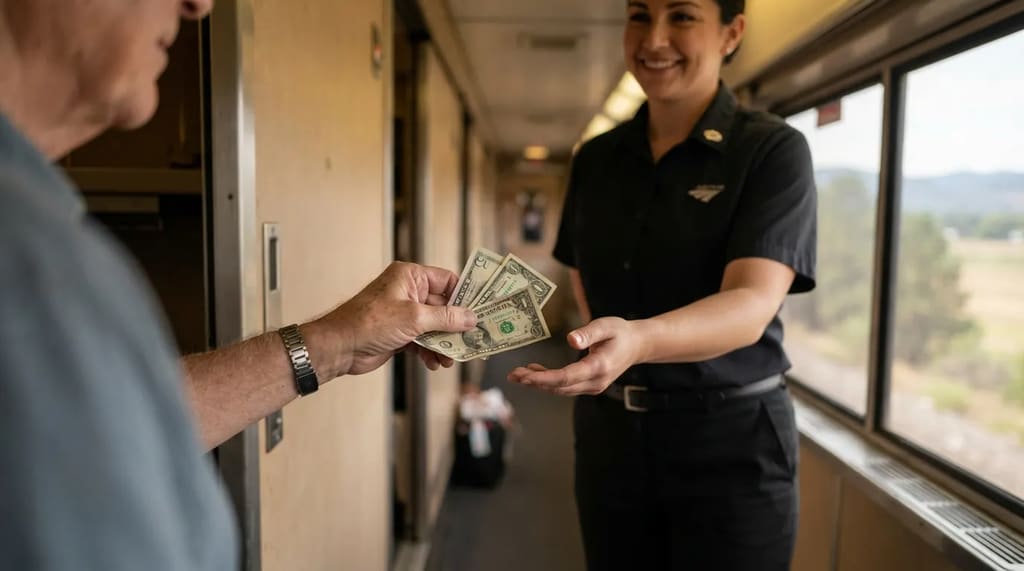
A sleeper trip involves several people working for you. Sleeper passengers are advised to tip the dining car server and the car attendant, so bring cash before you board.
Small bills are also useful at smaller station vendors that do not take cards. Singles and fives are easier to hand over than a twenty that needs change.
The attendant is the person who turns your seats into beds and brings your coffee, so the tip is worth planning for. Break larger bills at the departure station before boarding, since the train is a poor place to ask for change.
Cash fits in a pocket, whereas the bag that holds everything else is something you have to lift yourself.
#4 – A Bag You Can Lift Over Your Head
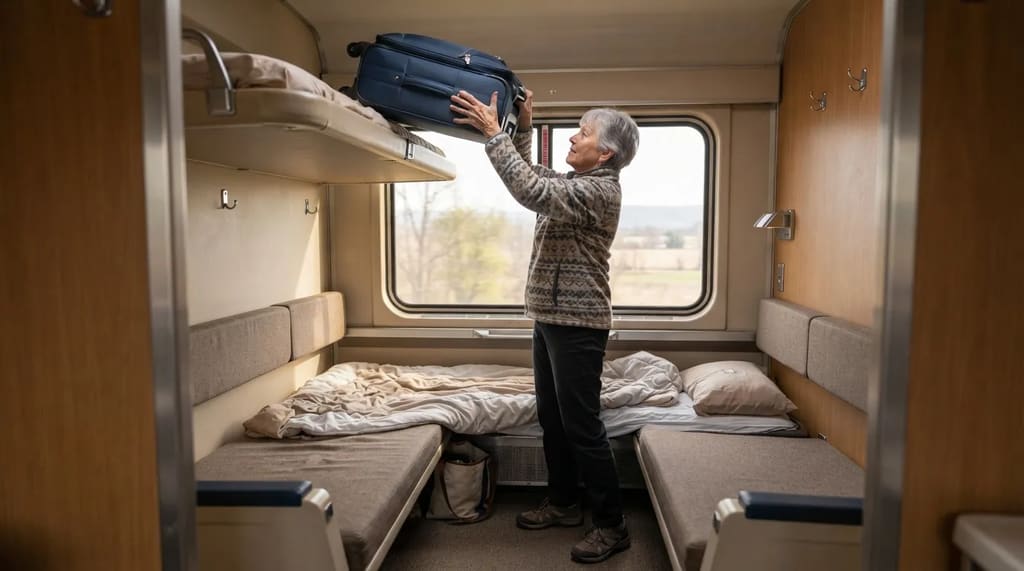
Amtrak is generous with luggage, though the limits are specific. Each passenger may bring one personal item and two carry-on bags free of charge, within these sizes:
- Personal item: 25 pounds, 14 by 11 by 7 inches
- Each carry-on: 50 pounds, 28 by 22 by 14 inches4
The rule that matters most for older riders is the lifting one: passengers must be able to safely lift carry-on items over their heads onto the luggage shelf. A 50-pound allowance is a ceiling, not a target, so pack what you can lift without help.4
Space inside the room is the other limit. Amtrak Vacations suggests one to two suitcases for a roomette, and sleeping rooms have limited floor and storage space.
One workable plan is two bags. One goes into the sleeper room and the other holds what you need for the hotel, with the second bag checked where the service is offered.
Checked baggage is available only when your train and both stations handle it.
#3 – Photo ID and the Senior Discount That Stops Short
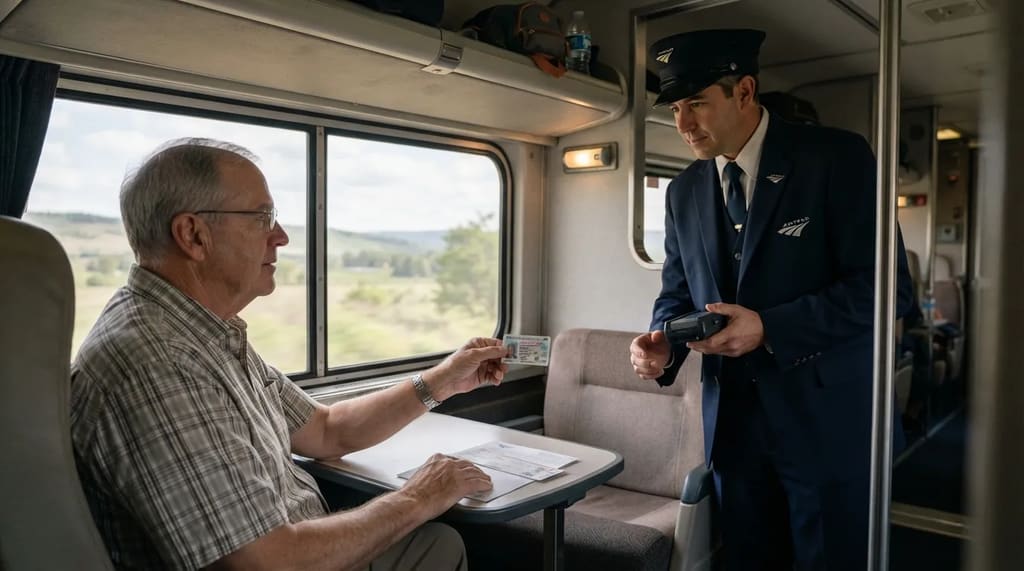
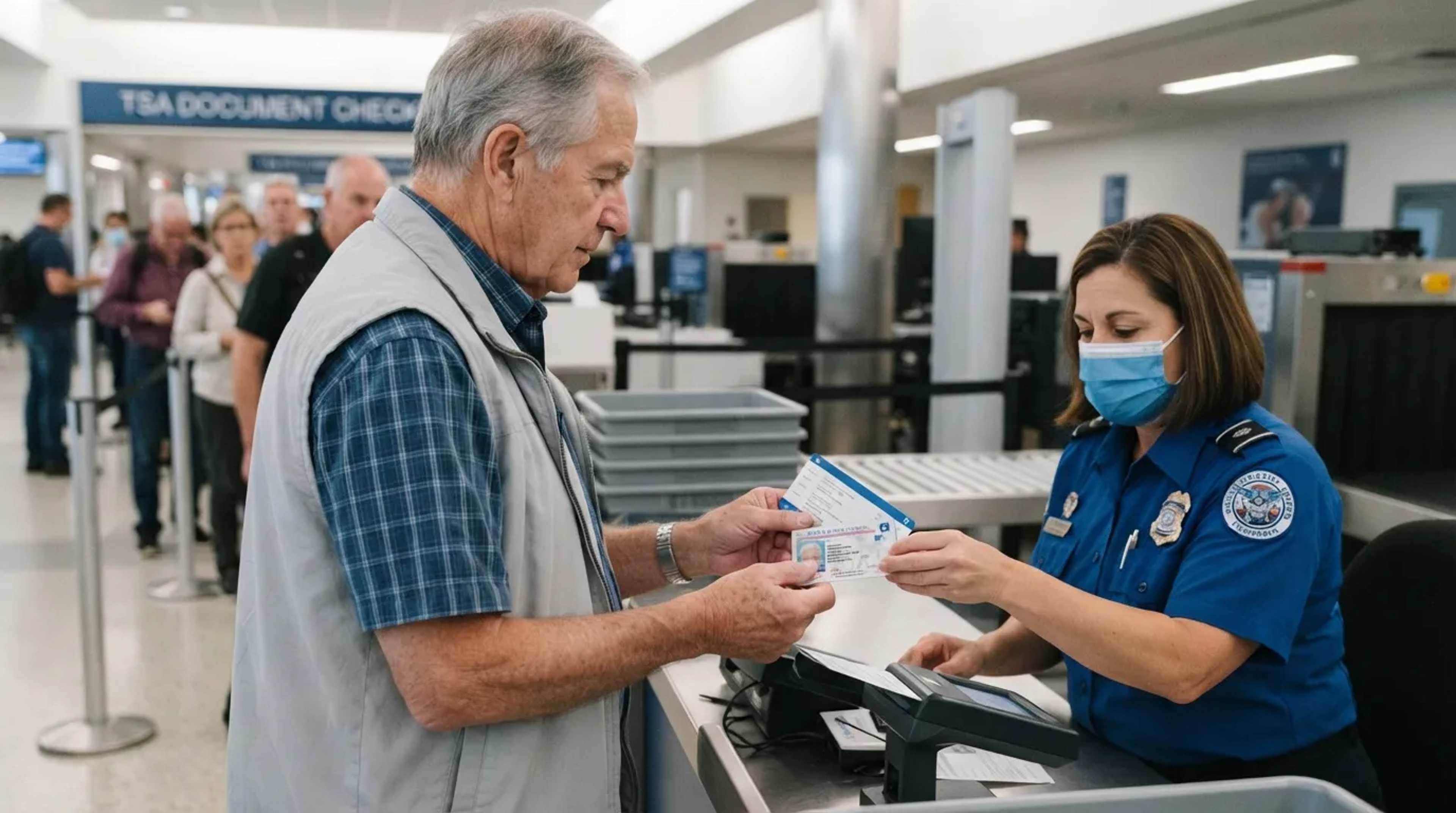
Your age is something you carry with you. Valid proof of age is required when you buy your ticket and again on board the train.
Travelers 65 and older can save 10% on train fare when booking through Amtrak, and you select Senior as the traveler type when you book. You must be 65 on the day of travel.
Fast Facts
- Senior discount: 10% off train fare
- Minimum age: 65 on the day you travel
- How to get it: choose Senior as the traveler type when booking
- Proof of age: needed at purchase and again on board
The discount has a limit that surprises people planning a sleeper trip. It does not apply to sleeping accommodation charges, and the room charge is usually the larger cost of a roomette or bedroom.5
Related Stories From Travelbinger
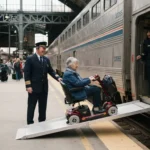
Book the Senior fare anyway, since it costs you nothing. But keep your expectations in line with the savings: on a sleeper trip, the discount is a modest one.
Carry the ID in a pocket with your ticket, not in a suitcase on the rack. The medicines belong somewhere even closer, in a bag that never leaves your side.
#2 – Daily Medicines in the Bag You Keep Beside You
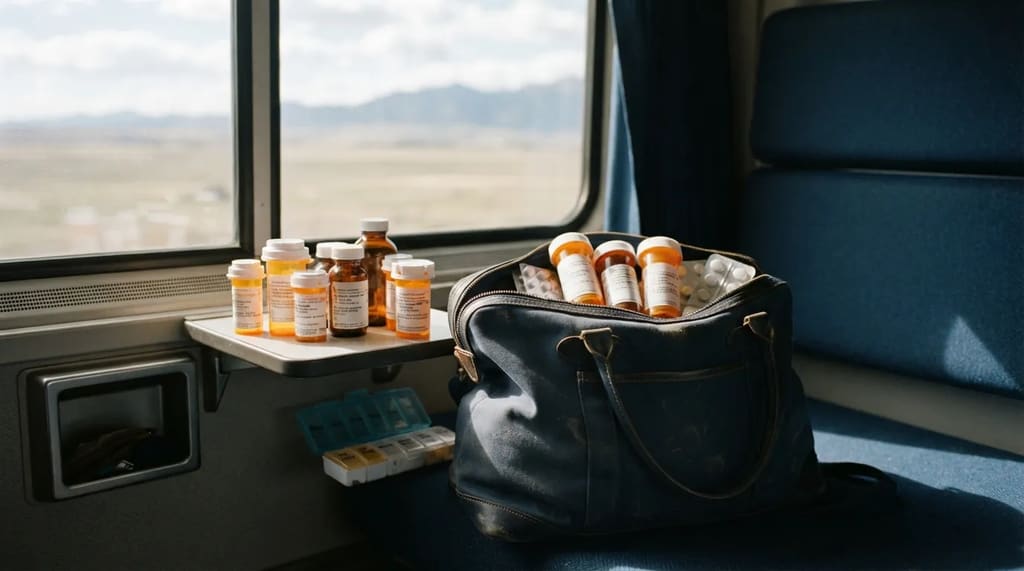
Where your pills ride matters on a trip this long. A checked bag travels in a baggage car, away from you, and checked baggage is available only when your train and stations handle it.
Keep every medicine you take in the bag that stays with you, in its original labeled bottle. Add a few extra days’ worth in case a delay stretches the trip.
Delays are a fair assumption on long routes. A travel guide recommends keeping a change of clothes in your carry-on, not just in checked luggage, in case of a delay, and medicines deserve the same treatment.
A cross-country trip also crosses time zones, so ask your doctor or pharmacist how to time doses on the days you travel. That is a safety question for a professional, and it is better answered before you leave than from a berth.
Pills that keep at room temperature are the easy case, and the ones that must stay cold are a problem the crew generally cannot solve for you.
#1 – A Small Cooler With Ice Packs
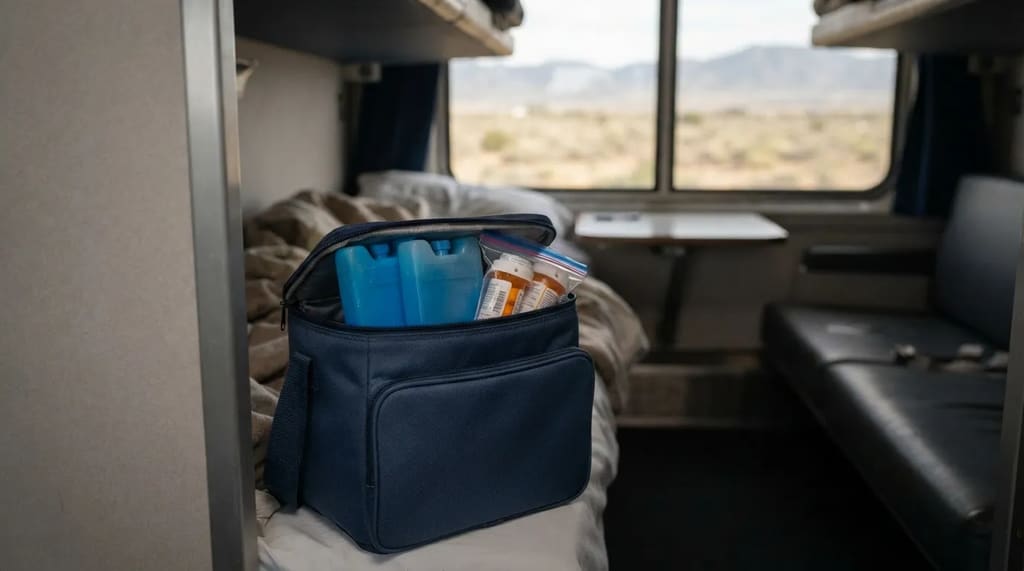
This is the item that earns the top spot. Sleeping car rooms are not equipped with mini-fridges, so there is nowhere in your room to keep anything cold.3
Amtrak staff generally cannot store food items and medications that do not come from Amtrak. That is a rule of the service rather than a courtesy that varies by attendant, and it means the crew cannot keep your refrigerated medicine for you.3
The workable answer is your own cooler with ice packs. Over a trip that lasts more than a day, ask your pharmacist how long a cooler of that size will hold its temperature for your medicine.
- A small insulated cooler that fits in the room
- Reusable ice packs, frozen solid before you leave
- Medicines in their labeled packaging, so they are easy to identify
The same logic applies to special diets. Passengers with medical or dietary needs are advised to pack additional nourishment, because the café car and the dining car can run short, as the snack item showed.
What the Ticket Covers and What It Leaves to You
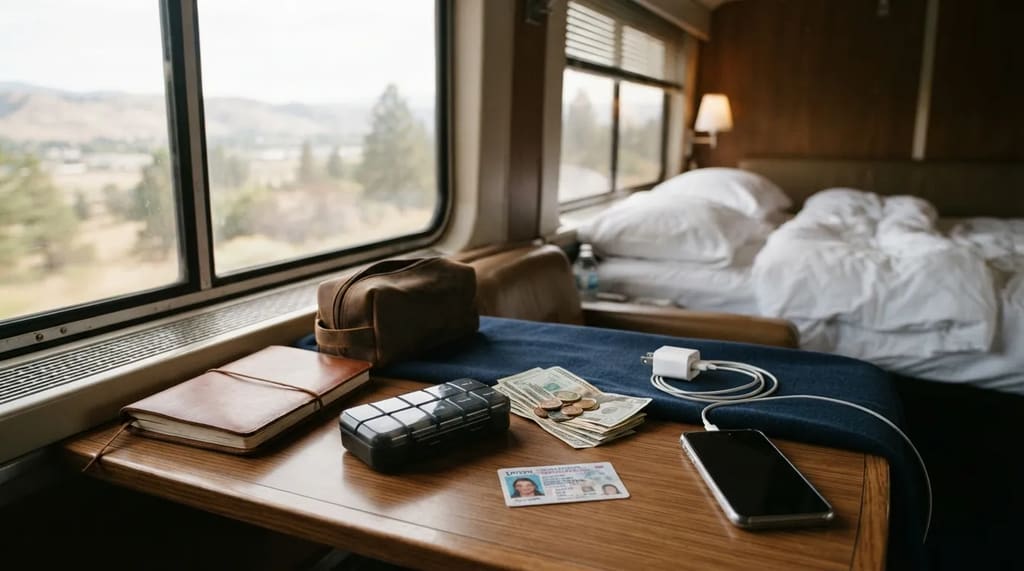
A sleeper fare is generous. It usually includes meals, bedding, water, towels and an attendant, so your packing list can be shorter than you would expect.
What is left is the list above: items the train cannot supply or is not allowed to hold for you. Packing for a sleeper car means filling those gaps rather than carrying a hotel with you.
Quick Compare
- Usually on the ticket: meals (confirm for your route), bedding, water, towels, an attendant
- Yours to bring: cold storage, medicines, tip cash, photo ID, a USB charger
So what is the one thing you have always had to carry yourself on a long trip, because nobody else could hold it for you?
- Amtrak Roomette vs. Bedroom: https://www.amtrak.com/difference-between-a-roomette-a-bedroom
- Amtrak Vacations Sleeping Accommodations: https://www.amtrakvacations.com/sites/amtrak/files/2021-08/AVUS_Sleeping%20Accommodations.pdf
- Sleeper Car Packing List: https://dektraveljournal.com/amtrak-the-first-timer-sleeper-car-packing-list/
- Amtrak Baggage Policy Guide: https://taketrains.com/guides/us/amtrak-baggage-policy
- Amtrak Sleeper Senior Discount Details: https://retirehub.org/senior-discounts/amtrak/