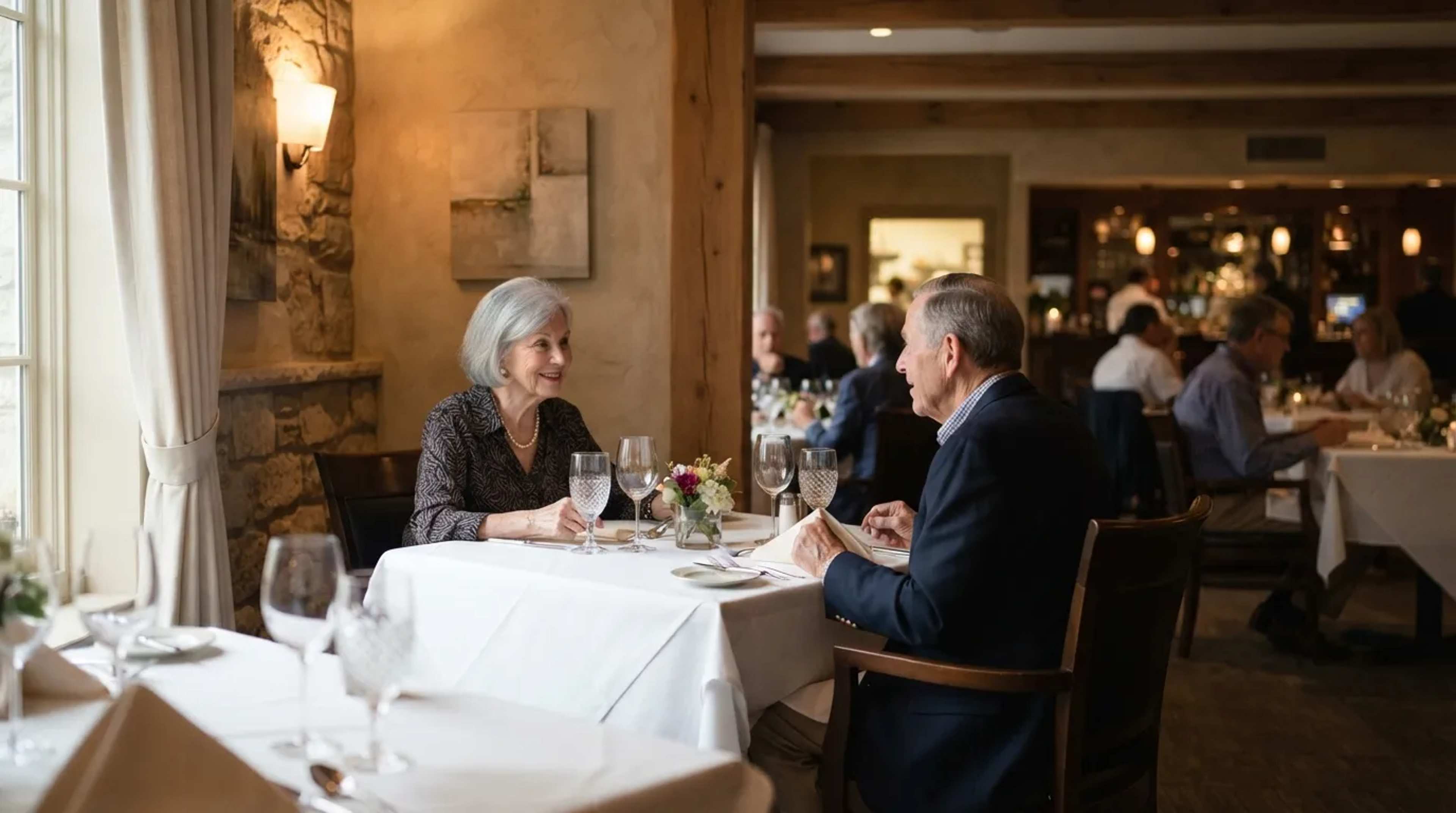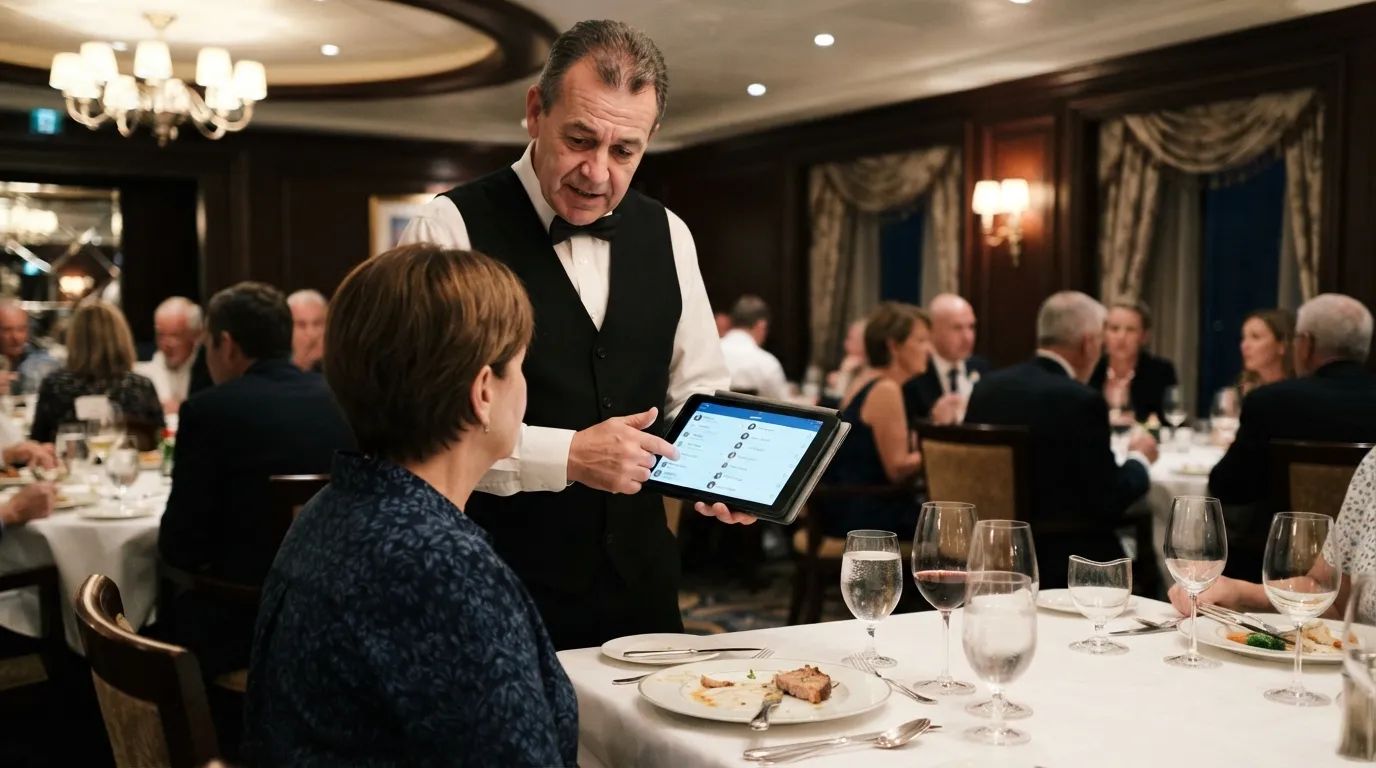
A sit-down dinner in the main dining room runs an hour to an hour and a half, and on lines such as Holland America it’s included in the fare.1 It looks like the easiest meal of the trip, which is exactly why small slips go unnoticed.
Those slips cost you wait time, wasted courses and surprise charges. The twelve mistakes below climb from minor to serious, and the last one involves your health in a way a form filled out at home can’t fully cover. First, a habit that looks polite and isn’t.
#12 – Stacking Your Dishes to Help the Server
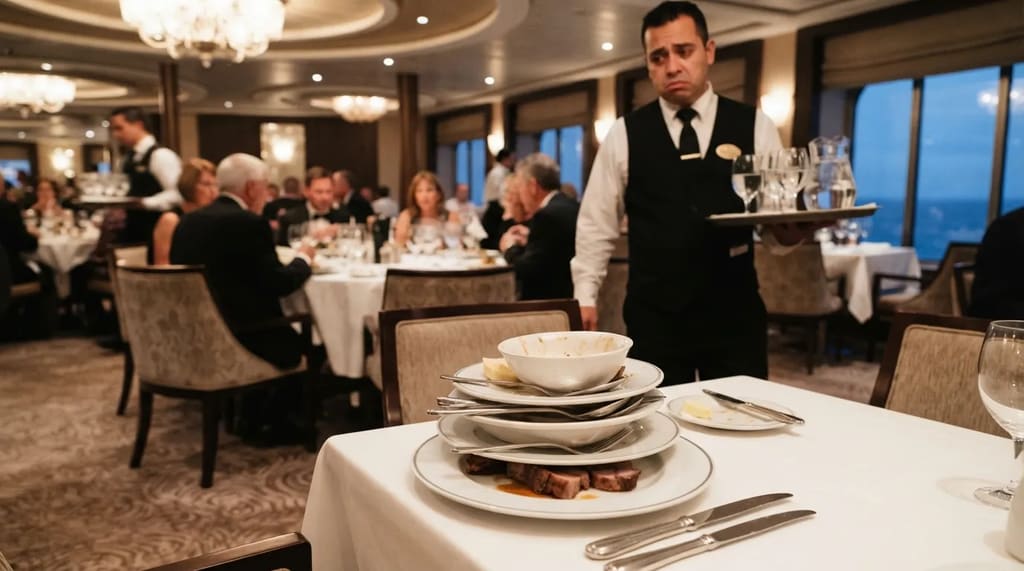
Leave the dishes where they are. Clearing your own table feels considerate, but it can work against the person you’re trying to help.
If your server is already on the way to another table, stacked plates can pull that server over to you first, and a supervisor may read the detour as slow work. That matters most when the room is full.
So the better courtesy is a smaller one: let the server clear, and say thank you when the plates go. When you’ve finished eating, set your knife and fork together on the plate so the server can see you’re done.
This is one habit where doing less is better manners. Spend the energy on a kind word to your server instead.
Plates are the easy part of the evening. What you order to drink can slow the whole table, and it comes with a charge you may not have noticed.
#11 – Ordering a Complicated Cocktail at the Table
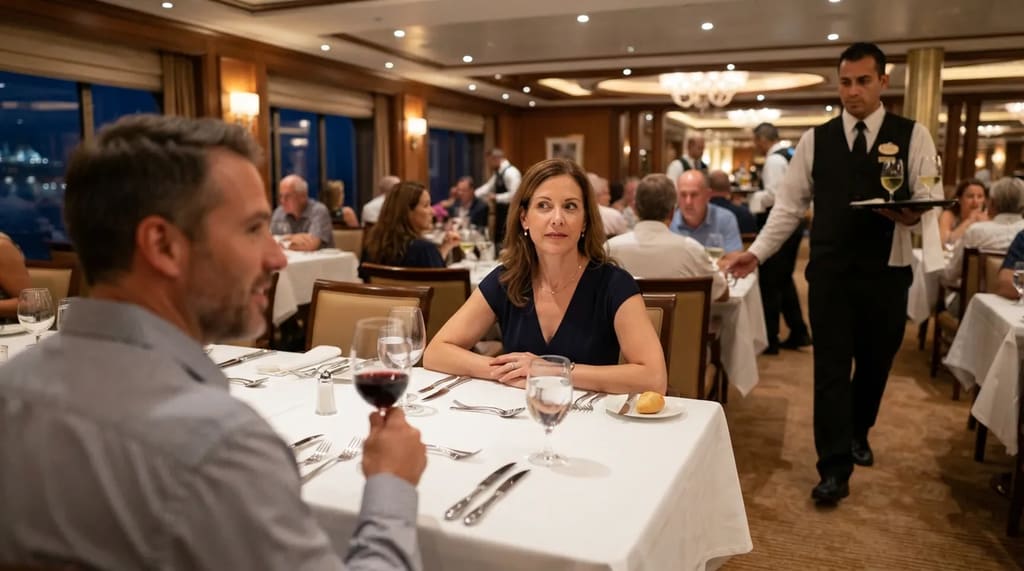
A multi-step cocktail is a bar order, and at a dining table it has a long way to go before it reaches you. It takes much longer, and it often doesn’t taste as good as one made at the bar itself.
The fix is simple: have the fancy drink at the bar before dinner, then keep table orders simple. A glass of wine, a beer or a basic mixed drink arrives faster and doesn’t hold up the round for everyone else.
Money matters here too, since most cruise lines add an 18% to 20% service charge on top of several onboard purchases.2 A pricey cocktail therefore costs more than the number printed beside it.
Worth Knowing
- The 18% to 20% service charge typically applies to drink packages.
- It also applies to bar tabs and specialty dining.
- Room service and spa purchases carry it as well.
- It is added on top of the price you see, so the real cost is higher.
If you hold a drink package, that percentage is charged on the package too. Keep it in mind when you add up the week.
Drinks carry a surcharge, but most of the food on the menu doesn’t. That’s why diners who order too little leave real value on the table.
#10 – Ordering One Plate When the Menu Allows More
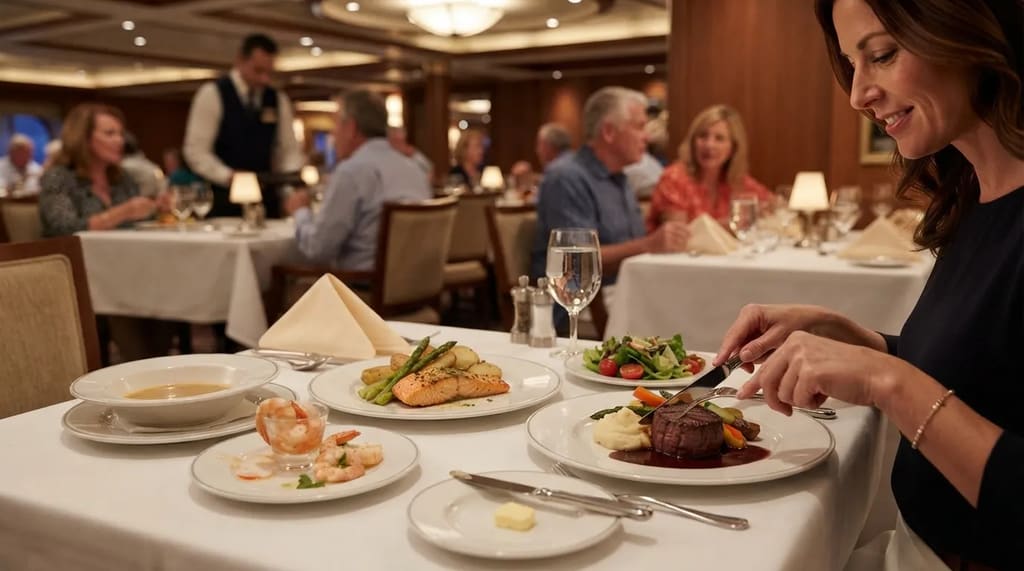
Portions in the dining room tend to be smaller than at a land restaurant, so a single plate can leave you hungry. First-time cruisers often don’t realize they can order as much food as they want in the main dining room.
Menus list appetizers, entrées and desserts, and many passengers assume that means one of each. You can ask for a second starter or a second entrée.
Two starters and a small salad can make a better dinner than a heavy entrée. One exception: Royal Caribbean, for example, sometimes adds surcharges to certain items on the main dining room menu, so read for a fee before you order extra.
That’s a small risk, since the dishes without a fee are already covered by your fare. A bold choice therefore costs you very little.
Ordering extra is easy. Sending a plate back is where polite diners freeze.
#9 – Eating a Dish You Don’t Like in Silence
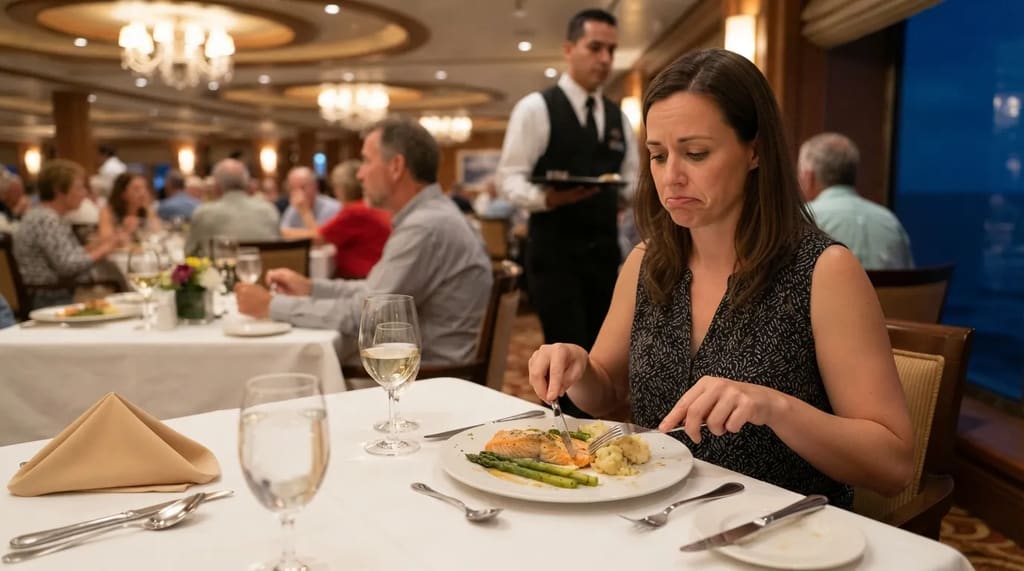
If a dish isn’t what you expected, or it arrives lukewarm, you don’t have to sit there and eat it. If you even hint that you didn’t love your food, a waiter or manager will insist on bringing you something else.
Many diners freeze because they don’t want to be a nuisance. Say so at the first bite and ask for a replacement.
Waiting until the plate is half gone makes the request awkward for everyone. The menu is included and changes daily, yet plenty of guests stick to the same three safe dishes all cruise.
Waiters can only offer what they know you want. Order the dish you can’t pronounce at least once this trip, because the worst outcome is a replacement.
A replaced plate affects one seat. The next mistake affects every seat at the table at once.
#8 – Ordering Without Agreeing on Courses as a Table
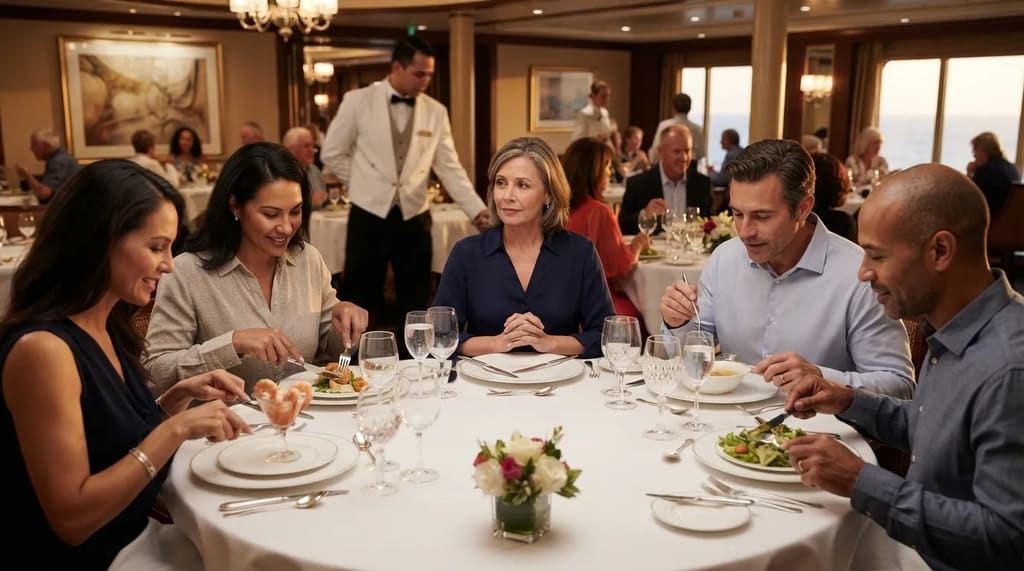
Cruise dinners run on a rhythm, and waiters time each course around every seat at the table. When one person skips a course the others are having, that person’s seat falls out of step.
Cruise dining kitchens fire courses for each table in sequence. A table that orders unevenly is harder to serve together, and one diner ends up watching the others eat.
Agree on how many courses you want before the first order is taken. If someone wants only a main course, say so up front so the server can pace the whole table around it.
It takes one sentence at ordering time to prevent the problem, and it costs nothing.
#7 – Showing Up in Shorts or Pool Wear
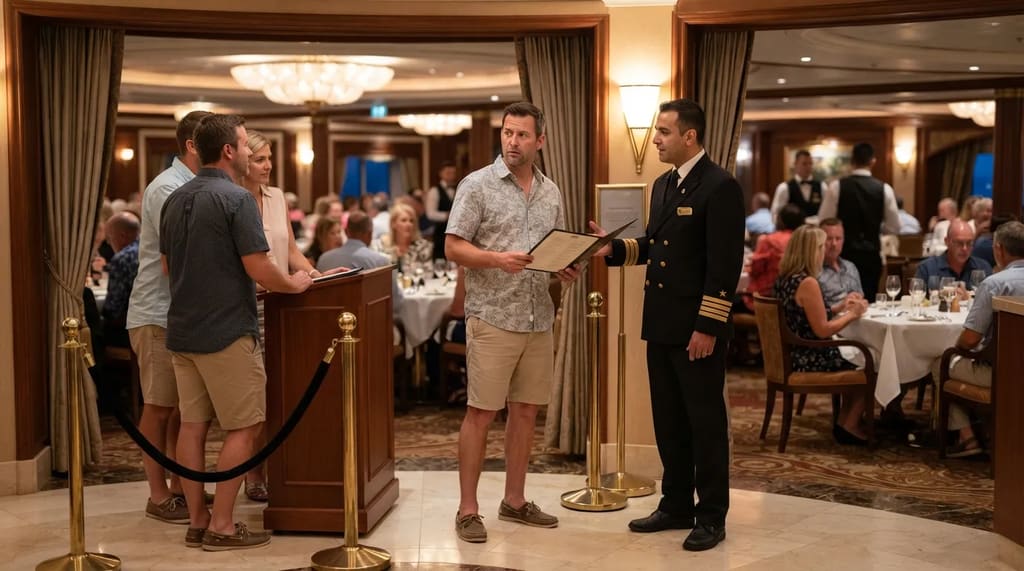
On some lines, including Celebrity Cruises, shorts aren’t permitted in the main dining room in the evening, and guests wearing them have been turned away at the door.3 Pool wear is not permitted in the main dining room either.
Lines draw the boundary in different places, so compare a few before you pack.
At a Glance
- Azamara: bars bare feet, tank tops, t-shirts, baseball caps, bathing suits, shorts, and torn or distressed jeans.
- Princess: smart casual means skirts, dresses, slacks and blouses for women, and long pants with collared shirts or a sports jacket for men.
- Carnival: smart casual.
- Cunard: black tie optional.
Shorts can get you turned away at dinner on some lines. Read your own line’s page before you pack.
Ordinary evenings deserve more of your attention than formal night. Formal night is announced and planned for, while the everyday rule is the one that catches a guest at the door.
Dressed correctly, you can still lose your table by walking in late, or by not walking in at all.
#6 – Arriving Late or Skipping a Fixed Seating
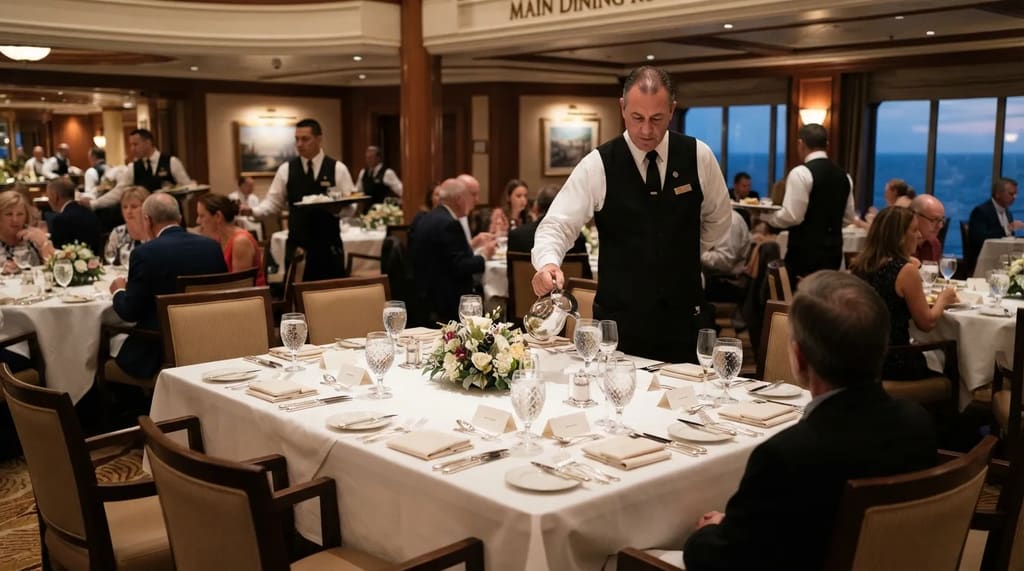
Traditional dining typically offers an early seating around 6 p.m. and a late one around 8 p.m. Times vary by line and ship, but the rule doesn’t.
Your waiter has planned the evening around those seatings, and a late arrival ripples through the whole service flow. If you can’t make your seating, call the dining room and say so.
A quick call is the thoughtful thing to do when you have plans elsewhere. Skipping a fixed seating without notice creates more chaos than most passengers assume.
Open dining has its own version of this mistake. One guide puts typical waits at 20 to 45 minutes during the peak window of 7:30 to 8:30 p.m.
Many cruise lines now let you reserve the dining time you want each night, or put your party on a waitlist in the app. Use it, because a booked table beats standing at the host stand with the rest of the evening crowd.
Both problems start months earlier, with the dining plan you picked when you booked.
#5 – Choosing the Wrong Dining Plan for Your Party
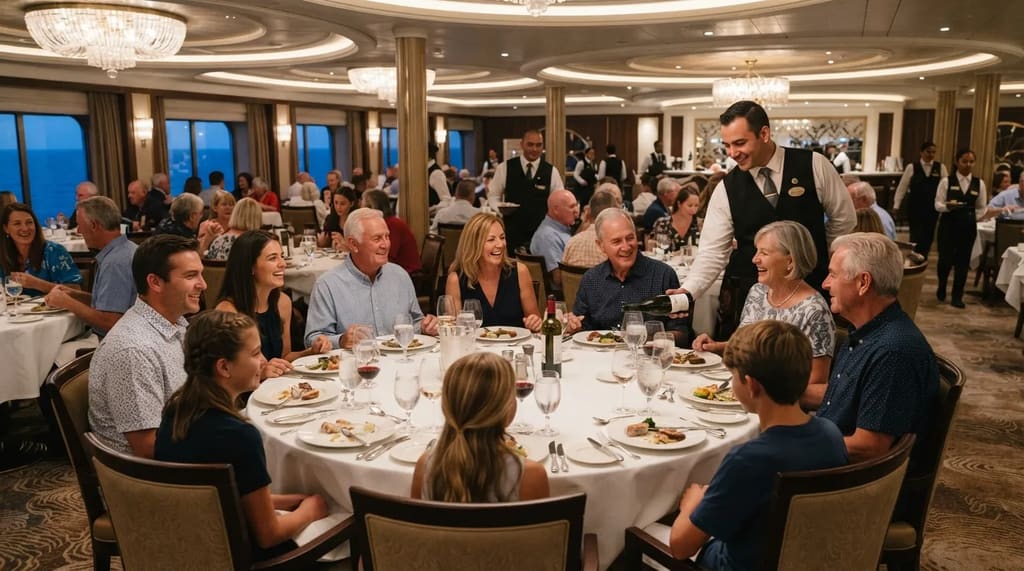
Traditional seating gives you the same table, the same waiters and the same dinner companions every night. Anytime dining gives you freedom, and the price is a different table and different servers each evening.
Big groups feel the difference most. A large party should choose traditional dining for a set time and table. Choose anytime instead and there can be a long wait to seat everyone together.
Traditional also suits anyone who likes being known. The reward is the same waiter all cruise, who can become your advocate for special requests and menu recommendations.
Even on a line with no official set time, such as Norwegian, you can ask early in the cruise for the same table and waiters.
Quick Compare
- Traditional: same table, same waiters, same companions every night.
- Anytime: a different table and different servers each evening.
- Best for big parties: traditional, since anytime can mean a long wait for a table that seats everyone.
- Best for unpredictable days: anytime, because nobody is holding a table for you.
Anytime dining is overrated for big families and for anyone who values a familiar face. It fits couples with unpredictable days, because nobody is holding a table for you.
Whichever plan you pick, it does nothing for the passengers who never come through the door.
#4 – Skipping the Included Dining Room After One Bad Night
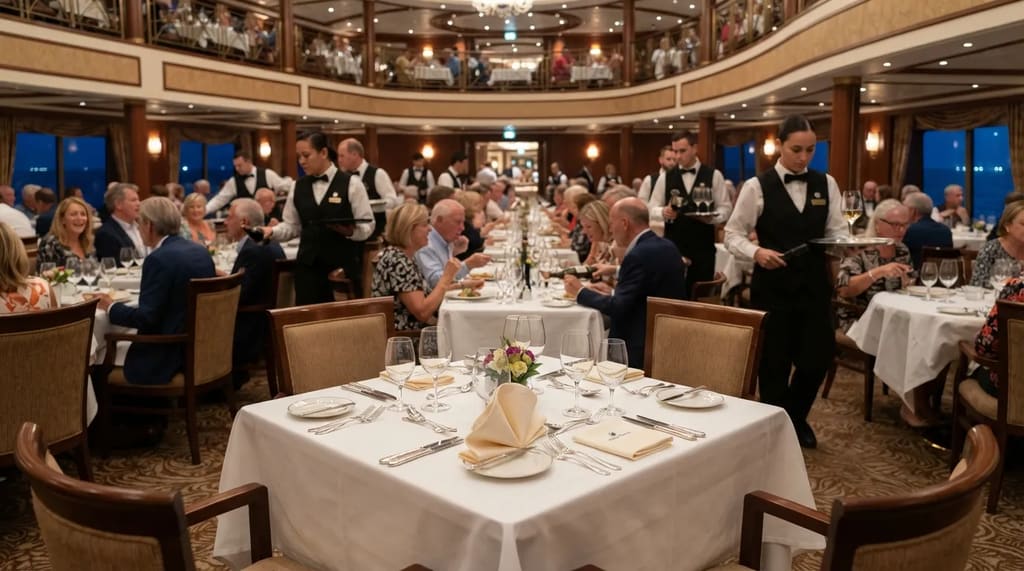
Some guests complete a seven-day cruise without entering the main dining room, missing multi-course meals included in the fare. Their empty chairs leave a quiet gap on the waiter’s section chart.
Often it begins with a rough first dinner: a chaotic, disorganized night that makes someone write off the dining room for the rest of the cruise. One embarkation night is a poor sample of a whole week.
Cost shouldn’t hold you back either. On Holland America there’s no reservation fee, and reservations are recommended only for a preferred time.1
Give the dining room at least two nights before you decide. With traditional seating, you get a server who knows your preferences by night two.
Whether you eat there or not, one line on your bill is already paying for the people who run that room.
#3 – Ignoring the Daily Gratuity Line on Your Bill
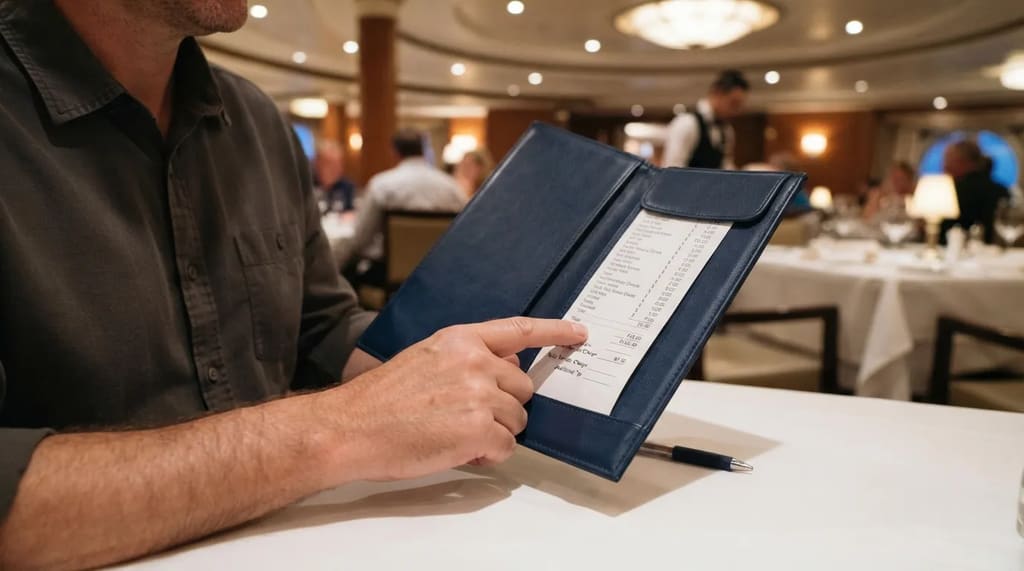
Daily automatic gratuities in 2026 typically run from $16 to $22.50 per guest, depending on line and cabin type. Carnival charges $17 in a standard stateroom and $19 in a suite, while Royal Caribbean charges $18.50 to $21.4
The charge is per person, not per cabin. Royal Caribbean says the money is shared among dining, bar and culinary staff, stateroom attendants and other hotel teams.4
Most major lines let you change the daily charge, though Norwegian is a notable exception.
Fast Facts
- Adjustable at guest services: Royal Caribbean, Carnival, Celebrity, Princess, Holland America, MSC, Disney and Cunard.
- Deadline: before the morning of disembarkation.
- Norwegian: doesn’t adjust the charge onboard.
- Norwegian refunds: require a letter after the cruise with a valid reason.
Your waiter is already part of that pool, so a second tip isn’t required. Leave the charge alone unless service truly failed.
The 18% to 20% drink charge from earlier is a separate cost. Check both lines on your folio.
A gratuity shows up on your bill where you can see it. The request in the next section has to be made weeks before you sail, long before any bill exists.
Related Stories From Travelbinger


#2 – Telling the Cruise Line Nothing Before You Sail
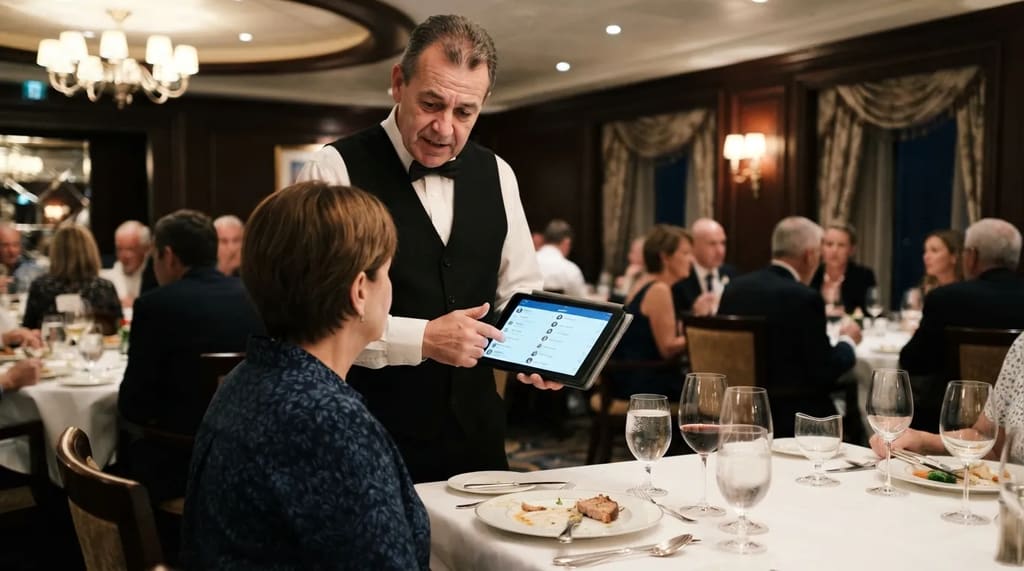
Disney Cruise Line asks guests to report allergies and dietary requests at least 30 days before sailing. Other lines set their own windows, so look for the deadline on your line’s allergy page when you book.5
Report allergies and dietary needs to the line weeks before you sail. Guests with restrictions are flagged in a reservation system, so the server is alerted when you check into the main dining room.
This goes beyond allergies. Carnival lists low-sugar among the needs it accommodates, so a diabetic or heart-conscious diet is worth a note too.6
Advance notice also helps the galley. Each meal is planned well in advance, which means a request made weeks ahead is easier to fill than one made at the table.
A flag in the system is a strong start. It isn’t the whole job, and the final mistake is the one that leaves a gap between the form and your plate.
#1 – Assuming the Paperwork Will Reach Your Plate
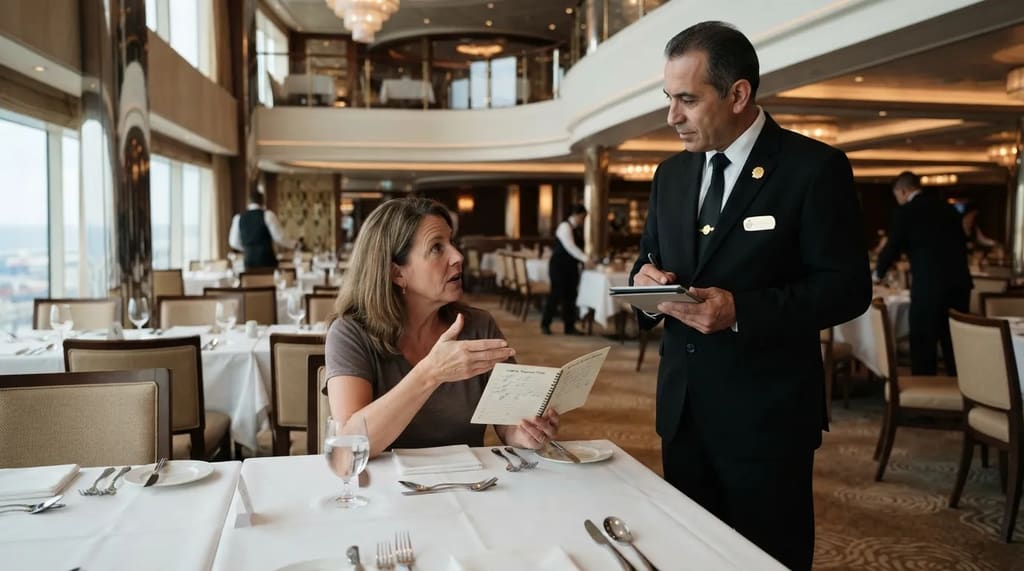
The form gets your name into a system, but it doesn’t replace a conversation. Nobody should feel certain that everything will be fine just because a form was filled out and a waiter or maître d’ was told.
Across the lines, the guidance reads almost the same. Disney tells guests to confirm the request with the head server on the first night and remind the server at each meal.
Tell the head waiter on night one, then remind your server every meal. On embarkation day, walk into the main dining room before the evening rush and ask for the maître d’ or head server.
Royal Caribbean advises guests with special dietary needs to book Traditional Dining instead of My Time Dining. With a fixed waiter, your needs are learned by the second evening.
Carnival says special dietary requirements can only be accommodated in the main dining room,6 and it urges extra care in the buffet, casual venues and room service. For any serious allergy, check with your doctor and your cruise line before you sail, since lines handle it differently.
Give the Dining Room What It Can’t Guess
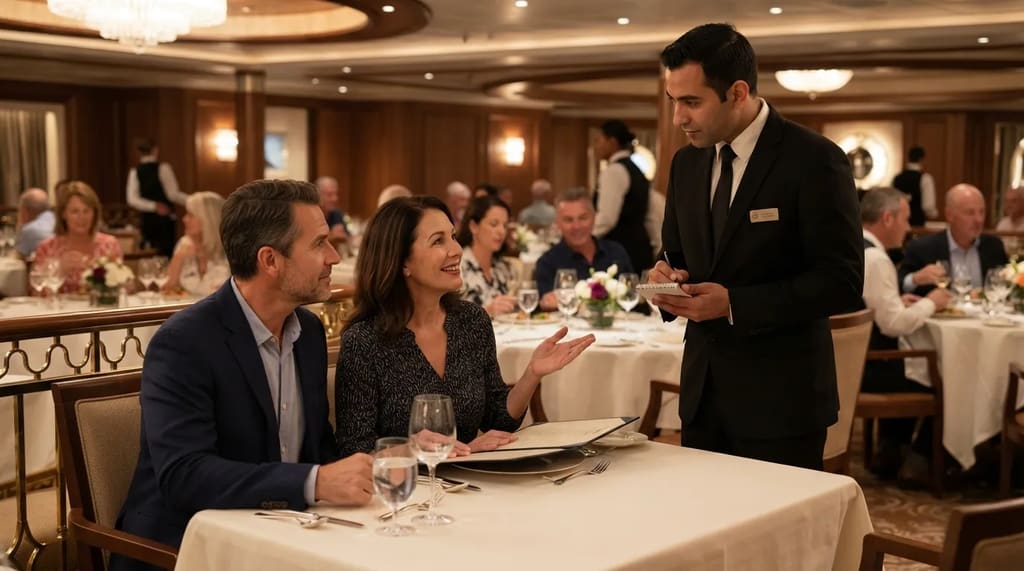
Every mistake on this list comes back to information. The crew can’t know your allergy, your late arrival, your group’s size or your dislike of a dish unless you tell them, and the sooner you do, the smoother the evening.
Treat the first night aboard as a briefing for your dining team rather than a test of whether the room is good enough. A two-minute word with the head waiter does more than a week of private grumbling.
Which dining plan have you chosen on past cruises, set seating or anytime, and what made you stick with it?
Bonus: The Night-Before Menu Move Waiters Wish More Guests Knew
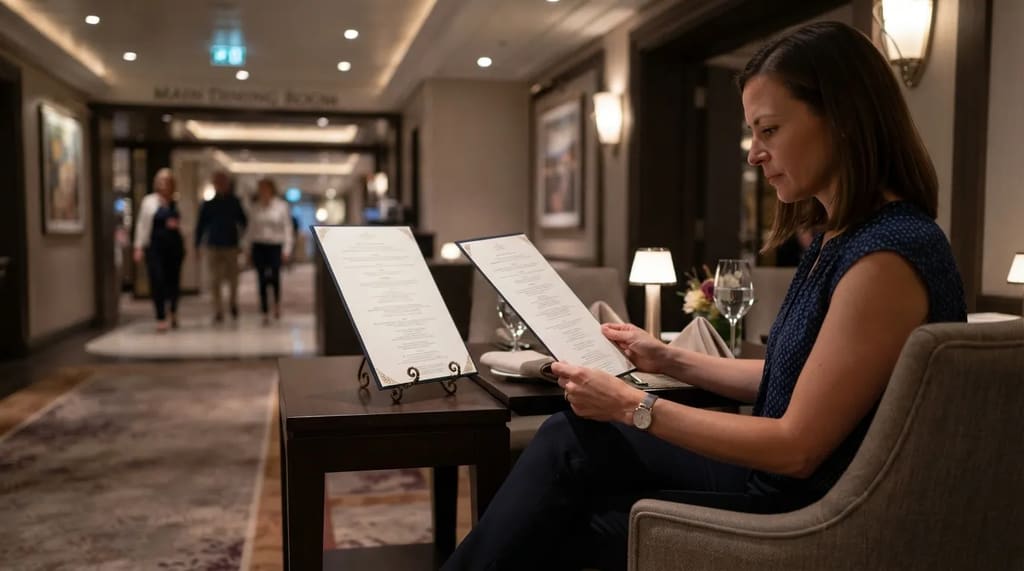
Don’t wait until you’re seated to read the menu. Look at tomorrow’s dinner menu tonight, and talk to your server while there’s still a full day to plan.
On many ships the next evening’s main dining room menu is posted near the dining room entrance or in the line’s app. If you can’t find it, ask your server or the head waiter for a copy.
- Step 1: After dinner, read tomorrow’s menu and pick your first and second choices, plus one extra starter to try.
- Step 2: Tell your server your picks and any changes you’d like, such as sauce on the side or a swap of the side dish. Ask politely whether the kitchen can accommodate them.
- Step 3: If you have allergies or dietary needs, ask whether your meal can be pre-ordered with the dining team, as Carnival suggests, and confirm it again when you sit down.
Availability and policies differ by line and ship, so treat this as a request, not a guarantee. Even so, the kitchen gets a day of notice instead of a rushed ticket, and you arrive at the table already knowing what you want.
- Holland America Dining Room: https://www.hollandamerica.com/en/us/onboard-experiences/dining/the-dining-room
- Royal Caribbean Gratuities Guide: https://www.royalcaribbean.com/guides/what-is-included-on-a-cruise
- Celebrity Dining Information: https://celebrity.cruiselines.com/cruise_info/dining_line.cfm
- Cruise Industry News Gratuities: https://cruiseindustrynews.com/cruise-news/2024/10/royal-caribbean-to-raise-daily-gratuities/
- Cruise Allergy Notice Deadlines: https://www.cruise-collective.com/article/cruising-with-a-food-allergy-what-to-arrange-before-you-board
- Carnival Guests with Allergies: https://www.carnival.com/about-carnival/special-needs/allergies