Most snowbirds believe Arizona residency comes down to one number: 183 days. The real picture is messier, and the rules that trip people up often have nothing to do with how long they stay.
Some involve car plates, rental income, or old voter cards, and one hinges on a $15 permit most people never hear about. The scariest one may not even be in Arizona.
#13 – Owning a Home Doesn’t Make You a Resident

Owning an Arizona house is not what Arizona looks at.
Owning property or spending time in Arizona doesn’t automatically make you a resident.1 That’s the good news.
The bad news: a second home doesn’t shield you either. The Arizona Department of Revenue decides residency using domicile and physical presence.1
Your whole life gets weighed, not just your deed.
So how many days does it actually take to cross the line? The answer isn’t the one you’ve heard…
#12 – The Day Count Isn’t What You Think

The famous 183-day rule is not Arizona’s presumption.
Plenty of guides repeat 183 days. But sources quoting the state’s statute describe a different trigger: more than nine months of the tax year in Arizona creates a presumption of residency.2
Nine months is roughly 274 days, not 183. Still, fewer days doesn’t automatically make you a nonresident, because Arizona also weighs domicile and intent.
- Sources conflict on the number.
- Intent can override the calendar either way.
But the day count is the easy part. The next rule has no checkbox at all…
#11 – Arizona Has No “Declaration of Domicile” Form

You can’t file your way into Arizona residency.
Florida snowbirds know the declaration of domicile. Arizona has no formal declaration-of-domicile filing.
Instead, domicile is your true, fixed, and permanent home, the place you intend to return to after temporary absences. That intent has to be shown through objective evidence.
Physical presence is a secondary factor used to back up the claim.1 With no form to hide behind, your paper trail does the talking.
And your habits matter even more somewhere else. Your old state has its own clock running…
#10 – Your Old State Runs a Separate Clock

Winning the Arizona day count can still lose you the tax fight back home.
Many states use a statutory-residency test. Most count you as a resident if you keep a permanent place of abode there and spend more than 183 days in the state.
Michigan is one example. It uses a 183-day threshold, while Arizona’s nine-month presumption works out to roughly 274 days.
Quick Compare
- Arizona: presumption of residency after more than nine months (roughly 274 days).
- Michigan: a 183-day threshold.
- Many other states: a permanent place of abode plus more than 183 days.
- The catch: Different thresholds mean one state can claim you while the other doesn’t.
Your northern state may claim you before Arizona ever does. Its presumption points the other direction.
Many snowbirds obsess over Arizona’s rules. Many tax pros argue that’s backwards, since the tougher auditor is usually the state you left.
Now to the money question everyone asks about retirement income…
#9 – Social Security Is Safe. Your 401(k) Isn’t.

Arizona’s retiree-friendly reputation has a catch.
The good part: Arizona completely exempts Social Security benefits from state income tax.3 Federal tax is a separate matter.
The catch: private pensions, 401(k), and IRA withdrawals get no special exclusion and are taxed at the flat 2.5% rate.3 That applies if Arizona treats you as a resident.
The flat 2.5% rate has applied since January 1, 2023. Government pensions get different treatment and sources disagree on the details, so check the current rules.
But there’s one type of income that nonresidents can’t dodge…
#8 – The Rental Income Nobody Mentions

A nonresident can still owe Arizona a tax return.
Nonresidents only pay on Arizona-source income. Own a Scottsdale rental while living in Nevada, and you still file an Arizona return for that income.
Nonresidents with Arizona-source income file Form 140NR.1 Even a casual rental to a friend of a friend can land on a state return.
- Rent your casita for the summer? It counts.
- Live elsewhere full time? You still file.
And if your rental is short-term, there’s a second layer most owners miss…
#7 – The License for Short-Term Rentals

Arizona taxes lodging separately from income.
Arizona taxes short-term lodging through its Transaction Privilege Tax, and owners generally need a Department of Revenue license. That’s a different system from your income tax return.
Worth Knowing
- Rental income is reported on your income tax return, such as Form 140NR for nonresidents.
- Lodging tax runs through the Transaction Privilege Tax system.
- Owners generally need a Department of Revenue license.
- One rental property can trigger both obligations.
It’s a tax on the business of renting, so you can owe it even if the income is modest. Check current requirements before listing your property.
Many owners see a short-term rental as an easy way to offset winter costs. Some advisers say the paperwork makes it more trouble than it’s worth for part-timers.
Even if you skip rentals, what happens when you spend part of the year as a resident? The math surprises people…
#6 – “Part-Year” Doesn’t Mean Half the Tax

Part-year status is not a 50% discount.
Part-year residents owe tax on income earned during their Arizona residency, plus Arizona-source income during nonresidency. It’s not a simple 50% reduction, and the form is Form 140PY.4
The key word is “moved.” A part-year resident moved into or out of Arizona during the tax year, changing domicile.4
Seasonal travel back and forth generally doesn’t qualify. Some forum posters hope to use the status to save money, but it depends on a real change of domicile.
Taxes are only one piece. Property is next, and the savings have conditions…
#5 – Property Tax Perks Come With Strings

Arizona’s low property taxes may not all apply to you.
Arizona’s effective property tax rate of roughly 0.48% is among the lowest in the West. That draws plenty of seasonal buyers.
But primary-residence exemptions are typically reserved for full-time residents. Certain benefits, like those exemptions, usually don’t extend to part-timers.
On the plus side, Arizona has no state estate tax. Your home state may still have its own.
Now to the car in your driveway, where one small permit causes big confusion…
#4 – The $15 Permit Hardly Anyone Knows About
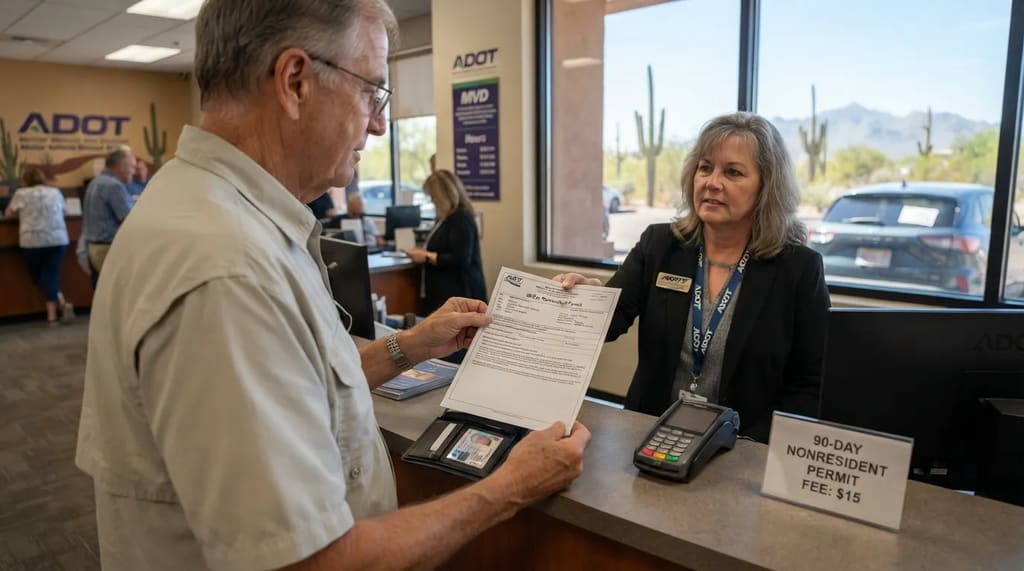
Buying a car in Arizona doesn’t force you to register it there.
A 90-Day Nonresident Registration costs $15 from the MVD or an Authorized Third Party office. It exists so out-of-state buyers can drive a new purchase home.5
You’ll need your out-of-state ID and the dealer invoice or assigned title.5 Then you register the car where you actually live.
- Buying a car to take home? Ask about this permit.
- Fees and rules can change, so confirm with ADOT.
Registering locally brings another surprise, and it’s one that can hold up your paperwork…
#3 – The Emissions Test You Didn’t Plan For
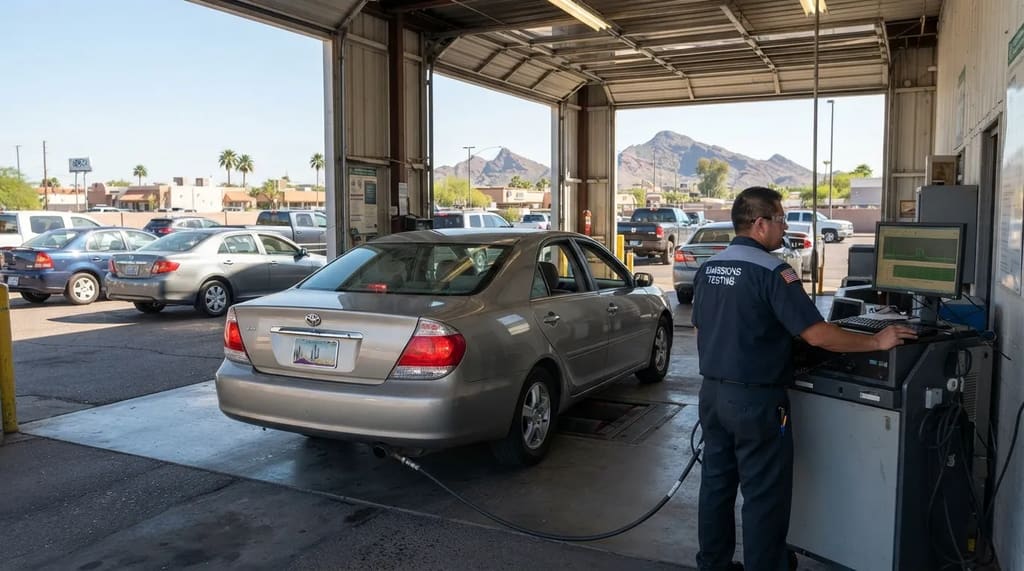
Registering locally can trigger a test your home state never required.
The catch is that it only matters when you register in Arizona. If your car stays plated at home, the Arizona emissions program generally doesn’t apply.
But once you register locally, skipping the test can hold up your renewal. Some vehicles in the Phoenix Metro and Tucson areas need emissions testing before registration.6
Newer vehicles are typically exempt for their first few model years. Exemptions and testing areas can change.
So when must you register at all? The rule is murkier than you’d expect…
Related Stories From Travelbinger



#2 – The Registration Deadline Nobody Agrees On

Driving an unregistered car in Arizona is a bigger deal than a fine.
One law firm says anyone living in Arizona seven months or longer in a calendar year must register their vehicle. It also calls driving an unregistered vehicle a criminal traffic violation.
That post is several years old, so verify current rules.
Insurance guidance is similar: under seven months, you’re classed as part-time and don’t have to register or insure in Arizona. Seven months and nine months aren’t the same threshold.
The MVD’s own guidance is plainer: you must register as soon as you become an Arizona resident.
At a Glance
- Law firm post (older): seven months or longer in a calendar year means register.
- Insurance guidance: under seven months is part-time.
- MVD: register as soon as you become a resident.
- Tax presumption: more than nine months, roughly 274 days.
Many snowbirds treat the seven-month line as a safe harbor. Many experts say that’s a mistake once you’ve shown other signs of residency.
But the biggest risk isn’t even in Arizona. It’s the one back home…
#1 – Your Old State Is Watching Your Calendar

The scariest audit comes from the state you left behind.
Some states are known for it. New York is known for residency audits and reportedly tracks days using credit card transactions, cell phone records, and social media.
Day counts alone often don’t survive scrutiny. An active driver’s license, voter registration, or a primary-residence home in the old state undermines an Arizona domicile claim.
Arizona audits are reportedly less common and less aggressive than California’s or New York’s. The pressure points north, not south.
Canadian snowbirds face their own federal wrinkle. Form 8840 is the IRS Closer Connection Exception Statement, and missing it can expose filers to U.S. resident taxation.7
That’s the thread that ties all 13 rules together.
Arizona’s rules rarely hinge on one clean number. The day-count rule most people cite isn’t clearly the one Arizona uses, and your home state may run a stricter test.
The surprises hide in the details: rental income can trigger a filing, lodging has its own tax, and a $15 permit can spare you a registration you don’t need. In the end, the calendar is just the opening act, and your paper trail tells the real story.
Which of these rules surprised you most, and which one should snowbirds worry about first?
- Arizona Residency Requirements Guide: https://arqwealth.com/what-are-arizonas-residency-requirements-for-tax-purposes/
- Arizona Nine-Month Residency Presumption: https://support.taxslayerpro.com/hc/en-us/articles/360009169194-Arizona-State-Tax-Return-Information
- Arizona Retirement Income Tax: https://brevy.com/financial/arizona/retirement-income-tax
- Arizona Part-Year Residency Rules: https://remotelaws.com/state-income-tax/us-states/arizona/
- ADOT Vehicle Permits: https://azdot.gov/mvd/services/vehicle-services/vehicle-registration/vehicle-permits
- ADOT Emissions Testing: https://azdot.gov/mvd/services/vehicle-services/vehicle-registration/emissions
- IRS Closer Connection Exception: https://www.irs.gov/individuals/international-taxpayers/closer-connection-exception-to-the-substantial-presence-test