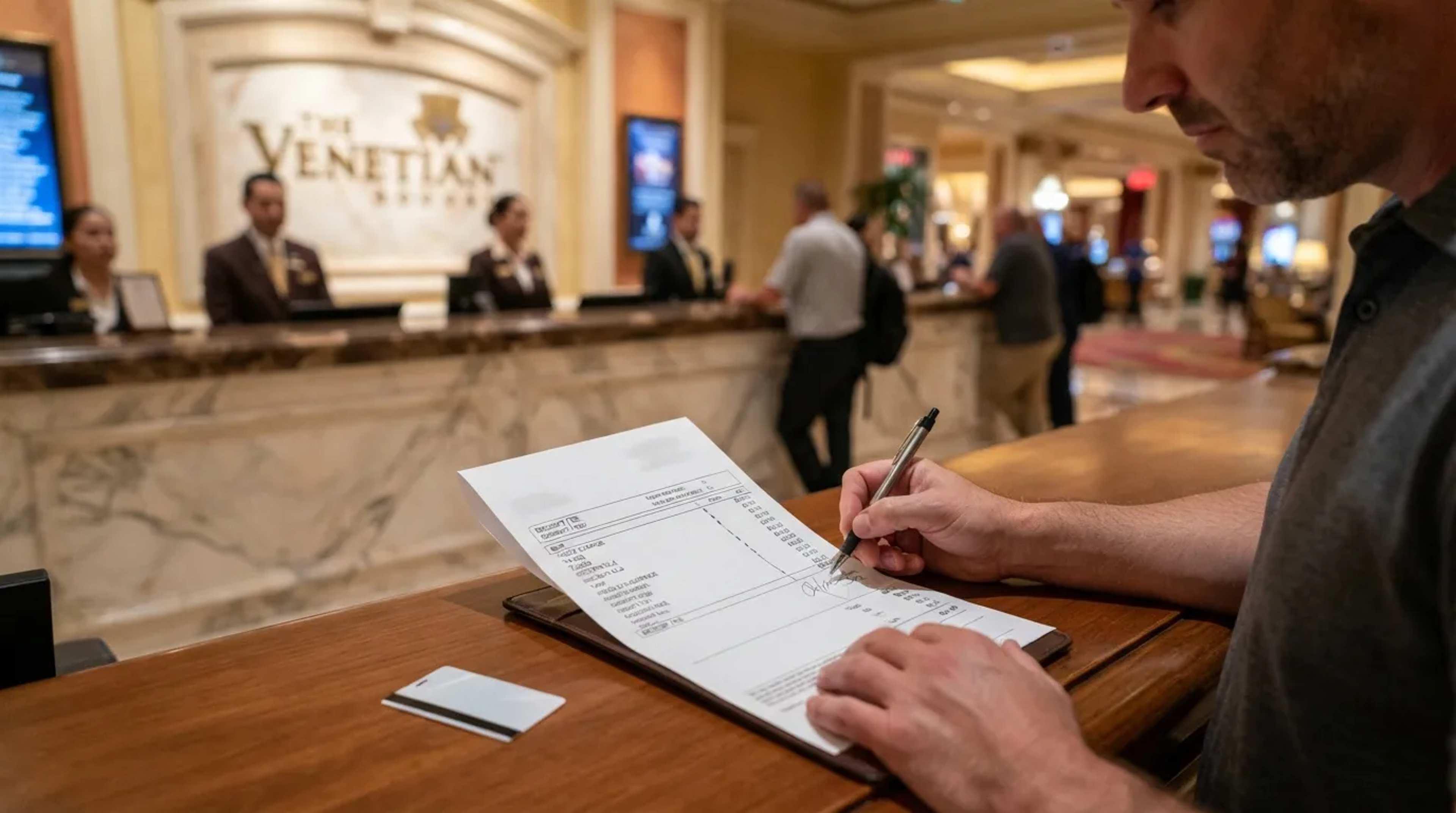
A tour invoice looks final. Neat columns, a total at the bottom, a deposit due date. But many of those lines are really opening offers, and a $6,000 tour payment can carry up to $180 in card fees at Visa’s 3% ceiling alone.
That’s one line on one invoice, and it’s far from the only one that moves. The 15 entries below run from small irritations up to the biggest charge on many solo invoices. The last one has the most room to move and the most documented ways around it, and the way it moves may surprise you.
#15 – The 3% Card Fee You Can Often Sidestep

On a $5,000 payment, a 3% card fee is $150, and some operators list it as its own line. Visa bans the fee on debit and prepaid cards.1 Mastercard publishes a 4% cap, but a 3% ceiling keeps a merchant inside both networks’ limits, so 3% is the number to hold in your head.
That makes the first question easy: does paying by debit card or check remove the line? Ask for a debit or check option before you enter any card number. Connecticut, Maine, Massachusetts and Puerto Rico don’t allow card surcharges at all1, and where they are allowed, the fee has to be disclosed and listed as a separate line on the receipt.
It’s the smallest dollar item on this list, but it shows the pattern: every charge has a rule behind it, and a rule is easier to cite than a complaint. The next line is harder to pin down, because nobody says what it pays for.
#14 – The “Service Fee” Nobody Will Define

A line called service fee, admin fee or documentation fee can mean almost anything, and that’s exactly why it deserves a question. Since May 12, 2025, companies selling live-event tickets or hotel rooms and other short-term lodging have had to display the total price up front.2
That rule covers only those two product types, so a tour invoice isn’t directly governed by it. But it shows where regulators think vague add-on fees cross a line.
Send one question in writing: what does this fee pay for, and is that cost already inside the tour price? Ask what the fee covers, in writing, before you pay it. A fee that can’t be explained in one sentence is a fair candidate for a request to waive it. If you booked through an agent and the operator also charges an admin fee, ask which of them is doing the work the fee describes.
Worth Knowing
- Vague labels to look for: service, admin, documentation and handling fees.
- Ask whether the fee is charged per person or once per booking.
- Ask whether it’s refundable if you cancel before departure.
- Ask whether the same fee appears again on any agent’s invoice.
Hotels carry their own version of this line under a better-known name, and that one now comes with a federal rule attached.
#13 – The Resort Fee on a One-Night Stop

Hotels in the U.S. must now show the total price with mandatory fees included, but the rule doesn’t make the fees go away. It doesn’t prohibit any fees or cap what a company can charge. The total price leaves out government charges and optional extras, and businesses must disclose the purpose of fees that aren’t in the total.3
So if your invoice shows a resort or destination fee for a hotel night, ask two things: was it already built into the tour price, and what does it cover? A group that sleeps one night at a resort and leaves at 7 a.m. may never touch the pool or gym the fee pays for.
Ask for the fee to be waived or credited if you won’t use what it covers. I wouldn’t count on the federal rule to do that for you, because it governs how fees are displayed, not whether they exist. And even a waived fee leaves the question of how you get to that hotel in the first place.
#12 – The Airport Transfer That Misses Your Flight Time

Your flight lands three hours after the group’s, and a private transfer shows up on the invoice. Group tours commonly include airport pickup only for arrivals inside a set window, and anything outside it can be billed separately. The charge is easy to miss because it’s usually added after the flights are fixed.
Before you pay, ask for the transfer window in writing and ask whether your arrival fits it. Get the pickup window in writing and compare it with your landing time. If the operator booked your flights, the mismatch is theirs to fix, and it’s reasonable to ask them to include the transfer.
If you booked your own flights, a different arrival day or a cheaper local option may beat a private car. Pickup isn’t the only thing that can arrive pre-selected, because some invoices also bill you for activities you never chose.
#11 – Excursions You Never Actually Picked

Optional should mean optional, so a bundled excursion package priced as one block deserves a second look. Block pricing hides the arithmetic: you might want two of the five activities in it, yet you’re paying for all five. Operators often present the bundle as a convenience, and sometimes it really is a discount.
The fix is to ask for every excursion priced separately and keep only the ones you’d book anyway. Ask for each excursion priced on its own line, then keep only the ones you want. My view is that bundles are overrated unless you’d book every item in them, because the discount vanishes the moment you skip one.
Tips can overlap in a similar way, though that money goes to people instead of companies.
#10 – Tips Paid Once on the Invoice and Again in Cash

Some operators fold guide and driver gratuities into the tour price. Others list a suggested daily amount, and some leave it entirely to you. If the invoice carries a gratuity line and the guide also expects an envelope at the end, you’ve covered the same service twice.
The question to send is plain: are gratuities for the guide, driver and hotel staff included, and is anything extra expected on the trip? Ask exactly which tips are prepaid before you pack envelopes of cash. It’s also fair to ask whether you can pay gratuities directly instead of in advance, so the amount follows the service you actually received.
At a Glance
- Prepaid on the invoice: one less thing to carry, but the amount is fixed before the trip starts.
- Paid directly: follows the service you actually got, but you need cash and a plan.
- Both at once: the one combination worth asking about, since it can mean paying twice.
A prepaid tip line is a decision made on your behalf, and it’s your call whether to hand that decision over. Insurance is another add-on that arrives with a price already attached, and that price isn’t always the best one available.
#9 – The Insurance Premium Added for You

Travel insurance on a tour invoice is an add-on, separate from the tour price. G Adventures’ booking terms, for example, exclude add-ons, insurance and taxes when they calculate how much a surcharge has raised the price.4 That separation tells you something useful: the premium is its own purchase, so it’s a purchase you can price elsewhere.
Ask whether the operator requires insurance or merely offers it, since those are very different situations. Get one outside quote before you accept the operator’s plan. Compare cancellation limits, medical coverage abroad and any pre-existing condition rules, and check what coverage your credit card already includes.
Accepting the first plan because it’s on the invoice is convenience pricing, and I’d treat it as one. Check policy details with the insurer or a licensed agent before you rely on any plan. Insurance covers the unexpected, but a misspelled name is a different sort of surprise.
#8 – A Name Typo That Costs Real Money
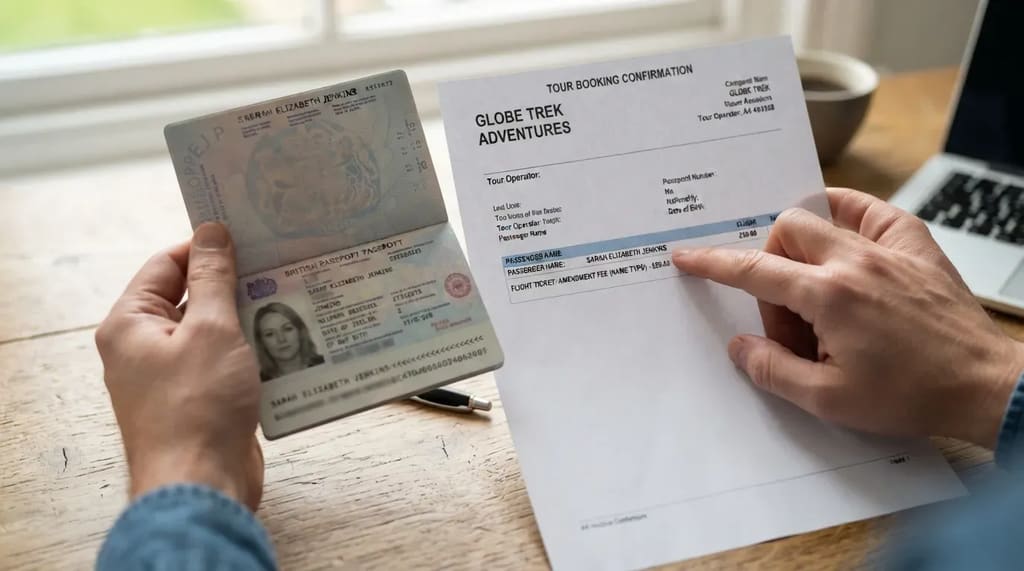
The name on your airline ticket has to match your passport, and a mismatch can trigger a correction fee. Britain’s travel trade body ABTA notes that charges for amendments to a booking are separate from surcharges, so a change fee can appear even when the price hasn’t moved.5 Operators and airlines set these fees differently, and you can’t predict the amount from the invoice.
Check every name, spelling and date of birth against your passport before you pay. Compare each name on the invoice with your passport before paying anything. If the error came from the operator typing your form, ask for the fix at no charge.
If you made the mistake, you may still get the fee reduced by raising it quickly, before tickets are issued. Fees like this are small, whereas a charge listed as taxes can be harder to examine because it’s labeled as unavoidable.
#7 – Taxes and Port Fees Lumped Into One Number

Some operators advertise tour prices before sales tax. Charges such as landing taxes, port embarkation fees and airport charges are also named in operators’ terms as costs that can be passed on. When they all land on the invoice as a single figure, you can’t tell what’s a real government charge and what’s operator markup.
Genuine taxes are rarely negotiable, but the itemizing is the point, because it lets you catch duplicates. Ask for taxes and fees broken out line by line. If your own airfare already includes airport charges, check that the tour hasn’t listed the same ones again.
Comparing two operators is also tricky if one quotes pre-tax and the other all-in, so get the same basis on both. That settles what the charges are, though not whether the base price will stay put.
#6 – A Date Supplement for the Wrong Week

Two departures of the same tour a week apart can carry different prices. Holiday weeks and festival dates often get a supplement, and it’s easy to miss because the brochure shows a single “from” price. The invoice is where the difference finally appears.
Flexibility is your leverage here. Tour operators with excess inventory during shoulder seasons are frequently more willing to waive or reduce supplements, which suggests that departures near the edges of the season are worth asking about.
Ask for the price of the departures a week before and a week after. If your calendar is open, that one question can move you out of the supplement without any haggling. Dates aren’t the only thing that can shift under you after booking, since the airfare can too.
#5 – The Airfare Increase After You’ve Paid

If your flight is ticketed separately, U.S. rules protect it. DOT regulations prohibit post-purchase price increases for air transportation, baggage fees and optional services that were already selected and paid for at purchase. Airlines can still charge more if you change your itinerary, upgrade a cabin, or add bags or services afterward.
Airfare inside a tour package works differently, because the operator’s booking terms set the rules. Some operators reserve the right to pass on increases in transportation and fuel costs, airport charges and currency changes, which is why the clause matters more than the airline’s own policy.
Ask whether your flight is inside the package or ticketed on its own. That tells you whether the airline rule or the operator’s clause protects you. Currency is the next cost an operator can sometimes pass along, and that clause comes with a deadline.
#4 – The Currency Clause With a Deadline Attached

Exchange rates can move between booking and departure, and many operators write that risk into their terms. G Adventures’ terms list currency and exchange fluctuations among the reasons it can add a surcharge after a confirmation invoice.6 The same terms say the price can’t be raised once you’ve paid in full, which makes the payment date matter.
Some operators go the other way. When Globus fixed its 2022 and 2023 prices, it said they weren’t subject to fluctuations for currency or services, so the sticker price was the price.7
Quick Compare
- G Adventures: a surcharge is possible after confirmation, but not once you’ve paid in full.
- Globus (2022 and 2023 prices): fixed prices, not subject to currency or service fluctuations.
- What that means for you: the same question gets a very different answer depending on the operator.
Find the clause that sets the last date your price can change. Ask whether the price is fixed in dollars and whether paying in full earlier locks it. That’s the cheapest insurance on the list, since it costs one question. Fuel works the same way on a ship, except it’s charged per person, per day.
#3 – The Cruise Fuel Supplement Charged by the Day

Cruise contracts can include a fuel clause that kicks in when oil prices cross a set level. Fine print on many cruise lines lets them add roughly $9 to $12 per person, per day, once a barrel of oil passes a preset price. At the top of that range, two guests on a 10-night sailing would owe up to $240 if the clause were triggered.
Related Stories From Travelbinger



Whether a line triggers it is a separate matter, and the first question is what the trigger and the daily cap are. Ask for the trigger price and the daily cap in the fuel clause. It’s also worth asking whether the clause still applies after final payment.
A line that invokes it risks goodwill with booked guests, and that gives you room to ask before you commit. The land-tour version of this clause is written with a percentage and a clock instead.
#2 – A Land-Tour Fuel Clause and Its 7% Exit

A confirmation invoice isn’t the same as paying in full. G Adventures’ terms say it won’t raise a tour’s price after you’ve paid in full, but before that point the operator can impose surcharges. An increase of more than 7% lets you cancel without penalty or accept the change.4
You have 14 days to say which, or you’re treated as having accepted. On a $4,000 base price, 7% is $280.
Other operators go further. When fuel prices jumped in 2022, Tauck’s COO told Travel Weekly the company had no plans to add any fuel surcharge to tour and cruise prices.7 Ask for the surcharge clause in writing before you pay the deposit. I’d treat a written no-surcharge promise as worth more than a lower sticker price that leaves the door open.
The biggest charge on many solo invoices comes next, and it runs on a different logic from any of these.
#1 – The Single Supplement That Can Vanish With One Call

A single supplement is a premium surcharge on a traveler who goes alone but uses a room that could fit two or more. Unlike the 3% card fee in #15, no card network sets a ceiling on it, which is why it’s often the largest line for a solo traveler.
It’s also flexible, because an empty bed earns the operator nothing. Tour companies sometimes scrap it for the first few people who book a tour they fear won’t sell out, and operators occasionally reduce it as the booking deadline closes in.
Some operators have built their appeal around it. Overseas Adventure Travel, founded in 1978, has long promoted waived single supplements on select departures. Roommate matching is another route, though it can cost you privacy and a sense of security in your own room.
Ask the operator to waive it on a named departure and month. Calling the company directly instead of booking through a third-party platform opens the possibility of a waiver, especially if the departure has capacity. Check what you’d get too, since single rooms may lack the balcony or view a double has.
An invoice is a draft until you pay it, and every line above is easiest to move before the deposit, when you’re still free to walk away. After payment, you’re negotiating with a contract instead of a salesperson. So the habit worth keeping is simple: read the invoice as a list of questions, not a total.
Which line on your last tour invoice did nobody ever explain to you?
- Card Surcharge Rules: https://www.lawpay.com/about/blog/credit-card-surcharge-rules/
- Junk Fee Rule Explained: https://www.mannypay.io/beyond-the-swipe/industry-news/ftc-junk-fee-rule-total-price-rules-for-tickets-and-hotels/
- Wiggin Junk Fee Analysis: https://www.wiggin.com/publication/the-ftc-releases-new-junk-fee-rule/
- G Adventures Booking Terms: https://www.gadventures.com/terms-conditions/booking-terms/row-booking-terms/
- ABTA Surcharge FAQ: https://www.abta.com/help-and-complaints/frequently-asked-questions/ive-paid-my-holiday-arrangements-can-my-travel
- G Adventures Canada Terms: https://www.gadventures.com/terms-conditions/booking-terms/canada-booking-terms/
- Travel Weekly Fuel Surcharges: https://www.travelweekly.com/Travel-News/Tour-Operators/Tour-operators-avoid-fuel-surcharges