
Here is the catch hiding inside that headline: no major cruise line has a blanket “over 60, fee waived” rule. What exists is messier, and in a few cases better. It is a patchwork of age-linked fares, free accessibility services and policy quirks that can shrink or erase charges for people who ask early. Most of it never shows up on the booking page.
The twist is how little of this comes down to your birthday. Some perks start at 55. Others have no age rule at all, and a few charges you might expect to vanish will stay right on your bill. Here is what the published policies actually say, starting with the quieter ones.
13. The Daily Gratuity Charge Most Passengers Treat as Untouchable
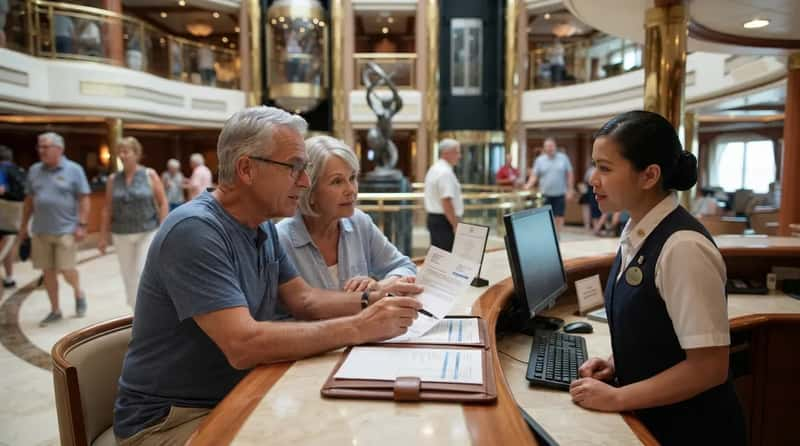
Gratuities usually land on your onboard account without a second thought. A 2026 senior-travel roundup notes that gratuities can be adjusted at guest services. That is a different thing from a waiver. It means the line may let you change the amount on request.
The key detail is timing. The conversation tends to go smoothly at guest services, not at the pier on the last morning. Policies differ by line, and no source I found ties gratuity changes to age. Ask before you sail what the rules are and where the form lives, so you aren’t learning it in a queue. But the next charge is one nobody will waive.
12. The Scooter Rental Fee That Stays on Your Bill

This one is a reality check. Royal Caribbean provides complimentary wheelchair assistance for embarkation and disembarkation only. If you want a chair or scooter during the cruise, you can bring your own or rent one delivered to your stateroom. Rentals come from outside companies, such as Scootaround.
Norwegian is stricter. It says if you use a wheelchair, you must bring your own and it must be collapsible. Celebrity’s guidance for travel agents says the same: guests must bring their own collapsible wheelchair. So the help at the gangway is free, but the mobility gear you use all week is generally not. Budget for it and book it early.
Quick Compare
- Royal Caribbean: free chair help at embarkation and disembarkation only
- Royal Caribbean, mid-cruise: bring your own or rent from an outside company
- Norwegian and Celebrity: bring your own collapsible wheelchair
Free help does exist, though, and it starts at the terminal.
11. The Cheap Fare With a $50-Per-Person Catch

Some of the lowest fares come with the strictest terms. One 2026 cancellation guide says Carnival’s Early Saver rate has a non-refundable deposit and a $50-per-person fee for any changes. A senior price can look great until you learn which fare family it sits in.
Another guide explains that cruise lines increasingly offer cheaper non-refundable deposit fares, and you lose the deposit even if you cancel early. A standard deposit, by contrast, can typically be refunded if you cancel before the final payment date. The cheapest-looking fare can be the most expensive one to change. Before you pay anything, ask which fare type you’re getting and what changing a name or date costs.
That deposit gets complicated when the refund arrives as something other than cash.
10. The “Cancel for Any Reason” Refund That Arrives as a Coupon

Many travelers hear “any reason” and picture a check. Princess describes its Cancellation Protection as cancel for any reason up to 72 hours before travel begins and receive a 100% refund of eligible cancellation fees. Its fine print also says that for reasons outside the listed ones, the fee comes back as future cruise credit.
Disney’s version works similarly. Its plan offers a future cruise credit of up to 75% of the cancellation fee for any reason not covered by the insurance portion. A credit only helps if you plan to sail with that same line again. Third-party “cancel for any reason” insurance is a different product. It typically returns 50% to 75% of non-refundable costs. Read which kind you’re buying, and ask whether the payout is cash or credit.
9. The Special Diet Request That Needs a Deadline, Not a Fee

Low-sodium, gluten-free and diabetic-friendly meals are common at the big lines. Carnival lists vegetarian, low-cholesterol, low-fat, low-carbohydrate, low-sugar and gluten-free options. Its gluten-free pizza dough, pasta, bread, buns and cake are available upon request. The policy pages I reviewed don’t attach a price to these requests.
What they do attach is a deadline. Norwegian says special diets must be requested at least two months before your cruise. Celebrity’s agent guidance asks for requests at least 21 days before sailing, or 60 days for Europe and South America. Miss the window and you may be working it out at the dinner table on night one. Also note that Carnival says specific dietary requirements cannot be guaranteed on shore excursions.
If a menu can be free for the asking, a cabin should be too, right? Not so fast.
8. The Accessible Cabin Premium That Actually Doesn’t Exist

Many people assume a roomier cabin with roll-in access costs extra. According to a guide by a former cruise-line purser’s office staffer, the major lines do not charge more for an accessible stateroom. The catch is supply, not price.
The same guide cites Consumer Reports figures on how scarce these cabins are. Celebrity also asks for paperwork. The cost is the same as a regular cabin, but the real price is how early you must book. What unlocks it is a documented need, not a birthday.
Fast Facts
- Price premium: none at the major lines, per the purser-office guide
- Supply: roughly 3% of staterooms are accessible
- Booking window: 6 to 12 months ahead
- Celebrity paperwork: a physician’s letter on letterhead confirming the disability
And a related service is free once you reach the terminal.
7. The Terminal Wheelchair Help That Costs Nothing but Isn’t Guaranteed

Getting through a crowded terminal is where many older passengers dread the day. The same purser-turned-writer says that wheelchair assistance on and off the ship is free. Carnival’s own page says to contact a representative once you arrive at the cruise terminal.
Carnival adds some limits. Assistance is first-come, first-served, with a 325-pound weight limit. It does not provide sighted guide services or one-on-one assistance. Free doesn’t mean on-demand. It means you should plan around the line’s rules and notify the cruise line before you sail.
Now for the charges that really are tied to age, and the first one hides in plain sight.
6. The AARP Credit That Only One Line Treats as Its Own

AARP membership can open perks, but the list is shorter than most people assume. One 2026 roundup says Holland America is the main direct AARP cruise partner, and Carnival, Royal Caribbean, Norwegian, Princess, Celebrity, MSC and Disney aren’t direct partners. A separate site lists up to $100 in onboard credit through the AARP Travel Center. Treat those numbers as a starting point and verify them.
Another route is AMAC, which partners with cruise lines to offer discounts, bonuses and free upgrades to members. Loyalty clubs can matter even more. Princess and Holland America don’t run a blanket senior discount, so their repeat-guest programs carry most of the savings. One 2026 guide says the loyalty perks are typically the bigger prize.
Next up is the rate that most online searches never show you.
5. The Senior Rate You May Have to Call to Hear About

Not every line posts its senior price. One older-adult guide says Norwegian and Princess require you to call or chat with an agent to request the senior rate, while Carnival and Royal Caribbean usually show it online. A cruise-planning site also notes that agents sometimes have access to unpublished rates. Sources conflict on Princess, and another guide says it has no dedicated senior discount covering all cruises.
Eligibility is usually looser than people think. At least one site says one passenger in the cabin must be 55 or older. MSC is reported to take up to 10% off for guests 65 and over, though conditions apply. Here’s the twist: the senior fare can get beaten by other promotions. One roundup points to a “BOGO60” deal that takes 60% off the second guest.
There’s one charge, though, where the lines have gone further than any discount.
4. The Solo Supplement That Some Cabins Never Had

Cruise pricing assumes two people per cabin. Travel alone and you can face a single supplement, which is an extra fee charged to solo travelers because most cabins are priced for double occupancy. Some lines have designed it away. Norwegian’s Studios are purpose-built for one person, at roughly 100 square feet, and priced with no single supplement.
Others use timed promotions. Tauck offers no single supplement on Category 1 cabins on every European river cruise, according to Cruise Critic. AmaWaterways has run waived supplements on select 2027 Europe sailings, with offer windows that have now closed. The window to ask is often a sale window. Ask what’s open now, since age doesn’t change the math here.
Back on the mainstream lines, the biggest age-based savings hide behind a single click.
3. The Royal Caribbean Box Most Seniors Scroll Past

Royal Caribbean’s discount is on its website, but you have to find it. At the guest-count step, click “Apply a promo code and exclusive rates”. A pop-up then lets you pick “Seniors (Age 55+)” and click “Apply discounts”.
The age there is 55, not 60. One guide says lines typically discount 5 to 15 percent for passengers 55 and older. The same source says you may need to show proof of age at check-in. The whole thing sits behind one easy-to-miss pop-up. The discount may not apply to every sailing or cabin, so check the final price.
At a Glance
- Where to look: the guest-count step while booking
- What to click: “Apply a promo code and exclusive rates”
- What to pick: “Seniors (Age 55+)”, then “Apply discounts”
- Typical range: 5 to 15 percent, per one guide
- At check-in: be ready to show proof of age
Carnival has its own version, with a twist.
2. The Carnival Senior Fare With No Price Tag

Carnival does offer senior fares for guests 55 and up. The line provides a dedicated calendar for seniors aged 55 and up, so you can view the lowest fares for that age group. But it doesn’t advertise a set rate, and the discounts aren’t available for every cruise.
During booking, Carnival asks whether you’re 55 or older. After you pick a room, it shows a list of eligible discount offers. Cruise Critic’s tip, as relayed by a 2026 roundup, is to add the “Deals” filter and choose “Age 55+”. The discount exists, but there’s no headline price to compare it against. That is exactly why so many travelers never claim it.
But the most expensive charge on this list is not a fare at all, and nobody advertises it.
1. The Cancellation Penalty That Has No Age Exclusion

Cancel late and the penalty can bite hard. Holland America’s standard schedule lists tiers that fall from a full refund to no refund at 60 days or less before travel, depending on the sailing. Older travelers often book far ahead, so plans can change. That is why this one tops the list.
Here is the reassurance. Holland America says its Cancellation Protection Plans start at $79 per person and contain no exclusions for pre-existing conditions or age. The Standard plan refunds 80% of eligible amounts if you cancel in writing 24 hours before travel. Platinum goes further, with enhanced refunds and additional protections. It’s one of the few places where your age works in your favor, because it isn’t held against you.
Standard insurance has its own limits. It covers cancellation for specific listed reasons, not every change of heart. Read the policy, then ask the cruise line or your agent in writing before you pay your first deposit.
So there is no secret “over 60” waiver, and anyone promising one is overselling it. What exists is smaller and more useful: 55+ fares that are real but rarely advertised, accessibility help that is largely free, and single supplements that vanish on the right cabins. Some policies, like Holland America’s cancellation plan, don’t count your age against you. A few charges, like scooter rentals, will follow you aboard no matter what you say.
The lines rarely volunteer any of this. The savings tend to go to the people who asked first.