
That smile at the cabin door isn’t just good manners. The moment you step onto a plane, flight attendants are running a quiet, practiced scan that takes roughly three to four seconds – and for passengers over 60, that scan is especially deliberate. Most people never sense it happening. But by the time you’ve found your row, the crew already knows more about you than you’d expect.
What’s surprising is just how specific it gets. It’s not just “is this person using a cane.” It’s the way you grip your boarding pass, the pace you walk the aisle, whether you heard the greeting at the door, and whether your shoes could handle a fast exit. Crew members run this assessment on every single flight – and for passengers over 60, there are 13 signals in particular that immediately put someone on their radar. Here’s what the people at the front of the plane are actually watching for.
#13 – How You Walk Down the Jetbridge Before You Even Board
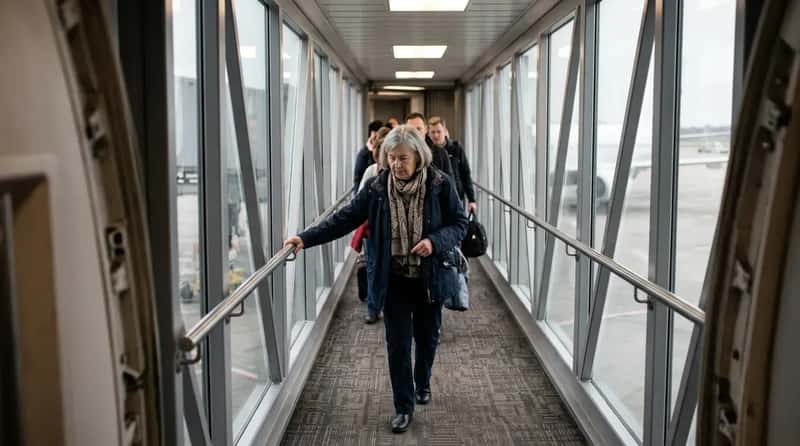
The assessment starts before you ever reach Row 1. Cabin crew are required by the FAA to monitor passenger boarding as part of standard pre-flight safety duties, and that monitoring begins at the jetbridge. Your gait, your pace, and whether you’re holding the railing are already being clocked before you’ve exchanged a single word with anyone on the plane.
A slow or unsteady walk can trigger an internal crew note that gets shared during the pre-flight captain’s briefing – meaning the entire crew may quietly know about a mobility concern before pushback. A passenger flagged at the jetbridge stage may have their seat location noted by attendants working every section of the cabin. It’s one of the earliest signals the crew can act on, and it sets the tone for everything that follows.
Fast Facts
- Cabin crew training covers aviation physiology, hypoxia, and passenger surveillance as required curriculum
- Flight attendant initial training typically runs 4 to 8 weeks, packed with safety, medical, and emergency response modules
- Crew are trained to recognize barriers to communication, including language, cultural differences, and varying levels of understanding
- The FAA requires at least one crewmember to verify no exit seat is occupied by someone unable to perform emergency functions before every pushback
#12 – Whether You’re Traveling Solo or With a Companion
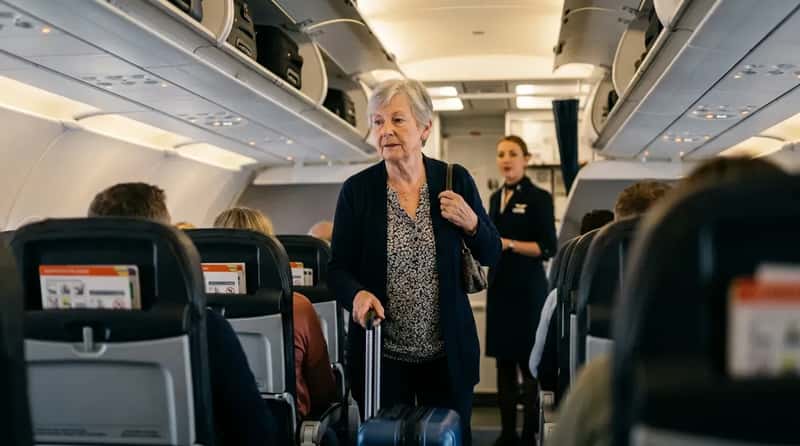
The moment a passenger over 60 boards alone, it changes the crew’s entire service calculation. A solo older traveler means there’s no one in the adjacent seat to flag a problem if one develops at altitude – no companion to hit the call button, notice a color change, or keep someone calm during turbulence. Crew quietly adjust their service plan the moment they register that detail.
If you’re 68 and traveling alone, the attendant working your section will check on you more frequently – not intrusively, but deliberately. A traveling companion is essentially a built-in safety net. Without one, the crew quietly becomes that net instead. It’s one of the most consequential reads a flight attendant makes in under three seconds, and it costs the passenger nothing to know it’s happening.
#11 – Visible Medical Accessories, Compression Socks, or Oxygen Equipment
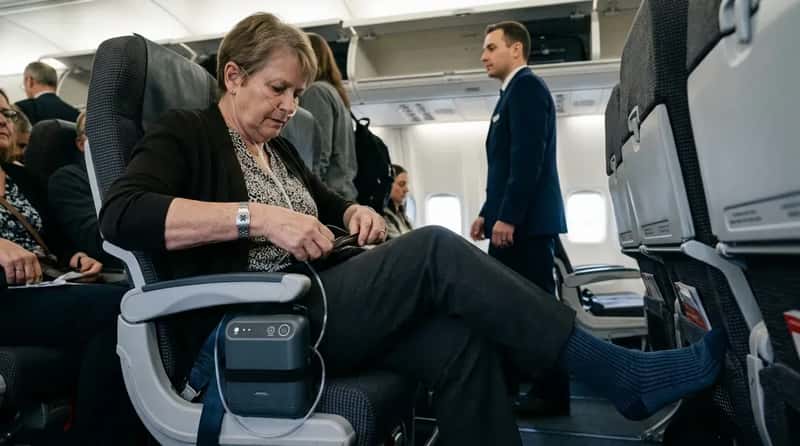
Compression socks, medical alert bracelets, insulin cases, and portable oxygen units are all things crew notice before you’ve even sat down. Compression socks on a passenger over 60 often send a reassuring signal – this traveler understands deep vein thrombosis risk on long flights and has done their homework. But visible oxygen equipment or an insulin case tells a more complex story that crew need to process fast, before the door closes.
Oxygen therapy is the most common crew intervention in in-flight medical events, involved in a significant share of cases documented in aviation medical literature. Passengers with known pulmonary conditions can request supplemental in-flight oxygen in advance through most major U.S. airlines. A crew member who spots a portable oxygen unit during boarding will quietly confirm its status before pushback – not to inconvenience the passenger, but because it directly affects what the crew can do if something goes wrong at altitude.
Worth Knowing
- A Cochrane review of 12 clinical trials found high-certainty evidence that compression stockings significantly reduce the risk of symptomless DVT on flights over four hours
- The CDC warns that journeys of 4 hours or more – by any mode of transport – raise the risk of blood clots and DVT
- In people with additional clotting risk factors, compression stockings reduced DVT incidence from roughly 30 cases per 1,000 down to 3 per 1,000 in one major review
- Flight attendants are trained to use onboard oxygen, AEDs, and medical kits – and to coordinate with ground-based medical professionals mid-flight
#10 – The Footwear You’re Wearing
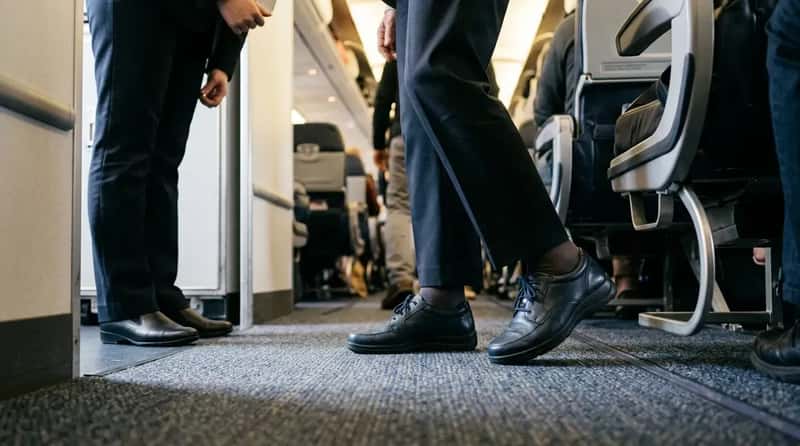
Flight attendants look at your shoes the moment you board – and for older passengers, this carries serious operational weight. They’re specifically watching for footwear that could become a hazard in an emergency evacuation. High heels, loose sandals, and rigid dress shoes are the items that give crew pause, because evacuation slides and debris-covered tarmacs are unforgiving terrain.
Crews are not judging passengers for their style choices. But an older passenger in open-toe sandals or slick-soled dress shoes is someone a crew member will mentally position near their station during an emergency – a calculated, pre-planned adjustment made before the safety demo even begins. It’s a quiet calculation that takes one second and could matter enormously if the unthinkable happens on landing.
#9 – Whether You Respond to the Greeting at the Door
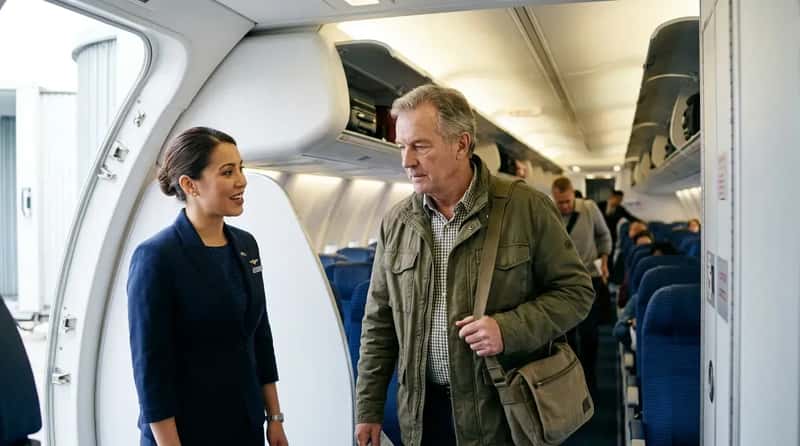
Most passengers nod back when a flight attendant says hello. The ones who don’t – not from rudeness, but because they genuinely didn’t hear it – tell the crew something critical. A passenger who misses the door greeting entirely may be hard of hearing, and if they haven’t flagged it, they could miss safety announcements, emergency instructions, or vital updates delivered verbally over the PA. It’s one of the quietest ways crew identify hearing loss without a single word being spoken about it.
This is more consequential than it sounds. In an emergency, verbal commands are the primary tool cabin crew use to direct passengers toward exits, away from hazards, and into brace positions. A passenger who can’t hear those commands is among the most vulnerable people on the plane – and crew need to know that before the wheels leave the ground. A missed hello at the door can set off a quiet but important chain of crew preparation that lasts the entire flight.
#8 – Whether You’re Seated in or Near an Exit Row
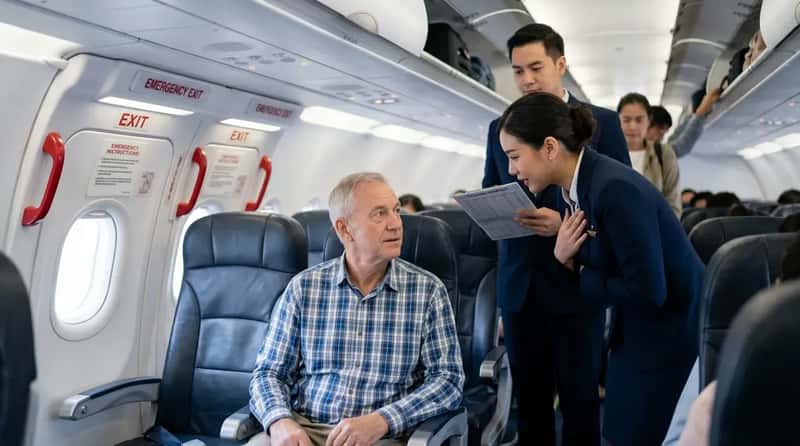
This is one of the few observations that can result in an immediate conversation before the door closes. Exit row seating comes with strict FAA rules: passengers who are pregnant, injured, traveling with young children, or unable to perform emergency exit functions cannot legally sit there – regardless of how they booked. Mistakes happen at check-in, and crew catch them during boarding.
For a traveler over 60 seated in an exit row, a quiet word from the crew and a seat swap before pushback isn’t optional – it’s protocol. FAA regulations require exit row passengers to be physically capable of operating an exit door – which can weigh up to 60 pounds on some aircraft – and to verbally confirm their willingness and ability before each departure. This rule is firm, and experienced crew enforce it even when the passenger booked the seat intentionally, sometimes simply because they wanted the legroom without realizing the legal restriction attached to it.
At a Glance: Exit Row Rules That Apply to Every U.S. Flight
- Age minimum: Must be at least 15 years old
- Physical requirement: Must be able to reach, grip, push, pull, and lift the exit door (up to 60 lbs. on some aircraft)
- Language requirement: Must understand and speak English to receive and relay crew instructions
- Verbal confirmation: Flight attendants are required to ask each exit row passenger to confirm willingness and ability before departure
- No exemptions: Passengers with mobility aids, those caring for small children, or anyone unable to assist must be reseated – no exceptions
#7 – Signs of Confusion or Disorientation While Boarding
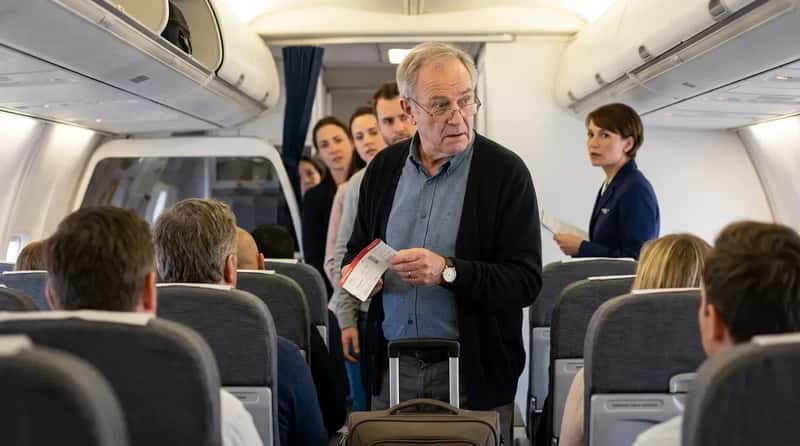
Pausing mid-aisle to re-examine a boarding pass or blocking flow while reorganizing a bag – none of this is unusual during a busy boarding. But in a passenger over 60, crew read it differently. That same confusion that looks like simple unfamiliarity in a younger traveler can signal early disorientation in an older one, and experienced flight attendants have learned to hold both possibilities in mind simultaneously.
This matters because confusion during boarding can foreshadow bigger problems at altitude. Moderate hypoxia – reduced oxygen at cruising altitude – can amplify cognitive fogginess that was barely visible on the ground. Cabin crew training specifically covers aviation physiology including hypoxia, sensory limitations, and high-altitude conditions so they can recognize these early signs. A passenger showing signs of confusion while the plane is still at the gate is one a crew member will physically check on during cruise, not just during the service run. Spotting it early is the difference between a discreet check-in and a mid-flight medical situation.
#6 – How You Handle Overhead Bin Stress
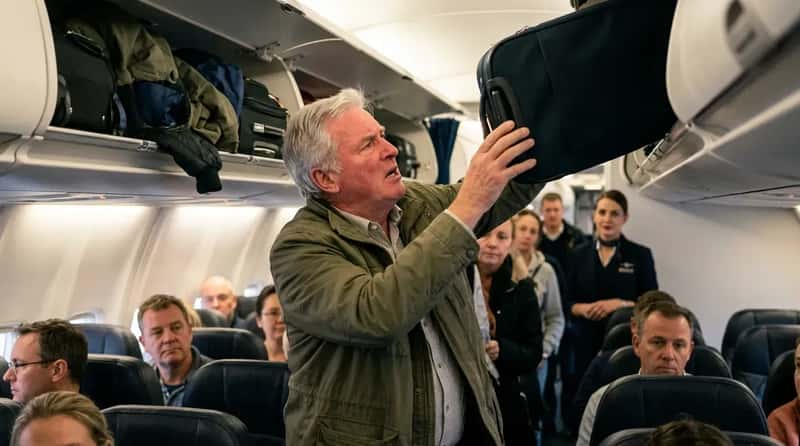
A full overhead bin is stressful for everyone. But how a passenger reacts to that stress tells the crew something they’ll carry with them for the entire flight. Flight attendants read behavioral cues from the moment passengers step on board – assessing whether someone seems cooperative, nervous, or already wound tight, purely through body language and how they move down the aisle.
A passenger over 60 who responds to a full overhead bin with visible agitation – flushed face, raised voice, physical frustration – tells the crew something about their stress response that matters for the hours ahead. What looks like a minor luggage dispute is actually a window into how that person will respond under real pressure. Experienced crew bank that information immediately, and may quietly arrange for that passenger to sit closer to a crew station where they can be monitored without anyone making a scene.
#5 – Skin Color, Pallor, or Visible Physical Discomfort
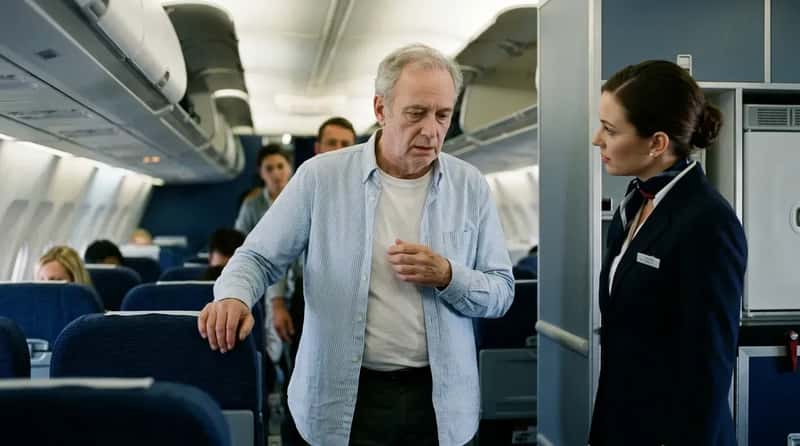
Flight attendants are trained to notice when someone looks unwell – and for passengers over 60, they look harder. A passenger boarding with a gray or ashen complexion, labored breathing, or visible sweatiness isn’t just having a rough travel day. At 35,000 feet, with cabin pressure equivalent to sitting at 6,000 to 8,000 feet of elevation, a person who’s already struggling on the ground can deteriorate quickly.
This is where crew training becomes genuinely life-saving. Nearly 70% of U.S. adults aged 60 to 79 have some form of cardiovascular disease – and cardiac symptoms are among the most common reasons flights are diverted. A crew member who spots warning signs during boarding has the power to get help on the ground – rather than diverting mid-ocean or managing a crisis with a defibrillator and limited supplies. Catching it at the gate is always better than catching it over the Atlantic.
“The majority of all emergencies happen on take-off or landing with no prior warning. These emergencies are sudden and unexpected, leaving minimum time to react.”
FAA Cabin Safety Compendium
#4 – Whether You Pay Attention to the Safety Demo
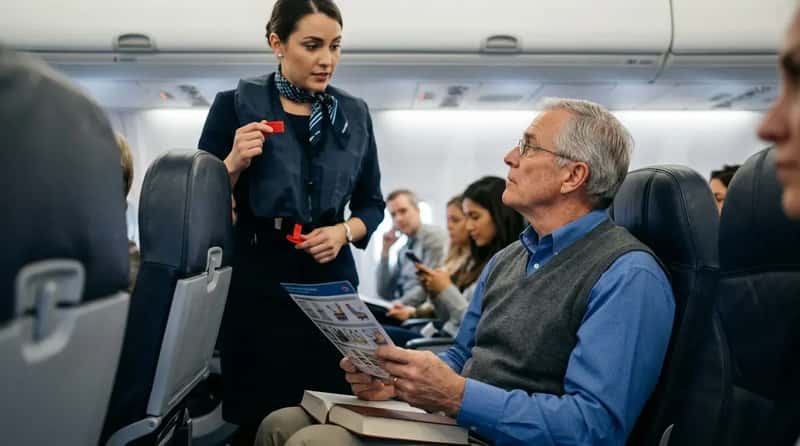
Most passengers tune out the safety demonstration. Flight attendants notice – and they remember. If you look up, follow the demo, or pull out the safety card, that gets quietly filed away as a positive signal. A passenger who pays attention is one who already knows where the exits are, understands the brace position, and is more likely to follow verbal instructions fast under pressure.
The passenger over 60 who puts down their book and watches the demo earns a quiet mark in the crew’s mental ledger as someone they can count on to act – a distinction that genuinely matters when every second counts. The ones talking through it, wearing headphones, or scrolling their phones get mentally flagged as passengers who may need more hands-on guidance if an emergency occurs. It’s a two-minute window that shapes the crew’s entire emergency plan for each individual seat.
#3 – Whether You Ask for Help or Insist You’re Fine
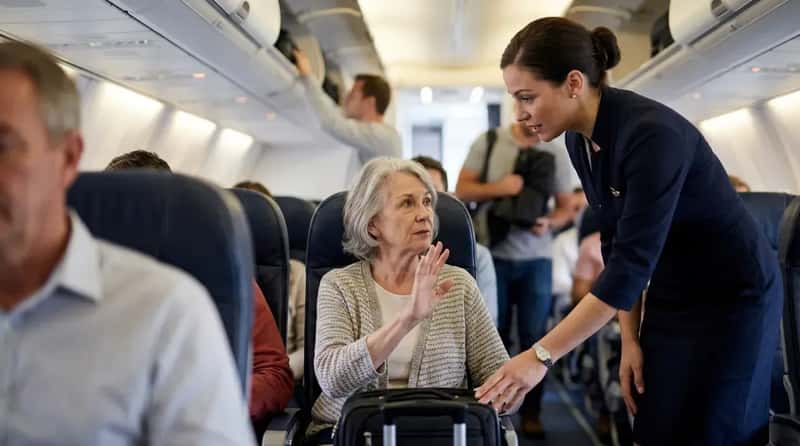
This is the signal crew talk about most. The hardest passenger to help is the one who clearly needs something but hasn’t said so. Among travelers over 60, that situation is far more common than most crews ever expect. Flight attendants are trained to act on what they observe – not just what they’re told – and the gap between those two things is often widest with older passengers who don’t want to seem like a burden.
It plays out in small, telling ways: the passenger hovering near the overhead bin who won’t ask for a hand, the traveler who can’t hear the crew but nods along anyway, the older woman traveling alone who waves off the attendant with a firm “I’m fine” while looking anything but. The passenger who insists they don’t need help while visibly struggling is the one a seasoned crew member watches most carefully from takeoff to touchdown – precisely because that passenger is unlikely to press the call button when it matters most.
Quick Compare: Passengers Who Make the Crew’s Job Easier vs. Harder
- Watches the safety demo vs. wears headphones through it
- Mentions a health condition at boarding vs. waves off every offer of help
- Makes eye contact at the door vs. stares straight ahead without acknowledging crew
- Asks for help with the overhead bin vs. struggles silently and nearly falls
- Responds clearly to questions vs. nods without having heard a word
#2 – Mobility Challenges During the Aisle Walk
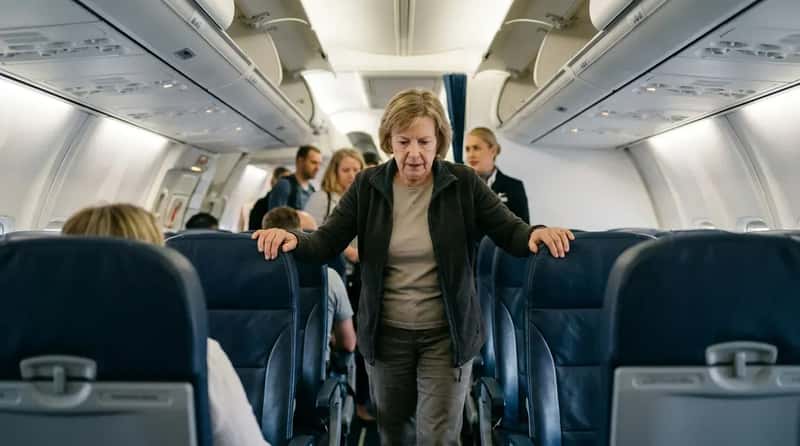
The walk from the cabin door to the seat is one of the most revealing thirty seconds of a passenger’s boarding. Flight attendants pay close attention to older travelers who may need extra time to settle in or additional support during an emergency – and they mentally note exactly where those passengers are seated. In an evacuation, knowing in advance who may move slowly and where they’re sitting can be the difference between a managed exit and a bottleneck.
A passenger over 60 who grips every headrest for balance while walking the aisle is one the crew will position mentally near their section before the plane is even pushed back. Noticing these challenges early also helps during deplaning, when an unsteady passenger moving against the flow of a crowd can create real risk. Flight attendants who spot it at boarding can arrange early deplaning assistance quietly, before it ever becomes a problem.
#1 – Eye Contact (or the Deliberate Lack of It) at the Cabin Door
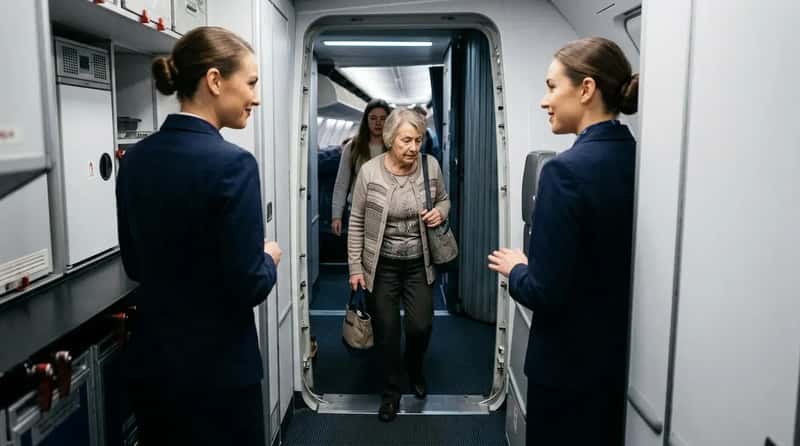
The single most revealing signal a passenger over 60 sends the moment they board isn’t a cane, a limp, or a medical badge. It’s whether they make eye contact at the door – and what that eye contact actually looks like. In the few seconds of that greeting, experienced flight attendants are reading whether someone is alert, oriented, frightened, unwell, or already in distress. The whole picture assembles itself in one glance.
A passenger who meets the crew’s eyes, nods, and moves with purpose reads as confident and capable. One who stares blankly, looks through the attendant, or averts their gaze with visible anxiety tells an entirely different story. This split-second read at the cabin door is the signal that ties everything else together – and it happens before a single word is spoken. It’s the foundation every crew member’s mental passenger map is built on, flight after flight, without the passenger ever knowing it happened.
None of this is surveillance. Every one of these signals exists because cabin crew are genuinely trying to keep a pressurized tube full of hundreds of people safe and accounted for – long before the fasten seatbelt sign comes on. For passengers over 60, being seen by the crew isn’t a disadvantage. It’s a quiet safety net most travelers never even know is there. And now you do.