Alabama’s hands-free law applies even when you’re stopped at a red light. The state transportation department says hands-free means hands-free at all times, stoplights included.
That’s one of 13 rules that trip up winter visitors who assume a vacation stay comes with vacation rules. Some cost a $50 fine, and others can leave Alabama treating you as a resident for tax purposes.
The final rule decides how the state sees you and changes how every other item applies to your winter. But start with the one you can break before you leave the driveway.
#13 – The Phone Rule That Applies at Red Lights

Officers can ticket you for holding a phone to make a call, text, watch a video, FaceTime or use GPS. Anything more than a single touch or swipe counts as a violation.
A first offense costs $50 and one point on your record. A second offense within 24 months is $100 and two points, and later offenses are $150 and three points.1 2
The law is a secondary offense, so an officer can’t pull you over for the phone alone. Don’t count that as protection, because a missed turn signal or a drifting lane gives them a reason to stop you, and the phone ticket rides along.1
With the phone settled, the next trouble spot is the water, where an exemption you may be counting on stops at the state line.
#12 – The Over-65 Fishing Break That Isn’t Yours

Alabama does let older anglers fish saltwater without buying a license. But that exemption is written for residents age 65 and over.
Nonresidents 16 and older need a saltwater license, sold as an annual license or a seven-day trip license. Your age doesn’t change that if you’re visiting from another state.
Quick Compare
- Alabama resident, 65 or older: no saltwater license needed.
- Nonresident, 16 or older: saltwater license required, at any age.
- Anyone under 16: no license needed, resident or not.
Piers don’t get you out of it either, since a saltwater license is required for pier fishing in the Gulf. On the surf, carry the license and be ready to show it if authorities ask.
A license in your wallet still leaves one purchase on the table, and that one has no age break at all.
#11 – The Add-On With No Senior Exemption

Some fish need a second permit on top of the license. A Reef Fish Endorsement is required to possess, take or try to take any of the Gulf reef fish species listed in Rule 220-3-.46.3
It applies to every angler 16 and older, and the state’s list of who must hold it includes people 65 and older, lifetime license holders, pier license holders and charter boats. The age break from the last item doesn’t reach it.
That makes it the easiest rule to miss. An angler who thinks the license settles everything can be out of compliance the moment a reef fish is on the line.
Gear matters too, and some of it looks too harmless to count.
#10 – Cast Nets, Gigs and Crab Traps

Tossing a cast net for bait feels casual, but the license rules don’t treat it that way. A saltwater license is required for cast netting, gigging, spear fishing and recreational crab traps.
A state fee listing adds that artificial bait, flies and lures also trigger the saltwater license, as do five or fewer crab traps. The license follows the method, not the seriousness of the trip.
If grandchildren are visiting, residents and nonresidents under 16 don’t need a license. Every adult in the group who handles a rod, net or trap does.
Knowing what needs a license is half of it. The other half is how long the license lasts, and it’s shorter than a winter-to-winter calendar suggests.
#9 – Why Your Annual License Covers One Winter

Alabama licenses expire on August 31, regardless of the date purchased. A nonresident license for the current season is valid from September 1 through the following August 31.
So a license bought in November runs out the following summer, and next winter you buy again. An annual license buys you one season, not two.
Price depends on where you live. A Louisiana resident pays $129.20 for an annual saltwater license in Alabama, while a Florida resident pays $48.20.3
Seven-day trip licenses are also available to nonresidents. Compare the two if you’ll fish only a week or so.
A saltwater license also has a limit on its reach, and where salt water turns to fresh isn’t always obvious.
#8 – Where Salt Water Ends and Fresh Begins

Alabama treats saltwater and freshwater fishing as separate licenses. Nonresidents need a separate saltwater license, and nonresidents 16 and older generally need the right Alabama license before fishing public freshwater.
A saltwater license is required in the shaded saltwater areas on Outdoor Alabama’s boundary page. The water you’re standing beside may not be the type you assume.
A day split between a bay and an inland lake can mean two purchases. Check the map the evening before, not on the bank.
Some visitors try to dodge the nonresident price by buying a resident license, and the state has a test for that.
#7 – The Resident License Test

Pier fishing shows how much your address matters. A pier license is $7.65 for Alabama residents and $14.15 for nonresidents.
A resident license requires an Alabama ID and 90 days of continuous residence, plus a Social Security number. If your driver’s license or ID is from another state, you buy the nonresident version.
At a Glance
- Resident pier license: $7.65.
- Nonresident pier license: $14.15.
- Resident proof: Alabama ID, Social Security number and 90 days of continuous residence.
- Out-of-state ID: you buy the nonresident version.
The state tracks residents closely. Even residents who don’t need a saltwater license, such as those 65 or older, must complete a free angler registration.
Don’t chase the lower price. The Alabama ID that unlocks it brings obligations that can cost far more than the gap between the two fees.
#6 – The 30-Day License Clock

Thirty days is all a new Alabama resident gets. Every new resident has to obtain an Alabama driver’s license within 30 days after establishing residence in the state.4
The clock starts when you establish residence, not when you arrive. The rule speaks to new residents, not to people passing the season in a rental.
If you do move, a valid out-of-state license means a written exam and an eye test, and without one you’d also take a road test. Don’t swap your home license for an Alabama one just to be tidy, because it’s a residency step, not a courtesy.
The car carries a similar deadline on its plates, and missing that one adds a penalty and interest.
#5 – The Tag, the Penalty and the County Tax
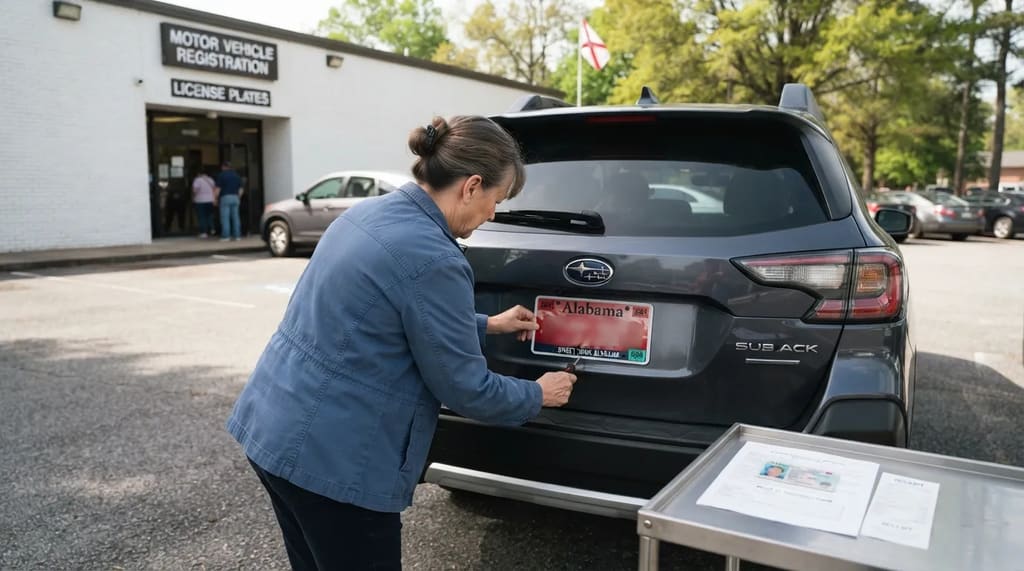
Registration has its own 30-day clock. New residents must register their vehicle within 30 days of it entering the state.5
Late registration costs a $15 penalty plus interest.5 You’ll also need a valid Alabama driver’s license, since plates can’t be registered without one, and proof of liability insurance at 25/50/25 minimums.
The fee isn’t the real expense. The county collects an annual ad valorem property tax on your vehicle at every renewal.
A winter stay doesn’t call for Alabama plates. The tag, like the license, is meant for people who’ve settled in.
Plates aside, the bigger bill for some snowbirds comes from money earned in Alabama while living somewhere else.
#4 – Income Earned Inside Alabama

Nonresidents are taxable on income from property owned or business transacted within Alabama.6 That can include rent from a vacation property.
Nonresidents with Alabama-source income file Form 40NR each year.6 7 The form isn’t optional just because your home is elsewhere.
Nonresidents are taxed only on Alabama-source income, so income from outside the state stays off that form.
The harder question is which category you fall into, and for married couples the answer can differ between two people.
#3 – When Spouses Are Taxed Differently

A married couple isn’t always one taxpayer in Alabama’s eyes. A joint return can’t be filed if one spouse is a part-year Alabama resident and the other lives in another state.
One resident spouse and one nonresident spouse means married filing separate. If one of you stays in Alabama longer than the other, this is where it applies.
Related Stories From Travelbinger


The filing thresholds follow the status. Married filing separate must file at gross income of $5,750 while an Alabama resident, versus $11,500 for a joint return.
Fast Facts
- Joint return: $11,500 gross income filing threshold.
- Married filing separate: $5,750 while an Alabama resident.
- Split residency: one part-year resident spouse and one out-of-state spouse can’t file jointly.
Even with your filing status sorted, there’s a way to end up paying twice if one return goes missing.
#2 – The Credit That Requires Another Return

Being taxed twice on the same income is avoidable. Alabama offers residents a credit on income taxed by both Alabama and another state.6
There’s no credit unless you file a nonresident return with the other state. You attach Alabama Schedule CR and a copy of that other return.
It mirrors the Form 40NR rule from earlier. That form is what a nonresident files with a state that has a claim on income earned there, and here it’s the filing that unlocks the credit.
The most important rule on this list isn’t about phones, fishing or forms. It decides which of the others apply to you.
#1 – Domicile Decides Everything Else

Every rule above hangs on one word. An Alabama resident is someone domiciled there, domicile is where you live permanently, and a person can have only one.
Guidance for filers adds a second route. People who aren’t domiciled in Alabama can still be residents if they keep a permanent home there or spend more than seven months of the tax year in the state.
Most winter stays fall well short of seven months, but a permanent Alabama home is a separate question. Residency is what triggers the license clock, the tag deadline, the resident fishing license and the tax return.
Worth Knowing
- Driver’s license: new residents get 30 days to switch.
- Vehicle tag: 30 days to register, with a $15 penalty plus interest if late.
- Resident fishing license: needs an Alabama ID and 90 days of continuous residence.
- Taxes: residency changes which income Alabama can tax.
Someone who changes domicile has to change it with the state, or stays a resident and keeps owing income tax. Counting days on a calendar is overrated as a strategy, because domicile comes first.
A tax professional can tell you where your own situation falls.
Alabama’s rules are less about how long you stay than about what you say your life is based on. A license, a tag and a tax return each tell the state something about where you live.
The useful habit is to keep that story consistent: decide which state is home, then make the paperwork match. Where is your driver’s license issued, and does it match the state you’d name as home if Alabama asked?
- ALDOT Hands-Free Law: https://www.aldotnews.com/2024/03/11/phones-down-hands-on-the-wheel-its-alabamas-law/
- Drive Safe Alabama Hands-Free: https://drivesafealabama.org/safety-initiatives/hands-free-law/
- Alabama Nonresident License Fees: https://fishinglicenseinfo.org/alabama-fishing-license-cost/
- Alabama Code Driver License: https://codes.findlaw.com/al/title-32-motor-vehicles-and-traffic/al-code-sect-32-6-1/
- Out-of-State Vehicle Registration Alabama: https://www.dmvusa.com/al/alabama-out-of-state-registration/
- Alabama Revenue Filing FAQ: https://www.revenue.alabama.gov/faq-categories/filing/
- Form 40NR Booklet: https://www.revenue.alabama.gov/wp-content/uploads/2026/01/25f40nrbk.pdf